Digital marketing agencies face a unique challenge: managing ad tracking across dozens of client accounts, multiple platforms, and increasingly complex privacy landscapes. When tracking breaks down, agencies lose the ability to prove ROI—and that's when clients start questioning their investment.
The agencies that thrive are those that build robust, scalable tracking systems that work reliably across every client engagement. They don't just collect data—they capture complete customer journeys, reconcile conflicting platform reports, and demonstrate clear value even when browser restrictions and privacy regulations make tracking harder than ever.
This guide covers seven proven strategies that help agencies capture accurate data, demonstrate clear value to clients, and make confident optimization decisions even as the tracking landscape evolves. Master these approaches, and you'll build the kind of tracking infrastructure that turns data chaos into competitive advantage.
1. Implement Server-Side Tracking as Your Foundation
The Challenge It Solves
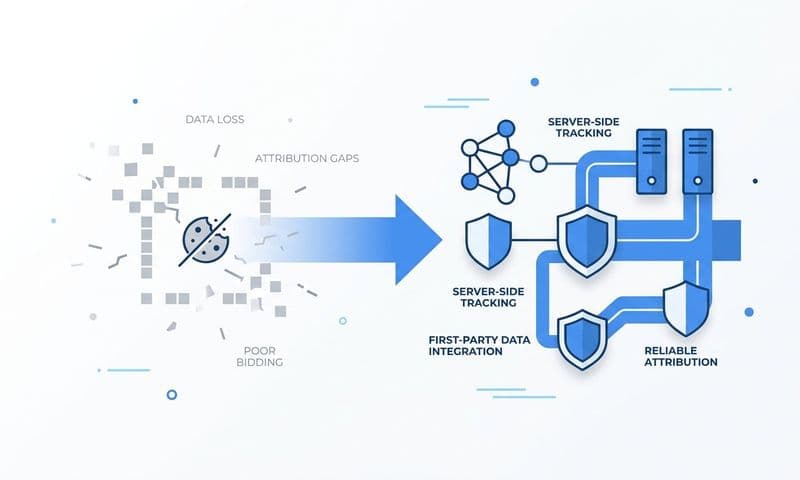
Browser-based tracking is failing agencies at scale. Safari's Intelligent Tracking Prevention blocks third-party cookies by default. Firefox Enhanced Tracking Protection does the same. Ad blocker usage continues to grow across desktop and mobile devices. When you're managing tracking for dozens of clients, these browser limitations compound into serious data gaps that make it impossible to accurately measure campaign performance.
The result? You're making budget decisions based on incomplete information, and your clients see inconsistent reporting that erodes their confidence in your recommendations.
The Strategy Explained
Server-side tracking moves data collection from the browser to your server infrastructure. Instead of relying on JavaScript pixels that browsers can block, you capture conversion events on your server and send them directly to ad platforms through their APIs. This approach bypasses browser restrictions entirely while giving you complete control over what data gets collected and how it's transmitted.
Think of it like switching from sending mail through a postal service that randomly loses packages to having a direct courier service. The data flows reliably because it's not dependent on browser cooperation.
For agencies, this means you can finally trust that you're capturing the full picture of campaign performance across every client account—regardless of which browsers their customers use or what privacy settings they've enabled.
Implementation Steps
1. Set up a server-side tracking container using Google Tag Manager Server-Side or a dedicated tracking infrastructure that can receive and process conversion events from your clients' websites and applications.
2. Configure server-side event forwarding to send conversion data directly to Meta's Conversions API, Google's Enhanced Conversions, and other platform APIs you're using for client campaigns.
3. Implement fallback logic that captures events through both browser pixels and server-side tracking, then deduplicates them using event IDs to ensure you're not double-counting conversions while maintaining data completeness.
Pro Tips
Start with your highest-spend clients first to prove the value before rolling out agency-wide. Document the data quality improvements you see in platform reporting—typically agencies notice that conversion counts increase by meaningful amounts once server-side tracking eliminates browser-based data loss. This documentation becomes powerful proof when pitching the infrastructure investment to other clients.
2. Build Unified Cross-Platform Attribution Models
The Challenge It Solves
Every ad platform wants to take credit for conversions. Meta claims a conversion happened because of their ad. Google says it was their search ad. TikTok insists their video drove the sale. When you're running integrated campaigns across multiple platforms, these conflicting attribution claims create reporting chaos that makes it impossible to know which channels actually deserve budget increases.
Your clients see the confusion and start questioning whether anyone really knows what's working. Without a unified view, you're stuck defending platform-specific reports instead of providing clear strategic guidance.
The Strategy Explained
Unified attribution creates a single source of truth by collecting conversion data outside the ad platforms, then applying consistent attribution logic across all channels. Instead of letting each platform use its own attribution window and methodology, you define the rules once and apply them uniformly to every touchpoint in the customer journey.
This approach lets you see the complete path to conversion—the TikTok ad that created awareness, the Google search that happened three days later, and the Meta retargeting ad that closed the deal. You're not picking winners and losers based on platform-reported data. You're analyzing the actual sequence of interactions that led to revenue.
Implementation Steps
1. Implement a tracking system that captures every ad click, impression, and conversion event in a centralized database where you control the attribution logic rather than relying on platform-reported conversions.
2. Define your attribution model based on client business models—first-touch attribution for top-of-funnel awareness campaigns, last-touch for direct response, or multi-touch models that credit multiple touchpoints along the journey.
3. Create client dashboards that show both platform-reported conversions and your unified attribution view side by side, helping clients understand why the numbers differ and why your unified view provides more accurate strategic guidance.
Pro Tips
Don't try to convince clients that platform reporting is wrong—show them how different attribution windows and methodologies create natural discrepancies. Position your unified view as complementary intelligence that helps you make better budget allocation decisions across the entire marketing mix. The goal isn't to replace platform reporting but to add strategic context that platforms can't provide.
3. Connect Ad Data Directly to CRM Revenue Events
The Challenge It Solves
Ad platforms optimize for conversions, but conversions aren't revenue. A lead form submission counts as a conversion whether it becomes a $100 customer or a $100,000 enterprise deal. For agencies managing B2B clients or businesses with complex sales cycles, this disconnect between ad metrics and actual revenue makes it nearly impossible to prove true campaign ROI.
You're reporting on lead volume and cost per lead while your client is wondering why revenue hasn't moved. The gap between marketing metrics and business outcomes is where client relationships break down.
The Strategy Explained
CRM integration connects ad click data to closed revenue events, letting you track the complete journey from first touchpoint to final sale. When a lead enters the CRM, you maintain the connection to which ads and campaigns influenced that lead. When the deal closes weeks or months later, you can attribute that revenue back to the original marketing touchpoints.
This creates a direct line of sight from ad spend to revenue generated. You're no longer defending cost per lead metrics—you're showing exactly which campaigns drove profitable customer acquisition and which ones attracted leads that never converted to revenue.
Implementation Steps
1. Implement tracking that captures unique identifiers for every ad click and passes those identifiers through to your clients' CRM systems when leads are created, maintaining the connection between marketing touchpoints and CRM records.
2. Set up automated data syncs that pull closed-won revenue data from the CRM back into your attribution system, matching revenue events to the original ad interactions that influenced those deals.
3. Build revenue-focused reporting that shows metrics like revenue per ad dollar spent, customer acquisition cost based on actual closed deals, and campaign ROI calculated from real revenue rather than estimated conversion values.
Pro Tips
Start with a simple integration that tracks first-touch attribution to revenue, then expand to multi-touch models as you prove value. For B2B clients, focus on showing how different campaigns influence different deal sizes—often you'll discover that certain channels attract higher-value prospects even if their lead volume is lower. This insight transforms budget allocation decisions.
4. Create Standardized UTM and Tracking Conventions
The Challenge It Solves
When different team members create campaigns using inconsistent naming conventions, your tracking data becomes unusable. One person uses "utm_campaign=spring-sale" while another uses "utm_campaign=Spring_Sale_2026" and a third uses "utm_campaign=spring-promo". Your reporting tools treat these as three separate campaigns, fragmenting data and making performance analysis impossible.
Multiply this problem across dozens of clients and multiple team members, and you end up with tracking chaos that forces you to spend hours cleaning data instead of analyzing performance and optimizing campaigns.
The Strategy Explained
Standardized tracking conventions establish consistent rules for how every campaign element gets tagged. You define exactly how campaign names should be structured, which UTM parameters are required versus optional, and what naming patterns to use for different campaign types. These conventions become non-negotiable standards that every team member follows for every client.
Think of it like establishing a filing system for a library. Without consistent categorization, finding specific books becomes impossible. With clear standards, anyone can locate exactly what they need instantly.
Implementation Steps
1. Document your agency's UTM taxonomy with specific naming conventions for each parameter—use lowercase only, define separators (hyphens vs underscores), establish required fields, and create templates for common campaign types.
2. Build URL builder tools or templates that enforce your conventions automatically, preventing team members from creating non-compliant tracking URLs even if they wanted to.
3. Implement validation checks that flag non-standard UTM parameters before campaigns launch, catching inconsistencies during campaign setup rather than discovering them weeks later when analyzing performance data.
Pro Tips
Create a living document that includes real examples of properly formatted UTMs for every campaign type your agency runs. Include bad examples too—showing what not to do helps team members understand why the standards matter. Review and update your conventions quarterly as you add new platforms or campaign types to your service offerings.
5. Feed Enriched Conversion Data Back to Ad Platforms
The Challenge It Solves
Ad platform algorithms need quality conversion data to optimize effectively. When browser restrictions and privacy measures reduce the conversion signal that platforms receive, their machine learning systems have less information to work with. Campaigns take longer to exit the learning phase, targeting becomes less precise, and optimization recommendations become less reliable.
For agencies managing performance campaigns, this degraded signal quality means you're fighting platform algorithms that don't have enough data to make smart decisions about who to show ads to and how much to bid.
The Strategy Explained
Conversion APIs let you send conversion data directly from your server to ad platforms, enriching the signal quality beyond what browser-based tracking can capture. You're not just reporting that a conversion happened—you're sending additional context like conversion value, customer lifetime value predictions, and offline conversion events that browsers never see.
Meta's Conversions API and Google's Enhanced Conversions are specifically designed to improve campaign performance by giving platform algorithms more complete information about which ad interactions lead to valuable outcomes. When you feed better data into these systems, they compound that advantage across every optimization decision they make.
Implementation Steps
1. Implement Meta's Conversions API and Google's Enhanced Conversions for every client account, ensuring you're sending server-side conversion events with maximum available customer information parameters.
2. Configure event matching quality by including as many customer identifiers as possible—email, phone, address, external ID—to help platforms match conversion events to the right users despite privacy restrictions.
3. Send enriched conversion values that reflect true business value rather than simple conversion counts, helping platform algorithms optimize for high-value conversions rather than just conversion volume.
Pro Tips
Monitor event match quality scores in Meta's Events Manager and Google's conversion tracking interfaces. Low match quality means platforms can't effectively use your conversion data for optimization. Focus on improving match rates before worrying about other optimization tactics—better signal quality creates compounding improvements across every aspect of campaign performance.
6. Establish Real-Time Monitoring and Alert Systems
The Challenge It Solves
Tracking breaks silently. A developer pushes a website update that removes your tracking code. A client changes their checkout flow without telling you. A platform API changes its requirements and your integration stops working. By the time you notice the problem during your weekly reporting review, you've lost days or weeks of conversion data that you can never recover.
For agencies managing dozens of active campaigns, these tracking failures corrupt your data, waste ad spend on campaigns you can't measure, and create reporting gaps that damage client confidence.
The Strategy Explained
Automated monitoring systems continuously verify that tracking is working correctly across every client account. You set baseline expectations for conversion volume, tracking event frequency, and data quality metrics. When actual performance deviates from those baselines—conversion volume drops suddenly, tracking events stop firing, or data quality degrades—you receive immediate alerts that let you investigate and fix problems before they cause serious damage.
This is like having a smoke detector in every room instead of waiting to smell smoke yourself. You catch problems early when they're small and fixable rather than discovering catastrophic failures after the damage is done.
Implementation Steps
1. Set up automated alerts that notify you when conversion volume drops below expected thresholds for any client account, when tracking events stop firing entirely, or when data quality metrics like event match rates degrade significantly.
2. Create daily tracking health reports that summarize key metrics across all client accounts—conversions tracked, events fired, API connection status—making it easy to spot anomalies before they become serious problems.
3. Implement testing protocols that verify tracking functionality after any website changes, campaign launches, or platform updates, catching configuration issues during controlled testing rather than discovering them in production.
Pro Tips
Build tiered alert systems that distinguish between critical failures requiring immediate attention and minor anomalies worth investigating when convenient. Alert fatigue is real—if everything triggers urgent notifications, your team will start ignoring them. Reserve critical alerts for situations that truly require immediate response, like complete tracking failure or major data loss events.
7. Document and Scale Your Tracking Playbook
The Challenge It Solves
As your agency grows, tracking implementation becomes a bottleneck. The senior team members who understand your tracking infrastructure are constantly pulled into new client setups. Junior team members lack the knowledge to implement tracking correctly without extensive hand-holding. Every new client onboarding takes longer than it should because you're rebuilding processes from memory instead of following documented procedures.
Without scalable processes, your tracking quality degrades as you grow. The careful attention to detail that worked when managing ten clients becomes impossible when managing fifty.
The Strategy Explained
A tracking playbook documents every aspect of your tracking implementation as repeatable processes that any team member can follow. You create step-by-step setup guides for each platform, checklists for client onboarding, troubleshooting flowcharts for common issues, and quality assurance procedures that ensure consistent implementation across every engagement.
This documentation transforms tracking from specialized knowledge held by a few senior people into standardized procedures that scale across your entire team. New hires can implement tracking correctly from day one. Client onboarding becomes faster and more reliable. Quality stays consistent even as your agency doubles in size.
Implementation Steps
1. Create comprehensive tracking setup guides for each platform and integration you use, including screenshots, code snippets, and decision trees that walk team members through every configuration choice they need to make.
2. Build client onboarding checklists that ensure every tracking component gets implemented correctly—server-side tracking configured, UTM conventions established, CRM integration tested, monitoring alerts activated—before campaigns launch.
3. Document troubleshooting procedures for common tracking issues with clear diagnostic steps and resolution paths, enabling junior team members to solve routine problems without escalating to senior staff.
Pro Tips
Treat your tracking playbook as a living document that evolves with your agency. After every client implementation, capture lessons learned and update procedures to prevent similar issues in the future. Schedule quarterly playbook review sessions where the team discusses what's working, what's confusing, and what needs better documentation. The best playbooks are built incrementally through real implementation experience, not written in isolation.
Building Your Competitive Advantage Through Tracking Excellence
Mastering ad tracking isn't just a technical requirement—it's a competitive advantage that separates agencies that retain clients from those that churn through them. When you can prove ROI with confidence, demonstrate clear value across every channel, and make optimization decisions based on complete data, you become the agency that clients trust with their most important growth initiatives.
Start with server-side tracking as your foundation. This single change eliminates the browser-based data loss that undermines everything else you build on top of it. Once you're capturing reliable conversion data, layer in unified attribution that reconciles conflicting platform reports into strategic clarity.
Connect your ad data to CRM revenue events so you're measuring actual business outcomes rather than proxy metrics. Establish standardized tracking conventions that maintain data quality as your team grows. Feed enriched conversion data back to ad platforms through conversion APIs to compound campaign performance over time.
Implement monitoring systems that catch tracking failures before they corrupt weeks of data. Document everything in a scalable playbook that transforms specialized knowledge into repeatable processes.
The agencies that invest in robust tracking infrastructure today will be the ones confidently proving ROI while competitors struggle with data gaps and client skepticism. Every strategy in this guide builds toward a single outcome: giving you complete visibility into what's working so you can make confident decisions that drive real growth for your clients.
Ready to elevate your marketing game with precision and confidence? Discover how Cometly's AI-driven recommendations can transform your ad strategy—Get your free demo today and start capturing every touchpoint to maximize your conversions.