

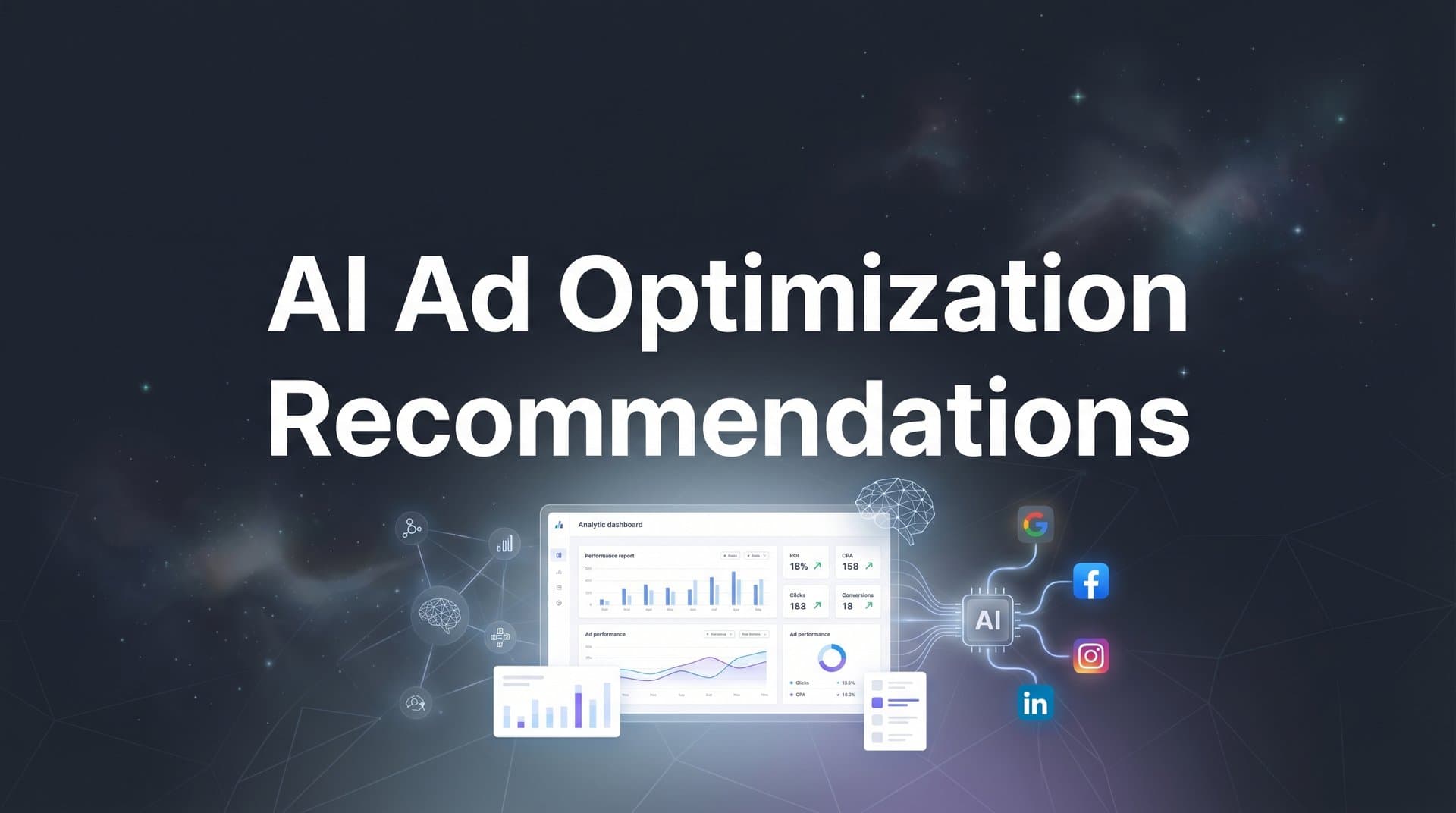
Digital marketers are increasingly relying on AI to optimize their advertising campaigns, but many discover that the quality of AI recommendations varies dramatically based on how they set up their systems. The difference between mediocre AI suggestions and game-changing optimization insights often comes down to the data you feed these systems and how you structure your campaigns for machine learning success.
Think of AI optimization like training an athlete. A coach who only sees game highlights can offer some suggestions, but a coach who tracks every practice session, nutrition choice, and recovery metric can provide transformational guidance. Your AI systems work the same way.
This guide walks through seven actionable strategies that help marketers get more accurate, revenue-focused AI ad optimization recommendations. Whether you're working with native platform AI like Meta Advantage+ or Google Performance Max, or using third-party attribution tools, these approaches will help you unlock better insights and scale your campaigns with confidence.
1. Feed Your AI Complete Customer Journey Data
The Challenge It Solves
Most AI systems only see fragments of the customer journey. They might track the initial ad click and the final purchase, but miss the email nurture sequence, the sales call, the demo request, and the retargeting touchpoints in between. This incomplete picture leads to recommendations that optimize for visibility rather than actual revenue generation.
When your AI can't see the full journey, it makes decisions based on partial information. It's like asking someone to complete a puzzle with half the pieces missing.
The Strategy Explained
Complete customer journey tracking means connecting every interaction point into a unified data stream that your AI can analyze. This includes ad clicks, website visits, form submissions, email opens, CRM activities, sales calls, and purchase events. The goal is creating a continuous thread from first touch to closed deal.
Modern attribution platforms can capture these diverse touchpoints and unify them into customer profiles. When AI systems analyze these complete journeys, they identify patterns that partial data would never reveal. They start recognizing that certain ad combinations, followed by specific content interactions, lead to higher-value customers.
This comprehensive view transforms AI recommendations from "this ad got clicks" to "this ad sequence drives qualified leads who convert at 3x the average deal size." Understanding these patterns is essential for effective AI recommendations for ad campaign optimization.
Implementation Steps
1. Map every customer touchpoint in your marketing ecosystem, from initial awareness through post-purchase. Document where each interaction is tracked and where data gaps exist.
2. Implement tracking pixels and webhooks that capture events across your website, landing pages, email platform, CRM, and sales tools. Ensure each system can pass customer identifiers to maintain continuity.
3. Connect these data sources through an attribution platform that unifies the journey. Verify that individual customer paths are being reconstructed accurately by reviewing sample journeys.
Pro Tips
Start with your highest-value conversion events and work backward. If demo requests are your key metric, ensure you're tracking every touchpoint that precedes them. Test your tracking by going through the customer journey yourself and verifying each event appears in your analytics.
2. Implement Server-Side Tracking for Data Accuracy
The Challenge It Solves
Browser-based tracking has become increasingly unreliable. iOS App Tracking Transparency restrictions, browser privacy features, and ad blockers create significant data loss. When your AI optimization systems work with incomplete conversion data, they make poor scaling decisions. They might recommend cutting budgets on channels that are actually performing well, simply because conversions aren't being captured.
Many marketers have experienced the frustration of knowing they received leads from a campaign, but their analytics showing zero conversions. This data gap cripples AI optimization.
The Strategy Explained
Server-side tracking bypasses browser limitations by sending conversion data directly from your server to ad platforms and analytics tools. Instead of relying on JavaScript pixels that can be blocked or restricted, your server communicates conversion events using APIs and secure server-to-server connections.
This approach captures conversions that browser tracking misses. When someone converts on an iPhone with tracking restricted, server-side implementation still records and reports that conversion. Your AI systems receive a more complete dataset, leading to optimization recommendations based on actual performance rather than partial visibility.
The technical shift is significant, but the impact on data accuracy makes it essential for modern advertising. Platforms like Meta and Google have built robust server-side APIs specifically to address browser tracking limitations. Without accurate data, you'll face significant ad optimization challenges that undermine your entire strategy.
Implementation Steps
1. Audit your current conversion tracking to quantify data loss. Compare server-side conversions (like CRM entries) against pixel-tracked conversions to identify the gap.
2. Set up server-side tracking infrastructure using Conversion API for Meta, Enhanced Conversions for Google, or a unified attribution platform that handles multiple channels. Configure your server to send conversion events with as many customer identifiers as possible.
3. Implement parallel tracking initially, running both browser pixels and server-side tracking simultaneously. Monitor data quality improvements and gradually shift optimization focus to the more complete server-side data.
Pro Tips
Include multiple customer identifiers in your server-side events: email addresses (hashed), phone numbers, IP addresses, and user agent strings. The more matching parameters you provide, the better ad platforms can attribute conversions accurately. Prioritize high-value conversion events first when implementing server-side tracking.
3. Send Enriched Conversion Events Back to Ad Platforms
The Challenge It Solves
Ad platform AI systems optimize based on the conversion signals you send them. If you only report that a conversion happened, without context about conversion quality or revenue value, the AI treats all conversions equally. This leads to optimization recommendations that maximize conversion volume rather than conversion value.
The result? Your AI might recommend scaling campaigns that generate lots of low-quality leads while suggesting budget cuts for campaigns driving fewer but higher-value customers.
The Strategy Explained
Conversion enrichment means sending detailed conversion data back to ad platforms after you've gathered additional context. When someone converts, you initially know they filled out a form. Days or weeks later, you know whether they became a customer, their deal size, and their lifetime value potential.
By feeding this enriched data back to platforms like Meta and Google, you enable their AI to optimize for business outcomes rather than surface-level actions. The platform learns that certain audience segments, ad creatives, and placements drive higher-value customers. Future optimization recommendations reflect this revenue-focused understanding.
Our roundup of the best AI ad creative generator options can help you shortlist.
This creates a virtuous cycle where better data leads to better AI recommendations, which lead to better campaign performance, which generates more valuable data. Implementing conversion rate optimization best practices alongside enrichment amplifies these results.
Implementation Steps
1. Define which conversion attributes matter most for your business: deal size, customer lifetime value, lead quality scores, or product categories. Determine how quickly you can gather this data after initial conversion.
2. Set up systems to capture enrichment data from your CRM, sales platform, or customer database. Create processes to match this data back to the original ad click or conversion event.
3. Configure conversion sync to send enriched events back to ad platforms. Use offline conversion uploads, enhanced conversions, or attribution platform integrations to update the platforms with revenue and quality data.
Pro Tips
Start with purchase value data if you're in e-commerce, or lead quality scores if you're in B2B. Even basic enrichment like "converted to customer: yes/no" dramatically improves AI optimization compared to no enrichment. Send updates as soon as you have the data rather than waiting for perfect information.
4. Use Multi-Touch Attribution to Identify True Performers
The Challenge It Solves
Last-click attribution creates a distorted view of channel performance. It credits the final touchpoint before conversion while ignoring all the awareness, consideration, and nurturing interactions that made that conversion possible. When AI systems optimize based on last-click data, they recommend cutting budgets from top-of-funnel channels that are actually essential to your conversion path.
This is particularly problematic for longer sales cycles where customers interact with multiple channels before converting. Your retargeting campaign gets all the credit while your prospecting campaigns that introduced the customer get none.
The Strategy Explained
Multi-touch attribution distributes conversion credit across all touchpoints in the customer journey based on their actual contribution. Different models weight touchpoints differently: linear attribution spreads credit evenly, time-decay gives more credit to recent interactions, and position-based models emphasize first and last touches.
When your AI systems analyze multi-touch attribution data, they understand the full ecosystem of channels working together. They recognize that certain channels excel at awareness while others drive conversions. Optimization recommendations become more sophisticated, suggesting budget allocation that maintains the entire funnel rather than just optimizing the bottom.
This holistic view prevents the common mistake of killing top-of-funnel campaigns because they don't show direct conversions, only to watch your overall conversion volume collapse weeks later. Proper attribution window optimization strategies ensure you're capturing the full picture.
Implementation Steps
1. Choose an attribution model that aligns with your sales cycle and business model. B2B companies with long cycles often benefit from position-based or time-decay models, while e-commerce might use linear or data-driven attribution.
2. Implement attribution tracking that captures all customer touchpoints and applies your chosen model. Review attribution reports to understand how credit distributes across channels compared to last-click.
3. Recalibrate your optimization goals and AI recommendations based on multi-touch insights. Adjust budget allocation to support the full funnel rather than just last-click performers.
Pro Tips
Compare multiple attribution models side by side initially to understand how different approaches change channel valuation. Don't make dramatic budget shifts immediately. Use multi-touch insights to inform gradual optimization while monitoring overall conversion volume and quality. Look for channels that appear frequently in converting journeys even if they rarely get last-click credit.
5. Structure Campaigns for Machine Learning Success
The Challenge It Solves
AI optimization systems need sufficient data volume to identify patterns and make reliable recommendations. When campaigns are fragmented across dozens of tiny ad sets, each with minimal spend and few conversions, machine learning algorithms struggle to find statistical significance. The AI essentially operates blind, making recommendations based on insufficient evidence.
For a deeper dive into this space, see our guide to ad spend optimization tools.
Many marketers over-segment their campaigns, creating separate ad sets for every minor audience variation or creative test. This approach worked in manual optimization but undermines AI performance.
The Strategy Explained
Campaign consolidation means organizing your advertising into structures that give AI systems the data volume they need. Instead of 20 ad sets each spending $50 per day, you might create 3-5 ad sets each spending $200-300 per day. This concentration allows algorithms to process more conversion events per campaign unit, leading to faster learning and more confident optimization.
Modern ad platforms increasingly recommend broader targeting and consolidated campaign structures. Meta's Advantage+ campaigns and Google's Performance Max are built on this principle. They work best when you provide clear conversion goals and sufficient budget, then let the AI find the right audiences and placements. Understanding ad platform learning phase optimization helps you navigate this transition effectively.
This doesn't mean eliminating all testing or segmentation. It means being strategic about where you segment and ensuring each campaign element has enough volume for AI to optimize effectively.
Implementation Steps
1. Audit your current campaign structure and calculate weekly conversion volume per ad set or campaign. Identify ad sets receiving fewer than 50 conversions per week as potential consolidation candidates.
2. Consolidate similar audiences and objectives into broader campaigns. Combine demographic variations, interest targeting overlaps, and minor creative differences into unified campaigns with larger budgets.
3. Implement dynamic creative optimization and automated placements to give AI more optimization levers within consolidated campaigns. Monitor performance during the transition period, allowing 2-3 weeks for machine learning to stabilize.
Pro Tips
Maintain separation between fundamentally different objectives or audiences, like prospecting versus retargeting, or B2B versus B2C segments. The goal is consolidation within logical groupings, not throwing everything into a single campaign. Watch for AI recommendations about expanding targeting or increasing budgets as signals that your structure is working effectively.
6. Establish Clear Optimization Goals Tied to Revenue
The Challenge It Solves
AI systems optimize for the goals you set, not the goals you wish you had set. When marketers optimize for clicks, impressions, or even basic conversions without revenue context, AI dutifully maximizes those metrics regardless of business impact. You might get thousands of clicks that never convert, or conversions that generate minimal revenue.
This misalignment between optimization objectives and business outcomes creates a dangerous situation where improving AI-recommended metrics actually hurts profitability.
The Strategy Explained
Revenue-based optimization means configuring your AI systems to maximize business value rather than vanity metrics. This involves setting up value-based bidding, defining conversion values, and establishing ROAS or profit targets as primary objectives.
When ad platforms know the revenue value of different conversions, their AI can make sophisticated decisions. They learn that certain audiences generate higher-value purchases, specific creatives attract better customers, and particular times of day drive more profitable conversions. Leveraging ad spend optimization strategies ensures your budget flows toward revenue-generating activities.
This alignment transforms AI from a tool that drives volume into a system that drives profitability. The recommendations you receive focus on scaling what actually grows your business, not just what generates activity.
Implementation Steps
1. Define your primary business objective in measurable terms: target ROAS, cost per acquisition limit, or profit per conversion. Ensure this metric accurately reflects business health rather than marketing activity.
2. Configure ad platform conversion tracking to include revenue values. Set up value-based bidding strategies that optimize for conversion value rather than conversion volume.
3. Align all optimization decisions and AI recommendations against your revenue-based objective. Review performance reports through the lens of business impact rather than intermediate metrics.
Pro Tips
If you can't track revenue directly, create proxy values based on historical conversion-to-customer rates and average deal sizes. A lead quality score system can serve as a value signal even when actual revenue data isn't immediately available. Regularly validate that your optimization goals still align with business priorities as your product mix and pricing evolve.
7. Review and Act on AI Recommendations Systematically
The Challenge It Solves
Many marketers receive AI optimization recommendations but lack a consistent process for evaluating and implementing them. Some suggestions get ignored, others get implemented without validation, and valuable insights get lost in the daily chaos of campaign management. This ad hoc approach means you're not fully leveraging the AI systems you've invested in building.
Without systematic review, you miss patterns in AI suggestions that could reveal deeper optimization opportunities or data quality issues that need addressing.
The Strategy Explained
Systematic AI review means establishing regular processes to examine, validate, and act on optimization recommendations. This includes scheduled review sessions, evaluation criteria for determining which suggestions to implement, and feedback loops to measure recommendation impact.
Create a weekly or bi-weekly ritual where you review all AI-generated insights from your attribution platform, ad platforms, and analytics tools. Categorize recommendations by type: budget adjustments, targeting changes, creative optimizations, or structural improvements. Evaluate each against your business objectives and data quality standards. Using AI-powered ad optimization tools can streamline this review process significantly.
Document which recommendations you implement and track their performance impact. This creates organizational learning about which types of AI suggestions deliver results for your specific business, making future evaluations more efficient.
Implementation Steps
1. Schedule recurring optimization review sessions in your calendar. Block dedicated time weekly or bi-weekly when you won't be interrupted by day-to-day campaign management.
2. Create an evaluation framework for AI recommendations. Define criteria like minimum confidence level, alignment with business goals, resource requirements, and risk assessment. Use this framework to prioritize which suggestions to implement.
3. Implement a testing protocol for significant AI recommendations. Rather than making dramatic changes based on a single suggestion, test major optimizations at smaller scale first and measure results before full rollout.
Pro Tips
Keep a log of AI recommendations and implementation outcomes. This historical record helps you identify which types of suggestions consistently work for your business and which tend to underperform. Look for patterns in recommendations that might indicate data quality issues, like AI consistently suggesting budget increases for campaigns you know aren't performing well.
Putting These Strategies Into Action
The quality of your AI ad optimization recommendations directly correlates with the quality of data you provide and how you structure your campaigns for machine learning success. Start by auditing your current data collection setup to identify gaps in customer journey tracking.
Prioritize implementing server-side tracking and conversion sync to immediately improve the data quality feeding your AI systems. These foundational improvements create ripple effects across all your optimization efforts. Better data means better recommendations, which lead to better performance, which generates more valuable data.
Then work on campaign structure and attribution modeling to ensure your optimization recommendations reflect true revenue impact rather than last-click vanity metrics. Consolidate fragmented campaigns to give AI sufficient conversion volume, and align your optimization goals with actual business outcomes.
The marketers who get the best AI ad optimization recommendations are those who treat data quality as a competitive advantage. They understand that AI systems are only as good as the information they receive and the objectives they're given. By implementing these seven strategies, you position your campaigns to receive insights that actually drive profitable scaling decisions.
Remember that AI optimization is not a set-it-and-forget-it solution. It requires ongoing attention to data quality, systematic review of recommendations, and continuous alignment between AI objectives and business goals. The investment in getting this foundation right pays dividends in every campaign you run.
Ready to elevate your marketing game with precision and confidence? Discover how Cometly's AI-driven recommendations can transform your ad strategy. Get your free demo today and start capturing every touchpoint to maximize your conversions.


