You've built a dozen ad variations. Headlines, images, CTAs—all carefully crafted. You launch them, wait three days, check the numbers, pause the losers, and scale the winner. Then you start over with new tests. By the time you've identified what works, your audience has already seen it fifty times and your creative is fatigued.
This is the reality of traditional split testing in 2026. The process that once felt strategic now feels painfully slow. Your competitors are iterating faster. Ad platforms are demanding more creative volume. And the manual testing cycle—hypothesis, launch, wait, analyze, repeat—can't keep pace with how quickly modern campaigns evolve.
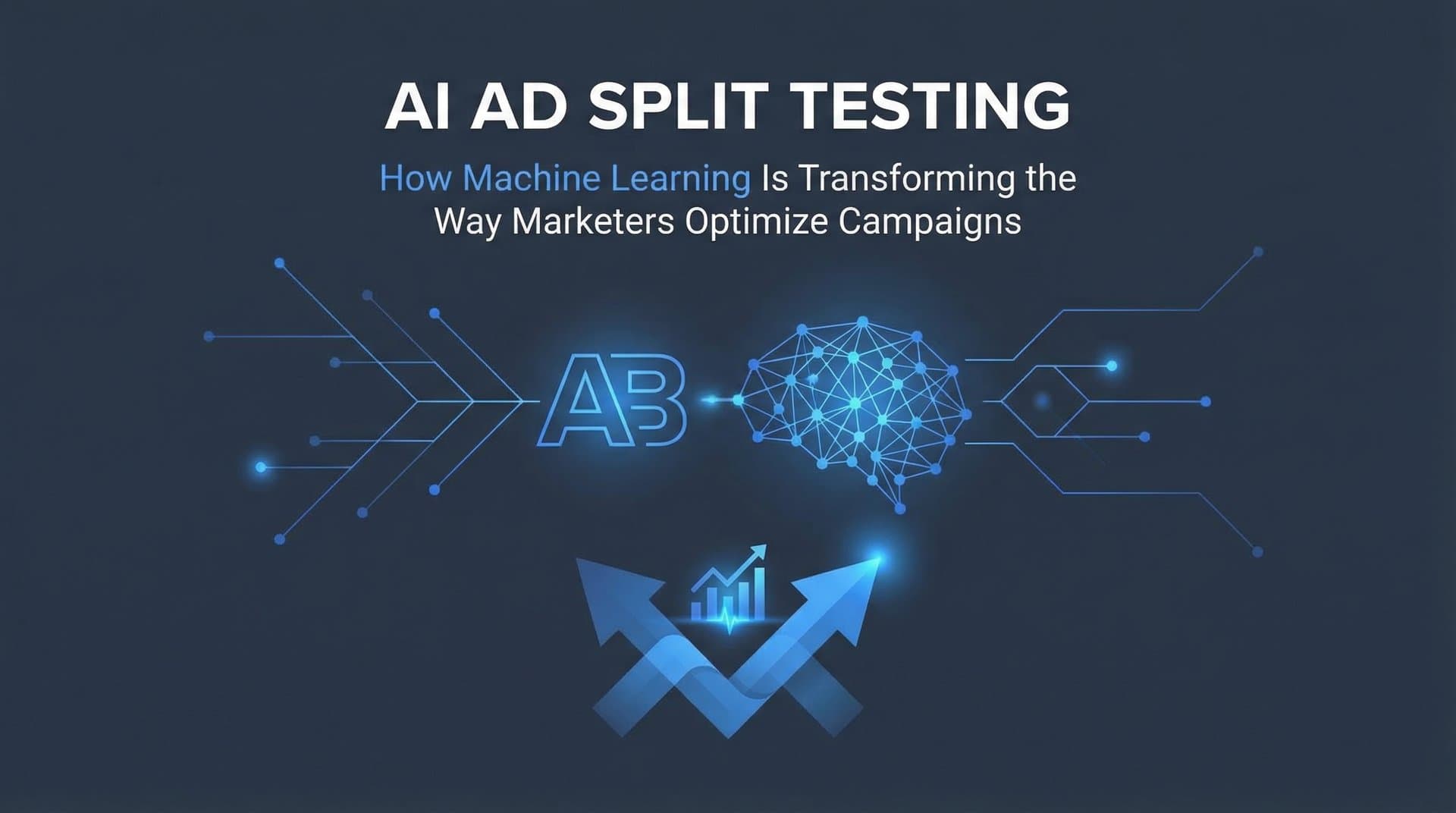
AI ad split testing changes this equation entirely. Instead of testing one variable at a time over weeks, machine learning systems evaluate hundreds of combinations simultaneously, automatically shifting budget toward winners in real time. It's not just faster A/B testing. It's a fundamentally different approach that addresses the core bottleneck in campaign optimization: the gap between how fast data accumulates and how quickly humans can act on it.
The Mechanics Behind AI-Powered Ad Testing
Traditional A/B testing follows a linear path. You test headline A against headline B. Once you have a winner, you test image variations. Then you move to audience segments. Each test requires sufficient data before you can confidently declare a winner, which means waiting days or weeks between iterations.
AI split testing operates differently. Machine learning algorithms test multiple variables simultaneously—headlines, images, audiences, placements—and analyze how these elements interact with each other. Instead of isolating one variable at a time, AI systems evaluate combinations: how headline A performs with image B for audience segment C on placement D.
This multivariate approach reveals insights that sequential testing misses entirely. A headline that underperforms with one audience might be your top performer with another. An image that works brilliantly in feed placements might fall flat in stories. AI testing surfaces these nuanced patterns by processing performance signals across all combinations at once.
The real power comes from real-time optimization. As data accumulates, machine learning algorithms continuously adjust budget allocation. High-performing combinations receive more spend. Underperformers get throttled back. This happens automatically, often within hours rather than days, based on statistical models that predict likely winners before traditional significance thresholds are reached.
Think of it like having a team of analysts monitoring every ad variation 24/7, making micro-adjustments based on performance trends, and reallocating budget every few hours. Except the AI never sleeps, never misses a pattern, and processes data volume that would overwhelm any human team.
The algorithms analyze performance signals across multiple dimensions simultaneously. Click-through rates, conversion rates, cost per acquisition, engagement patterns, time-to-conversion—all feeding into predictive models that identify which combinations will likely deliver the best results. Understanding what defines a split test winner becomes crucial when interpreting these AI-generated insights.
Machine learning also identifies patterns humans typically miss. Maybe your ads perform better on Tuesdays with a specific audience segment. Perhaps certain creative elements resonate differently based on time of day or device type. AI testing surfaces these insights automatically, without requiring you to hypothesize and test each possibility manually.
The automated winner selection removes the guesswork from optimization decisions. Instead of staring at dashboards trying to determine if a 0.3% difference in conversion rate is meaningful, the AI applies statistical rigor to declare winners based on confidence intervals and performance trajectories. You get clear signals about what's working, faster.
Why Traditional Split Testing Falls Short in 2026
Sequential testing made sense when campaigns had fewer moving parts. Test one headline against another. Wait for significance. Move to the next variable. But modern advertising has evolved beyond what this methodology can effectively handle.
Ad fatigue happens faster now than it did even two years ago. Audiences see more content, scroll faster, and develop banner blindness more quickly. By the time you've completed a three-week testing cycle to identify your winning creative, that creative has already been shown to your audience dozens of times. The winner you finally scale is already losing effectiveness.
The creative production bottleneck compounds this problem. Traditional testing requires you to produce variations, launch them, wait for results, then produce new variations based on learnings. This cycle takes weeks. Meanwhile, your competitors using AI testing are iterating daily, learning faster, and adapting to audience preferences in real time.
Manual audience segmentation introduces another layer of delay. You need to hypothesize which audience segments to test, set them up individually, monitor performance across each segment, and then manually analyze results. With AI testing, audience optimization happens automatically—the system identifies which segments respond best to which creative combinations without requiring manual setup for every possibility.
Result interpretation becomes overwhelming as campaign complexity increases. When you're testing five headlines across three images with four audience segments and multiple placements, you're looking at hundreds of potential combinations. Implementing an accelerated testing strategy becomes essential for keeping pace with this complexity.
The data volume problem is the fundamental issue traditional testing cannot solve. Modern campaigns generate massive amounts of performance data across dozens of variables. Every ad variation, every audience segment, every placement produces data points. Human analysis cannot process this volume quickly enough to make timely optimization decisions.
Consider the math. If you're testing just five creative variations across four audience segments on three placements, that's 60 combinations. Traditional A/B testing would require months to test these sequentially. AI testing evaluates all 60 simultaneously, identifying the top performers within days.
Platform algorithms also move faster than manual testing cycles. Meta's algorithm, Google's Smart Bidding, TikTok's optimization systems—they all adjust in real time based on performance signals. Manual testing that takes weeks to complete means you're always playing catch-up, optimizing for conditions that have already changed.
Key Components AI Tests Simultaneously
AI split testing evaluates every element of your ad experience at once, identifying which combinations drive the best results. This simultaneous testing reveals interactions between variables that sequential testing would never uncover.
Creative Elements: The AI analyzes every component of your ad creative—headlines, body copy, calls-to-action, images, video hooks, and design elements. It identifies which headline resonates best with which image, which CTA drives the most conversions, and which video hooks prevent scroll-through.
For video ads, machine learning examines hook effectiveness within the first three seconds, engagement patterns throughout the video, and which end screens drive action. It tests different video lengths, pacing, music choices, and visual styles simultaneously, determining which combinations keep viewers watching and which drive conversions.
Copy variations get tested across multiple dimensions. Different value propositions, tones of voice, urgency levels, and benefit statements—all evaluated concurrently. The AI identifies which messaging resonates with specific audience segments, often revealing that different groups respond to completely different value propositions.
Audience Variables: Machine learning tests demographic segments, interest-based targeting, lookalike audiences, and behavioral patterns all at once. It discovers which audience segments respond best to which creative approaches, automatically allocating budget toward the highest-performing combinations.
The system evaluates audience interactions you might never think to test manually. Perhaps your product messaging resonates differently with 25-34 year-olds versus 35-44 year-olds. Maybe certain interest combinations predict higher purchase intent. AI testing surfaces these insights by analyzing performance across every audience variation simultaneously.
Lookalike audience optimization happens automatically. The AI identifies which seed audiences produce the best lookalikes for your specific offer, which similarity percentages perform best, and which geographic regions show the strongest response. This level of granular audience optimization would take months to test manually.
Placement and Format Optimization: Different placements perform differently for different creatives and audiences. Feed placements, stories, reels, search results, display networks—each has unique characteristics. AI testing evaluates performance across all placement options simultaneously, identifying where each creative variation performs best.
Format optimization extends beyond just placement. The AI tests square versus vertical formats, static images versus video, carousel ads versus single image, and determines which format works best for each combination of creative and audience. Leveraging ad builder platforms can help you rapidly produce the creative variations needed for comprehensive AI testing.
Device-level optimization also happens concurrently. Mobile versus desktop performance, iOS versus Android behavior, tablet engagement patterns—all analyzed simultaneously to ensure budget flows toward the most effective device and placement combinations for each ad variation.
Setting Up AI Split Tests for Maximum Impact
AI testing delivers powerful results, but only when set up correctly. The system needs clear direction, quality inputs, and accurate data to make intelligent optimization decisions.
Define Success Metrics First: Before launching any AI split test, establish exactly what success looks like. Are you optimizing for return on ad spend, cost per acquisition, or conversion volume? The metric you choose determines how the AI evaluates performance and allocates budget.
Be specific about your success criteria. "Lower CPA" isn't enough. Define the target CPA that makes your unit economics work. Specify whether you're optimizing for all conversions or specific high-value actions. The more precise your success definition, the better the AI can optimize toward your actual business goals.
Consider both short-term and long-term metrics. An ad variation might drive immediate conversions but attract lower-quality customers. If you have attribution data showing customer lifetime value, feed that into your success metrics. AI testing combined with proper attribution reveals which ads drive not just conversions, but revenue.
Feed the System Quality Creative Variations: AI testing requires sufficient creative diversity to identify meaningful patterns. If you feed the system five nearly-identical headlines, you'll get marginal insights. Provide genuinely different creative approaches—different value propositions, visual styles, and messaging angles.
Aim for meaningful variation across creative elements. Test different benefit statements, not just word-order changes. Evaluate distinct visual approaches, not just color variations. The AI needs real differences to identify what resonates with different audience segments.
Don't confuse quantity with quality. Feeding the system 50 mediocre creative variations won't outperform 10 thoughtfully-crafted options. Focus on testing genuinely different strategic approaches rather than minor tactical tweaks. The AI will identify which strategic direction works best.
Establish Proper Tracking Infrastructure: AI split testing is only as good as the data it receives. If your tracking setup misattributes conversions or misses revenue events, the AI will optimize toward inaccurate signals. Using an accurate ad attribution platform ensures your AI testing receives reliable performance data.
Server-side tracking becomes critical for AI testing accuracy. Browser-based tracking misses conversions due to ad blockers, iOS privacy features, and cookie limitations. When the AI doesn't see all conversions, it makes optimization decisions based on incomplete data, often favoring ads that appear to perform well but actually underperform.
Accurate attribution ensures the AI understands true campaign impact. If your attribution system only tracks last-click conversions, AI testing will optimize for bottom-funnel performance while ignoring ads that drive awareness and consideration. Multi-touch attribution provides the complete picture AI systems need to optimize effectively across the entire customer journey.
Connect your AI testing platform to your actual revenue data. In-platform conversion tracking shows what ad platforms see, but your CRM and revenue data show what actually happened. This connection allows AI to optimize for real business outcomes rather than platform-reported metrics that may not align with actual revenue.
Interpreting AI-Generated Insights and Taking Action
AI testing produces winners faster than traditional methods, but understanding what those results mean requires a different analytical approach. The speed and volume of insights demand new frameworks for interpretation and action.
Understanding 'Winning' in an AI Context: Traditional A/B testing waits for statistical significance—usually 95% confidence that the difference isn't due to chance. AI systems often identify directional winners earlier by analyzing performance trajectories and predicting likely outcomes before full significance is reached.
This doesn't mean the AI is guessing. Machine learning models analyze patterns across thousands of previous tests, identifying early signals that correlate with eventual winners. An ad variation showing strong engagement patterns similar to previous high performers gets flagged as a likely winner, even if it hasn't accumulated enough conversions for traditional significance.
The practical implication: you can act on insights faster, but with awareness of confidence levels. An AI-identified winner with 85% confidence might be worth scaling cautiously while continuing to monitor performance. A winner with 98% confidence based on substantial data warrants more aggressive scaling.
Scaling Without Over-Reliance: When AI identifies a winning combination, the temptation is to pour all budget into that winner immediately. This approach often backfires. Even the best-performing ad eventually fatigues. Audiences tire of seeing the same creative, engagement drops, and costs rise.
Smart scaling means gradually increasing budget on winners while maintaining a testing budget for new variations. Allocate 60-70% of budget to proven winners, but keep 30-40% testing new creative approaches. This balance ensures consistent performance while continuously discovering new winners before current ads fatigue.
Watch for performance degradation signals. If your winning ad's CPA increases by 20% or engagement rates drop significantly, it's entering fatigue. Having new tested variations ready to scale prevents performance gaps when winners decline. AI testing should be continuous, not a one-time exercise to find a winner.
Diversify your winning portfolio. If AI identifies three strong performers, scale all three rather than just the top one. This approach reduces fatigue risk and provides backup options if one ad's performance suddenly drops. Multiple winners also reveal different audience segments and messaging approaches that resonate.
Building Feedback Loops: The real power of AI testing emerges when insights inform future creative strategy. Patterns identified across multiple tests reveal what consistently works for your audience, guiding creative production toward higher-probability winners.
Analyze winning patterns across tests. If ads featuring customer results consistently outperform product features, that's a strategic insight for all future creative. Applying ad campaign performance analysis methods helps you extract these actionable patterns from your testing data.
Document learnings from each testing cycle. Which value propositions resonated? Which visual styles drove engagement? Which calls-to-action generated conversions? These insights compound over time, making each subsequent testing round more effective because you're starting from a more informed baseline.
Feed AI insights back to your creative team. When machine learning identifies that certain headline structures or visual approaches consistently win, brief your designers and copywriters with these patterns. This creates a virtuous cycle where creative production becomes more efficient and testing cycles identify winners faster.
Putting AI Ad Split Testing Into Practice
Start with Hypotheses, Let AI Challenge Assumptions: Begin each testing cycle with a clear hypothesis about what might work, but remain open to AI revealing unexpected winners. You might believe benefit-focused headlines will outperform feature-focused ones, but let the data determine reality rather than forcing that assumption.
The best approach combines human creativity with machine learning analysis. Use your marketing expertise to generate diverse creative approaches worth testing. Use AI to determine which approaches actually perform best with real audiences. This partnership between human strategy and machine optimization produces better results than either alone.
Embrace Continuous Testing: AI split testing isn't a campaign launch tactic—it's an ongoing optimization process. The most successful advertisers treat testing as a permanent component of their media strategy, continuously introducing new variations and retiring fatigued creative.
Establish a regular cadence for introducing new creative variations. Weekly or bi-weekly refreshes ensure the AI always has new combinations to evaluate, preventing the stagnation that happens when you find a winner and stop testing. Markets change, audiences evolve, and competitors adapt. Continuous testing keeps you ahead of these shifts.
Amplify AI Testing with Accurate Attribution: The effectiveness of AI split testing multiplies when combined with accurate attribution data. Platform-reported conversions tell you which ads the algorithm thinks are working. Understanding incrementality testing vs attribution helps you distinguish between correlation and true causal impact.
This distinction matters enormously. An ad might generate lots of conversions that platforms track, but if those conversions come from low-value customers who don't generate revenue, you're optimizing toward the wrong metric. Accurate attribution reveals true campaign impact, allowing AI testing to optimize for actual business outcomes rather than platform-reported metrics.
Server-side tracking and multi-touch attribution ensure AI systems receive complete, accurate performance data. When every conversion is tracked correctly and attributed to the right touchpoints, machine learning algorithms make better optimization decisions. The AI sees the full picture rather than the fragmented view browser-based tracking provides.
The Future of Campaign Optimization
AI ad split testing represents more than an incremental improvement in campaign optimization. It's a fundamental shift in how marketers approach testing—from slow, manual, sequential processes to intelligent, automated, concurrent experimentation that operates at machine speed.
The traditional testing approach—hypothesize, launch, wait, analyze, iterate—cannot compete with the pace modern advertising demands. Ad fatigue happens faster. Platform algorithms adjust in real time. Competitors iterate daily. Manual testing cycles that take weeks simply cannot keep up.
Machine learning addresses this speed gap by processing data volume and complexity that overwhelms human analysis. Hundreds of combinations tested simultaneously. Real-time budget optimization. Automated winner identification. Pattern recognition across dimensions humans cannot effectively monitor manually. This isn't just faster testing—it's fundamentally more capable testing.
The real power emerges when AI testing combines with accurate attribution data. Platform algorithms optimize for what they can see, but server-side tracking and proper attribution show what actually drives revenue. When AI testing systems receive complete, accurate performance data, they optimize toward real business outcomes rather than incomplete platform metrics.
This combination—intelligent testing plus accurate measurement—creates a competitive advantage that compounds over time. Every testing cycle generates insights that inform the next cycle. Creative production becomes more efficient as you understand what works. Budget allocation becomes more effective as you identify true revenue drivers. The gap between companies using this approach and those relying on manual testing widens continuously.
For advertisers in 2026, AI split testing isn't an experimental tactic—it's becoming table stakes. The question isn't whether to adopt AI testing, but how quickly you can implement it effectively. Your competitors are already iterating faster, learning more from their campaigns, and optimizing toward better outcomes. The manual testing approach that worked in 2023 cannot compete with the speed and intelligence of machine learning optimization.
Ready to elevate your marketing game with precision and confidence? Discover how Cometly's AI-driven recommendations can transform your ad strategy—Get your free demo today and start capturing every touchpoint to maximize your conversions.