
Marketing teams are drowning in data but starving for insights. You've got Google Analytics showing one story, Facebook Ads Manager telling another, and your CRM painting a completely different picture. Meanwhile, your campaigns are burning budget while you're stuck playing guessing games with optimization.
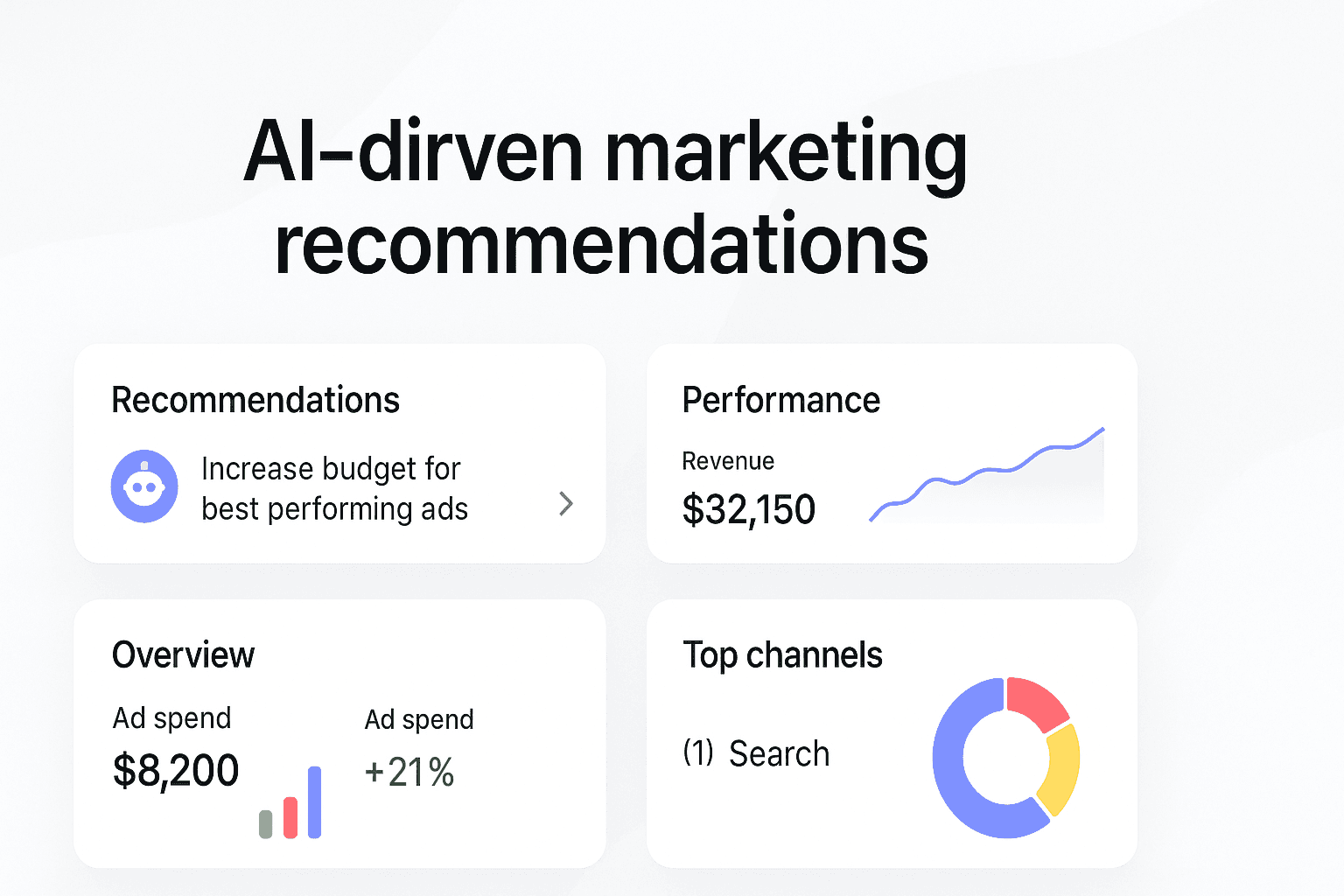
The solution isn't more data—it's smarter data. AI-driven marketing recommendations transform overwhelming analytics into clear, actionable strategies that directly impact your bottom line. Instead of spending hours analyzing reports, you get specific recommendations: "Increase budget on Campaign X by 30%" or "Shift ad spend from Facebook to Google for this audience segment."
The marketers winning in 2026 aren't just collecting data—they're using AI to make faster, more accurate decisions than their competitors. These seven strategies will show you exactly how to implement AI-driven recommendations that turn your marketing chaos into predictable revenue growth.
1. Implement AI-Powered Customer Lifetime Value Predictions
Most marketing teams optimize for immediate conversions without understanding which customers will actually drive long-term profitability. You're celebrating a $50 customer acquisition cost without realizing some customers will generate $5,000 in lifetime value while others churn after a single $30 purchase. This blind spot leads to acquisition strategies that attract low-value customers while your budget constraints prevent you from investing adequately in high-value prospect channels.
The financial impact is staggering. When you can't predict customer lifetime value, you're forced to use the same acquisition cost ceiling across all channels and audiences. This means you're either overpaying for low-value customers or missing high-value prospects because you won't increase bids to competitive levels.
Why Traditional CLV Calculations Fall Short
Traditional customer lifetime value calculations rely on historical averages—taking total revenue from existing customers and dividing by customer count. This backward-looking approach treats all customers as identical and can't predict the value of prospects you haven't acquired yet.
The limitation becomes obvious when you consider two customers: one who makes a single purchase and never returns, another who becomes a loyal advocate making purchases for years. Historical averages lump these vastly different customers together, giving you a meaningless middle number that doesn't inform acquisition decisions.
AI predictive CLV transforms this by analyzing hundreds of behavioral signals to forecast each individual customer's future value before they even make their first purchase. The system identifies patterns in engagement, browsing behavior, and demographic data that correlate with high lifetime value, then scores prospects based on these predictive indicators.
The Mechanics of AI CLV Prediction
AI customer lifetime value prediction works by analyzing your existing customer base to identify characteristics and behaviors that distinguish high-value customers from low-value ones. The machine learning model examines purchase frequency, average order value, product category preferences, engagement patterns, support interactions, and dozens of other signals.
Once trained on historical data, the AI can score new prospects and customers in real-time. When someone visits your website, downloads content, or engages with your emails, the system updates their predicted CLV based on how their behavior compares to your historical high-value customer patterns.
This creates a dynamic scoring system where predicted value changes as prospects demonstrate more high-value or low-value behaviors. A prospect who initially scores low might jump to high-value prediction after engaging with specific content or browsing premium product categories.
Implementation Strategy for CLV Predictions
Data Integration Foundation: Connect your CRM, e-commerce platform, email system, and website analytics into a unified customer data platform. The AI needs complete visibility into customer interactions across all touchpoints to identify predictive patterns accurately.
Historical Data Preparation: Clean and organize at least 12-24 months of customer data including purchase history, engagement metrics, support interactions, and any available demographic information. The model needs sufficient examples of both high-value and low-value customers to learn distinguishing patterns.
Model Training and Validation: Train the AI on 70% of your historical data, then validate accuracy on the remaining 30%. The model should accurately predict which customers in your validation set became high-value vs. low-value. Refine the model until prediction accuracy reaches acceptable levels for your business.
Prospect Scoring Implementation: Deploy the trained model to score all new prospects and existing customers. Set up automated scoring that updates as prospects take actions on your website, engage with emails, or interact with your brand across channels.
Acquisition Strategy Adjustment: Use predicted CLV scores to segment your acquisition campaigns. Create separate campaigns targeting high-CLV prospect profiles with higher bid strategies and more aggressive acquisition tactics. Maintain lower-cost acquisition approaches for prospects predicted to have lower lifetime value.
2. Deploy Real-Time Campaign Performance AI Monitoring
Campaign performance doesn't wait for your weekly review meetings. By the time you notice a 40% drop in conversion rates or a spike in cost-per-acquisition, you've already burned through thousands in wasted ad spend. The gap between when performance shifts and when you respond determines whether you're optimizing campaigns or just documenting their decline.
Real-time AI monitoring transforms this reactive approach into proactive campaign management. Instead of discovering problems in retrospect, you get immediate alerts when performance deviates from expected patterns, complete with specific recommendations for corrective action.
Why Real-Time Monitoring Outperforms Scheduled Reviews
Traditional campaign management operates on review cycles—daily check-ins for high-spend campaigns, weekly reviews for everything else. This schedule-based approach creates blind spots where performance can deteriorate for hours or days before anyone notices.
AI monitoring analyzes performance continuously, processing data from all your advertising platforms simultaneously. The system establishes baseline performance expectations for each campaign based on historical patterns, then flags anomalies the moment they occur. A sudden 30% increase in cost-per-click at 2 AM gets detected and addressed before your morning coffee, not during next week's performance review.
The speed advantage compounds over time. Quick responses to performance shifts preserve budget that would otherwise be wasted on declining campaigns. More importantly, rapid detection of winning patterns allows you to scale successful campaigns while they're still performing, rather than after the opportunity has passed.
Setting Up Intelligent Performance Monitoring
Effective real-time monitoring requires connecting all your advertising platforms and analytics tools to a unified system that can process data continuously. This integration creates a complete view of campaign performance across channels, enabling the AI to detect patterns and anomalies that single-platform monitoring would miss.
Start by establishing your key performance indicators and acceptable variance ranges. The AI needs to understand what constitutes normal performance fluctuation versus genuine problems requiring intervention. A 10% daily variance in impression volume might be normal, while a 10% spike in cost-per-acquisition signals an issue.
Configure alert thresholds based on campaign importance and budget size. High-spend campaigns warrant immediate alerts for smaller performance shifts, while lower-budget tests can tolerate wider variance before triggering notifications. The goal is actionable alerts, not alert fatigue from constant minor fluctuations.
Set up automated response protocols for different alert types. When the AI detects creative fatigue, it should automatically rotate to fresh variations. When cost-per-acquisition exceeds targets, the system can reduce bids or pause campaigns until you review the situation. These automated responses prevent small issues from becoming expensive problems.
We break down the leading options in our AI marketing creative generator guide.
Understanding AI Performance Recommendations
Real-time monitoring generates two types of insights: alerts about current problems and recommendations for optimization opportunities. The alerts are reactive—"Campaign X is underperforming, consider pausing or adjusting." The recommendations are proactive—"Campaign Y shows strong performance with Audience Z, consider increasing budget."
The AI identifies performance patterns by comparing current metrics against historical baselines and cross-campaign benchmarks. When a campaign's click-through rate drops 25% below its 30-day average, that's an alert. When a new audience segment shows 40% better conversion rates than your standard targeting, that's an opportunity recommendation.
These recommendations become more accurate as the system learns from your specific campaigns and business outcomes. Early recommendations might suggest conservative 10-15% budget adjustments. As the AI validates its predictions against actual results, it develops confidence in more aggressive optimization suggestions.
The key is treating AI recommendations as decision support, not automated rules. Review the reasoning behind each suggestion. A recommendation to pause a campaign might make sense if performance has genuinely declined, but if the drop coincides with a known seasonal pattern or recent targeting change, human judgment should override the AI suggestion.
Turning AI Recommendations Into Marketing Success
The most successful marketing teams in 2026 aren't just using AI tools—they're building AI-driven decision-making processes that compound competitive advantages over time. Start with one or two strategies that address your biggest current challenges, then expand your AI capabilities as you see results.
If you're struggling with attribution chaos, implement cross-platform attribution AI first to get accurate performance data across all channels. For teams wasting sales resources on low-quality leads, predictive lead scoring delivers immediate ROI by focusing efforts on high-probability prospects. Budget-constrained marketers should prioritize AI budget allocation to maximize returns from existing spend before scaling.
The key is treating AI recommendations as strategic guidance rather than automated rules. The best results come from marketers who combine AI insights with human creativity and strategic thinking. Your AI can tell you which campaigns to optimize and where to shift budget, but you still need to create compelling offers and engaging creative concepts that resonate with your audience.
Ready to transform your marketing data into revenue-generating decisions? Get your free demo to see how Cometly's AI-driven attribution platform delivers the cross-platform insights and automated recommendations that turn marketing chaos into predictable growth. Or explore our academy to learn advanced AI marketing strategies and discover how leading brands achieve these results in our case studies.