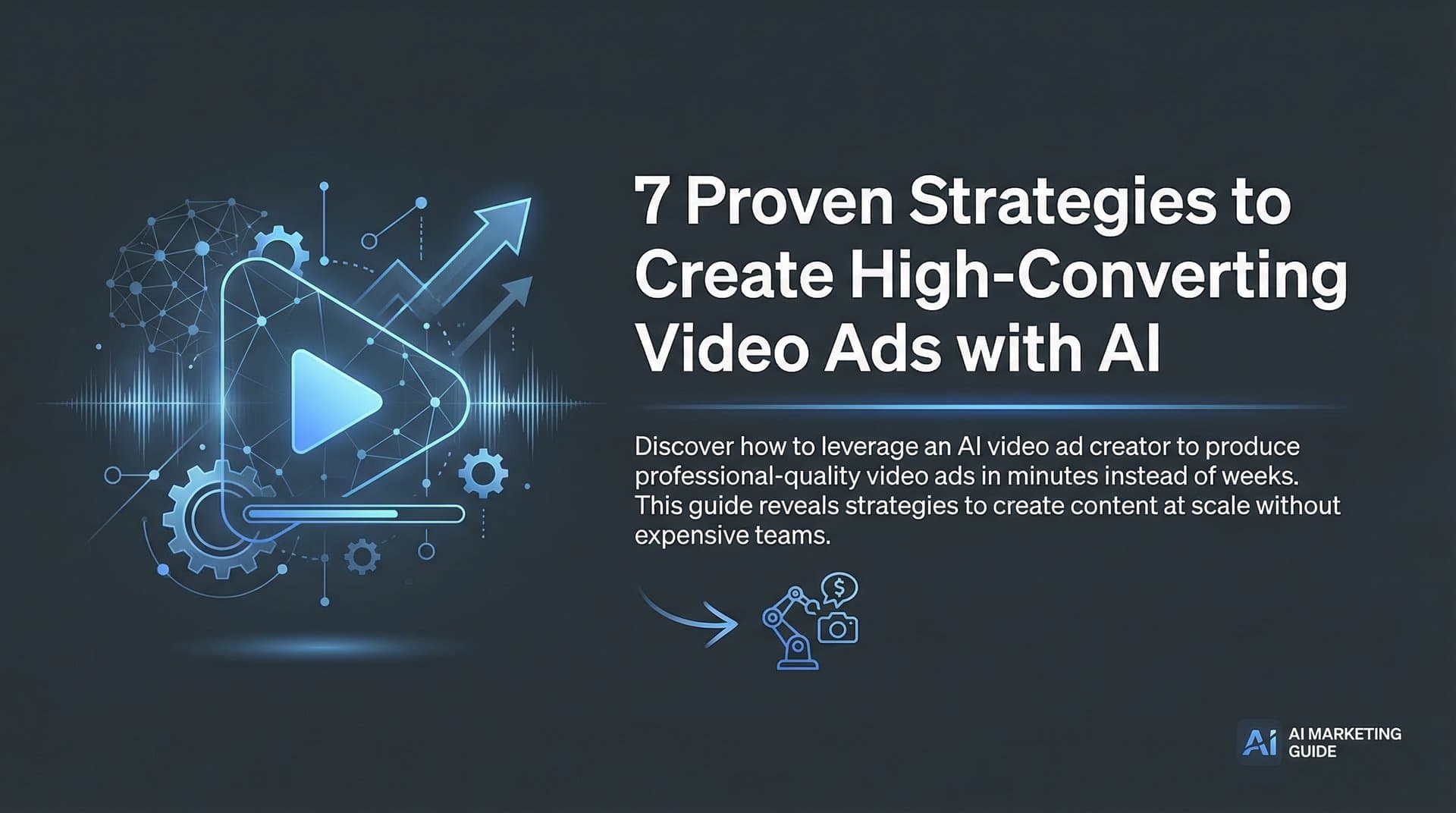
Video ads dominate digital advertising, but creating them at scale has traditionally required expensive production teams, lengthy timelines, and significant creative resources. AI video ad creators have changed this equation entirely—enabling marketers to produce professional-quality video content in minutes rather than weeks.
However, simply having access to AI tools isn't enough. The marketers seeing real results are those who've developed strategic approaches to leverage these platforms effectively.
This guide breaks down seven battle-tested strategies for using AI video ad creators to produce ads that actually convert, covering everything from creative briefing to performance optimization.
1. Start with Clear Creative Briefs, Not Vague Prompts
The Challenge It Solves
Many marketers approach AI video tools with generic prompts like "create a product ad" and wonder why the output misses the mark. AI tools are powerful, but they need context to produce creatives that align with your brand, audience, and campaign objectives.
Without structured guidance, you'll waste time regenerating content and making manual adjustments that defeat the purpose of using AI in the first place.
The Strategy Explained
Think of your creative brief as a strategic blueprint that guides the AI toward your desired outcome. Instead of asking for a generic video ad, provide specific details about your target audience, the problem your product solves, the emotional tone you want to convey, and the action you want viewers to take.
For example, rather than "create an ad for our project management software," your brief should specify: "Create a 15-second video ad targeting overwhelmed marketing managers who struggle with team collaboration. Show the frustration of missed deadlines, then position our tool as the solution. Use a professional but empathetic tone, and end with a clear CTA to start a free trial."
This level of detail gives AI tools the context they need to generate content that resonates with your specific audience and campaign goals. Understanding your acquisition funnel helps you craft briefs that address each stage of the customer journey.
Implementation Steps
1. Document your target audience's pain points, demographics, and decision-making factors before opening any AI tool.
2. Define the core message hierarchy: What's the one thing viewers must understand, and what supporting points reinforce it?
3. Specify visual and tonal preferences: Do you want fast-paced cuts or slower storytelling? Energetic or calm music? Bright colors or muted tones?
4. Include your brand guidelines: Logo placement, color schemes, fonts, and any messaging guardrails.
5. Define success metrics upfront: What action should viewers take, and how will you measure whether the creative achieved its goal?
Pro Tips
Create a template brief that you can adapt for different campaigns. This ensures consistency across your video ads while saving time on each new project. Keep a swipe file of competitor ads and note what elements you want to emulate or avoid—this gives AI tools concrete reference points.
2. Build a Modular Content Library for Rapid Iteration
The Challenge It Solves
Starting from scratch with every video ad creates unnecessary bottlenecks. When you need to test multiple variations quickly or respond to market changes, the time spent sourcing new assets and rebuilding concepts from zero kills your agility.
Marketers who scale video production successfully have systems in place that enable rapid assembly rather than constant recreation.
The Strategy Explained
Build a categorized library of reusable video components that can be mixed and matched based on campaign needs. This includes product demo clips, customer testimonial snippets, b-roll footage, branded transitions, text overlays, and music tracks organized by mood and tempo.
When you need a new ad variation, you're assembling proven components rather than creating everything from scratch. This approach dramatically reduces production time while maintaining quality and brand consistency. Exploring the best AI video ad generator options can help you build this library faster.
If you're evaluating vendors, our AI UGC ad generator breakdown can help.
Your modular library becomes more valuable over time as you identify which components perform well and refine your collection based on actual results.
Implementation Steps
1. Audit your existing video assets and organize them into clear categories: product features, customer benefits, social proof, problem scenarios, and solution demonstrations.
2. Use AI tools to generate additional modular components that fill gaps in your library—create multiple versions of common elements like intros, outros, and transition sequences.
3. Establish a naming convention that makes components easy to find: Include the asset type, emotional tone, duration, and any platform-specific considerations in the filename.
4. Create assembly templates for common ad formats: product launch, feature announcement, testimonial showcase, limited-time offer, and educational content.
5. Document which combinations perform best so future campaigns can leverage proven formulas while still testing new variations.
Pro Tips
Prioritize creating hooks and opening sequences in your modular library—these are the components you'll test most frequently. Keep your library lean by regularly archiving underperforming assets. Quality beats quantity when it comes to reusable components.
3. Leverage UGC-Style Formats for Authenticity at Scale
The Challenge It Solves
Audiences have grown skeptical of polished, corporate-feeling ads. Traditional influencer partnerships can be expensive and time-consuming to coordinate, creating barriers for teams with limited budgets or tight timelines.
The challenge is producing authentic-feeling content that resonates with audiences without the overhead of managing multiple content creators.
The Strategy Explained
User-generated content (UGC) style ads feel more genuine because they mirror the organic content people encounter on social platforms. AI video tools can now generate content that captures this authentic aesthetic—from casual smartphone-style framing to conversational delivery—without requiring actual influencer partnerships.
Our walkthrough on how to make UGC ads with AI covers the process in detail.
The key is understanding what makes UGC content feel authentic: imperfect framing, natural lighting, conversational language, and a focus on real-world use cases rather than marketing speak. Learning how to create UGC style ads without creators can dramatically reduce your production costs while maintaining authenticity.
We break down the leading options in our AI UGC content generator guide.
This approach works particularly well for platforms like TikTok and Instagram Reels, where users expect content that blends seamlessly with organic posts.
Implementation Steps
1. Study successful UGC content in your niche to identify common visual and narrative patterns that resonate with your audience.
2. Brief your AI tool to create video ads that mimic smartphone recording: vertical format, natural lighting, casual framing, and minimal editing effects.
3. Script conversational narratives that sound like genuine recommendations rather than sales pitches—use phrases like "I've been using this for three weeks and here's what I noticed" instead of "This revolutionary product will transform your life."
4. Generate multiple personality variations using an AI UGC creator: different speaking styles, ages, and use cases to appeal to various segments of your audience.
5. Test UGC-style ads against your traditional polished creatives to quantify the performance difference for your specific audience.
Pro Tips
Don't make UGC-style content too perfect—slight imperfections actually increase authenticity. Include real product demonstrations rather than just talking heads. The most effective UGC-style ads show the product solving a specific problem in a relatable context.
4. Implement Systematic Hook Testing
The Challenge It Solves
The first three seconds of your video ad determine whether viewers keep watching or scroll past. Many marketers spend significant time perfecting the full video while treating the opening as an afterthought, resulting in well-crafted ads that nobody watches beyond the hook.
Without systematic testing of opening sequences, you're essentially guessing what will capture attention in an increasingly crowded feed.
The Strategy Explained
Your hook is the single most important element of any video ad. Systematic hook testing means creating multiple opening variations for each core video concept and letting data reveal which approaches best capture your audience's attention.
This isn't about testing minor tweaks—it's about exploring fundamentally different hook strategies. One variation might open with a provocative question, another with a surprising statistic, another with a relatable problem scenario, and another with immediate value delivery.
The goal is discovering which hook category resonates most powerfully with your specific audience, then doubling down on that approach while continuing to test variations within the winning category. Understanding what 3 second video views mean helps you measure hook effectiveness accurately.
Implementation Steps
1. Identify five distinct hook categories to test: question-based ("Are you still doing X?"), pattern interrupt ("Stop doing X immediately"), problem-focused ("Tired of X?"), benefit-led ("Get X in 30 seconds"), and social proof ("Why 10,000 marketers switched to X").
2. Use AI tools to generate multiple variations within each category—create at least three different executions of each hook type.
3. Keep the video body consistent across all variations so you're isolating the hook's impact on performance.
4. Run controlled tests where each hook variation receives equal budget and targeting, then measure retention rates at the 3-second mark.
5. Analyze which hook categories drive the highest watch-through rates and conversion rates, not just initial engagement.
Pro Tips
Pay attention to platform-specific hook performance—what works on Facebook might not work on TikTok. Test hooks with and without text overlays, as some audiences respond better to visual text reinforcement. Remember that the best hook gets people to watch, but the best video gets people to convert—optimize for both metrics.
5. Optimize for Platform-Native Formats from the Start
The Challenge It Solves
Many marketers create one video ad and repurpose it across all platforms, wondering why performance varies dramatically. Each platform has distinct format requirements, audience expectations, and algorithmic preferences that reward native-feeling content.
Repurposed content often feels out of place and underperforms compared to ads specifically designed for each platform's unique environment.
The Strategy Explained
Platform-native optimization means creating video ads that align with how users naturally consume content on each specific platform. This goes beyond just adjusting aspect ratios—it involves adapting pacing, narrative structure, visual style, and even the fundamental creative approach.
TikTok ads perform best when they mirror organic TikTok content: fast-paced, trend-aware, and entertainment-first. LinkedIn video ads need professional framing, slower pacing, and business-focused messaging. Instagram Reels favor visually striking content with strong hooks and quick payoffs.
When you brief AI tools to create platform-specific versions from the start, you're optimizing for each platform's unique success factors rather than compromising with a one-size-fits-all approach. Knowing the correct Facebook video ads size specifications ensures your content displays properly.
Implementation Steps
1. Research top-performing organic content on each platform you're targeting to understand what resonates with users in that environment.
2. Create platform-specific creative briefs that outline format requirements (aspect ratio, duration, caption placement), pacing expectations, and narrative structures that work best on each platform.
3. Generate separate video ads for each platform using AI tools, adjusting the creative approach to match platform norms—don't just resize the same video.
4. Test different video lengths on each platform: some audiences prefer quick 15-second ads while others engage with longer storytelling formats.
5. Monitor platform-specific engagement signals: watch time, shares, comments, and conversion rates to understand which creative approaches work best where.
Pro Tips
Start with your highest-performing platform and create the native version first, then adapt the core message to other platforms rather than starting with a generic version. Pay attention to sound-on versus sound-off viewing patterns—some platforms require captions and visual storytelling while others can rely more heavily on audio.
6. Connect Creative Performance to Revenue Outcomes
The Challenge It Solves
Engagement metrics like views, likes, and shares feel good but don't always correlate with business results. Many marketers optimize for vanity metrics while the ads that actually drive revenue go unnoticed because they don't generate flashy engagement numbers.
Without connecting creative performance to actual conversions and revenue, you risk scaling ads that entertain but don't convert.
The Strategy Explained
Revenue-focused creative analysis means tracking which specific video ads drive actual conversions, customer acquisitions, and revenue—not just top-of-funnel engagement. This requires connecting your creative production workflow to your attribution system so you can see the complete journey from ad exposure to conversion.
The goal is identifying which creative elements, messaging angles, and formats drive the outcomes that matter to your business. Sometimes the highest-performing creative from a revenue perspective has moderate engagement metrics but resonates powerfully with high-intent buyers. Using ad attribution reporting software helps you connect creative performance to actual revenue.
This approach shifts your optimization focus from creating ads that get attention to creating ads that drive action from the right audience.
Implementation Steps
1. Implement proper tracking that connects each video ad creative to downstream conversion events—use UTM parameters, platform pixel tracking, and attribution tools that capture the full customer journey.
2. Create a creative performance dashboard that displays both engagement metrics and revenue metrics side by side for every video ad variation.
3. Analyze creative performance across the entire funnel: which ads drive the most qualified leads, which drive the highest conversion rates, and which drive the best customer lifetime value.
4. Document the creative elements present in your top revenue-driving ads: messaging angles, visual styles, hooks, and CTAs that correlate with actual conversions.
5. Brief future AI-generated videos to incorporate the creative patterns that have proven to drive revenue, not just engagement.
Pro Tips
Segment your creative analysis by audience type—what converts new customers might differ from what drives repeat purchases. Look beyond last-click attribution to understand which creatives play assist roles in longer customer journeys. Test whether your highest-converting creatives can be adapted to drive even more engagement without sacrificing conversion quality.
7. Scale Winners Through AI-Powered Variation Testing
The Challenge It Solves
Even your best-performing video ads eventually experience creative fatigue as audiences see them repeatedly. Many marketers respond by creating entirely new concepts from scratch, abandoning proven winners instead of extending their effectiveness through strategic variation.
The challenge is maintaining creative freshness while leveraging the core elements that made your winning ads successful in the first place.
The Strategy Explained
Once you've identified winning video ads through proper performance tracking, use AI tools to generate systematic variations that test different elements while preserving the core components that drive results. This approach extends the lifespan of successful creatives and helps you understand which specific elements contribute most to performance.
Variation testing isn't about making random changes—it's about methodically testing different hooks, visual styles, music choices, CTAs, and messaging angles while keeping other elements constant. Tracking your video engagement rate across variations reveals which changes resonate with your audience.
The goal is creating a portfolio of related high-performers rather than constantly searching for the next completely different winning concept.
Implementation Steps
1. Identify your top three performing video ads based on revenue outcomes, not just engagement metrics.
2. Break down each winning ad into its component elements: hook, visual style, pacing, music, messaging angle, CTA, and any unique creative elements.
3. Use AI tools to generate variations that test one element at a time: create three different hooks for the same video body, or test three different music tracks with the same visual content.
4. Run structured tests where variations compete directly against each other with equal budget and targeting to isolate the impact of each change.
5. Build a variation library of proven winning combinations that can be refreshed periodically to combat creative fatigue.
Pro Tips
Test variations in waves rather than all at once—this helps you identify which changes drive improvement and which hurt performance. When you discover a variation that outperforms the original, use it as the new baseline for the next round of testing. Don't abandon winning creatives too quickly—sometimes a brief pause followed by reintroduction can restore performance without requiring new variations.
Putting These Strategies Into Action
Start by auditing your current video ad workflow—identify where AI can eliminate bottlenecks and where strategic thinking needs to guide the tools. Begin with strategies one and four (clear briefs and hook testing) as they provide the fastest path to improved results.
As you build momentum, layer in the modular library approach and platform optimization. Most importantly, close the loop between creative production and performance data.
Tools like AdStellar AI can handle the creative generation and testing—generating scroll-stopping video ads, launching campaigns directly to Meta with AI-optimized audiences, and automatically surfacing your top performers with real-time insights across every creative and campaign.
The marketers winning with AI video ads aren't just using the tools—they're using them strategically. They understand that AI accelerates execution but strategy determines direction.
Ready to elevate your marketing game with precision and confidence? Discover how Cometly's AI-driven recommendations can transform your ad strategy—Get your free demo today and start capturing every touchpoint to maximize your conversions.