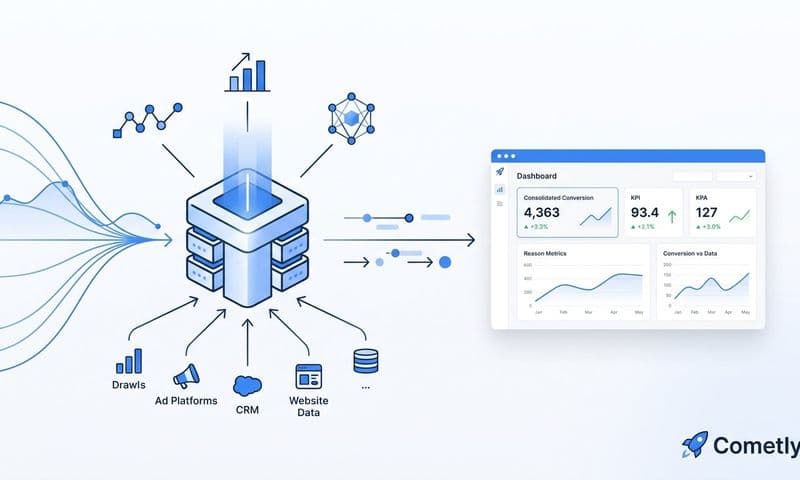
Marketing teams today generate massive amounts of data across dozens of touchpoints—ad platforms, CRMs, websites, email campaigns, and more. The challenge isn't collecting data; it's making sense of it all. Big data tools help you process, analyze, and act on this information at scale, turning raw numbers into revenue-driving insights.
This guide covers the best big data tools for marketers and analytics teams in 2026, from attribution platforms to data warehouses and visualization tools. Whether you need to track customer journeys, optimize ad spend, or build custom dashboards, you'll find the right solution here.
1. Cometly
Best for: Marketing attribution and AI-powered ad optimization across all channels
Cometly is a marketing attribution and analytics platform that tracks customer journeys across ad platforms, CRMs, and websites to show which channels drive revenue.
 11 Best Big Data Tools for Marketing Analytics in 2026
Where This Tool Shines
Cometly excels at solving the attribution puzzle that plagues modern marketing teams. While most analytics tools show surface-level metrics, Cometly connects every touchpoint to actual conversions and revenue, giving you a complete view of what's working.
The platform's AI-powered recommendations set it apart. Instead of just showing you data, Cometly analyzes performance patterns across all your campaigns and suggests specific optimizations to scale what's working and cut what's not.
Key Features
Multi-Touch Attribution: Track customer journeys across all marketing touchpoints to see the full path to conversion.
AI Ads Manager: Get AI-driven recommendations for budget allocation and campaign optimization across channels.
Server-Side Tracking: Bypass iOS limitations and browser restrictions with accurate server-side event tracking.
Conversion Sync: Feed enriched conversion data back to ad platforms to improve their algorithm performance.
Real-Time Analytics Dashboard: Monitor campaign performance and attribution data as it happens.
Best For
Digital marketers and agencies running paid campaigns across multiple platforms who need to understand true ROI and optimize ad spend with confidence. Especially valuable for teams struggling with iOS tracking limitations or managing complex customer journeys.
Pricing
Custom pricing based on ad spend volume. Contact their team for a quote tailored to your campaign scale.
2. Snowflake
Best for: Enterprise data warehousing with unlimited scalability and multi-cloud flexibility
Snowflake is a cloud data platform that provides data warehousing, data lakes, and data sharing capabilities with separation of storage and compute.
 11 Best Big Data Tools for Marketing Analytics in 2026
Where This Tool Shines
Snowflake revolutionized data warehousing by separating storage from compute. This means you can scale processing power up or down without moving data around, paying only for what you use. Marketing teams with fluctuating query demands benefit enormously from this flexibility.
The platform's data sharing capabilities are genuinely unique. You can share live datasets with partners, agencies, or internal teams without copying data or setting up complex pipelines. This makes collaboration seamless when you're working with external analytics partners.
Key Features
Separation of Storage and Compute: Scale resources independently and pay only for what you use.
Zero-Copy Data Sharing: Share live data with partners without duplicating datasets or managing access complexity.
Multi-Cloud Support: Deploy on AWS, Azure, or Google Cloud based on your infrastructure preferences.
Semi-Structured Data Support: Query JSON, Avro, and Parquet data alongside traditional tables without transformation.
Time Travel and Cloning: Access historical data states and create instant dataset copies for testing.
Best For
Enterprise marketing teams managing massive datasets across multiple sources who need flexible scaling and data sharing capabilities. Ideal when you're consolidating data from numerous marketing platforms and need to collaborate with agencies or partners.
Pricing
Usage-based pricing starting around $2 per credit. Storage costs separate at approximately $23 per TB per month. Most marketing teams spend $500-$5,000 monthly depending on query volume.
3. Google BigQuery
Best for: Serverless data warehousing with native Google marketing platform integrations
Google BigQuery is a serverless, highly scalable data warehouse with built-in machine learning and native integration with Google's marketing ecosystem.
 11 Best Big Data Tools for Marketing Analytics in 2026
Where This Tool Shines
BigQuery's serverless architecture means you never think about infrastructure. You write queries, and Google handles everything else—scaling, optimization, and resource allocation. For marketing teams without dedicated data engineers, this simplicity is transformative.
The native connectors to Google Ads and Google Analytics make it the obvious choice if you're heavily invested in Google's marketing stack. Data flows automatically without third-party ETL tools, and you can query billions of rows in seconds.
Key Features
Serverless Architecture: No infrastructure management required—query petabytes of data without provisioning servers.
Native Google Marketing Connectors: Direct integration with Google Ads and Google Analytics for seamless data flow.
BigQuery ML: Build and deploy machine learning models using SQL without moving data to separate tools.
Real-Time Analytics: Stream data in real-time and query it immediately for up-to-the-second insights.
Columnar Storage: Optimized storage format delivers fast query performance on analytical workloads.
Best For
Marketing teams using Google Ads and Google Analytics who want fast, serverless analytics without infrastructure overhead. Perfect for teams with SQL skills but limited data engineering resources.
Pricing
Free tier includes 1TB of queries and 10GB of storage monthly. Beyond that, $5 per TB queried and $0.02 per GB per month for storage. Most marketing teams spend $100-$1,000 monthly.
4. Apache Spark
Best for: Large-scale data processing and machine learning on massive marketing datasets
Apache Spark is an open-source unified analytics engine for large-scale data processing with built-in modules for SQL, streaming, and machine learning.
 11 Best Big Data Tools for Marketing Analytics in 2026
Where This Tool Shines
Spark's in-memory processing makes it significantly faster than traditional batch processing frameworks. When you're running complex transformations on millions of customer records or training machine learning models on historical campaign data, this speed advantage becomes critical.
If you're evaluating vendors, our AI ad maker breakdown can help.
The unified framework is Spark's secret weapon. You can handle batch processing, real-time streaming, SQL queries, and machine learning all within the same platform. This eliminates the complexity of stitching together multiple tools for different processing needs.
Key Features
In-Memory Processing: Process data in RAM for speeds up to 100x faster than disk-based alternatives.
Unified Batch and Streaming: Handle both historical analysis and real-time event processing with the same codebase.
MLlib Machine Learning Library: Build and deploy machine learning models at scale without moving data.
Spark SQL: Query data using familiar SQL syntax alongside advanced programming capabilities.
Flexible Deployment: Run on Hadoop, Kubernetes, cloud platforms, or standalone clusters.
Best For
Data teams processing massive marketing datasets who need both batch analytics and real-time streaming capabilities. Best suited for organizations with engineering resources to manage infrastructure and write code.
Pricing
Free as open-source software. Managed versions like Databricks or AWS EMR have usage-based pricing starting around $0.07-$0.30 per compute hour depending on instance size.
5. Tableau
Best for: Intuitive data visualization and interactive dashboards for marketing teams
Tableau is a visual analytics platform that transforms data into interactive dashboards and reports accessible to technical and non-technical users alike.
 11 Best Big Data Tools for Marketing Analytics in 2026
Where This Tool Shines
Tableau democratizes data analysis by making it genuinely accessible to non-technical marketers. The drag-and-drop interface lets anyone build sophisticated visualizations without writing code, turning raw data into compelling stories that drive decisions.
The platform's ability to connect to virtually any data source sets it apart. Whether your data lives in Snowflake, Google Sheets, Salesforce, or a marketing database, Tableau connects seamlessly and lets you blend sources for comprehensive analysis.
Key Features
Drag-and-Drop Visualization: Build complex charts and dashboards without coding using intuitive visual controls.
100+ Data Connectors: Connect to databases, cloud services, spreadsheets, and marketing platforms natively.
Tableau Prep: Clean and shape data visually before analysis without writing transformation scripts.
Mobile-Optimized Dashboards: Access and interact with dashboards on any device with responsive design.
Ask Data Natural Language: Query data using plain English questions without knowing SQL or formulas.
Best For
Marketing teams who need powerful visualization capabilities without requiring technical expertise. Ideal when you want to empower non-technical team members to explore data and build their own reports.
Pricing
Starts at $15 per user per month for Viewer (dashboard consumption only). Explorer at $42 per user per month. Creator at $75 per user per month for full authoring capabilities.
6. Databricks
Best for: Unified data engineering, data science, and analytics on a lakehouse architecture
Databricks is a unified data analytics platform combining data engineering, data science, and business analytics on a lakehouse architecture.
 11 Best Big Data Tools for Marketing Analytics in 2026
Where This Tool Shines
Databricks pioneered the lakehouse concept—combining the best of data lakes and data warehouses. This means you get the flexibility to store any data type at low cost while maintaining the performance and governance of a traditional warehouse. For marketing teams drowning in diverse data formats, this flexibility is invaluable.
We break down the leading options in our AI ad creator guide.
The collaborative notebooks transform how data teams work together. Data engineers, analysts, and marketers can work in the same environment, sharing code, queries, and insights in real-time. This breaks down silos that typically slow down analytics projects.
Key Features
Lakehouse Architecture: Combine data lake flexibility with data warehouse performance and governance.
Collaborative Notebooks: Work together in real-time with shared notebooks supporting SQL, Python, R, and Scala.
Delta Lake: Reliable data storage layer with ACID transactions and time travel capabilities.
MLflow Integration: Manage the complete machine learning lifecycle from experimentation to deployment.
Unity Catalog: Centralized governance and discovery across all data assets.
Best For
Organizations with both data engineering and data science needs who want a unified platform for the entire analytics workflow. Best when you're building advanced marketing models or processing complex multi-source datasets.
Pricing
Usage-based pricing starting around $0.07 per DBU (Databricks Unit) for jobs compute. All-purpose compute starts at $0.40 per DBU. Most marketing teams spend $1,000-$10,000 monthly depending on workload complexity.
7. Amazon Redshift
Best for: AWS-native data warehousing with deep integration into Amazon's ecosystem
Amazon Redshift is a fully managed cloud data warehouse that makes it simple to analyze data using standard SQL and existing BI tools within the AWS ecosystem.
 11 Best Big Data Tools for Marketing Analytics in 2026
Where This Tool Shines
Redshift's tight integration with AWS services makes it the natural choice if you're already invested in Amazon's cloud. Data flows seamlessly from S3, RDS, DynamoDB, and other AWS services without complex ETL pipelines or third-party connectors.
The serverless option removes infrastructure management entirely. You don't provision clusters or manage scaling—Redshift automatically adjusts capacity based on query demands. For marketing teams without dedicated database administrators, this simplicity is transformative.
Key Features
Columnar Storage: Optimized storage format delivers fast performance on analytical queries typical in marketing analysis.
Redshift Spectrum: Query data directly in S3 without loading it into the warehouse first.
Automatic Workload Management: Intelligent query prioritization ensures critical reports run fast during peak usage.
Native AWS Integration: Seamless connections to S3, Glue, Lambda, and other AWS services.
Serverless Option: Automatic scaling without cluster management or capacity planning.
Best For
Marketing teams already using AWS infrastructure who want a fully managed data warehouse with minimal operational overhead. Ideal when your data already lives in S3 or other AWS services.
Pricing
Provisioned clusters start at $0.25 per hour for dc2.large nodes. Serverless pricing from $0.375 per RPU-hour. Most marketing teams spend $500-$5,000 monthly depending on data volume and query frequency.
8. Looker
Best for: Semantic modeling layer ensuring consistent metrics across marketing teams
Looker is a business intelligence platform with a semantic modeling layer that ensures consistent metrics and definitions across marketing teams.
Where This Tool Shines
Looker's semantic modeling layer solves a problem most BI tools ignore: inconsistent metric definitions. With LookML, you define business logic once—how revenue is calculated, what constitutes a qualified lead, how attribution windows work—and everyone uses the same definitions. This eliminates the "why don't our numbers match" conversations that plague marketing teams.
The Git-based version control for analytics is genuinely innovative. You can track changes to metrics, roll back to previous definitions, and manage analytics code like software development. This brings discipline and accountability to business intelligence that other tools lack.
Key Features
LookML Modeling Language: Define metrics and business logic once in code for consistent definitions across all reports.
Embedded Analytics: Embed dashboards and reports directly into marketing tools and internal applications.
Git-Based Version Control: Track changes, collaborate on analytics code, and roll back to previous metric definitions.
Strong Data Governance: Centralized control over who can access what data and how metrics are calculated.
API-First Architecture: Programmatic access to all functionality for custom integrations and automation.
Best For
Enterprise marketing organizations where metric consistency and governance are critical. Best when you have multiple teams analyzing the same data and need to ensure everyone speaks the same analytical language.
Pricing
Custom pricing based on user count and features. Typically starts around $5,000 per month for small teams and scales based on organization size and requirements.
9. Segment
Best for: Customer data platform collecting and routing marketing data to analytics tools
Segment is a customer data platform that collects, cleans, and routes data from marketing touchpoints to analytics tools and data warehouses.
Where This Tool Shines
Segment eliminates the integration nightmare that comes with modern marketing stacks. Instead of implementing tracking code for every analytics tool separately, you implement Segment once and route data to hundreds of destinations. When you add a new tool, you flip a switch in Segment rather than deploying new tracking code.
The identity resolution capabilities are where Segment truly delivers value. It stitches together user behavior across devices and sessions, creating unified customer profiles even when people switch between mobile, desktop, and tablet. This cross-device view is essential for understanding modern customer journeys.
Key Features
Single API for Data Collection: Implement tracking once and route data to 400+ destinations without additional code.
400+ Pre-Built Integrations: Connect to analytics tools, marketing platforms, and data warehouses with configuration instead of custom code.
Real-Time Data Streaming: Events flow to destinations in real-time for immediate analysis and activation.
Identity Resolution: Stitch user behavior across devices and sessions into unified customer profiles.
Privacy Controls: Manage consent and data governance centrally across all connected tools.
Best For
Marketing teams using multiple analytics and marketing tools who want to centralize data collection and eliminate integration complexity. Ideal when you're frequently adding or changing tools in your stack.
Pricing
Free tier available for startups with up to 1,000 monthly tracked users. Team plan starts at $120 per month. Business tier with advanced features requires custom pricing based on data volume.
We compare the leading options in our free AI ad generator roundup.
10. Apache Kafka
Best for: Real-time event streaming for marketing data pipelines and applications
Apache Kafka is a distributed event streaming platform for building real-time data pipelines and streaming applications at scale.
Where This Tool Shines
Kafka excels at handling massive streams of real-time events—website clicks, ad impressions, email opens, purchase transactions—without breaking a sweat. When you need to process millions of events per second and make them available to downstream systems immediately, Kafka is the proven solution.
The durability and fault tolerance make it reliable for mission-critical marketing systems. Events are persisted to disk and replicated across multiple servers, so you never lose data even if servers fail. This reliability is essential when you're building systems that affect revenue.
Key Features
High-Throughput Event Streaming: Handle millions of events per second with low latency for real-time marketing systems.
Fault-Tolerant Architecture: Replicate data across multiple servers for reliability and zero data loss.
Kafka Streams: Build real-time stream processing applications directly on the event stream.
Kafka Connect: Pre-built connectors for databases, cloud storage, and SaaS applications.
Exactly-Once Semantics: Guarantee that events are processed exactly once, preventing duplicate actions or missed events.
Best For
Engineering teams building real-time marketing systems that need to process and react to events as they happen. Best when you're creating event-driven architectures or need to stream data between multiple systems in real-time.
Pricing
Free as open-source software. Managed options like Confluent Cloud start at $0.10 per GB ingested plus compute costs. Self-hosting requires infrastructure investment but eliminates platform fees.
11. Fivetran
Best for: Automated data replication from marketing platforms to data warehouses
Fivetran is an automated data movement platform with pre-built connectors that replicate data from marketing platforms to warehouses without engineering maintenance.
Where This Tool Shines
Fivetran removes the ongoing maintenance burden of data pipelines. When marketing platforms change their APIs or add new fields, Fivetran automatically adapts without requiring engineering intervention. This reliability means your data keeps flowing even when your team is focused on other priorities.
The pre-built data models transform raw API data into analytics-ready tables automatically. Instead of spending weeks understanding how Facebook Ads structures their data, you get clean, normalized tables ready for analysis immediately after connection.
Key Features
300+ Pre-Built Connectors: Connect to major marketing platforms, databases, and SaaS tools without custom development.
Automatic Schema Migrations: Adapt to source system changes automatically without manual intervention or broken pipelines.
Incremental Data Syncs: Replicate only new and changed data for efficiency and cost control.
Pre-Built Data Models: Transform raw API data into analytics-ready tables automatically.
SOC 2 Type II Certified: Enterprise-grade security and compliance for sensitive marketing data.
Best For
Marketing teams who want reliable data replication without dedicating engineering resources to pipeline maintenance. Perfect when you need data from multiple marketing platforms centralized in a warehouse for analysis.
Pricing
Free tier available for limited connectors and data volume. Paid plans start at $1 per MAR (Monthly Active Row). Most marketing teams spend $500-$3,000 monthly depending on data volume and number of connectors.
Building Your Big Data Stack
The right combination of tools depends on your specific needs and existing infrastructure. For marketing attribution and ad optimization, Cometly provides the specialized capabilities you need to understand what's driving revenue and optimize accordingly.
For enterprise data warehousing, choose Snowflake if you want maximum flexibility and data sharing capabilities, or BigQuery if you're heavily invested in Google's marketing ecosystem. Redshift makes sense when you're already using AWS services extensively.
Visualization needs? Tableau remains the gold standard for user-friendly, powerful dashboards. Looker offers stronger governance if metric consistency across teams is critical.
Building real-time marketing systems requires event streaming. Combine Kafka for data movement with Spark for processing when you need to react to customer behavior in real-time.
For most marketing teams, the winning stack follows a clear pattern: a data warehouse (Snowflake or BigQuery) for centralized storage, an attribution tool (Cometly) for marketing-specific insights, a data integration platform (Fivetran or Segment) to move data efficiently, and a visualization layer (Tableau or Looker) for analysis.
Start with your biggest pain point. If you can't track attribution accurately, begin with Cometly. If data is scattered across platforms, start with a warehouse and integration tool. If insights aren't reaching decision-makers, prioritize visualization.
The tools covered here represent the current state of big data for marketing in 2026. They're mature, proven, and actively maintained. Choose based on your team's skills, existing infrastructure, and specific analytical needs rather than chasing the newest technology.
Ready to elevate your marketing game with precision and confidence? Discover how Cometly's AI-driven recommendations can transform your ad strategy—Get your free demo today and start capturing every touchpoint to maximize your conversions.