Marketing dashboards are everywhere. You've probably built a few yourself—connecting data sources, setting up widgets, tracking KPIs. Databox has been a go-to solution for thousands of teams who want their metrics in one place. It does what it promises: consolidates data from dozens of platforms into clean, trackable dashboards.
But here's the thing. As your marketing operation matures, you start asking different questions. Not just "What are my numbers?" but "Which ads actually drive revenue?" Not "What's my traffic?" but "Where should I shift budget to maximize ROI?" Databox excels at showing you what happened. It's less equipped to tell you why it happened or what to do next.
That gap becomes critical when you're managing significant ad spend across multiple platforms, dealing with attribution challenges from iOS privacy changes, or trying to feed better conversion data back to ad algorithms. You need tools that go beyond dashboard consolidation to actual revenue intelligence.
This guide breaks down seven Databox alternatives built for different needs: attribution platforms that connect ads to revenue, free visualization tools for budget-conscious teams, agency-specific reporting solutions, data pipeline systems for technical teams, and ecommerce-focused analytics. Each serves a distinct purpose. Your job is matching the right tool to your specific analytics gap.
1. Cometly: Marketing Attribution with AI-Powered Ad Optimization
What Makes It Different
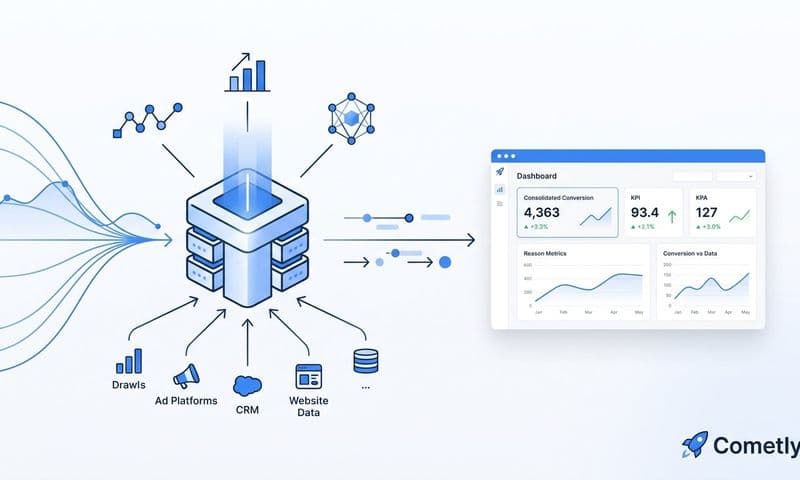
Cometly isn't trying to replace your dashboard. It's solving the attribution problem that dashboards can't fix: connecting every ad click, form fill, and sales call to actual revenue. While Databox shows you aggregated metrics from your ad platforms, Cometly tracks individual customer journeys from first touch to closed deal.
 7 Best ChartMogul Alternatives for Smarter Revenue Analytics in 2026
The platform uses server-side tracking to capture data that browser-based tools miss—especially critical after iOS privacy updates degraded pixel accuracy. It then feeds enriched conversion data back to Meta, Google, and other ad platforms through Conversion Sync, improving their AI targeting and optimization.
For marketing teams managing multi-channel campaigns, this creates a fundamentally different workflow. Instead of looking at siloed platform reports and guessing which channels deserve more budget, you see unified attribution showing exactly which touchpoints contribute to revenue.
Core Capabilities
Multi-Touch Attribution: Track the complete customer journey across all marketing touchpoints. See which ads, emails, and content pieces influenced each conversion, not just the last click.
AI Ads Manager: Get optimization recommendations based on actual revenue data. The AI identifies high-performing campaigns across channels and suggests budget reallocation to maximize ROI.
Server-Side Tracking: Capture accurate conversion data even when browser pixels fail. This addresses the tracking gaps created by iOS privacy changes and ad blockers.
Conversion Sync: Send enriched event data back to ad platforms. When Meta and Google receive better conversion signals, their algorithms optimize more effectively for your actual business outcomes.
AI Chat for Analysis: Ask questions about your marketing data in natural language. Instead of building custom reports, query your attribution data conversationally to find insights faster.
Best For
Marketing teams and agencies running paid advertising across multiple platforms who need to prove ROI and optimize budget allocation based on revenue, not vanity metrics. Especially valuable if you're dealing with long sales cycles, multiple touchpoints, or significant iOS traffic that's degraded your pixel accuracy.
Ecommerce brands, SaaS companies, and lead generation businesses see the clearest value because they can connect ad spend directly to revenue outcomes. If you're currently making budget decisions based on platform-reported ROAS that doesn't match your actual revenue, Cometly addresses that disconnect.
Implementation Approach
Connect your ad platforms, CRM, and website tracking. Cometly integrates with major ad networks, analytics platforms, and sales systems to build a unified view of customer journeys.
Set up server-side tracking to capture accurate conversion data. This typically involves installing tracking code and configuring event parameters to match your conversion goals.
Configure your attribution models. Compare first-touch, last-touch, linear, and time-decay models to understand how different approaches change your channel valuation.
Enable Conversion Sync for your ad platforms. This feeds enriched conversion data back to Meta, Google, and other networks so their algorithms optimize for your actual business outcomes.
Use AI recommendations to identify optimization opportunities. Review suggested budget shifts and scaling opportunities based on actual revenue performance.
2. Google Looker Studio: Free Visualization for Google-Centric Teams
The Budget-Conscious Option
Looker Studio remains the most compelling free alternative to paid dashboard tools. If your marketing stack centers on Google products—Analytics, Ads, Search Console—and you need custom reporting without monthly fees, it's hard to beat.
We compare the leading options in our marketing dashboard software alternatives roundup.
The platform lets you build unlimited dashboards with complete design control. You can connect data sources, create calculated fields, build custom visualizations, and share reports with stakeholders. For small teams or agencies managing multiple clients, the zero-cost model is significant.
The tradeoff is manual setup and limited non-Google integrations. You'll build each report from scratch, and connecting data from platforms outside Google's ecosystem requires either third-party connectors or workarounds. It's powerful for what it does, but it demands time investment.
Core Capabilities
Unlimited Free Dashboards: Create as many reports as you need without usage limits or subscription costs. Share them with unlimited users.
Native Google Integration: Connect Google Analytics, Google Ads, Search Console, YouTube, and other Google services directly without authentication hassles.
Custom Calculations: Build calculated fields and metrics using formulas. Create custom KPIs that combine data from multiple sources.
Blended Data Sources: Combine data from different platforms in single visualizations. Compare Google Ads performance against organic search traffic in unified charts.
Collaborative Editing: Multiple team members can edit reports simultaneously. Version history lets you revert changes if needed.
Best For
Small marketing teams, startups, and agencies with limited budgets who primarily use Google marketing tools. Also valuable for organizations that need client-facing reports but can't justify dashboard software costs.
If you're evaluating vendors, our marketing dashboard software comparison breakdown can help.
Works especially well if you're comfortable with data connections and report building. The learning curve isn't steep, but you'll need someone who can structure data sources and design effective visualizations.
Limitations to Consider
Third-party integrations require paid connector services like Supermetrics or manual data imports. If you need Facebook Ads, LinkedIn, or CRM data alongside Google metrics, you'll either pay for connectors or export data manually.
No automated insights or recommendations. Looker Studio shows you data beautifully, but it won't tell you what to do with it. You're responsible for analysis and interpretation.
Performance can lag with complex reports or large datasets. Dashboards with many data sources and heavy calculations may load slowly, especially for viewers with slower connections.
3. Klipfolio: Real-Time KPI Monitoring with PowerMetrics
The Real-Time Focus
Klipfolio positions itself around instant KPI visibility. The platform refreshes metrics in real time, making it valuable for teams that need to monitor performance actively rather than review historical reports. Think operations teams watching conversion rates, sales managers tracking daily pipeline, or customer success monitoring churn signals.
The company offers two products: Klipfolio Classic for custom dashboard building, and PowerMetrics for pre-built metric tracking. PowerMetrics takes a different approach than traditional dashboards—instead of building visualizations, you define metrics and let the platform handle presentation.
This metric-first philosophy works well for teams that want standardized KPI tracking without design work. You connect data sources, define calculations, set goals, and PowerMetrics creates the tracking interface automatically.
Core Capabilities
PowerMetrics for Instant Setup: Pre-built metrics library for common KPIs. Connect a data source and start tracking without building custom dashboards.
Real-Time Data Refresh: Metrics update continuously as source data changes. Monitor performance without manual refreshes or scheduled updates.
Goal Tracking: Set targets for each metric and track progress visually. Get alerts when metrics cross thresholds or deviate from expected ranges.
Extensive Integration Library: Connect to hundreds of data sources through native integrations and REST API support. Build custom connections when needed.
Collaborative Metric Management: Multiple team members can define, track, and discuss metrics in shared workspaces. Comment on specific data points and share insights.
Best For
Operations-focused teams that prioritize real-time monitoring over historical analysis. Works especially well for organizations with clearly defined KPIs that need constant visibility rather than deep analytical exploration.
SaaS companies tracking product metrics, agencies monitoring client performance, and sales teams watching pipeline metrics find value in the real-time approach. Less suitable if you need complex attribution or cross-channel journey analysis.
Pricing Consideration
PowerMetrics offers a free tier with limited metrics and users, then scales based on metric volume and team size. Klipfolio Classic uses separate pricing for custom dashboard needs. Evaluate both products to determine which fits your use case—they serve different purposes despite coming from the same company.
4. Whatagraph: Automated Agency Reporting with White-Label Options
Built for Client Reporting
Whatagraph targets a specific pain point: agencies spending hours each month compiling client reports. The platform automates cross-channel data collection and formats it into presentation-ready reports that you can white-label with your agency branding.
Instead of manually pulling data from Google Ads, Facebook, Instagram, LinkedIn, and analytics platforms, then formatting it in slides or documents, Whatagraph connects all sources and generates reports automatically. You set up the template once, and it updates with fresh data on your schedule.
For agencies managing multiple clients, this time savings compounds quickly. A report that took three hours to compile manually becomes a five-minute review and send. The platform also maintains historical data, making month-over-month and year-over-year comparisons automatic.
Core Capabilities
Cross-Channel Data Integration: Connect all major marketing platforms—social media, advertising, analytics, SEO tools—in one interface. Data syncs automatically without manual exports.
Automated Report Generation: Create report templates that populate with current data. Schedule delivery to clients weekly, monthly, or on custom intervals.
White-Label Branding: Add your agency logo, colors, and branding to all reports. Clients see your brand, not Whatagraph's.
Custom Metrics and Calculations: Build calculated fields combining data from multiple sources. Create agency-specific KPIs that match your reporting methodology.
Client Portal Access: Give clients login credentials to view their dashboards directly. They see live data without waiting for scheduled reports.
Best For
Marketing agencies and consultants managing multiple client accounts who spend significant time on manual reporting. The value proposition is straightforward: trade software cost for time savings and professional presentation.
Works especially well for agencies with standardized reporting frameworks. If you deliver similar reports to most clients with minor variations, template-based automation provides maximum efficiency.
Agency-Specific Advantages
Client management features include user permissions, multiple workspace organization, and report approval workflows. You can separate client data completely, assign team members to specific accounts, and maintain audit trails of report changes.
The platform also offers performance benchmarking across your client portfolio. See which accounts perform above or below average for specific metrics, helping you identify optimization opportunities and best practices to replicate.
5. Supermetrics: Data Pipeline for BI Tools and Warehouses
The Integration Layer
Supermetrics solves a different problem than visualization tools. It's not a dashboard—it's the data pipeline that feeds dashboards, spreadsheets, and data warehouses. Think of it as the extraction layer that gets marketing data from APIs into the tools where you actually work.
For a deeper dive into this space, see our marketing dashboard software guide.
The platform connects to major marketing and advertising platforms, then pushes that data to destinations like Google Sheets, Excel, Looker Studio, Tableau, Power BI, BigQuery, Snowflake, and others. You define what data you need, set a refresh schedule, and Supermetrics handles the extraction.
This approach works well for organizations with existing BI infrastructure or teams that prefer working in spreadsheets. Instead of paying for another dashboard tool, you enhance the tools you already use with automated marketing data feeds.
Core Capabilities
Extensive Source Connectors: Extract data from major advertising platforms, social networks, analytics tools, and marketing automation systems. New connectors added regularly.
Flexible Destination Options: Send data to spreadsheets, visualization tools, or data warehouses. Use the same connector across multiple destinations.
Automated Refresh Scheduling: Set data to update hourly, daily, or on custom schedules. Maintain fresh data without manual exports.
Custom Field Selection: Choose exactly which metrics and dimensions to extract. Avoid pulling unnecessary data that clutters your reports.
Historical Data Backfills: Import historical data when setting up new connections. Build trend reports without losing past performance context.
Best For
Data-savvy marketing teams and analysts who work primarily in spreadsheets or existing BI platforms. Also valuable for organizations with data warehouses that want marketing data integrated alongside other business data sources.
Technical teams appreciate the API-level access and data warehouse integration. Marketing teams benefit from spreadsheet connectivity that lets them analyze data in familiar environments without learning new tools.
Implementation Approach
Identify your primary work environment—spreadsheets, BI tool, or data warehouse. Supermetrics offers different products for each destination, so choose the version that matches where you'll analyze data.
Connect your marketing data sources and configure which metrics to extract. Start with core platforms, then expand to additional sources as you refine your reporting needs.
Set up refresh schedules that balance data freshness with API rate limits. More frequent updates consume more API calls, which may affect pricing on higher tiers.
Build your analysis layer on top of the data Supermetrics delivers. The platform handles extraction; you handle visualization, calculation, and interpretation in your chosen tool.
6. AgencyAnalytics: All-in-One Platform for Agency Workflows
Beyond Reporting
AgencyAnalytics bundles marketing reporting with SEO tools, rank tracking, and client management features. Instead of subscribing to separate tools for reporting, keyword tracking, site audits, and client communication, you get integrated functionality in one platform.
This consolidation appeals to agencies tired of juggling multiple subscriptions and training staff on different interfaces. The tradeoff is depth—specialized tools often provide more advanced features in their specific domains, but AgencyAnalytics covers the core needs most agencies have for most clients.
The platform emphasizes ease of use over customization. You won't build complex calculated metrics or custom data transformations, but you'll get client reports running quickly with minimal configuration.
Core Capabilities
Integrated SEO Tools: Built-in rank tracking, site audits, backlink monitoring, and keyword research. No need for separate SEO subscriptions for basic needs.
White-Label Client Dashboards: Automated reporting with your agency branding. Clients log in to see their metrics without seeing the AgencyAnalytics platform.
Campaign Management: Track PPC campaigns across Google Ads, Facebook, and other platforms. See spend, performance, and conversions in unified views.
Client Communication Tools: Built-in annotation features, report comments, and goal tracking. Communicate directly within the platform instead of external email threads.
Staff Account Management: Assign team members to specific clients with granular permissions. Control who sees which data and who can make changes.
Best For
Small to mid-size agencies managing 10-50 clients who want operational simplicity over advanced features. The all-in-one approach reduces tool sprawl and simplifies team training.
Agencies focused on SEO and PPC services find the most value since those capabilities are built in. If you primarily offer social media management or content marketing, you'll still need additional specialized tools.
Pricing Structure
AgencyAnalytics charges per client campaign rather than per user, which benefits agencies with multiple team members working across accounts. Evaluate total cost based on your client count and compare against buying separate tools for reporting, SEO, and rank tracking.
7. Triple Whale: Ecommerce Attribution for Shopify Stores
Built for DTC Brands
Triple Whale focuses exclusively on ecommerce attribution, with deep Shopify integration and features designed for direct-to-consumer brands. If you're running a Shopify store with significant ad spend across Meta, Google, TikTok, and other platforms, it addresses the attribution challenges specific to ecommerce operations.
The platform connects to your Shopify store, ad accounts, and analytics to track customer journeys from ad click through purchase. It then attributes revenue to specific ads, creatives, and campaigns—helping you understand which content drives actual sales, not just clicks or add-to-carts.
Creative analytics is a standout feature. Triple Whale tracks performance at the individual ad creative level, showing you which images, videos, and copy variations generate the best return. This granularity helps creative teams and media buyers collaborate more effectively.
Core Capabilities
Shopify-Native Tracking: Direct integration with Shopify's data model. Track revenue, orders, and customer behavior without complex setup.
Multi-Touch Attribution: See the complete path to purchase across all touchpoints. Understand which channels work together to drive conversions.
Creative Analytics: Track performance by individual ad creative. Identify which images, videos, and copy variants deliver the best ROAS.
Incrementality Testing: Run holdout tests to measure true incremental impact of your advertising. Separate correlation from causation.
Cohort Analysis: Track customer lifetime value by acquisition source and cohort. Make budget decisions based on long-term value, not just first-purchase ROAS.
Best For
Shopify and Shopify Plus stores spending significant money on paid advertising who need better attribution than native platform reporting provides. Especially valuable for brands with multiple products, complex customer journeys, or high customer lifetime values where first-purchase ROAS doesn't tell the full story.
DTC brands that invest heavily in creative production benefit from the creative-level tracking. Understanding which content resonates lets you double down on winning formats and kill underperformers faster.
Platform Limitations
Triple Whale is purpose-built for ecommerce, specifically Shopify. If you run lead generation, SaaS, or service businesses, the platform isn't designed for your use case. Similarly, if you use other ecommerce platforms like WooCommerce or BigCommerce, integration is limited or unavailable.
The platform also focuses on paid advertising attribution rather than comprehensive marketing analytics. You'll get deep insights into ad performance but less capability for email marketing analysis, content performance, or organic channel attribution.
Choosing Your Databox Alternative: A Decision Framework
The right analytics platform depends on what question you're trying to answer. Databox consolidates metrics effectively, but these alternatives solve more specific problems.
If your core challenge is attribution—connecting ad spend to actual revenue and optimizing budget across channels—Cometly addresses what dashboard tools can't. Server-side tracking, multi-touch attribution, and AI-powered recommendations help you make better spending decisions, not just track what you already spent.
For budget-conscious teams working primarily in Google's ecosystem, Looker Studio delivers free visualization with unlimited dashboards. You'll invest time instead of money, but the result is professional reporting without subscription costs.
Agencies managing multiple clients should evaluate Whatagraph for automated reporting or AgencyAnalytics for bundled SEO and reporting capabilities. The choice depends on whether you prioritize reporting automation or tool consolidation.
Data-savvy teams with existing BI infrastructure benefit from Supermetrics' pipeline approach. Extract marketing data into the tools you already use rather than adopting another platform.
Shopify stores with significant ad spend find purpose-built value in Triple Whale's ecommerce attribution and creative analytics. The platform speaks the language of DTC operations.
The common thread across successful implementations: match the tool to your specific analytics gap. Don't choose based on feature lists or vendor marketing. Identify what decision you can't make confidently with current data, then select the platform that fills that specific gap.
Most mature marketing operations use multiple tools for different purposes. Attribution platforms for revenue tracking, visualization tools for stakeholder reporting, data warehouses for historical analysis. The goal isn't finding one tool that does everything—it's building a stack where each component solves a distinct problem well.
Ready to elevate your marketing game with precision and confidence? Discover how Cometly's AI-driven recommendations can transform your ad strategy—Get your free demo today and start capturing every touchpoint to maximize your conversions.