Small businesses face a unique analytics challenge: limited budgets, lean teams, and the pressure to make every marketing dollar count. Unlike enterprise companies with dedicated data teams, small business owners often wear multiple hats—making it critical to focus on analytics strategies that deliver actionable insights without overwhelming complexity.
This guide cuts through the noise to deliver seven proven marketing analytics strategies specifically designed for small business realities. Whether you're running your first paid ad campaign or looking to optimize an existing multi-channel approach, these strategies will help you understand what's actually driving revenue, eliminate wasted ad spend, and scale your marketing with confidence.
The goal isn't to track everything—it's to track what matters most for growth.
1. Start With Revenue-Focused Attribution (Not Vanity Metrics)
The Challenge It Solves
Many small businesses fall into the vanity metrics trap—celebrating high click-through rates, growing impressions, and increasing website traffic while struggling to understand which marketing activities actually generate revenue. When you're operating on a tight budget, tracking metrics that don't connect to sales is like celebrating how many people walked past your store without knowing who actually bought something.
This disconnect between activity metrics and business outcomes leads to misallocated budgets and missed growth opportunities.
The Strategy Explained
Revenue-focused attribution means setting up your analytics to track the direct connection between marketing touchpoints and actual sales or qualified leads. Instead of stopping at surface-level engagement metrics, you're following the data all the way through to revenue generation.
This approach requires proper tracking setup that connects your marketing platforms to your actual conversion events—whether that's completed purchases, signed contracts, or qualified leads that convert to customers. The key is ensuring every dollar spent on marketing can be traced to a specific revenue outcome.
For small businesses, this often means integrating your CRM with your marketing analytics platform so you can see not just which ads got clicks, but which ads led to customers who actually paid.
Implementation Steps
1. Define what counts as a valuable conversion for your business—completed purchases, qualified leads, demo bookings, or subscription sign-ups that historically convert to paying customers.
2. Set up server-side tracking that captures conversion events from your CRM or payment system, not just website actions, ensuring you're measuring actual revenue events rather than proxy metrics.
3. Connect your ad platforms to your conversion tracking system so you can attribute revenue back to specific campaigns, ad sets, and individual ads across all channels.
4. Create a simple dashboard that shows revenue per channel, cost per acquisition based on actual customers (not just leads), and return on ad spend calculated from real revenue data.
Pro Tips
Start by tracking just one clear revenue metric before expanding to others. If you sell products, track completed purchases. If you're B2B, track closed deals or qualified opportunities. Avoid the temptation to create complex scoring systems before you've mastered basic revenue attribution. The businesses that win with analytics start simple and add complexity only when needed.
2. Consolidate Your Data Sources Into a Single Dashboard
The Challenge It Solves
Picture this: You start your morning checking Meta Ads Manager, then switch to Google Ads, jump over to your email marketing platform, review Google Analytics, and finally check your CRM—all before you've had your second coffee. This platform-hopping wastes time and makes it nearly impossible to understand how your marketing channels work together.
When your data lives in silos, you can't see the complete picture of what's driving growth. You might think Facebook is your best channel because it shows great engagement metrics, while missing that Google Ads actually drives more qualified leads who convert to customers.
The Strategy Explained
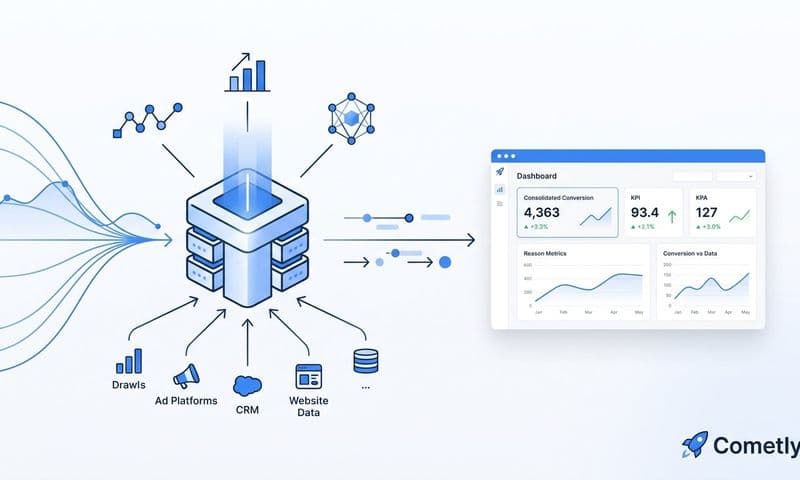
Data consolidation means bringing all your marketing metrics into one unified dashboard where you can compare performance across channels using consistent metrics. Instead of logging into five different platforms with five different reporting interfaces, you access a single view that shows how every marketing dollar is performing.
This doesn't mean abandoning your individual platforms—you'll still use Meta Ads Manager to create ads and Google Analytics for website insights. But for daily decision-making and performance analysis, you work from one consolidated dashboard that pulls data from all sources.
The real power comes from seeing relationships between channels. You might discover that customers who see both a Facebook ad and a Google search ad convert at three times the rate of those who only see one or the other.
Implementation Steps
1. List every marketing platform you currently use—ad platforms, email marketing, social media, analytics tools, and your CRM—to understand the full scope of data sources you need to connect.
2. Choose a marketing attribution platform that integrates with your existing tools and provides a unified dashboard view, prioritizing platforms that offer pre-built integrations rather than requiring custom development.
3. Connect your data sources to your chosen platform, starting with your highest-spend channels first, and verify that conversion data is flowing correctly before adding additional integrations.
4. Create a primary dashboard view that shows your most important metrics across all channels—typically revenue by source, cost per acquisition, return on ad spend, and conversion rates.
Pro Tips
Don't try to consolidate everything at once. Start with your two or three highest-spend channels and get comfortable with unified reporting before adding more complexity. Many small businesses find that consolidating just their paid advertising data—Meta, Google, and maybe LinkedIn—delivers 80% of the value with 20% of the setup effort.
3. Track the Full Customer Journey (Not Just the Last Click)
The Challenge It Solves
Most default analytics setups only give credit to the last thing a customer clicked before converting. This creates a distorted view of your marketing performance where bottom-funnel tactics look amazing while the awareness and consideration activities that actually started the journey get zero credit.
Think about your own buying behavior. You probably saw multiple ads, visited the website several times, read reviews, and researched alternatives before making a purchase. But in last-click attribution, only that final Google search gets credit—completely ignoring the Facebook ad that introduced you to the brand three weeks earlier.
The Strategy Explained
Full customer journey tracking means capturing every marketing touchpoint from first exposure to final purchase, creating a complete timeline of how customers discover, evaluate, and ultimately choose your business. This requires moving beyond browser-based tracking to server-side methods that can follow customers across devices and sessions.
Server-side tracking sends conversion data directly from your server to your analytics platform, bypassing browser limitations like cookie blocking, ad blockers, and iOS tracking restrictions. This means you capture a more complete picture of the customer journey even as privacy-focused browsers become more common.
For small businesses, this visibility is transformative. You might discover that customers typically need three to five touchpoints before converting, or that your email nurture sequence plays a critical role in closing sales that started with paid ads.
Implementation Steps
1. Implement server-side tracking using your marketing attribution platform's server-side integration, which sends conversion events directly from your server rather than relying on browser pixels that can be blocked.
2. Set up unique tracking parameters for each marketing channel and campaign so you can identify the source of every touchpoint in the customer journey, using UTM parameters consistently across all campaigns.
3. Configure your tracking to capture key journey milestones beyond just conversions—first website visit, content downloads, email opens, product page views, and cart additions—to understand the complete path to purchase.
4. Review journey reports weekly to identify common patterns in how customers discover and evaluate your business, looking for opportunities to optimize the journey by adding or improving touchpoints.
Pro Tips
Start by mapping the journey for your best customers—those who spend the most or have the highest lifetime value. Understanding how your most valuable customers found you will reveal which marketing touchpoints deserve more investment. Many small businesses discover that their highest-value customers have longer, more complex journeys than average customers, which completely changes budget allocation priorities.
4. Use AI-Powered Insights to Identify Winning Campaigns Faster
The Challenge It Solves
Analyzing marketing data manually is time-consuming and requires expertise that most small business owners simply don't have. You might spend hours comparing campaign performance, trying to spot patterns, and wondering whether the differences you're seeing are statistically significant or just normal fluctuations.
Meanwhile, opportunities to scale winning campaigns or cut underperforming spend slip by because you didn't catch the signals quickly enough. By the time you've manually analyzed last week's data, market conditions have already changed.
The Strategy Explained
AI-powered analytics tools analyze your marketing data continuously, identifying patterns and anomalies that would take hours to spot manually. These tools surface actionable recommendations—like which campaigns are trending upward and deserve more budget, or which audience segments are converting at unexpectedly high rates.
The key advantage for small businesses is that AI democratizes data analysis. You don't need a data science background to benefit from sophisticated pattern recognition and predictive insights. The AI does the heavy lifting of analyzing thousands of data points and presents you with clear, prioritized recommendations.
Modern AI tools can identify winning combinations of ad creative, audience targeting, and budget allocation across multiple channels simultaneously—something that would be nearly impossible to analyze manually with limited time and resources.
Implementation Steps
1. Choose a marketing analytics platform with built-in AI recommendations rather than just data visualization, prioritizing tools that provide specific action items rather than general insights.
2. Connect all your marketing data sources to the AI platform so it has complete visibility into performance across channels, ensuring the AI can spot cross-channel patterns and optimization opportunities.
3. Set up automated alerts for significant performance changes—campaigns that suddenly improve or decline beyond normal variation—so you can act quickly on AI-identified opportunities or problems.
4. Review AI recommendations at least twice per week, implementing the highest-priority suggestions first and tracking the results to build confidence in the AI's guidance over time.
Pro Tips
Don't blindly follow every AI recommendation at first. Start by implementing suggestions for your smallest campaigns to test the AI's accuracy before making major budget shifts. As you verify that the AI's recommendations improve performance, you can confidently scale up its influence on your decision-making. The goal is to augment your marketing judgment with AI insights, not replace your business knowledge entirely.
5. Feed Better Conversion Data Back to Ad Platforms
The Challenge It Solves
Ad platforms like Meta and Google use machine learning to optimize your campaigns, but their algorithms are only as good as the data they receive. When browser-based tracking misses conversions due to cookie blocking or iOS restrictions, these platforms operate with incomplete information—like trying to navigate with a map that's missing half the roads.
This incomplete data means ad platforms can't accurately identify which audience segments, placements, and creative variations actually drive conversions. They end up optimizing toward the wrong signals, wasting your budget on strategies that don't actually work.
The Strategy Explained
Conversion sync feeds enriched, server-side conversion data back to your ad platforms through their Conversions API or similar server-side integration methods. Instead of relying on browser pixels that might be blocked, you send conversion events directly from your server to the ad platform.
This server-side approach captures significantly more conversions than browser-based tracking alone, giving ad platforms a more complete picture of what's working. When Meta or Google can see that a particular audience segment converts at twice the rate of others, their algorithms can automatically shift budget toward that segment.
The enriched data also includes additional context about conversions—like customer lifetime value, purchase categories, or lead quality scores—that helps ad platforms optimize toward your most valuable outcomes rather than just conversion volume.
Implementation Steps
1. Implement Meta's Conversions API and Google's Enhanced Conversions to send server-side conversion data that bypasses browser-based tracking limitations and captures more complete conversion information.
2. Configure your conversion events to include additional parameters beyond basic conversion confirmation—like purchase value, product categories, or lead quality indicators—to help ad platforms optimize toward your most valuable outcomes.
3. Set up event matching to deduplicate conversions captured by both browser pixels and server-side tracking, ensuring you don't accidentally report the same conversion twice and skew your data.
4. Monitor the match quality scores provided by ad platforms to verify that your server-side events are being properly attributed to the correct users, adjusting your implementation if match rates fall below recommended thresholds.
Pro Tips
Start with your highest-value conversion events first—completed purchases or closed deals—before adding every possible micro-conversion. Ad platforms perform best when optimizing toward clear, valuable outcomes rather than a complex mix of signals. Once you've verified that server-side tracking improves performance for your primary conversions, you can add additional events to further refine the algorithm's optimization.
6. Establish Weekly Analytics Routines That Take 30 Minutes or Less
The Challenge It Solves
Many small business owners approach analytics reactively—diving into data only when something seems wrong or when they need to make a major decision. This reactive approach means you miss gradual performance shifts until they've already significantly impacted your business.
On the flip side, some business owners fall into the trap of obsessive daily monitoring, making impulsive changes based on normal day-to-day fluctuations rather than meaningful trends. This leads to constant campaign tweaking that prevents strategies from reaching their full potential.
The Strategy Explained
A weekly analytics routine creates a sustainable middle ground—frequent enough to catch important trends early, but not so frequent that you're reacting to noise. The key is focusing on just five core metrics that actually drive business decisions, rather than trying to review every available data point.
This routine should take 30 minutes or less, making it realistic to maintain even during your busiest weeks. The consistency matters more than the depth—a quick weekly check that actually happens beats a comprehensive monthly review that keeps getting postponed.
Automated reporting handles the heavy lifting, delivering your key metrics in a standardized format every week. You're not building reports from scratch each time—you're reviewing a consistent dashboard and looking for meaningful changes from the previous week.
Implementation Steps
1. Choose five key metrics that directly impact business decisions—typically revenue by channel, cost per acquisition, return on ad spend, conversion rate, and customer acquisition cost—and ignore secondary metrics during your routine review.
2. Set up automated weekly reports that arrive at the same time each week, ideally Monday morning, so you can review performance and plan the week's marketing activities with fresh data.
3. Create a simple decision framework: if any metric changes by more than 20% from the previous week, investigate the cause; if changes are smaller, note them but don't take immediate action unless you see a consistent trend over multiple weeks.
4. Block 30 minutes on your calendar every Monday morning specifically for analytics review, treating it as an unmissable appointment rather than a task that gets pushed aside when things get busy.
Pro Tips
Keep a simple log of the marketing changes you make each week—new campaigns launched, budget adjustments, audience tests. When you review your analytics the following week, you'll be able to connect performance changes to specific actions rather than wondering what caused the shift. This creates a feedback loop that steadily improves your marketing instincts over time.
7. Compare Attribution Models to Find Your True ROI
The Challenge It Solves
Different attribution models tell dramatically different stories about which marketing channels deserve credit for conversions. Last-click attribution makes bottom-funnel tactics look amazing while ignoring everything that happened earlier. First-click attribution does the opposite, giving all credit to awareness activities while ignoring the nurture and conversion work.
When you rely on just one attribution model, you're making budget decisions based on an incomplete perspective. You might be dramatically under-investing in channels that play crucial supporting roles, or over-investing in channels that get credit for conversions they didn't actually influence.
The Strategy Explained
Attribution model comparison means running multiple models side-by-side to understand how different perspectives change the perceived value of each marketing channel. By viewing your data through last-click, first-click, linear, and time-decay lenses simultaneously, you develop a nuanced understanding of how each channel contributes to the customer journey.
This comparative approach reveals which channels are true revenue drivers versus which ones simply happen to be present at the moment of conversion. You might discover that your email marketing looks mediocre in last-click attribution but plays a critical role in linear attribution, indicating it's an important nurture channel that deserves continued investment.
For small businesses with multi-channel strategies, this visibility prevents the common mistake of cutting channels that appear underperforming in last-click attribution but actually play essential roles in the broader customer journey.
Implementation Steps
1. Set up at least three attribution models in your analytics platform—last-click, first-click, and linear or time-decay—to see how different credit allocation methods change the perceived performance of each channel.
2. Run a side-by-side comparison for your last full month of data, creating a simple spreadsheet that shows how much revenue each channel receives credit for under each attribution model.
3. Calculate the variance between models for each channel—if Facebook gets 30% credit in last-click but 45% in linear attribution, that 15-point difference suggests it plays a strong supporting role in multi-touch journeys.
4. Use the insights from model comparison to adjust budget allocation, typically increasing investment in channels that show strong performance in first-click or linear models even if they look weak in last-click attribution.
Pro Tips
Don't expect one attribution model to be "correct" while others are "wrong." Each model reveals a different truth about your marketing. The goal is to use multiple perspectives to make more informed decisions rather than finding the single perfect model. Many successful small businesses make budget decisions based on a weighted average of multiple attribution models rather than relying on any single view.
Putting It All Together
Implementing these seven strategies doesn't require a massive budget or a dedicated analytics team—it requires focus on what actually moves the needle for your business. Start with strategy one: shift from vanity metrics to revenue-focused attribution. Once you can see which channels truly drive sales, the other strategies become easier to prioritize.
The path forward is clear: consolidate your data so you're not wasting time platform-hopping, track the full customer journey to understand what really influences buying decisions, and let AI surface the insights that matter most. Feed better conversion data back to your ad platforms so their algorithms can optimize toward real results, not incomplete signals.
Establish sustainable weekly routines that keep you informed without overwhelming your schedule, and compare attribution models to ensure you're investing in channels that deserve it—not just the ones that happen to get last-click credit.
The businesses that master marketing analytics don't just survive—they outcompete larger rivals who are drowning in data they can't act on. While your competitors are still trying to figure out which campaigns are working, you'll be scaling the winners and cutting the losers with confidence.
Ready to elevate your marketing game with precision and confidence? Discover how Cometly's AI-driven recommendations can transform your ad strategy—Get your free demo today and start capturing every touchpoint to maximize your conversions.