In today's complex marketing ecosystem, relying on surface-level metrics like clicks and impressions is a recipe for wasted ad spend. True growth comes from understanding the entire customer journey, from the first touchpoint to the final sale, and knowing precisely which actions drive revenue. But with countless data streams from ads, social media, email, and your website, connecting the dots can feel impossible. This guide cuts through the noise to help you find clarity.
This article provides a comprehensive breakdown of the 12 best marketing analytics tools available today. We move beyond generic feature lists to give you an honest assessment of each platform, complete with screenshots, direct links, and practical use cases. You will learn not just what each tool does, but who it's truly built for, whether you're a SaaS startup, a D2C e-commerce brand, a multi-client agency, or an enterprise marketing department. We will analyze core capabilities, implementation hurdles, and critical limitations.
Our goal is to help you move from guessing to knowing exactly which strategies are impacting your bottom line. A crucial part of this is understanding how to assign credit to different touchpoints in a customer's journey. To truly move beyond vanity metrics and understand which of your marketing efforts drive revenue, delve deeper into marketing attribution modeling. This framework is foundational for leveraging the tools we are about to explore. Let's find the right solution to transform your raw data into your most valuable asset.
1. Cometly
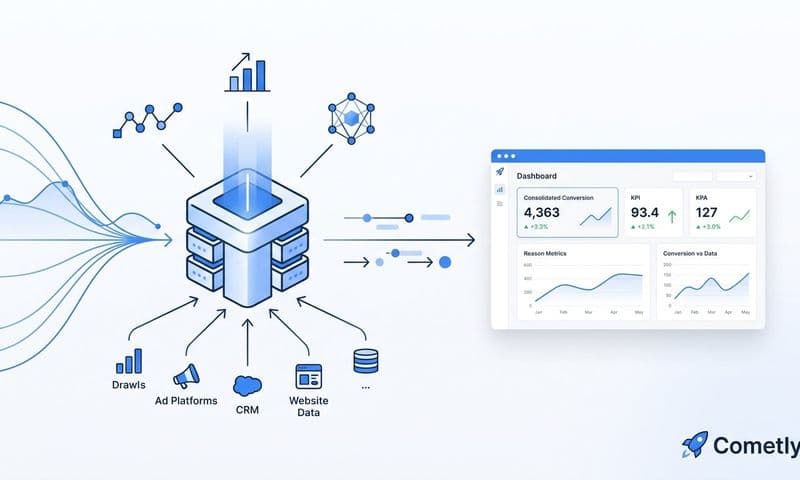
Cometly stands out as a powerful, revenue-first marketing attribution platform, earning its top spot among the best marketing analytics tools for its comprehensive approach to unifying the customer journey. It moves beyond surface-level metrics to provide a granular, real-time view of how every touchpoint, from paid ads to organic search, contributes to your bottom line. Its core strength lies in translating fragmented data into clear, actionable decisions that directly impact revenue and profitability.
The platform is engineered to solve one of the biggest challenges in modern marketing: data accuracy in a privacy-first world. By integrating server-side tracking, it captures conversion events with precision, bypassing the limitations of browser-based pixels. This enriched data is then fed back to ad platforms like Meta and Google through a one-click conversion sync, dramatically improving their algorithmic targeting and boosting campaign ROI.
 12 Best Marketing Analytics Tools for Growth in 2026
Key Features and Use Cases
Cometly’s feature set is designed for action, not just analysis. Its multi-touch attribution models allow marketers to see precisely which channels and campaigns are driving sales, enabling confident budget allocation. The AI Ads Manager and AI Chat provide prescriptive recommendations, helping teams identify winning creatives and scale successful campaigns faster.
- Best For: SaaS, e-commerce, agencies, and enterprise teams needing precise ROI measurement and ad spend optimization.
- Standout Feature: The combination of built-in server-side tracking and one-click conversion sync is a game-changer for ad performance, ensuring platforms optimize based on accurate, complete data.
- Practical Use Case: An e-commerce brand can use Cometly to identify that a specific TikTok ad, while having a low last-click conversion rate, is a critical first touchpoint for high-value customers. They can then reallocate budget to that campaign with confidence, knowing its true impact on revenue.
Platform and Pricing
Cometly is built for rapid deployment with a zero-code setup and over 100 integrations, including Shopify, Salesforce, and Stripe. The onboarding process is hands-on, ensuring teams can start unifying their data sources within minutes.
Pricing details are not publicly listed; interested teams need to book a demo or start a free trial to receive a custom quote. This model ensures the plan is tailored to specific business needs, though it may be a hurdle for those preferring transparent, upfront costs.
Website: https://www.cometly.com
2. Google Analytics (GA4 and Analytics 360)
As the de facto starting point for web analytics, Google Analytics remains a cornerstone tool. The latest iteration, GA4, shifts from the session-based model of its predecessor to a more flexible, event-based data model. This allows for unified tracking across both websites and mobile apps, providing a more holistic view of the user journey.
GA4's strength lies in its deep, native integrations within the Google ecosystem, particularly with Google Ads. This connection enables marketers to create sophisticated audience segments for remarketing and import conversion data directly, which helps optimize ad campaigns. For teams needing more power, the free BigQuery export opens up possibilities for complex SQL queries and data warehousing, a feature previously exclusive to the enterprise tier. While GA4 offers a robust free platform, those requiring higher data limits, unsampled reporting, and service-level agreements (SLAs) can scale to Analytics 360. The transition from Universal Analytics to GA4 presents a learning curve, but mastering its event-driven approach is crucial for modern cross-platform analysis.
Best For: Teams of all sizes, especially those heavily invested in the Google Ads ecosystem.
Key Features:
- Event-Based Tracking: A flexible model for capturing user interactions across web and apps.
- Predictive Audiences: Uses machine learning to identify users likely to convert or churn.
- BigQuery Integration: Provides raw event data for advanced, custom analysis.
- Analytics 360: Offers enterprise-grade features like higher data limits and roll-up properties.
FeatureGA4 (Free)Analytics 360 (Enterprise)PricingFreeCustom (Starts ~$50k/year)Data LimitsStandard quotasHigher limits, unsampled reportsSupportCommunity forumsDedicated support, SLAsIntegrationStandard Google Marketing Platform, BigQueryExpanded integrations, advanced features
Pros:
- The free tier is powerful and accessible to everyone.
- Unmatched native integration with Google Ads and other Google products.
- A massive community and extensive documentation are available for support.
Cons:
- The GA4 interface and data model can be challenging for users accustomed to Universal Analytics.
- Free support is limited, which can be a hurdle for complex implementations.
- Enterprise pricing for Analytics 360 is opaque and requires a sales process.
Learn more about using GA4 for marketing attribution.
Website: https://marketingplatform.google.com/analytics
3. Adobe Analytics
A titan in the enterprise analytics space, Adobe Analytics is designed for large organizations that require deep, cross-channel customer journey analysis at scale. As a core component of the Adobe Experience Cloud, it moves beyond standard web metrics to offer a unified view of customer interactions across web, mobile, product, and offline touchpoints. Its real strength lies in its ability to stitch together complex data from various sources, providing a comprehensive picture of the entire customer lifecycle.
 12 Best Marketing Analytics Tools for Growth in 2026
Unlike more accessible platforms, Adobe Analytics is built for teams that need granular control, robust data governance, and sophisticated attribution modeling. Its deep integration with other Adobe products like Adobe Experience Platform (AEP) and Real-Time CDP allows for the activation of analytics insights directly into personalization and marketing campaigns. This makes it one of the best marketing analytics tools for enterprises aiming to create a cohesive and data-driven customer experience ecosystem. While its power is immense, the platform's complexity and significant investment make it best suited for mature analytics teams with dedicated resources.
Best For: Large enterprises and organizations already invested in the Adobe Experience Cloud.
Key Features:
- Customer Journey Analytics: Stitches together cross-channel data for a holistic view of user paths.
- Advanced Attribution: Sophisticated, customizable attribution models beyond last-click.
- Data Governance: Mature role-based permissions and data residency controls.
- Experience Cloud Integration: Deep, native connections with AEP, Target, and Campaign.
FeatureAdobe Analytics (Standard)Adobe Analytics (Ultimate)PricingCustom (Sales-led)Custom (Sales-led)Primary UseComprehensive digital and marketing analyticsAdds Customer Journey Analytics and advanced featuresSupportEnterprise onboarding and supportDedicated high-level support and servicesIntegrationDeep integration with the full Adobe Experience CloudFull platform integration with premium capabilities
Pros:
- Extremely powerful for enterprise-grade, cross-channel analysis.
- Extensive documentation and dedicated enterprise onboarding support.
- Mature and granular controls for roles, permissions, and data governance.
Cons:
- Pricing is not public and requires a significant investment and sales process.
- Can be overly complex and expensive for small to mid-sized teams.
- The learning curve is steep, often requiring specialized expertise.
Learn more about alternatives to Adobe Analytics.
Website: https://business.adobe.com/products/adobe-analytics.html
4. Mixpanel
Mixpanel is a self-serve product analytics platform that excels at helping teams understand how users engage with their digital products. Unlike traditional web analytics focused on page views, Mixpanel uses an event-based model to track specific user actions, making it one of the best marketing analytics tools for analyzing funnels, retention, and complex user flows. Its strength lies in providing clear, actionable insights into feature adoption and user behavior without requiring deep technical expertise.
The platform is designed for cross-functional teams, allowing product managers and marketers to visualize the customer journey, build behavioral cohorts, and identify points of friction. With a generous free tier and transparent, usage-based pricing for its paid plans, Mixpanel makes sophisticated product analytics accessible to startups and scalable for enterprises. Its user-friendly interface allows for the creation of detailed reports and dashboards that directly answer questions about user engagement and conversion.
 12 Best Marketing Analytics Tools for Growth in 2026
Best For: Product-led companies and marketing teams focused on user engagement and feature adoption.
Key Features:
- Interactive Reports: Build detailed funnels, flows, and retention reports to analyze user behavior.
- Cohort Analysis: Group users by behavior or attributes to understand long-term retention.
- A/B Testing: Integrate with testing tools to measure the impact of experiments on key metrics.
- Data Integrations: A strong ecosystem of integrations for data import and export.
FeatureFree TierGrowth & Enterprise PlansPricingFree (up to 20M events/month)Custom, usage-based (Starts at $20/month)Data Limits90-day data historyUnlimited data history, advanced featuresSupportCommunity forumsEmail support, dedicated success managersAnalysisCore reports (Funnels, Retention)Advanced features like Impact analysis, group analytics
For a deeper dive into this space, see our AI ad testing tool guide.
Pros:
- Very user-friendly interface that empowers non-technical users to build complex reports.
- Transparent pricing and a powerful free plan make it easy to get started.
- Excellent for understanding digital product usage and in-app user journeys.
Cons:
- Pricing can become expensive as event volume scales.
- Less suited for tracking marketing attribution across paid channels compared to specialized tools.
- Primarily focused on product analytics rather than a full-suite marketing analytics platform.
Learn more about Mixpanel alternatives.
Website: https://mixpanel.com/pricing
5. Amplitude
While many tools focus purely on marketing channels, Amplitude excels at connecting marketing activities to in-product user behavior. It’s a powerful product analytics platform that offers deep insights into how users engage with a website or app after the initial acquisition. This allows marketers to move beyond simple conversion tracking and understand feature adoption, user retention, and the long-term value generated by different campaigns.
 12 Best Marketing Analytics Tools for Growth in 2026
Amplitude's strength is its ability to create detailed behavioral cohorts, segmenting users based on the specific actions they take. This is crucial for product-led growth (PLG) companies and mobile-first businesses that need to optimize the entire customer lifecycle, not just the top of the funnel. The platform also integrates experimentation and session replay, providing a unified suite to analyze, test, and activate on user data without needing multiple disparate tools. While it's one of the best marketing analytics tools for product-focused teams, its pricing model can become costly as user volume grows.
Best For: Product-led companies, mobile app developers, and marketing teams focused on user engagement and retention.
Key Features:
- Behavioral Cohorts: Create highly specific audience segments based on in-app actions and events.
- Built-in Experimentation: Run A/B tests and manage feature flags within the same platform.
- Session Replay: Visually analyze user journeys to identify friction points and opportunities.
- Generous Free Tier: The Starter plan offers a solid entry point for new businesses.
FeatureStarter (Free)Plus (Self-Serve)PricingFreeStarts at $49/month (billed annually)MTUs/EventsUp to 50k MTUs / 10M events per monthBased on volume, with transparent pricingCore AnalyticsIncluded (Funnel, Retention, User Paths)Included + Advanced behavioral analyticsExperimentationBasic A/B testingAdvanced experimentation & personalization features
Pros:
- Combines product analytics, A/B testing, and session replay in one platform.
- Transparent, self-serve pricing makes it accessible for startups and SMBs.
- Powerful for understanding the link between marketing efforts and long-term user behavior.
Cons:
- Pricing based on Monthly Tracked Users (MTUs) and events can escalate quickly with growth.
- More focused on product behavior than top-of-funnel marketing channel attribution.
- Advanced features are gated behind higher-priced tiers.
Learn more about Amplitude alternatives for your business.
Website: https://amplitude.com/pricing
6. Heap (by Contentsquare)
Heap stands out in the marketing analytics tools space with its "autocapture" technology, which automatically collects every user interaction on a site or app without manual event tagging. This codeless approach dramatically speeds up time-to-value, allowing teams to retroactively analyze user behaviors and answer questions they didn't know they had at the time of implementation. This is particularly powerful for understanding the complete user journey from first touch to conversion, identifying drop-off points in funnels, and uncovering unexpected user paths.
Acquired by Contentsquare, Heap has bolstered its platform with AI-powered insights that surface key trends and anomalies in user data automatically. While its core strength is in product analytics, its comprehensive dataset makes it invaluable for marketers in SaaS and e-commerce who need to understand how feature adoption and user engagement correlate with marketing campaigns. Features like session replays (often an add-on) and data enrichment provide deep qualitative context to the quantitative data captured.
 12 Best Marketing Analytics Tools for Growth in 2026
Best For: Product-led growth companies and marketing teams needing to analyze user behavior without extensive developer resources.
Key Features:
- Autocapture: Automatically collects all user interactions, such as clicks, taps, swipes, and form submissions.
- AI-Powered Insights: Proactively identifies significant trends, friction points, and opportunities in user data.
- Data Enrichment: Connects user behavior data with sources like CRMs and marketing automation platforms.
- Session Replay & Heatmaps: Visual tools (often as add-ons) to understand the "why" behind user actions.
FeatureFree PlanGrowth PlanPro & Premier PlansPricingFree (up to 10k sessions/month)Custom QuoteCustom QuoteCore AnalyticsStandard charting & analysisAdvanced features, unlimited projectsEnterprise-grade features, SSOSupportCommunityStandard supportPremier support, dedicated CSMData GovernanceBasicAdvanced (e.g., data dictionary)Premium governance controls
Pros:
- Autocapture provides a complete dataset from day one, enabling retroactive analysis.
- Extremely fast implementation and time-to-value compared to manually tagged tools.
- Powerful for understanding complex user journeys in SaaS and e-commerce.
Cons:
- Pricing for higher-tier plans is not public and requires a sales consultation.
- Valuable features like session replay are often sold as separate, costly add-ons.
- The sheer volume of data from autocapture can be overwhelming without a clear analysis plan.
Website: https://www.heap.io/pricing
7. Hotjar
Where quantitative tools like Google Analytics tell you what is happening, Hotjar explains the why. This behavior analytics platform is designed to give marketers a visual understanding of user engagement. By providing tools like heatmaps and session recordings, it moves beyond numbers to show you precisely where users are clicking, scrolling, and getting stuck on your pages. This qualitative insight is invaluable for conversion rate optimization (CRO) and improving user experience.
For a deeper dive, see our guide to Google analytics alternatives for marketers.
Hotjar complements traditional analytics by bridging the gap between data and human behavior. For instance, if you notice a high drop-off rate on a specific step in your funnel, you can watch session replays of users who abandoned that page to diagnose the issue. This makes it one of the best marketing analytics tools for marketers focused on improving landing pages, optimizing funnels, and understanding the user journey on a more intuitive, visual level.
 12 Best Marketing Analytics Tools for Growth in 2026
Best For: CRO specialists, UX/UI designers, and product marketers looking for qualitative user behavior insights.
Key Features:
- Heatmaps & Session Replay: Visually represent user clicks, moves, and scrolls, and watch recordings of real visitor sessions.
- Funnels & Dashboards: Track conversion rates through key user flows and visualize core metrics.
- Surveys & Feedback Widgets: Collect direct feedback from users with on-site polls and pop-up surveys.
- Key Integrations: Connects with Google Analytics, Mixpanel, and Slack to enrich your data.
FeatureObserve (Free)Observe (Plus/Business)PricingFree ForeverStarts at $32/mo (Plus), $80/mo (Business)Session CaptureUp to 35 daily sessionsStarts at 100+ daily sessions, unlimited heatmapsData Retention3 months12+ monthsSupportCommunity supportEmail support
Pros:
- Extremely easy to set up and provides immediate, actionable visual insights.
- Highly effective for improving landing page performance and conversion funnels.
- The free and affordable paid tiers are great for small teams and startups.
Cons:
- It is not a comprehensive analytics or attribution platform; it's a specialized UX tool.
- Session limits and feature restrictions on lower-tier plans can be restrictive for high-traffic sites.
- Qualitative data requires interpretation and can be time-consuming to analyze at scale.
Website: https://www.hotjar.com/pricing/
8. HubSpot Marketing Hub
HubSpot Marketing Hub positions itself as an all-in-one marketing, sales, and service platform, making it a powerful contender among the best marketing analytics tools for teams seeking a unified system. Rather than being a standalone analytics product, its strength lies in providing analytics that are natively integrated with its CRM and marketing automation tools. This tight integration allows for seamless tracking of the entire customer journey, from the first marketing touchpoint to a closed deal, offering a clear line of sight into how marketing activities directly influence revenue.
The platform excels at connecting disparate marketing channels like email, social media, landing pages, and ads into a single cohesive report. For organizations that need to prove marketing ROI, the multi-touch revenue attribution features available in higher tiers are invaluable. These tools move beyond simple last-click models to show how different channels contribute to conversions throughout the funnel. While the most advanced analytics are reserved for enterprise plans, the Professional tier still offers robust custom reporting and campaign analytics that serve a wide range of businesses.
 12 Best Marketing Analytics Tools for Growth in 2026
Best For: B2B companies and businesses that need to align marketing and sales analytics within a single CRM-centric ecosystem.
Key Features:
- Native CRM Integration: Provides a complete view of the customer lifecycle from lead to sale.
- Multi-touch Revenue Attribution: Connects marketing campaigns directly to revenue (Enterprise tier).
- Custom Reporting & Dashboards: Build reports that track the specific KPIs and marketing journeys that matter most.
- Omni-channel Orchestration: Analyze performance across email, social media, ads, and web content in one place.
FeatureMarketing Hub ProfessionalMarketing Hub EnterprisePricingStarts at $800/mo (billed annually)Starts at $3,600/mo (billed annually)AttributionStandard campaign reportingMulti-touch revenue attributionCustom ReportingUp to 100 custom reportsUp to 500 custom reportsOnboardingOptional paid onboardingRequired paid onboarding
Pros:
- A unified stack reduces vendor complexity and data silos.
- Clear pricing structure based on marketing contacts and user seats.
- Strong support, extensive documentation, and a large partner ecosystem.
Cons:
- Costs can escalate quickly as your contact list and team grow.
- Advanced attribution and governance features are locked behind expensive enterprise tiers.
- Significant onboarding fees are often required for higher-level plans.
Website: https://www.hubspot.com/products/marketing
9. Salesforce Marketing Cloud Intelligence (formerly Datorama)
For large enterprises managing complex, multi-channel marketing campaigns, Salesforce Marketing Cloud Intelligence (formerly Datorama) offers a powerful solution to unify disparate data sources. It is designed to be a single source of truth, automating data ingestion and harmonization across paid, owned, and earned media. The platform’s core strength is its extensive library of prebuilt API connectors, which drastically reduces the engineering effort typically required for data integration.
 12 Best Marketing Analytics Tools for Growth in 2026
Marketing Cloud Intelligence applies a centralized data model to standardize metrics from different channels, enabling true cross-channel performance analysis and visualization. With its AI-powered insights, marketers can uncover optimization opportunities and receive automated summaries, all within the Salesforce ecosystem. This makes it one of the best marketing analytics tools for organizations that need robust governance, scalability, and deep integration with their existing Salesforce stack, particularly for rolling up paid media performance across a global portfolio.
Best For: Enterprise marketing teams and large agencies needing to unify high-volume, cross-channel data.
Key Features:
- Automated Data Ingestion: Harmonizes data using a marketing-specific data model.
- Prebuilt API Connectors: Extensive library for connecting to paid, owned, and earned channels.
- AI-Powered Insights: Delivers automated summaries and optimization recommendations.
- Salesforce Integration: Natively connects with Salesforce Data Cloud and other ecosystem products.
FeatureSalesforce Marketing Cloud Intelligence (Enterprise)PricingCustom (Requires Salesforce contract, annual billing)Data IngestionAutomated via prebuilt API connectors & custom sourcesSupportDedicated enterprise support and enablementIntegrationDeep integration within the Salesforce ecosystem
Pros:
- Excellent for high-scale, cross-channel marketing reporting and analysis.
- Robust governance features and enterprise-grade support are included.
- Powerful for creating consolidated performance views of paid media.
Cons:
- High entry price point with a commitment to annual billing.
- Requires investment in the broader Salesforce platform and enablement services.
- The platform can be complex and may require specialized expertise to manage.
Website: https://www.salesforce.com/marketing/analytics/pricing/
10. Semrush
While often categorized as an SEO tool, Semrush is a comprehensive competitive intelligence and marketing suite that provides critical analytics for channel performance. Its power lies in its massive datasets, which allow marketers to benchmark their performance against competitors across paid search, organic traffic, and content marketing. This external view is a crucial complement to internal, first-party data tools, offering context on market share and competitive strategy that other platforms can't provide.
Semrush shines when used for market research and strategic planning. By analyzing competitor ad copy, top-ranking keywords, and backlink profiles, teams can identify gaps and opportunities before investing in a campaign. The platform’s modular toolkit approach allows businesses to select specific functionalities, from local SEO to content marketing, without committing to the full suite. Integrating its reporting with tools like Looker Studio enables marketers to combine this competitive data with their internal metrics, creating a more complete picture of their marketing landscape.
If you're evaluating vendors, our AI ad copy breakdown can help.
Best For: SEO and content marketing teams, digital agencies, and businesses needing deep competitive intelligence.
Key Features:
- Comprehensive Toolkits: Specialized modules for SEO, Advertising, Content, and Social Media.
- Competitive Intelligence: Deep datasets on competitor keywords, ad spend, and traffic sources.
- Market Explorer: Provides market size, key players, and audience demographics.
- Looker Studio Integration: Connects Semrush data to broader business intelligence dashboards.
FeaturePro PlanGuru PlanBusiness PlanPricing~$129.95/month~$229.95/month~$449.95/monthUsers Included111Projects51540Keywords to Track5001,5005,000
Pros:
- Unparalleled depth in keyword and competitor data for strategic market research.
- Modular toolkits let you focus your subscription on specific marketing needs.
- Strong reporting capabilities and native integrations for a holistic view.
Cons:
- The sheer number of tools can create a steep learning curve for new users.
- Pricing can become expensive quickly, especially with add-ons and additional user seats.
- Some data, like traffic estimates, should be treated as directional rather than absolute.
Learn more about how Semrush fits into an AI SEO strategy.
Website: https://www.semrush.com
11. Ahrefs
While many marketing analytics tools focus on paid channels and website behavior, Ahrefs carves out its niche as an indispensable platform for search engine optimization (SEO) analytics. It operates one of the largest and most active web crawlers after Google, providing an extensive backlink index and historical keyword data. This allows marketers to perform deep competitive analysis, uncover high-value keywords, and audit their own site's technical health to improve organic performance.
Ahrefs excels at turning raw search data into actionable insights for content strategy and link-building campaigns. Its Site Explorer feature gives a 360-degree view of any website's SEO profile, revealing top organic pages, backlink sources, and paid search keywords. While its primary strength is organic search, this data is crucial for a holistic marketing strategy, as strong SEO performance can significantly lower customer acquisition costs and build a sustainable traffic source, making it one of the best marketing analytics tools for organic channel growth.
 12 Best Marketing Analytics Tools for Growth in 2026
Best For: SEO specialists, content marketers, and agencies focused on building and measuring organic search performance.
Key Features:
- Site Explorer: Provides a comprehensive overview of any domain's backlink profile and organic search traffic.
- Keywords Explorer: A robust tool for keyword discovery, difficulty analysis, and clickstream data.
- Site Audit: Scans websites for over 100 common technical and on-page SEO issues.
- Rank Tracker: Monitors keyword ranking performance over time across different locations and devices.
FeatureLite PlanEnterprise PlanPricingStarts at $99/monthCustom pricingUsers1 user5+ usersProjects5 verified projects100+ unverified projectsDataStandard data limits and historyExtended data history, API access, audit logs
Pros:
- Boasts one of the largest and most accurate backlink indexes in the industry.
- The user interface is intuitive and makes complex data easy to understand.
- Offers a free Ahrefs Webmaster Tools version for site owners to monitor their own SEO health.
Cons:
- Primarily focused on SEO and offers limited insights into other marketing channels.
- Pricing can become expensive as you scale users, projects, and data usage.
- The credit-based system for certain reports can be confusing and lead to unexpected costs.
Website: https://ahrefs.com/pricing
12. G2 (Marketing Analytics Category)
Instead of being a single tool, G2 serves as a critical research hub in the selection process for marketing analytics platforms. It's a B2B software marketplace that aggregates verified user reviews, allowing marketers to compare solutions based on real-world feedback rather than just vendor claims. This peer-driven approach helps teams vet and shortlist tools by understanding how they perform in similar organizational contexts.
G2's Marketing Analytics category provides an invaluable landscape view, complete with subcategories for specialized needs like mobile and web analytics. Its grid reports, which plot vendors based on satisfaction and market presence, offer a quick visual for identifying leaders and trending products. By using the platform's detailed filters and side-by-side comparison features, marketing teams can efficiently evaluate functionality, ease of use, and support quality, making it a foundational step for anyone searching for the best marketing analytics tools. While it's an essential resource for due diligence, it should be used in tandem with hands-on trials to confirm a tool’s fit.
Best For: Marketing teams in the procurement and evaluation phase of their tool selection process.
Key Features:
- Verified User Reviews: Provides authentic peer feedback on tool performance and support.
- Category Grids & Reports: Visually maps out the vendor landscape to identify market leaders.
- Side-by-Side Comparisons: Allows for direct feature, pricing, and rating comparisons.
- Buyer Guides & Research: Offers expert content to guide the selection process.
FeatureHow It Helps MarketersKey ConsiderationReviewsGain insights from real users to validate vendor claimsLook for reviews from companies of a similar size/industryComparisonsShortlist tools based on specific feature requirementsData can be vendor-supplied; always verify specificsGridsQuickly identify top-rated and trending solutionsHigh market presence doesn't always mean best fit for SMBsPricing InfoAccess general pricing tiers and trial linksInformation can be outdated; confirm on the vendor site
Pros:
- Excellent source of unbiased, peer-generated feedback and satisfaction scores.
- Simplifies the discovery of new and niche marketing analytics tools.
- Helps streamline the vendor shortlisting and procurement due diligence process.
Cons:
- Pricing information is often general or inconsistent across listings.
- The platform includes sponsored content that can influence visibility.
- It's a research aid; hands-on product trials are still essential for a final decision.
Website: https://www.g2.com/categories/marketing-analytics
Top 12 Marketing Analytics Tools Comparison
Tool | Key Features | UX / Quality | Price / Value | Target Audience | Unique Selling Points |
|---|---|---|---|---|---|
Cometly 🏆 | Real time multi touch attribution, server side tracking, AI Ads Manager, 100 plus integrations | ★★★★☆ Revenue focused with fast setup | Free trial or demo with sales led pricing | SaaS, ecommerce, agencies, and enterprises | One click conversion sync to ad platforms, zero code setup, AI driven recommendations |
Google Analytics (GA4 / 360) | Event based web and app analytics, machine learning insights, BigQuery export | ★★★★☆ Powerful with a learning curve | Free GA4 with paid Analytics 360 tier | SMB through enterprise advertisers | Native Google Ads and BigQuery integrations |
Adobe Analytics | Customer journey analytics, advanced attribution, enterprise governance | ★★★★☆ Enterprise grade but complex | Sales led pricing with high implementation cost | Large enterprises with complex requirements | Deep Adobe Experience Cloud integration and data residency controls |
Mixpanel | Funnels, retention analysis, cohorts, session replay | ★★★★☆ Intuitive for product teams | Free tier with transparent usage based pricing | Product led startups and product managers | Clear pricing calculator and strong retention tooling |
Amplitude | Behavioral analytics, experimentation, feature flags, activation | ★★★★☆ Broad platform across product and marketing | Free starter with MTU based paid tiers | Startups through enterprises building product analytics | Built in experimentation and feature activation |
Heap (Contentsquare) | Autocapture, AI insights, data enrichment, advanced add ons | ★★★☆☆ Fast time to value via autocapture | Free tier with custom enterprise pricing | SaaS and ecommerce teams needing quick insights | Full event capture without manual tagging |
Hotjar | Heatmaps, session replay, funnels, user surveys | ★★★★☆ Immediate visual UX insights | Affordable growth plans with limits on lower tiers | CRO teams and SMB product and marketing teams | Visual behavior analysis combined with on site feedback |
HubSpot Marketing Hub | Multi touch attribution, custom reporting, native CRM | ★★★★☆ Unified stack with strong onboarding | Published tiered pricing that scales with contacts | Businesses seeking all in one marketing and CRM | Native CRM integration with guided onboarding |
Salesforce Marketing Cloud Intelligence | ETL, data harmonization, prebuilt connectors, marketing data model | ★★★★☆ Enterprise reporting and governance | High entry price with annual contracts | Large enterprises on the Salesforce stack | Centralized marketing data model with Salesforce native integrations |
Semrush | SEO research, advertising intelligence, competitor analysis, reporting | ★★★★☆ Comprehensive research focused toolkit | Tiered plans with paid add ons | SEO teams, content marketers, and agencies | Deep keyword and competitive intelligence datasets |
Ahrefs | Site explorer, keyword research, backlink index, technical audits | ★★★★☆ Reliable and SEO centric | Transparent tiered pricing | SEOs, consultants, and site owners | Large backlink index with clear usage limits |
G2 (Marketing Analytics) | Verified reviews, category grids, buyer guides, comparisons | ★★★☆☆ Discovery focused marketplace | Free to browse with vendor driven pricing | Buyers shortlisting marketing analytics tools | Verified user reviews and side by side comparisons |
How to Choose and Implement the Right Marketing Analytics Tool for Your Business
Navigating the extensive landscape of marketing analytics platforms can feel overwhelming, but making the right choice is a pivotal step toward data-driven growth. We've explored a dozen of the best marketing analytics tools, from the comprehensive enterprise-level power of Adobe Analytics and Salesforce Marketing Cloud Intelligence to the nuanced product analytics of Mixpanel and Heap. We've also seen how tools like Semrush and Ahrefs dominate the SEO and competitive intelligence space, while all-in-one platforms like HubSpot offer a unified view for inbound marketing.
The key takeaway is that the "best" tool is not a one-size-fits-all solution; it's the one that directly addresses your unique business challenges, integrates seamlessly with your existing technology stack, and fits within your operational budget. The ideal platform for a B2B SaaS company focused on product-led growth will differ vastly from that of a D2C e-commerce brand scaling its paid advertising campaigns.
A Strategic Framework for Your Selection Process
To move from analysis to action, you need a structured approach. Don't let feature lists alone drive your decision. Instead, follow a deliberate process to ensure the tool you choose becomes a core asset, not a source of frustration.
- Define Your Core Questions: Start by documenting your most pressing marketing unknowns. Are you struggling with multi-touch attribution for your paid ads? Do you need a clearer picture of the user journey from first touch to conversion? Are you losing visibility due to iOS tracking restrictions? Your answers will immediately help you shortlist platforms like Cometly for attribution or Mixpanel for user behavior analysis.
- Audit Your Existing Tech Stack: Create a detailed map of your current marketing and sales tools (CRM, ad platforms, email service provider, e-commerce platform). The right analytics tool must offer robust, native integrations with these systems. A platform that requires complex, custom-built connectors will drain your technical resources and create data silos.
- Evaluate Technical Requirements and Team Skillset: Be realistic about your team's capabilities. A tool like Adobe Analytics offers immense power but demands a significant implementation effort and specialized expertise. In contrast, platforms like Hotjar or Cometly are designed for more straightforward setup and usability, making them accessible to smaller, more agile teams.
- Run Hands-On Trials and Demos: Never commit based on a sales pitch alone. Take full advantage of free trials and request personalized demos. Create a checklist of 3-5 critical use cases and test whether the tool can effectively address them. This hands-on phase is crucial for validating that the platform's interface, reporting capabilities, and data accuracy meet your expectations.
Planning for a Successful Implementation
Selecting a tool is only half the battle; a well-planned implementation is what unlocks its true value. A phased rollout is often more effective than a "big bang" launch. Start by integrating one or two key data sources, such as your primary ad platform and your website. Set up foundational tracking and dashboards, and train a small group of power users first.
As you build confidence and demonstrate early wins, you can expand the implementation to include more data sources and user groups. Remember that data is dynamic. Your analytics strategy must evolve alongside your marketing efforts. When evaluating different categories of marketing analytics, it's crucial to consider specialized solutions; for instance, you might want to explore leading social media monitoring tools to complement your primary platform's capabilities and gain a more holistic view of your brand's digital footprint.
Ultimately, the goal is to transform raw data into actionable intelligence that fuels smarter decisions, optimizes your marketing spend, and accelerates business growth. By thoughtfully evaluating your needs and diligently planning your implementation, you can equip your team with the insights needed to win in today's competitive digital landscape.
If your biggest challenge is proving ad ROI and achieving crystal-clear attribution in a post-iOS 14 world, Cometly is designed for you. Its server-side tracking, AI-powered ad management, and one-click conversion sync provide the accurate data modern performance marketers need to scale effectively. See how Cometly can help you connect every dollar spent to the revenue it generates.