

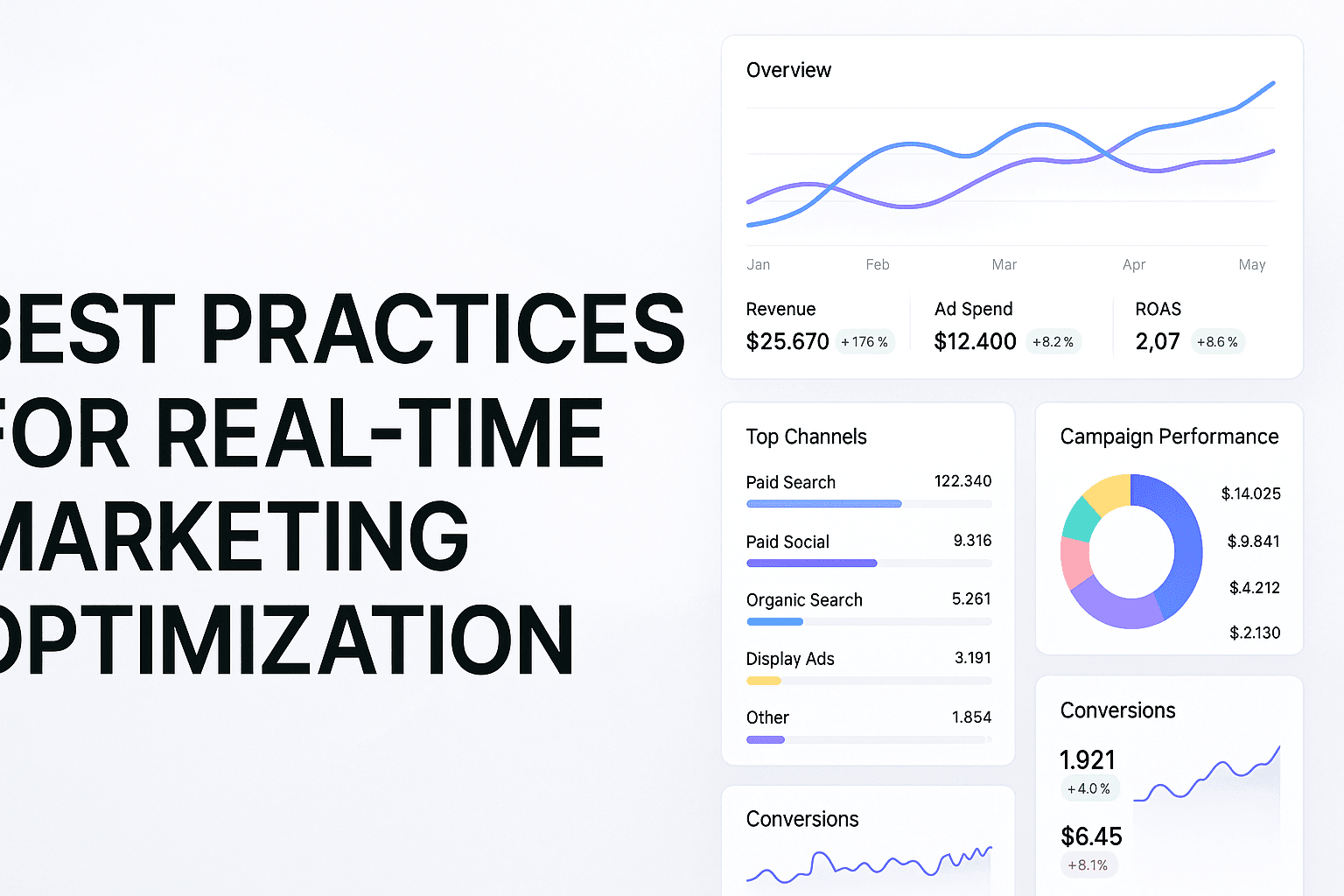
Your competitor just launched a campaign targeting your exact audience. Your ad costs are climbing by the hour. And your current campaign data won't refresh until tomorrow morning.
By then, you've already lost thousands in wasted spend and missed opportunities.
This scenario plays out daily for marketers stuck in reactive mode, waiting for batch reports and delayed insights while their competition moves at the speed of real-time data. Modern consumers expect personalized experiences that respond to their behavior instantly, while ad platforms reward campaigns that adapt quickly to performance signals.
The challenge isn't just having access to real-time data—it's knowing how to act on it effectively. Too many marketing teams get overwhelmed by the constant stream of performance metrics, leading to analysis paralysis or knee-jerk reactions that hurt long-term results.
Here are the essential practices that will transform how you approach marketing optimization, giving you the frameworks and systems needed to make confident, data-driven decisions in real-time.
1. Implement Comprehensive Multi-Touch Attribution Tracking
Without accurate attribution, real-time optimization becomes guesswork. Most marketers rely on last-click attribution or platform-specific data, missing the majority of the customer journey that influences conversions. This blind spot leads to budget misallocation, killing profitable campaigns while scaling ineffective ones. Real-time optimization requires seeing every touchpoint that contributes to revenue, not just the final interaction.
Think of it like trying to navigate a city using only the last turn before your destination. You'd miss all the highways, side streets, and detours that actually got you there. Marketing attribution works the same way—customers interact with your brand multiple times across different channels before converting, and each touchpoint plays a role in their decision.
Why Single-Touch Attribution Fails Real-Time Optimization
Platform-native analytics tools show you what happens within their ecosystem, but customers don't live in silos. A prospect might discover your brand through a Facebook ad, research you via Google search days later, receive an email reminder, and finally convert through a retargeting campaign. If you're only looking at last-click data, you'd credit that retargeting ad with the entire conversion—completely missing the awareness and consideration touchpoints that made it possible.
This creates a dangerous optimization cycle. You shift budget toward bottom-funnel activities that get last-click credit while starving the upper-funnel campaigns that actually drive awareness. Your cost per acquisition appears to improve temporarily, but your overall conversion volume drops because you've cut off the pipeline that feeds those final conversions.
Building Comprehensive Attribution Infrastructure
Deploy Server-Side Tracking: Browser-based tracking faces increasing limitations from cookie restrictions, ad blockers, and privacy regulations. Server-side tracking captures data directly from your servers, bypassing these limitations and providing more complete customer journey visibility across devices and platforms.
Establish Unified Event Tracking: Connect all customer touchpoints into a single tracking system—paid advertising clicks, organic search visits, email opens, website behavior, and even offline conversions like phone calls or in-store purchases. This unified view reveals how channels influence each other rather than competing for credit.
Configure Multi-Touch Attribution Models: Different attribution models serve different purposes. Time-decay models give more credit to recent interactions, position-based models emphasize first and last touchpoints, while data-driven models use machine learning to assign credit based on actual conversion patterns. Choose based on your sales cycle length and customer journey complexity.
Enable Real-Time Data Synchronization: Attribution insights only drive optimization when they flow back to your advertising platforms immediately. Set up API connections that feed attribution data to your ad accounts in real-time, allowing platform algorithms to optimize based on true revenue impact rather than last-click conversions.
Avoiding Common Attribution Pitfalls
Many teams implement attribution tracking but make critical mistakes that undermine its value. Changing attribution models frequently disrupts optimization algorithms and makes performance comparisons impossible. Your platforms need consistent signals to learn what drives conversions.
Another common error is treating all conversions equally regardless of quality or lifetime value. A customer who makes a single small purchase shouldn't receive the same attribution weight as one who becomes a high-value repeat buyer. Layer in customer lifetime value data to optimize for long-term revenue, not just immediate conversions.
Don't fall into the trap of over-attributing to upper-funnel activities without considering conversion quality. Awareness campaigns might touch many customers, but if those customers convert at lower rates or generate less revenue, your attribution model should reflect that reality.
Measuring Attribution Impact
The true
2. Deploy Real-Time Audience Optimization and Expansion
Your audience isn't static—customer behavior, intent signals, and conversion patterns shift throughout the day, week, and season. While you're running yesterday's targeting strategy, your competitors are already capturing the high-intent prospects who emerged this morning. Real-time audience optimization transforms your targeting from a set-it-and-forget-it approach into a dynamic system that identifies and scales winning segments before the opportunity disappears.
The challenge isn't just having audience data—it's acting on behavioral signals fast enough to matter. Most marketing teams update their targeting weekly or monthly, missing the micro-trends that separate profitable campaigns from mediocre ones. By the time you manually analyze which audience segments are converting, those prospects have already moved through their buying journey or been captured by faster-moving competitors.
Why Dynamic Audience Optimization Matters
Static audience targeting creates three critical problems that compound over time. First, you waste budget on segments that worked last month but have since declined in quality or intent. Second, you miss emerging high-value segments because your targeting criteria don't adapt to new behavioral patterns. Third, you allow converted customers to remain in your targeting pools, showing them ads they no longer need while missing opportunities to reach new prospects.
Real-time audience optimization solves these problems by continuously analyzing conversion data and engagement signals to identify which segments are performing right now. When a particular demographic, interest group, or behavioral segment starts converting at above-average rates, your system immediately expands targeting to similar prospects. When segments decline in performance, they're automatically deprioritized or excluded before significant budget waste occurs.
The impact extends beyond just efficiency gains. Dynamic audience optimization enables you to capture market opportunities during their peak value window—whether that's a trending topic driving search volume, a competitor's service outage creating switching opportunities, or seasonal buying patterns that emerge earlier than expected. Speed matters because these windows often close within hours or days.
Building Your Real-Time Audience System
Start by establishing behavioral tracking that captures intent signals beyond just conversions. Track engagement depth metrics like time on site, pages viewed, video watch percentage, and content downloads. These signals help identify high-intent prospects before they convert, enabling proactive targeting expansion rather than reactive optimization.
Configure your advertising platforms to create dynamic audiences based on real-time conversion data. When a specific audience segment reaches a minimum conversion threshold—typically 5-10 conversions depending on your volume—automatically generate lookalike audiences to scale targeting to similar prospects. Set these lookalike audiences to refresh daily or even hourly, ensuring they reflect the most current conversion patterns rather than outdated data.
Implement behavioral triggers that add prospects to retargeting audiences immediately after high-intent actions. Someone who views your pricing page, watches a product demo video, or adds items to cart without purchasing should enter targeted nurture sequences within minutes, not days. The faster you respond to intent signals, the higher your conversion probability.
Create sophisticated exclusion rules that remove converted customers, low-quality traffic, and exhausted segments in real-time. Nothing wastes budget faster than showing ads to people who already bought from you or repeatedly targeting prospects who've seen your ads dozens of times without converting. Set frequency caps that automatically exclude users after a defined number of impressions without engagement.
Establish cross-platform audience syncing to maintain consistent targeting across all advertising channels. When you identify a high-performing audience segment on one platform, immediately test similar targeting on your other channels. Conversely, when a segment underperforms across multiple platforms, that's a strong signal to exclude it entirely rather than continuing to test.
Advanced Optimization Techniques
Layer external data sources into your audience optimization system for contextual relevance. Weather data can trigger audience adjustments for weather-dependent products. Local events can expand targeting in specific geographic areas during high-traffic periods. Market conditions like stock performance or economic indicators can influence B2B audience prioritization based on buying capacity signals.
3. Implement Cross-Channel Performance Monitoring and Optimization
Most marketers optimize their campaigns in silos—tweaking Facebook ads in Ads Manager, adjusting Google Ads campaigns in their platform, and reviewing email performance in their ESP. This fragmented approach misses the bigger picture: your marketing channels don't operate independently. When you increase Facebook spend, it affects your Google Search conversion rates. When you pause email campaigns, your retargeting performance changes. Real-time cross-channel monitoring reveals these hidden interactions, preventing optimization decisions that improve one metric while quietly destroying overall performance.
The challenge isn't just seeing all your channels in one place—it's understanding how they influence each other in real-time. A prospect might see your Facebook ad during their morning commute, search for your brand at lunch, and convert through a retargeting ad that evening. Traditional channel-specific reporting would credit three separate "successes" when it's actually one coordinated journey. Without this unified view, you're essentially flying blind, making decisions based on incomplete information that can lead to budget waste and missed opportunities.
Building Your Cross-Channel Command Center
Start by establishing a unified dashboard that displays real-time performance across all marketing channels simultaneously. This isn't about creating another reporting tool—it's about building a decision-making hub that shows channel interactions as they happen. Your dashboard should display key metrics like cost per acquisition, conversion rates, and revenue alongside cross-channel attribution data that reveals how channels work together to drive results.
The most effective dashboards organize information by customer journey stage rather than by platform. Group your awareness channels (social media, display, video) together, your consideration channels (search, content, email) in another section, and your conversion channels (retargeting, remarketing, direct response) separately. This structure immediately reveals where prospects are getting stuck and which channel combinations drive the best results.
Configure alerts for performance anomalies that might indicate cross-channel conflicts or opportunities. If your Google Search costs suddenly spike, it might be because you just launched an aggressive Facebook campaign that's driving branded search volume. If your email open rates drop, check whether you've recently increased display advertising frequency—ad fatigue in one channel often affects engagement in others. These connections become obvious with unified monitoring but remain invisible when optimizing channels separately.
Implementing Intelligent Cross-Channel Attribution
Set up cross-channel attribution tracking that shows how channels influence each other's performance throughout the customer journey. This goes beyond basic multi-touch attribution—you need to see the sequential patterns that lead to conversions. Which channel combinations produce the highest-value customers? Do social media interactions improve search conversion rates? Does email engagement increase the effectiveness of retargeting campaigns?
Create optimization rules that consider total customer acquisition cost across all channels rather than individual platform metrics. A campaign might look expensive on its own but become profitable when you account for the downstream conversions it generates in other channels. Similarly, a channel with great standalone metrics might actually be cannibalizing conversions from more cost-effective sources.
Implement sequential messaging strategies that coordinate content and timing across channels for maximum impact. When someone clicks your Facebook ad but doesn't convert, your retargeting ads should acknowledge that interaction rather than starting from scratch. When prospects engage with your email content, your search ads should reflect that relationship stage. This coordination requires real-time data sharing between platforms and automated systems that adjust messaging based on cross-channel behavior.
Avoiding Common Cross-Channel Optimization Mistakes
The biggest mistake is optimizing channels in isolation without considering their interdependencies. Pausing a "low-performing" awareness campaign might seem smart until you notice your conversion campaigns suddenly have no one to retarget. Increasing bids on branded search terms might boost conversions temporarily while actually competing against your own organic rankings and driving up overall acquisition costs.
Many teams also fail to account for cross-device behavior in their cross
Putting It All Together
Real-time marketing optimization isn't about reacting to every data point—it's about building systems that respond intelligently to the signals that matter. The practices we've covered transform scattered data into actionable insights that drive immediate results.
Start with comprehensive attribution tracking to see the complete customer journey, then layer in automated budget reallocation to ensure your best campaigns never run out of fuel. Add real-time audience optimization to capture emerging opportunities, and support it all with dynamic creative testing that keeps your messaging fresh and engaging.
The most successful marketers don't try to implement everything at once. They prioritize based on their biggest pain points—whether that's wasted ad spend, missed opportunities, or declining campaign performance. Pick the 2-3 practices that address your most critical challenges, implement them systematically, and build from there.
The difference between reactive and proactive marketing comes down to having the right infrastructure in place. Platforms like Cometly provide the real-time attribution and analytics foundation that makes these practices possible, connecting every touchpoint to revenue so you can optimize with confidence rather than guesswork.
Your competitors are already moving at the speed of real-time data. The question isn't whether to adopt these practices—it's how quickly you can implement them before the gap becomes impossible to close. Get your free demo and see how real-time marketing optimization transforms campaign performance when you have complete visibility into what's actually driving results.



