
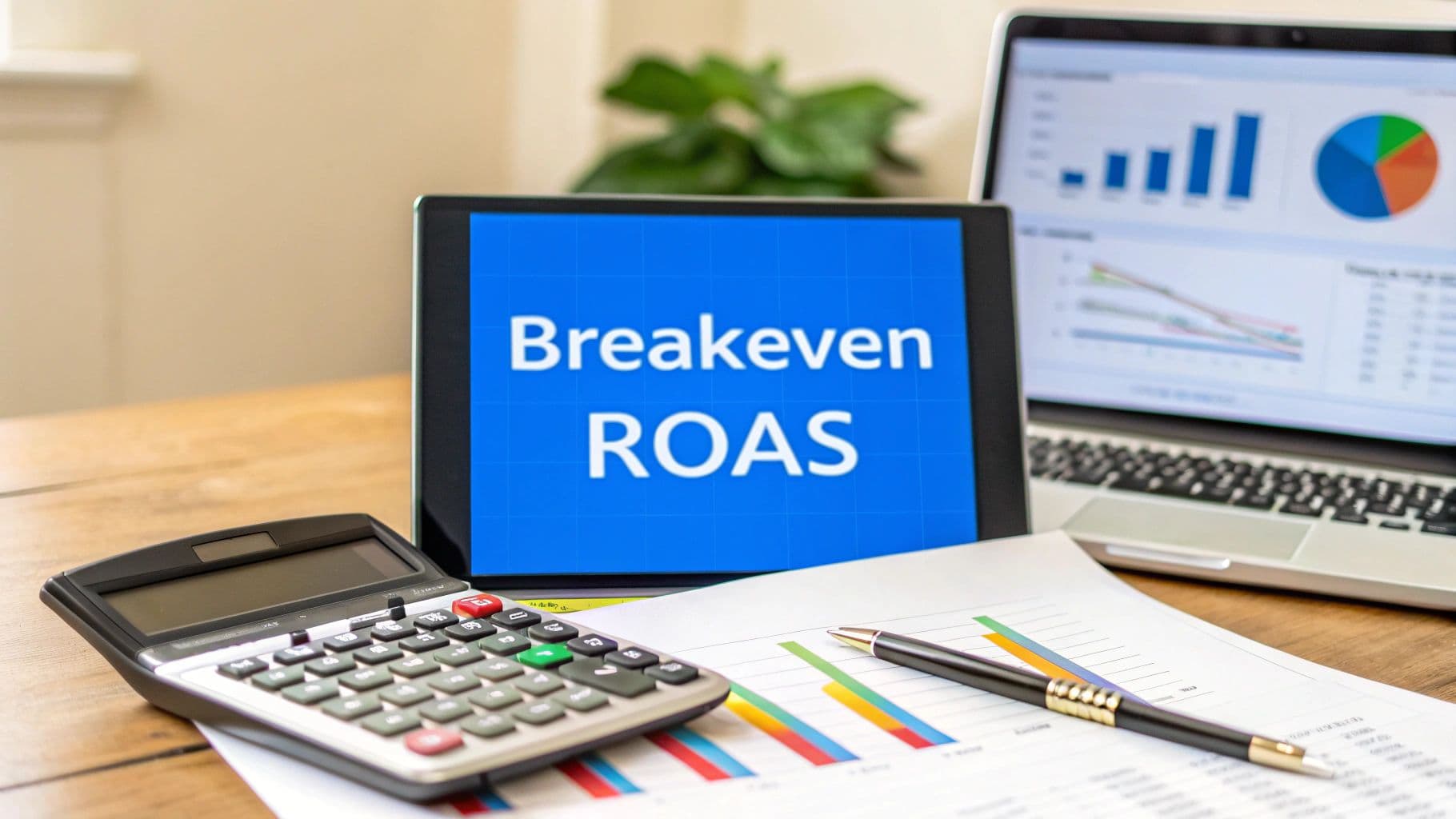
It feels like you're flying blind, doesn't it? Watching your ad spend climb day after day, without having a clue what your actual profitability point is. That's where a breakeven ROAS calculator comes in. It's the essential tool that tells you the absolute minimum Return on Ad Spend your campaigns need to hit just to avoid losing money.
Think of it as your financial waterline—anything below it, and you're leaking profit with every single conversion.
Why Your Ad Spend Is Leaking Profit Without a Breakeven ROAS
 Your Breakeven ROAS Calculator and Profitability Guide
It’s way too easy to get caught up in vanity metrics. Clicks, impressions, even a "good" overall ROAS in your ad manager dashboard... these numbers rarely tell the full story. When you don't have a clear breakeven point, you end up making critical budget decisions based on incomplete data. That’s a surefire recipe for wasted ad spend.
Breakeven ROAS cuts right through the noise. It’s not just another KPI to add to your spreadsheet; it’s the bedrock of a sustainable advertising strategy. This single metric reveals the bare-minimum performance your ads need to cover all the costs tied to a sale, from the product itself to shipping and sneaky transaction fees.
The Real Cost of Ignoring Your Breakeven Point
"Flying blind" isn't just a feeling—it has a real, quantifiable impact on your bottom line. In the cutthroat world of digital ads, especially on platforms like Facebook and Google, this mistake can be devastating.
One analysis of over 5,000 e-commerce campaigns found that brands ignoring their breakeven calculations wasted up to 27% of their ad budgets on unprofitable channels. For a mid-sized Shopify store, that translated to an average loss of $150,000 a year. Ouch.
Your breakeven ROAS is the financial North Star for your paid advertising. It turns ad spend from a speculative gamble into a calculated investment, making every dollar accountable to your profit margin.
But this isn't just about plugging leaks and avoiding losses. Knowing your breakeven ROAS empowers you to make smarter, faster decisions across the board.
- Set Realistic Campaign Goals: Ditch the arbitrary ROAS targets. Now you can aim for a number that's actually grounded in your business's real economics.
- Spot Winning Channels: You can quickly see which ad platforms are delivering profitable traffic and which ones are just burning cash.
- Scale with Confidence: When you know a campaign is crushing its breakeven point, you can pour more budget into it without biting your nails.
- Optimize Your Creative: A/B test your ads to see which ones deliver conversions above your profitability threshold, not just the ones with the cheapest clicks.
Shifting from Vanity Metrics to True Profitability
Ultimately, focusing on this metric forces a mindset shift. You stop asking, "How much revenue did my ads generate?" and start asking, "How much profit did my ads generate?" This simple change is what separates brands that constantly struggle with cash flow from those that build resilient, scalable businesses. To really nail this down, it helps to understand the full picture of Mastering Analytics in Advertising to Maximize Your ROI.
Related reading: our complete guide to AI talking avatar ads generator.
The relationship between ad spend and revenue is more complex than it seems, so getting the fundamentals right is key. If you want a refresher on the foundational formula, check out our guide on how to calculate return on ad spend. Grasping that concept is the first step toward gaining total control over your marketing budget and ensuring your ad dollars are actively building your business, not draining it.
We compare the leading options in our advertising manager roundup.
How To Manually Calculate Your Breakeven ROAS
 Your Breakeven ROAS Calculator and Profitability Guide
Ready to get your hands dirty and see what’s really going on inside a breakeven roas calculator? Good news: the core formula is surprisingly simple. You don’t need a finance degree to master it.
We compare the leading options in our WooCommerce UGC ad generator roundup.
At its heart, the entire calculation comes down to just one key metric: your gross profit margin.
The formula itself is clean and direct:
Breakeven ROAS = 1 ÷ Gross Profit Margin
That’s it. This elegant little equation tells you the absolute minimum return you need from your ads to cover the cost of the products you just sold. Let's break down how to nail that Gross Profit Margin figure so you can plug it in with total confidence.
First, Find Your Gross Profit Margin
Before you can pinpoint your breakeven point, you need to know exactly how much profit you make on a sale before factoring in ad spend. This is your Gross Profit Margin, and it's the foundation of this whole process.
To find it, you’ll first need to calculate your Gross Profit per order, which is just your revenue minus your Cost of Goods Sold (COGS). It's crucial that you know how to calculate sales revenue accurately, as it’s a core part of the formula.
Once you have your Gross Profit, the margin calculation is straightforward:
- Gross Profit Margin = (Revenue - COGS) ÷ Revenue
Let's walk through a real-world example. Imagine you run a DTC brand selling a premium skincare serum.
Here are your numbers for a single bottle:
- Product Selling Price (Revenue): $80
- Cost of Goods Sold (COGS): $20 (this includes ingredients, the bottle, and primary packaging)
First, get the Gross Profit per sale:
$80 (Revenue) - $20 (COGS) = $60 (Gross Profit)
Next, figure out the Gross Profit Margin:
$60 (Gross Profit) ÷ $80 (Revenue) = 0.75
Your Gross Profit Margin is 75%. Now we have the number we need for the main event.
Putting It All Together for Your Breakeven ROAS
With your Gross Profit Margin of 75% (or 0.75), you can now plug that right into the main breakeven ROAS formula.
- Breakeven ROAS = 1 ÷ 0.75
- Breakeven ROAS = 1.33
This means for every $1 you spend on ads, you need to bring in at least $1.33 in revenue just to cover the cost of making and selling that serum. Anything above a 1.33 ROAS is profit in your pocket. Anything below, and you’re literally paying to give your product away.
If you want a deeper dive into the mechanics of this, our complete guide on the return on ad spend formula is a fantastic resource.
Accounting for Hidden Variable Costs
The example above is nice and clean, but the real world is messy. Your true cost per order often includes more than just the product itself. These "hidden" variable costs can silently eat away at your margins if you ignore them.
What kind of costs are we talking about?
- Payment Processing Fees: Platforms like Stripe or Shopify Payments usually take around 2.9% + $0.30 per transaction.
- Custom Packaging: That branded mailer box and crinkle paper aren't free.
- Shipping & Fulfillment: These costs can fluctuate based on location and weight.
- Customer Service Software: If you pay per ticket or per user, a portion could be allocated here.
Let’s recalculate with these details added in for our skincare brand.
- Selling Price: $80
- COGS: $20
- Payment Fee (2.9% of $80 + $0.30): $2.62
- Custom Box & Inserts: $3.00
- Shipping Cost: $5.00
Now, the Total Variable Costs per order are:
$20 + $2.62 + $3.00 + $5.00 = $30.62
This completely changes our Gross Profit calculation:
$80 (Revenue) - $30.62 (Total Costs) = $49.38 (True Gross Profit)
And our new, more accurate Gross Profit Margin becomes:
$49.38 ÷ $80 = 0.617 or 61.7%
Finally, let’s find our true breakeven ROAS:
1 ÷ 0.617 = 1.62
Just by including those extra fees, our breakeven ROAS jumped from 1.33 to 1.62. That’s a massive difference when you're managing ad budgets at scale. This manual calculation gives you a rock-solid understanding of your business’s financial health before you even touch an automated tool.
Using Our Interactive Breakeven ROAS Calculator
Okay, you've done the math by hand and you get the theory. Now, let’s ditch the pen and paper.
We built an interactive breakeven ROAS calculator right into this page to do the heavy lifting for you. It's designed to give you instant clarity without the manual guesswork.
Just plug in your core business numbers, and it’ll spit out the exact ROAS you need to hit to stay profitable. No more manual errors—just a reliable benchmark in seconds.
Breaking Down the Calculator Inputs
The calculator is only as smart as the numbers you feed it. To get a result you can actually trust, you need to provide accurate data. Let's walk through the three essential inputs so you can use the tool with confidence.
- Average Order Value (AOV): This is the average amount a customer spends in a single transaction. Don't guess. Pull this number directly from your e-commerce platform like Shopify or your payment processor like Stripe. A precise AOV is the foundation of any meaningful calculation.
- Cost of Goods Sold (COGS): This is the direct cost of producing the product you sold. Think raw materials, manufacturing, and the primary packaging for the product itself. If you sell one main product, this is easy. If you have a whole catalog, use the COGS for your bestseller or a weighted average to get a solid baseline.
- Other Variable Costs per Order: This is where so many businesses trip up. You have to think beyond just the product. This field needs to capture every single cost that scales with an order. We're talking payment processing fees (~2.9% + $0.30 is a safe estimate), shipping expenses, fulfillment center pick-and-pack fees, and even the cost of custom mailers or package inserts.
Nailing these three numbers is the key to unlocking a breakeven ROAS that's actually accurate.
From Inputs to Actionable Insights
Once you enter your data and hit 'Calculate,' the tool instantly generates two critical metrics: your Gross Profit Margin and your Breakeven ROAS.
This isn't just data; it's a direct order for your marketing team. The output tells you exactly how much—or how little—breathing room you have in your ad campaigns.
To illustrate, here’s a look at the key metrics Cometly helps you track. Having these numbers dialed in is essential for any ROAS calculation.
This dashboard view really drives home how vital it is to have accurate, real-time data on AOV and other KPIs to make smart decisions on the fly.
Real-World Scenarios with the Calculator
Let's see how this plays out for three totally different businesses.
- Classic DTC Sneaker Brand:
- AOV: $120
- COGS: $35
- Other Costs (Shipping, Fees, Box): $15
- Resulting Breakeven ROAS: 2.40
- This brand knows any ad campaign running below a 2.4 ROAS is losing them money on the first purchase. Period.
- Subscription Box Service:
- AOV (First Month's Box): $45
- COGS (Products in Box): $18
- Other Costs (Custom Box, Fulfillment): $12
- Resulting Breakeven ROAS: 3.00
- Their margins are much tighter due to higher fulfillment costs and a lower price point. They need a higher ROAS just to break even on that critical first order.
- High-Ticket Digital Course Seller:
- AOV: $997
- COGS: $0 (it's a digital product)
- Other Costs (Payment Processing, Platform Fees): $35
- Resulting Breakeven ROAS: 1.04
- With sky-high margins, they can afford a much lower ROAS. Their main cost is the ad spend itself, which makes their customer acquisition game completely different.
- These examples show how dramatically the breakeven point can shift based on your business model. For a deeper dive with a similar tool, you can also check out this other helpful return on ad spend calculator. Using this calculator gives you a clear, non-negotiable performance floor for all your advertising.
Profitability Scenarios a Simple Calculator Misses
- https://www.youtube.com/embed/gTi8qAVGeCo
- Knowing your breakeven ROAS is like having the starting line marked on a racetrack. It's an absolutely essential baseline, but it's not the finish line.
- The real world of e-commerce is messy. It's full of nuances that a simple calculator can't possibly capture on its own. While it's a fantastic guardrail to keep you from bleeding cash, genuine profitability requires a much more layered approach.
- This is where the brands that merely survive get separated from the ones that scale sustainably. It’s all about looking past that first transaction and understanding the complete financial story of each customer you bring in. Shifting your perspective this way is the key to making smarter, more strategic decisions with your ad spend.
- Let's dig into the common complexities that determine long-term profitability and move you from just "not losing money" to building a truly resilient business.
When a Below-Breakeven ROAS Makes Perfect Sense
- I know this sounds completely backward, but sometimes the smartest move is to accept a first-purchase ROAS that’s below your breakeven point. Why on earth would you intentionally lose money on a new customer?
- The answer is one of the most important metrics in e-commerce: Customer Lifetime Value (LTV).
- If your data shows that a good chunk of new customers come back for a second, third, or even fourth purchase, that initial loss isn't a loss at all—it’s a strategic investment. This is especially true for brands with consumable products or killer customer loyalty programs.
- Take a direct-to-consumer coffee subscription brand, for instance:
- Breakeven ROAS: 2.5x
- Acquisition Campaign ROAS: 2.1x (technically, they're losing money here)
- Average LTV (over 6 months): 3x the initial purchase value
- In this situation, spending to acquire customers at a 2.1x ROAS is a winning play. The initial loss is quickly wiped out and turned into serious profit as customers renew their subscriptions month after month. The catch? You need reliable data on your repeat purchase rates and LTV. Without it, you’re just gambling.
The goal isn't just to break even on the first ad click. It's to acquire a customer whose total value far exceeds the initial cost of acquisition. Focusing only on the first sale is like judging a movie by its opening scene.
- This kind of decision-making is where you start blending your breakeven ROAS with more advanced marketing concepts. If you're looking to really nail down the true impact of your ads beyond that first sale, you should learn what incrementality in marketing is, as it gives you a much clearer picture of cause and effect.
Factoring in the Silent Profit Killers
- A simple breakeven calculator works on the assumption that every sale is perfect and final. But we all know that's not reality. Two silent profit killers—product returns and subscription churn—can absolutely dismantle your profitability if you ignore them.
- Product Returns: If you sell apparel, electronics, or home goods, returns are just part of the game. A 10% return rate means that 10% of your revenue from a campaign just disappears. Your ad spend, however, does not. Your effective ROAS is always lower than what your ad platform is telling you.
- Subscription Churn: For SaaS or subscription box companies, churn is basically the same as a return. If a new subscriber cancels after the first month, the juicy LTV you were banking on never shows up. High first-month churn can quickly turn a promising acquisition funnel into a financial black hole.
- To get a more realistic ROAS target, you have to account for these losses. A straightforward way to do this is to adjust your AOV downward in your calculation to reflect your historical return or churn rate. If you have a 15% return rate, just multiply your AOV by 0.85 before you plug it into the calculator. This "return-adjusted" AOV gives you a much safer, more realistic breakeven target.
Allocating Fixed Overhead for a Holistic View
- Your breakeven ROAS calculation is built on variable costs—the expenses that scale with each order. But what about your fixed costs? Things like software subscriptions, salaries, or office rent?
- While they don't fit neatly into a per-order formula, ignoring them gives you an incomplete picture of your overall business health. A more advanced approach is to figure out the "contribution margin" you need from each order to cover these fixed costs.
- This means setting a target ROAS that goes beyond simply breaking even on variable costs. You're now aiming for a specific profit per order that contributes to paying the bills.
- This visual shows the foundational variable inputs you need to start with.
 Your Breakeven ROAS Calculator and Profitability Guide
By starting with these core per-order costs (AOV, COGS, and variable fees), you establish a solid base. From there, you can begin layering in more complex factors like LTV and fixed overhead. - For example, if your fixed costs are $20,000 per month and you typically get 1,000 orders, you need an extra $20 in profit from each order just to cover overhead. You can work backward from that number to set a new, higher "profitability ROAS" target for your ad campaigns.
- This ensures your advertising isn't just paying for itself, but is actively funding the growth and stability of your entire operation.
Tying It All Together: How to Automate Your ROAS Data With Cometly
 Your Breakeven ROAS Calculator and Profitability Guide
- A breakeven ROAS calculator is a fantastic tool, but it comes with a massive weakness. Its accuracy depends entirely on the quality of the data you feed it. This is where most marketers trip up, leading to flawed targets and, inevitably, wasted ad spend.
- It’s the classic "garbage in, garbage out" problem. If your revenue numbers are fuzzy, your COGS are estimates, or you have no real handle on customer LTV, your breakeven ROAS is just a guess. Manually yanking data from spreadsheets, Shopify, and ad platforms isn't just a headache; it's a recipe for human error.
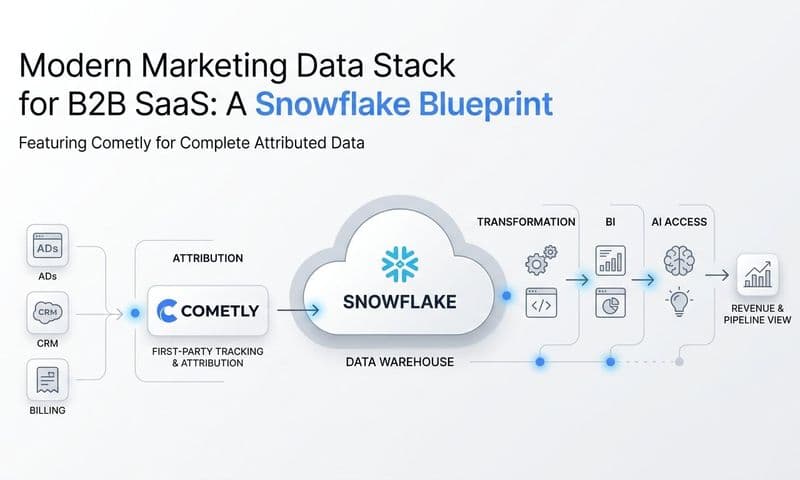
- This is why automation isn't a luxury—it's a necessity. A platform like Cometly is built to kill the guesswork by creating a single source of truth for your marketing data. It makes sure the numbers going into your calculations are always accurate, complete, and up-to-date.
Bypassing Data Gaps With Server-Side Tracking
- Relying on client-side tracking like the Facebook Pixel is a losing game, especially after all the iOS updates and the rise of ad blockers. This old method misses a huge chunk of conversion data, making you think your campaigns are tanking when they might actually be killing it.
- Server-side tracking is the fix. It sends conversion data directly from your server to the ad platforms, sidestepping browser-based interruptions entirely. You get a much, much clearer picture of your actual revenue.
- With Cometly, this isn't some complex technical nightmare. It gives you a rock-solid server-side tracking infrastructure right out of the box, ensuring you capture every possible sale. The result? A far more accurate ROAS calculation.
When your revenue data is incomplete, your breakeven ROAS is fundamentally flawed. Server-side tracking patches these holes, ensuring your profitability targets are based on reality, not on the fragmented data ad platforms can see.
- This level of accuracy is critical. For e-commerce brands in the US spending a collective $200B on ads each year, AI-driven platforms are a game-changer for recalibrating breakeven targets on the fly. This precision has been shown to boost campaign win rates by 15-20%. One DTC apparel brand even slashed wasted ad spend by 22% by integrating accurate historical data—a move that helped them handle the 25% cost spikes during Black Friday.
The Power of Multi-Touch Attribution
- Another huge blind spot in manual calculations is the reliance on a blended, account-wide ROAS. This number is dangerously misleading because it hides the true performance of individual channels, campaigns, and ads. Your Facebook campaigns likely have a completely different profitability threshold than your TikTok or Google ads.
- This is where multi-touch attribution becomes essential. Instead of giving 100% of the credit to the last click, it helps you see the entire customer journey and understand how different touchpoints worked together to get the sale.
- Top-of-Funnel: A TikTok ad might introduce someone to your brand. It'll have a low initial ROAS but creates massive long-term value by filling your funnel.
- Mid-Funnel: A Google Search ad could be where a customer does their final research before they're ready to buy.
- Bottom-of-Funnel: A retargeting ad on Facebook might be the final nudge that seals the deal.
- Cometly’s platform helps you assign the proper value to each of these steps, so you can set channel-specific ROAS targets. You might be perfectly fine with a lower ROAS on a top-of-funnel TikTok campaign because you know it's feeding your high-converting retargeting audiences. This kind of strategic thinking is a world away from a simple, blended target. You can learn more about Cometly's marketing attribution features and see how they clarify the entire customer journey.
Syncing Your Financials for Flawless Accuracy
- The final piece of the automation puzzle is connecting all your financial data so it’s perfectly synced and always current. Manually updating COGS every time your supplier changes prices or trying to calculate LTV from messy spreadsheets just isn't sustainable.
- Cometly handles this by integrating directly with the tools you already use.
- Shopify & WooCommerce: Pulls real-time revenue and order data.
- Stripe & PayPal: Syncs payment processing fees and transaction details.
- CRMs like Salesforce: Connects customer data to calculate accurate LTV.
- This direct sync means every variable in your breakeven ROAS formula—revenue, COGS, variable fees, and LTV—is pulled in automatically. No more manual entry, which means no more human error. Your ROAS targets become dynamic, adjusting in real-time as your business costs and customer behaviors change.
- This automated ecosystem frees you from the drudgery of data wrangling and lets you focus on what actually matters: strategy. Instead of spending hours buried in spreadsheets, you can spend minutes analyzing reliable reports, confident that the numbers you're seeing reflect the true financial health of your advertising.
Common Questions About Breakeven ROAS
- Even after you nail down the formula and play around with a breakeven ROAS calculator, some practical questions always pop up. Getting these details sorted is what turns the theory of breakeven ROAS into a powerful, day-to-day tool for making better marketing decisions.
- Let's dig into some of the most common questions we hear from marketers who are actually putting these ideas to work.
How Often Should I Recalculate My Breakeven ROAS?
- Your breakeven ROAS isn’t a "set it and forget it" number. It’s a living metric that has to reflect the current state of your business. If you only calculate it once a year, you might as well be navigating with an old map.
- You need to get into the habit of recalculating your breakeven ROAS anytime a key variable in your cost structure changes.
- Supplier Price Changes: If your COGS goes up or down, your margin shifts instantly.
- Shipping Rate Increases: Carriers update their rates annually, and even small changes can throw off your breakeven point.
- New Packaging: That switch from a cheap poly mailer to a fancy branded box? That's a new variable cost you have to factor in.
- Running a Major Sale: When you offer a 25% discount, your AOV takes a nosedive. Your breakeven ROAS for that sale period will be way higher than normal.
A good rule of thumb is to review your numbers quarterly and do an immediate recalculation whenever a major cost-related event happens. This keeps your targets grounded in your real-time business economics.
What Is a Good ROAS Target Beyond Breaking Even?
- Breaking even is the starting line, not the finish line. A "good" ROAS is one that not only covers your variable costs but also helps pay for fixed overhead and, most importantly, generates a healthy net profit.
- The best way to set a target is to work backward from your profit goals. Start by asking, "How much net profit do I want to make from each order?"
- Let's say you're aiming for a 20% net profit margin on every sale.
- Find Your Breakeven ROAS: First, you need your baseline. Let's imagine it's 1.8x. This means you need a profit margin of 55.5% just to cover costs.
- Add Your Profit Goal: To hit that 20% net profit, you have to add it on top. Your new "target profit margin" is 75.5% (55.5% to break even + 20% for you).
- Calculate Your New Target ROAS: The formula is the same:
1 / (1 - Target Profit Margin).
- But here's a simpler way to think about it: if a 1.8x ROAS gets you to $0 profit, then a 3.6x ROAS would roughly double your revenue relative to your costs, leaving a solid chunk for profit after you've covered COGS and ad spend. Your target ROAS is the lever you pull to control your business's overall profitability.
Should Every Campaign Have the Same ROAS Target?
- Absolutely not. Applying a single, blended ROAS target to all your campaigns is one of the most common—and costly—mistakes you can make. Different campaigns have different jobs, and their targets need to reflect that.
- Prospecting Campaigns: These ads are hitting cold audiences who have no idea who you are. The goal here is awareness and new customer acquisition. It's completely normal for these campaigns to run at a lower ROAS, sometimes just hovering around your breakeven point. You're paying to bring new people into your world.
- Retargeting Campaigns: Here, you're talking to a warm audience that's already checked you out. These campaigns should have a much higher ROAS target. Their job is to convert existing interest and drive sales efficiently.
- By setting tiered targets, you can judge each campaign on its actual mission within your funnel. This simple shift stops you from killing a top-of-funnel campaign that's successfully feeding your high-converting retargeting audiences.
- A calculator gives you the numbers, but making sense of them requires a tool that provides clarity across the entire customer journey. With Cometly, you can automate your data inputs, set channel-specific targets with multi-touch attribution, and finally see the true profitability of your ad spend. Stop guessing and start scaling with confidence at https://www.cometly.com.