
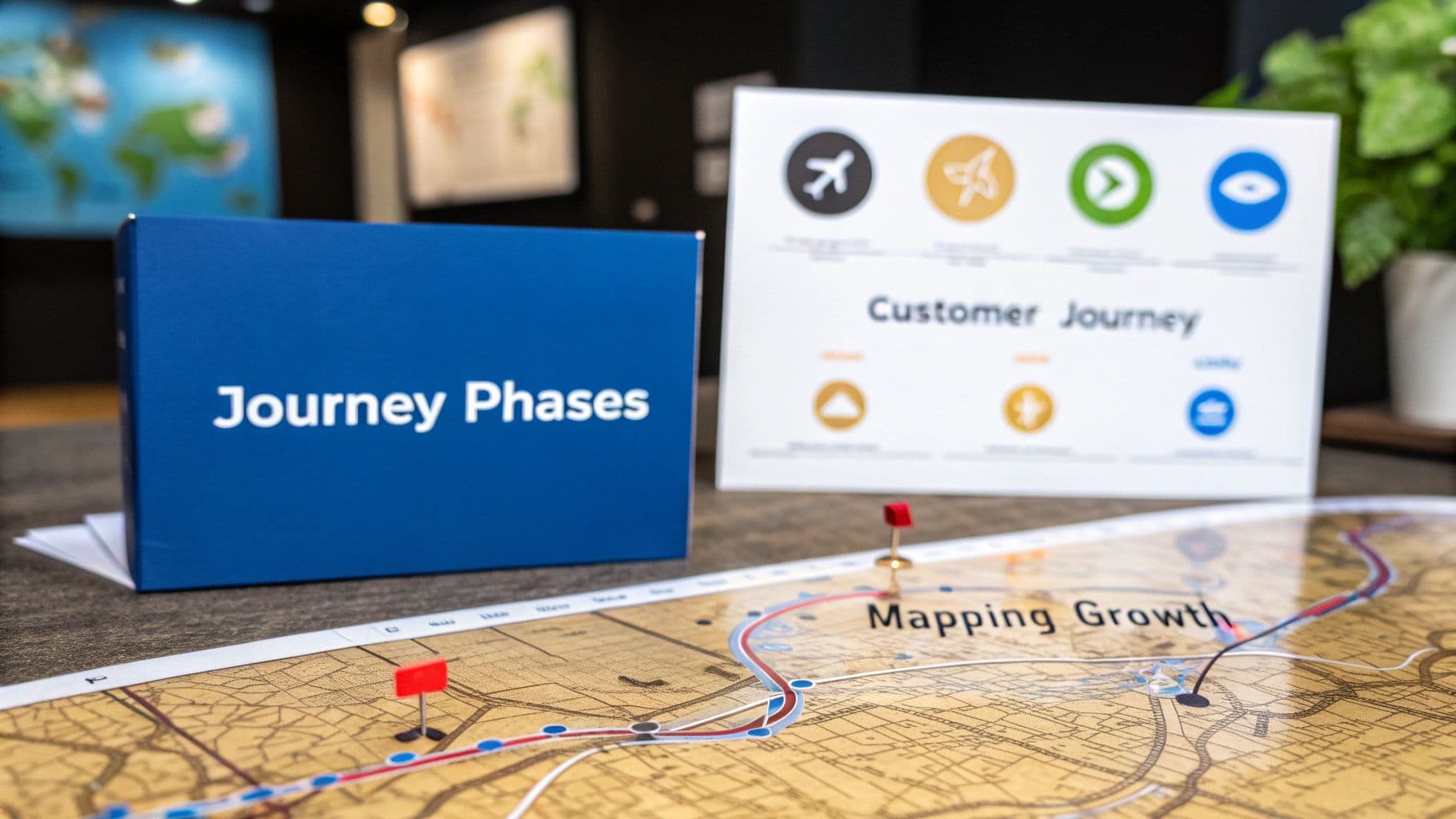
A customer journey phase is one of the distinct stages a person moves through when they interact with your brand—from the moment they first hear about you to the day they become a loyal fan.
Think of it like this: each phase is a key chapter in the story of your relationship with a customer, and every chapter has its own goals, challenges, and chances to connect.
The Modern Customer Journey Explained
 Mapping Every Customer Journey Phase for Maximum Growth
Forget the idea of a simple, straight line from A to B. The modern customer journey is a lot more like planning a big vacation. There are dozens of places to get inspiration, countless reviews to check, multiple booking sites to compare, and a ton of small decisions that lead to the final destination.
It’s a winding, scenic route, not a direct flight.
This path is scattered across all sorts of channels and devices. A potential customer might see your brand for the first time in a TikTok ad, search for you on Google later that day, read a blog post, get hit with a retargeting ad on Facebook, and finally click a link in an email to buy. Each interaction is a breadcrumb guiding them forward.
Core Stages of The Journey
To make sense of all this, marketers break the process down into a few core stages. The models can vary, but almost all of them follow the same basic progression from stranger to loyal advocate.
The most essential stages are:
- Awareness: This is the "first hello." It’s where a potential customer realizes they have a problem and discovers your brand might be the solution.
- Consideration: After they know you exist, the prospect starts doing their homework. They’re actively researching, comparing your stuff to the competition, and figuring out if you’re the right fit.
- Conversion: This is the moment of truth. The prospect pulls the trigger, whether that means making a purchase, signing up for a trial, or completing whatever your main business goal is.
But the journey doesn't end at the sale. The best brands know the map extends to two more crucial phases: Retention, which is all about keeping customers happy, and Advocacy, where those happy customers turn into your biggest promoters.
Why Mapping Each Phase Matters
For any marketer who has to justify their ad spend and prove ROI, understanding each phase of the customer journey is non-negotiable.
If you only give credit to the very last click before a purchase, you’re completely ignoring the dozens of earlier touchpoints that made the sale happen in the first place. It’s like giving all the credit for a championship win to the player who scored the final point, forgetting about the entire team’s effort throughout the game.
Without a clear map of this whole process, you're flying blind. You won't know which channels are bringing you new customers, which ones are building trust, or where people are dropping off.
By building a data-driven marketing strategy, you can light up the entire path, optimize every single step, and put your budget where it will actually make a difference.
Decoding The Awareness Phase
 Mapping Every Customer Journey Phase for Maximum Growth
This is the "first hello" in every customer relationship. The awareness phase is where a potential buyer realizes they have a problem and your brand pops up on their radar, often for the very first time. Think of it as the spark that gets their attention.
The goal here isn't to make a sale; it's to capture interest and plant a seed of brand recognition. You need to show up where your future customers are already spending their time. This isn't about a hard sell—it's about being helpful, interesting, or just plain entertaining.
Common First Touchpoints
The first interactions during the awareness phase are usually broad and varied, designed to reach a wide net of people. These are the digital handshakes that introduce your brand to the world.
Key touchpoints at this stage often include:
- Social Media Ads: A visually slick ad on Instagram or a viral-style video on TikTok can stop a user mid-scroll.
- Organic Search Results: When someone Googles a question tied to their problem, a well-optimized blog post from your site can be the first answer they find.
- Video Content: An educational YouTube tutorial or an entertaining short-form video can introduce your brand's personality and expertise.
- Influencer Mentions: A trusted creator giving your product a shout-out can instantly transfer credibility and introduce you to their entire audience.
Understanding the role of each customer journey touchpoint is foundational to mapping this phase correctly.
The real challenge in the awareness phase is that these first interactions are incredibly easy to undervalue. A single click from a Facebook ad might not lead to a sale that day, but it’s the crucial first step that kicks off the entire journey. Without tracking it, you lose the beginning of the story.
This initial stage is a huge opportunity, and businesses are investing heavily to nail it. The global customer journey analytics market hit USD 9.96 billion in 2022 and is projected to reach USD 41.70 billion by 2030. That growth highlights the intense focus on mapping these early touchpoints where customers first meet a brand.
Tracking Success In The Awareness Phase
Since sales aren't the primary goal, the metrics for success look a little different. The main objective is to figure out How to Build Brand Awareness that eventually leads to conversions down the line. We measure this with top-of-funnel KPIs that signal brand visibility and initial interest.
Key KPIs for this customer journey phase include:
- Impressions: The total number of times your ad or content was displayed.
- Reach: The number of unique people who actually saw your content.
- Click-Through Rate (CTR): The percentage of people who saw your ad and were interested enough to click on it.
For example, a direct-to-consumer brand launching a new skincare line might run video ads on TikTok and work with beauty influencers. They wouldn't measure success by immediate sales, but by the number of impressions, video views, and clicks to their "learn more" page.
These metrics prove their message is landing with the right audience, which sets the stage for everything that comes next.
Navigating The Consideration Phase
Once a potential customer knows your name, they enter the all-important evaluation stage. The consideration phase is where the real homework begins. People are no longer just window-shopping; they're actively comparing your solution against the competition, digging into the details, and trying to figure out if you're truly the best choice for them.
Think of it as the "due diligence" part of their decision. They’ve moved past that initial spark of interest and are now weighing pros and cons, hunting for reviews, and looking for proof that you can actually solve their problem. Your job is to arm them with the right information at the right time to build trust and prove your value.
Building Trust Through Key Touchpoints
In the consideration phase, your interactions need to be more focused and educational. The goal is to nurture the curiosity you sparked in the awareness stage and guide people closer to a decision. This means serving up targeted content that directly answers their questions and dismantles their objections.
Here are a few common touchpoints that build confidence:
- Targeted Retargeting Ads: Serving ads to people who have already visited your site, showing them case studies or specific product features that line up with what they were looking at.
- In-Depth Product Pages: Going way beyond a simple description. We're talking detailed specs, high-quality images, video demos, and crystal-clear pricing.
- Email Nurture Sequences: Sending a series of automated emails that teach subscribers about your product, share customer success stories, and offer genuinely helpful resources.
- Case Studies and Testimonials: Providing real-world proof that shows how actual people or businesses have won by using your solution.
This is where single-touch attribution models completely fall apart. A customer might see a retargeting ad, open three emails, and download a case study over several weeks. Giving credit only to the final click ignores the dozen or so interactions that built the confidence needed for a final decision.
Measuring Engagement and Intent
As your focus shifts from just getting noticed to actually educating, your KPIs have to evolve, too. Success in this phase isn't measured by impressions or clicks anymore. Now, you’re looking for signs of engagement and clear purchase intent—proof that your audience is actively weighing their options. For more on this, check out our guide on customer journey mapping software.
Important metrics to watch here are:
- Time on Page: How long are visitors sticking around on your key product pages or blog posts? Longer sessions suggest deeper engagement.
- Cost Per Lead (CPL): How much are you spending to get a lead from a content download or a webinar registration?
- Email Open and Click-Through Rates: Are your nurture sequences actually grabbing attention and pulling prospects back to your site?
A SaaS Company Example
Imagine a SaaS company that sells project management software. In their consideration phase, they retarget website visitors on LinkedIn with an ad for a free guide: "5 Ways to Streamline Your Team's Workflow." Once someone downloads it, they’re dropped into an email sequence that showcases specific software features, shares a video testimonial from a similar company, and invites them to a live demo.
Related reading: our complete guide to AI short form video ads generator.
During this process, analytics are absolutely critical as people evaluate their options across multiple channels. This phase sees an intense flow of data from various touchpoints, where confusion from disconnected data causes 90% of B2B purchase processes to stall. You can explore more on these findings by reading the full 2023 Forrester survey analysis. By tracking CPL and demo sign-up rates, the company can see exactly how well its content is turning curiosity into real sales opportunities.
Mastering The Conversion And Retention Phases
This is the moment of truth. All the awareness-building and consideration-nurturing has led to this exact point, where a curious prospect finally decides to become a paying customer. But the journey doesn't stop once the payment goes through; in fact, an equally important chapter is just beginning.
Let's break down the two final, most critical stages: the initial Conversion and the long-term game of Retention and Advocacy. One gets you the sale; the other builds an empire.
The Conversion Phase Unpacked
The conversion phase is where a prospect takes the decisive action that puts money in your pocket or a qualified lead in your pipeline. It’s the finish line of your initial acquisition effort, and the touchpoints here are laser-focused on making this final step as seamless and reassuring as possible.
Common touchpoints that seal the deal include:
- Checkout Pages: For e-commerce, this is the final gateway. It needs to be simple, fast, and trustworthy.
- Demo Request Forms: In B2B or SaaS, this is often the key conversion, signaling a high-intent lead is ready to talk to sales.
- "Buy Now" or "Sign Up" Buttons: The ultimate call-to-action that turns a visitor into a customer or user.
The metrics in this phase are tied directly to your bottom line. There's no ambiguity here—you're measuring real business impact. Key performance indicators (KPIs) like Conversion Rate, Customer Acquisition Cost (CAC), and Average Order Value (AOV) tell you not just if you're making sales, but how efficiently and profitably you're doing it.
The Retention and Advocacy Phase
Too many marketers see the sale as the end of the journey. In reality, it's the start of a new, potentially far more profitable one. The retention phase is all about turning that one-time buyer into a loyal, repeat customer. When you really nail this, they enter the advocacy phase, becoming brand evangelists who do your marketing for you.
The core takeaway is that the journey doesn't end at the sale. Sustainable, long-term growth is built on the foundation of happy customers who keep coming back and bring their friends with them.
This phase is nurtured through ongoing, value-driven interactions. Key touchpoints for building loyalty are:
- Post-Purchase Emails: Welcome sequences, order confirmations, and helpful tips on actually using the product.
- Customer Support Interactions: Every support ticket is a chance to turn a problem into a positive, brand-building experience.
- Loyalty Programs: Rewarding repeat customers for their continued business is a no-brainer.
Here, the KPIs shift to measure long-term value and loyalty. You'll want to track Customer Lifetime Value (LTV) to understand the total revenue a single customer brings over their entire relationship with you. Equally important is your churn rate—the percentage of customers who stop doing business with you. To get a better handle on this metric, you can learn more about managing customer attrition in our detailed guide.
For example, an e-commerce agency might run a campaign that brings in customers with a lower initial AOV but a much higher LTV. Without tracking post-purchase behavior, they might incorrectly cut a campaign that is actually building a highly profitable, long-term customer base. This is a perfect illustration of how analyzing the full journey reveals the true value of your marketing. By mastering both conversion and retention, you create a powerful engine for sustainable growth.
How To Measure Every Phase With The Right Tools
Knowing the customer journey phases is one thing, but actually measuring them is a completely different ballgame. To connect the dots from that first ad click to the final sale, you need a unified tracking platform. Without the right tools, you’re basically just guessing where your revenue is coming from.
Modern marketing is messy. A customer might see a Facebook ad on their phone, click a Google search result on their laptop a day later, and then open an email a week after that before finally buying. To make sense of it all, you need technology that captures every single one of these interactions.
Unifying Your Data With Server-Side Tracking
The secret to getting this right is server-side tracking. Unlike old-school browser-based tracking that gets blocked or messed up by privacy updates, server-side tech sends data directly from your server to your analytics and ad platforms. This creates a far more reliable and complete picture of what's happening.
This method ensures you see every touchpoint, giving you a crystal-clear view of the entire customer path. It’s the foundation for untangling the complex, multi-channel journeys your customers are really on.
Think of it this way: browser-side tracking is like trying to hear a conversation from across a noisy room—you’ll probably miss key words. Server-side tracking is like having a direct line, ensuring you hear every single word perfectly clear.
Visualizing The Full Journey With Multi-Touch Attribution
Once you're collecting clean data, the next job is to assign credit where it's due. This is where multi-touch attribution models are so powerful. Instead of giving 100% of the credit to the very last click, these models spread it across multiple touchpoints, showing you which channels are really driving results.
A couple of common multi-touch models include:
- Linear: This model gives equal credit to every single touchpoint in the journey. It’s a great way to understand the overall contribution of each channel.
- Time-Decay: This one gives more credit to the touchpoints that happened closer to the conversion. It's useful for seeing which interactions finally push customers over the finish line.
By using these models, you can finally see how your top-of-funnel awareness campaigns actually influence bottom-of-funnel sales. This insight is gold for optimizing your marketing budget and proving ROI across every single phase. If you're looking for more options, you can explore a range of customer journey analytics tools to find the best fit for your business.
Putting It All Into Practice
Getting this level of tracking set up doesn't have to be a nightmare. With a platform like Cometly, you can connect your ad platforms, website, and CRM in just a few clicks. You’ll set up your key conversion events—like a purchase or a lead form submission—and then let the system handle the rest.
This infographic shows how the journey continues long after the initial purchase, moving from the conversion into long-term retention and even advocacy.
 Mapping Every Customer Journey Phase for Maximum Growth
As you can see, the sale is really just the beginning of what could be a much more valuable relationship built on loyalty and word-of-mouth.
A centralized dashboard then pulls all your data together, letting you monitor your phase-specific KPIs in one spot. You can see which Facebook campaigns are driving awareness, which email sequences are nurturing leads, and which Google Ads are closing the most sales.
This unified view lets you make confident, data-backed decisions. You can finally shift your budget away from underperforming campaigns and double down on the ones that are proven to move customers through their journey. Ultimately, this approach puts a stop to wasted ad spend and directly boosts your marketing ROI.
Common Questions About The Customer Journey
Even after breaking down the customer journey, a few common questions always seem to pop up. Let's run through them to make sure these concepts are crystal clear and ready to apply to your own marketing.
What Is The Difference Between A Customer Journey And A Sales Funnel?
It's easy to mix these two up, but they look at the world from completely different perspectives.
A sales funnel is a linear, top-down model that shows how you guide a big group of prospects into a smaller group of customers. It’s a company-focused view, built around one single goal: closing the sale.
A customer journey, on the other hand, maps out the entire experience from the customer's point of view. It’s messy, non-linear, and recognizes every single touchpoint across every phase—from the moment they hear your name all the way to becoming a raving fan.
Think of it this way: a funnel is a straight waterslide designed to get people to the pool at the bottom. A customer journey is the entire water park, with multiple slides, lazy rivers, and concession stands people visit in whatever order they choose.
How Do I Choose The Right Attribution Model?
There’s no single "best" attribution model—the right one depends entirely on your business goals and how complex your customer journey is.
- Last-Click Attribution: This is the simplest model, giving 100% of the credit to the final touchpoint before someone converted. It's useful for knowing what closes deals, but it completely ignores all the hard work that came before it.
- First-Click Attribution: The exact opposite of last-click, this one credits the very first interaction a person had with your brand. It’s great for seeing which channels are best at kicking off new customer journeys.
- Multi-Touch Models (Linear, Time-Decay, U-Shaped): These are far more balanced, spreading credit across multiple touchpoints. They give you a much more realistic picture of how different channels work together to drive someone from awareness to a sale.
For most businesses, it makes sense to start with a simple model to get your bearings, then graduate to a multi-touch approach to get the full story.
How Can I Track Offline Touchpoints?
Tracking offline interactions like phone calls, in-store visits, or conversations at a trade show can feel like a headache, but it’s essential for building a complete picture of the journey. The trick is to create a bridge between the physical and digital worlds.
You can do this by using unique, trackable phone numbers for different ad campaigns, putting QR codes on print materials that link to specific landing pages, or even just asking customers at checkout how they heard about you. You can then feed this data into your CRM, which can be synced with a platform that pulls all your journey data together, making sure no touchpoint gets left behind.
Ready to map every touchpoint and prove your marketing ROI with pinpoint accuracy? Cometly unifies your data, giving you a crystal-clear view of the entire customer journey from first click to final sale. Eliminate wasted ad spend and scale with confidence by visiting https://www.cometly.com.