

Data-driven attribution cuts through the guesswork. Instead of using rigid rules, it leans on smart algorithms to give credit where credit is due, analyzing every single marketing touchpoint to see what actually led to a conversion. It looks at your unique customer data to figure out which channels—from the very first ad they saw to the last email they clicked—are truly driving your sales.
Why Marketers Are Moving Beyond Last-Click Guesswork
 Data Driven Attribution A Guide To Smarter Marketing
For years, marketers have been stuck on one frustrating question: which of our efforts are actually working? The default answer has almost always come from last-click attribution, a model that hands 100% of the credit to whatever a customer clicked right before buying.
Think about it. That's like crediting only the striker for scoring a goal, completely ignoring the midfielders who passed the ball and set up the perfect shot.
This dangerously simple view gives you a warped picture of your marketing performance. It consistently overlooks all the crucial "assists" that happen earlier in the buying process, like brand awareness campaigns on social media or that first blog post that got someone interested.
The Flaws of Simplistic Models
Relying on last-click is like trying to navigate a new city using only the final street sign—you know where you ended up, but you have no clue how you got there. This method will inevitably lead you to make some poor strategic decisions.
- Undervalued Channels: Top-of-funnel activities that introduce new customers to your brand are almost always under-credited.
- Misallocated Budgets: You might slash the budget for a Facebook ad that kicks off thousands of customer journeys, all because it rarely gets that final click.
- Incomplete Picture: It completely fails to capture how modern customers actually behave, interacting with a brand across multiple channels over days or even weeks.
To truly move beyond last-click guesswork, it's essential to first visualize the intricate paths your customers take, a process effectively achieved through understanding customer journey mapping.
Embracing a Smarter Approach
The cracks in last-click attribution are showing, especially as customer paths get more and more fragmented. If you want a deeper dive into its specific problems, you can learn more about the issues with last click attribution and see exactly why a change is needed. This growing frustration has finally cleared the way for a much more intelligent solution.
This is where data-driven attribution comes in.
Instead of following a one-size-fits-all rule, it uses your own historical data and machine learning to analyze the entire customer journey. It pinpoints which interactions—from the first ad impression to the last email they opened—had the biggest impact on the final sale and assigns credit accordingly. This gives you the clarity you need to optimize your whole marketing funnel, not just the very last step.
What Exactly Is Data Driven Attribution
Imagine you're a detective trying to solve a complicated case. Would you only listen to the last witness who saw what happened? Of course not. You’d interview everyone involved, analyze every single clue, and piece together the entire sequence of events to figure out the truth.
This is exactly how data-driven attribution works for your marketing.
Instead of leaning on a rigid, oversimplified rule like "credit the last click," it acts as your marketing detective. It analyzes every clue—every ad view, email open, social media interaction, and website visit—to solve the case of what genuinely led to a conversion. It’s a dynamic model that uses your company’s own historical data to figure out which touchpoints are the most influential.
This method doesn't just look at the paths of customers who converted. Crucially, it also examines the journeys of those who didn't. By comparing these two groups, machine learning algorithms can spot the patterns and specific interactions that have the highest probability of leading to a sale. It’s a custom model built for your unique business.
How Algorithms Replace Guesswork
At its core, data-driven attribution replaces assumptions with hard math. Traditional models are based on human-defined rules that are, by their very nature, biased. A first-click model, for instance, gives all the glory to the initial touchpoint. A linear model spreads credit evenly, assuming every single interaction was equally important—a scenario that’s highly unlikely in the real world.
Data-driven models throw those rigid rules out the window. They use sophisticated algorithms, like the Shapley value from game theory or Markov chains, to calculate the actual contribution of each marketing channel.
The model essentially asks, "If this specific touchpoint were removed from the customer's journey, how much would the probability of a conversion decrease?" The bigger the drop, the more credit that touchpoint receives.
This means the model learns and adapts over time. As your customers' behaviors shift or as you launch new campaigns, the attribution model recalibrates itself based on the fresh data flowing in. It ensures your insights stay relevant, rather than becoming outdated relics of a past strategy.
To get the full picture of how these interactions are tracked, you can explore our detailed guide on what is multi touch attribution.
A Clearer Picture of Marketing Performance
The shift towards this smarter model is happening for a clear reason. Today, a staggering 73% of e-commerce shoppers now travel across multiple channels before making a purchase. This complexity makes old last-click models obsolete because they ignore all the critical interactions that happened before that final click.
It's no surprise that adoption is surging, with 60% of leading professionals now viewing data-driven attribution as essential for understanding high-value customer journeys. You can discover more about these trends in marketing measurement on embryo.com.
Ultimately, data-driven attribution gives you a more accurate and actionable picture of your marketing performance. It moves beyond simply tracking conversions and starts explaining why they happen.
Here’s what that clarity looks like in practice:
- Fair Credit Distribution: Channels that introduce and nurture leads, like top-of-funnel content or social media campaigns, finally get the recognition they deserve.
- Smarter Budgeting: You can confidently shift your budget away from channels that only look good on a last-click report and invest in the ones that truly drive incremental value.
- Deeper Customer Insights: By understanding which sequences of touchpoints are most effective, you gain invaluable insight into how your customers actually make decisions.
Instead of making decisions based on an incomplete story, data-driven attribution hands you the full case file, empowering you to optimize your entire marketing engine with precision.
Comparing How Attribution Models Assign Credit
To really get why data-driven attribution is such a big deal, you have to see it in action against the old-school, rule-based models. Depending on which model you use, you can get a wildly different story about the exact same customer journey—and that leads to completely different decisions about where to put your money.
Let's walk through a classic example.
Imagine a potential customer, Sarah, is on the hunt for new project management software. Her path to purchase involves four distinct touchpoints before she finally pulls out her credit card and signs up for a paid plan.
- Touchpoint 1 (Facebook Ad): Sarah first learns your brand exists after seeing a targeted ad in her Facebook feed.
- Touchpoint 2 (Google Search): A week later, she’s actively searching for solutions and clicks on your organic search result.
- Touchpoint 3 (Email Promo): She signs up for your newsletter and, a few days later, gets a promotional email with a special offer.
- Touchpoint 4 (Direct Visit): She clicks the link in the email, browses your site, leaves, and then comes back later that day by typing your URL directly into her browser to make the purchase.
So, how would different attribution models split the credit for Sarah's $100 conversion? The answers might surprise you.
Rule-Based Models: A World of Bias
Rule-based models are rigid. They operate on a fixed set of instructions and never adapt to actual customer behavior. Think of them as a script—they just follow the rules, which often gives you a skewed picture of what really convinced the customer to buy.
Here’s how they’d score Sarah’s journey:
- First-Click Attribution: This model gives 100% of the credit ($100) to the Facebook Ad. The logic? That first touchpoint kicked off the whole journey, so it gets all the glory. Every other interaction is completely ignored.
- Last-Click Attribution: On the flip side, this model gives 100% of the credit ($100) to the Direct Visit. It only cares about the final action before the conversion, totally overlooking the ad, search, and email that got Sarah there in the first place.
- Linear Attribution: This model tries to be fair by splitting the credit evenly. Each of the four touchpoints gets 25% of the credit ($25). While it at least acknowledges every step, it makes the faulty assumption that each one was equally important.
As you can see, these simplistic models can easily lead you down the wrong path. For a deeper dive, check out our complete comparison of attribution models for marketers. Each rule-based system brings its own bias, either overvaluing the first touch, the last touch, or pretending every interaction carries the same weight.
The Data-Driven Attribution Difference
Now, let's look at how a data-driven model handles the same scenario. Instead of blindly following a rule, it crunches the numbers on thousands of similar customer journeys—both those that converted and those that didn't—to figure out the actual influence of each touchpoint.
A data-driven model doesn't just look at one path; it learns from all of them. It compares the journeys of customers who buy to those who don't, identifying which interactions have the highest statistical probability of leading to a sale.
This is a great way to visualize how a data-driven model works, processing all the different paths to assign credit where it's truly due.
 Data Driven Attribution A Guide To Smarter Marketing
Based on this kind of sophisticated analysis, the credit for Sarah's $100 conversion would look much more nuanced:
- Facebook Ad: 20% credit ($20)
- Google Search: 35% credit ($35)
- Email Promo: 40% credit ($40)
- Direct Visit: 5% credit ($5)
See the difference? The algorithm figured out that while the Facebook ad played a role in awareness, it was the Google search and the timely email promo that did the heavy lifting to push Sarah toward a decision. The final direct visit, while technically the last step, gets minimal credit because her intent to purchase was already solidified.
This dynamic, data-backed approach tells a far more accurate and actionable story of your marketing performance.
Let's break down how these models stack up side-by-side.
The table below gives you a quick snapshot of how each model assigns credit and the pros and cons that come with each approach.
Attribution Model | How It Works | Pros | Cons |
|---|---|---|---|
First Click | Assigns one hundred percent of credit to the first touchpoint | Simple and effective for highlighting top of funnel channels | Ignores all interactions that occur after the initial engagement |
Last Click | Assigns one hundred percent of credit to the final touchpoint before conversion | Easy to implement and clearly identifies closing channels | Provides no insight into awareness or consideration building channels |
Linear | Splits credit evenly across every touchpoint in the journey | Acknowledges the full customer journey | Assumes all touchpoints have equal influence, which is rarely true |
Data Driven | Uses machine learning to assign credit based on actual conversion influence | Most accurate and nuanced representation of performance | Requires large data volumes and can be complex to configure and interpret |
Ultimately, rule-based models offer simplicity but at the cost of accuracy. Data-driven attribution, on the other hand, delivers the kind of granular insight you need to make genuinely smart decisions about your marketing budget and strategy.
The Real-World Impact On Your Marketing Budget
 Data Driven Attribution A Guide To Smarter Marketing
Let's be honest, understanding different attribution models is more than just an academic exercise. It has a direct, powerful, and immediate impact on your most critical resource: your marketing budget.
When you finally ditch the old, biased rule-based models for an intelligent, data-driven approach, you’re not just getting a clearer report. You're fundamentally changing how you invest every single dollar.
This shift turns attribution from a backward-looking report card into a forward-looking strategic weapon. It gives you the confidence to make decisions that were impossible before, pulling funds from channels that only look good on paper and redirecting them to the ones that genuinely drive growth. The result is a more efficient, profitable, and sustainable marketing engine.
Instead of guessing which channels deserve more cash, you can see precisely which touchpoints—like an early-stage blog post or a mid-funnel retargeting ad—are punching way above their weight. This is how you stop funding underperformers and double down on the hidden gems that were previously getting zero credit.
From Inefficient Spend To Profitable Growth
The real beauty of data-driven attribution is its ability to reveal true performance. When you know the actual value each channel brings to the table, you can optimize your spending with surgical precision.
Imagine discovering that a specific video series on YouTube, while rarely getting the last click, is consistently involved in your highest-value customer journeys.
A last-click model would tell you to kill its budget. A data-driven model would scream at you to invest more. This is the kind of insight that separates good marketers from great ones. By reallocating funds based on true influence, you’re not just cutting waste; you’re actively fueling your most effective growth channels.
If you want to dig deeper into this process, our guide on marketing budget planning offers some great frameworks.
This strategic shift creates a ripple effect across your entire business:
- Lower Customer Acquisition Costs (CAC): You spend less to acquire each new customer by focusing only on the most efficient paths to conversion.
- Higher Return on Ad Spend (ROAS): Every dollar is put to work more effectively, boosting the overall profitability of your campaigns.
- Accelerated Growth: Smarter investments lead to faster, more sustainable scaling because your budget is finally aligned with actual customer behavior.
Battle-Tested Results From Major Brands
This isn't just theory; it’s a proven strategy used by some of the biggest names out there. The market for data-driven attribution software is exploding for one simple reason: it delivers tangible ROI.
Just look at HelloFresh. By switching to a data-driven model, they expanded their customer base, achieving 10% more conversions while simultaneously slashing their cost-per-acquisition by a massive 18%.
Similarly, the online pharmacy Medpex boosted its conversions by 29% while cutting its CPA by 28%. You can learn more about how major markets are using attribution software on futuremarketinsights.com.
These statistics prove that data-driven attribution is not an abstract analytical tool. It's a strategic weapon for boosting profitability and driving measurable growth in competitive markets.
The results speak for themselves. When companies get a clear, unbiased view of what truly influences their customers, they can optimize their budgets with a level of confidence that rule-based models could never provide. This clarity is the key to unlocking more efficient spending, higher conversion rates, and a much healthier bottom line.
It’s all about making every single marketing dollar work harder for you.
A Practical Guide to Implementing Data-Driven Attribution
Alright, let's move from theory to action. Getting started with data-driven attribution can feel like a huge mountain to climb, but it’s far more achievable than you might think. The journey doesn’t start with complicated algorithms or a team of data scientists. It starts with a solid foundation of clean, comprehensive data.
Seriously, if your data is a mess, even the most powerful model on the planet won't save you. Before you can let the numbers decide where to give credit, you have to be absolutely sure you’re collecting the right data from every single channel.
That means your tracking has to be buttoned up across your website, ad platforms, CRM, and anywhere else customers interact with your brand. Think of it like building a house—you can't start putting up walls until the foundation is perfectly set.
Choosing Your Platform
Once your data is in order, the next step is picking the right tool for the job. Several platforms offer data-driven attribution, but they’re not all created equal. The best choice usually comes down to your company's size, technical resources, and how deep you need to go with your insights.
For a lot of businesses, the most logical place to start is Google Analytics 4 (GA4). It’s free, it’s everywhere, and it now uses data-driven attribution as the default for all new conversion actions. This makes it an incredibly accessible entry point for teams who are ready to move beyond last-click guesswork.
But there's a catch. GA4’s model needs a certain amount of data to actually work properly.
- Conversion Volume: The algorithm needs at least 400 conversions for a specific goal within a 30-day period.
- User Paths: It also requires a minimum of 10,000 user paths (or customer journeys) within that same 30-day window.
If your numbers fall below these minimums, GA4 simply won't have enough information to build a reliable model. When that happens, it might fall back to a simpler, rule-based model, or the data-driven option just won't be available at all. This is a huge deal for smaller businesses or those with lower conversion volumes.
The Role of Centralized Data
While GA4 is a powerful starting point, its analysis is mostly limited to what happens inside the Google ecosystem. This creates some pretty big blind spots. It often struggles to pull in cost data from non-Google platforms (like Meta or TikTok) or smoothly integrate offline conversions.
The core problem with platform-specific models is that you're relying on insights you can't fully audit or verify. To get the real story, you need a system that sees everything—including all your ad spend—to calculate a true, complete ROI.
We compare the leading options in our ad spend management software roundup.
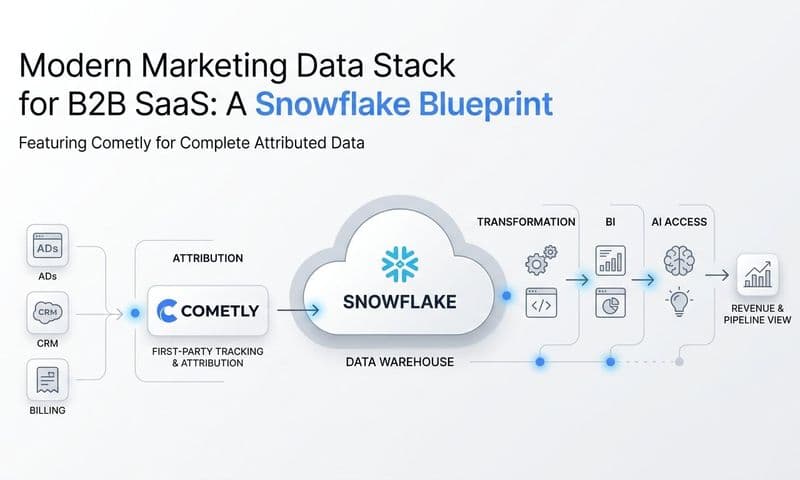
This is where dedicated attribution platforms like Cometly come in. They act as a central hub for all your marketing data, pulling information from every single channel—paid ads, organic search, email, social media, you name it. This creates a single, unified view of the entire customer journey and gets rid of the "black box" problem you find with individual platform models.
To get this level of clarity, structuring your data correctly is non-negotiable. Setting up a centralized data repository is a key first step. You can check out our guide on how to setup a datalake for marketing attribution to understand the technical groundwork involved. By bringing all your data together, you give your attribution model the complete picture it needs to deliver accurate, actionable insights that actually drive growth.
Future-Proofing Your Marketing Measurement
The way we track marketing performance is hitting a major turning point. With privacy taking center stage and third-party cookies on their way out, businesses are scrambling to find smarter, more reliable ways to see what’s actually working. This is where a solid data driven attribution strategy stops being a nice-to-have and becomes absolutely essential.
Trying to navigate this new world with old tracking models is like driving blindfolded. To really future-proof your marketing, you have to get a handle on the inherent difficulties in measuring marketing ROI, which is exactly the problem data-driven attribution was built to solve. It helps you build a measurement system that won’t crumble when the next industry shift happens.
The market is already voting with its dollars. The multi-touch attribution space is projected to more than double, exploding from USD 2.43 billion in 2025 to USD 4.61 billion by 2030. Data-driven models aren't just a small piece of that pie—they already command a 34.8% market share and are growing at a blistering 14.3% compound annual growth rate. This isn’t a trend; it’s a fundamental shift. You can read the full research on the multi-touch attribution market on mordorintelligence.com.
Integrating a Holistic View
To build a truly resilient system, the best marketers are looking beyond just clicks and digital touchpoints. The most sophisticated strategies now pair data-driven attribution with other powerful methods like Marketing Mix Modeling (MMM) to get the full picture.
Here’s how they work together:
- Data-Driven Attribution (DDA): Gives you a granular, user-level look at digital journeys. It shows you exactly how specific ads, emails, or social posts influence a conversion.
- Marketing Mix Modeling (MMM): Provides a high-level, top-down view. It analyzes how all marketing inputs—including offline channels like TV or print—and even external factors like seasonality or economic trends, affect sales over time.
When you combine the two, you can see both the micro-details of a single customer's path and the macro-impact of your entire marketing engine. This holistic view ensures you don't miss the offline pieces of the puzzle, like how a billboard might have prompted someone to later search for your brand online.
Combining granular DDA with high-level MMM creates a powerful feedback loop. You can use MMM to set strategic budgets across broad channels and then use DDA to optimize tactics within those channels for maximum efficiency.
The Predictive Power of AI
The future of attribution isn’t just about looking in the rearview mirror; it's about predicting what’s around the corner. AI and machine learning are transforming attribution models from simple credit-assigning tools into powerful forecasting engines.
Instead of just analyzing past data to see what worked, these advanced models can spot patterns that signal what a customer will do next. This lets you not only optimize your current campaigns but also forecast future outcomes with much greater confidence, helping you put your budget and resources where they’ll make the biggest impact tomorrow.
Common Questions About Data Driven Attribution
Once you start seriously considering a smarter measurement strategy, a few practical questions always pop up. Making the switch to data driven attribution is a big move, so let's tackle some of the most common sticking points right now.
How Much Data Do You Need?
This is easily the question I hear most often. The short answer? The more, the better.
An algorithm needs a ton of information to really learn how your customers behave and start spotting meaningful patterns. Without enough examples to work with, it can’t tell the difference between a genuinely influential touchpoint and just random noise.
For example, Google Analytics 4 won’t even activate its data-driven model without hitting specific thresholds. You generally need at least 400 conversions of a certain type and 10,000 user paths within a 30-day window. If your volume is below that, GA4 will just fall back to a simpler, rule-based model because it doesn't have the statistical confidence to build a custom one for you.
Is Every Platform's Model The Same?
Nope, and this is a critical point to get your head around. While the core idea is the same, the actual algorithms used by platforms like Google Analytics, Meta Ads, or specialized third-party tools are completely different. Each one runs on its own proprietary model, trained only on the data inside its own little world.
This is exactly why you see different attribution numbers for the same campaign when you look at different dashboards. It’s absolutely vital to pick a single source of truth and stick with it to avoid confusing yourself with conflicting reports.
Can These Models Ever Be Wrong?
While they're a huge leap forward from rule-based models, data-driven attribution isn't magic. It's not infallible. The model's accuracy is completely at the mercy of the quality and completeness of the data you feed it. Just think "garbage in, garbage out."
Any gaps in your tracking create blind spots, and that’s what leads to skewed results. Common culprits include:
- Incomplete Cross-Device Data: Failing to connect the dots when a user hops from their laptop to their phone.
- Missing Offline Touchpoints: Forgetting to account for in-store visits or sales calls that were kicked off by a digital ad.
- Unrecorded Channel Data: Not having the cost or impression data from every single place you're running ads.
The best way to think about data driven attribution is as a powerful directional tool. It gives you a much clearer, more reliable picture of what’s working, but you should always layer your own strategic thinking and business context on top of it.
Ready to get a truly unified view of your marketing performance without the black boxes? Cometly centralizes all your data into one powerful attribution platform, giving you the clarity needed to optimize your budget and scale with confidence. See how Cometly can transform your marketing measurement.