You're staring at three different dashboards at 11 PM on a Tuesday, and none of them agree. Google Ads says you got 127 conversions this month. Facebook claims 89. Your CRM shows 52 actual sales. Your CEO wants to know which campaigns are working, and you're about to tell them... what, exactly?
This isn't a technical glitch. It's the reality of modern digital marketing, where customers touch 6-8 different channels before buying, and every platform wants credit for the sale. The result? Marketing teams drowning in data but starving for actual insights.
The cost of this confusion isn't just frustration—it's revenue. When you can't see which campaigns truly drive results, you end up cutting winners and funding losers. You scale the wrong channels. You miss opportunities hiding in plain sight. And worst of all, you make decisions based on gut feeling instead of evidence, because the evidence is contradicting itself.
Here's what makes this particularly painful: the data exists. Every click, every view, every conversion is being tracked somewhere. The problem isn't lack of information—it's that the information is scattered across platforms, each telling a different story about the same customer journey.
But here's the good news: top-performing marketing teams have solved this. They've moved beyond platform-specific reports to unified marketing intelligence that shows exactly which campaigns drive revenue, how channels work together, and where to invest next. They're not smarter than you—they just have better systems for making sense of their data.
That's what digital marketing data analysis actually means. Not just collecting metrics or building dashboards, but transforming fragmented platform data into clear, actionable insights that drive profitable decisions. It's the difference between hoping your marketing works and knowing it does.
In this guide, you'll discover how professional marketers turn data chaos into competitive advantage. We'll break down what effective analysis really looks like, why it's become non-negotiable for growth, and how the technical pieces fit together to give you complete visibility into your marketing performance. You'll learn the common pitfalls that drain ROI, the infrastructure requirements for accurate attribution, and the practical steps to implement data-driven decision making in your own marketing operations.
By the end, you'll understand exactly how to move from conflicting platform reports to unified marketing intelligence—and why that shift changes everything about how you grow your business. Let's dive in.
Decoding Digital Marketing Data Analysis for Revenue Growth
Here's what most marketers get wrong: they think digital marketing data analysis means building dashboards and tracking metrics. It doesn't. Real analysis is about transforming those metrics into strategic decisions that directly impact revenue.
Digital marketing data analysis is the systematic process of integrating customer journey data across all touchpoints, applying advanced attribution models to understand true campaign performance, and extracting actionable insights that drive profitable optimization decisions. It's not about collecting more data—it's about making sense of the data you already have.
Think of it this way: your Google Ads dashboard shows cost per click. Your Facebook Ads Manager shows engagement rates. Your CRM shows closed deals. But none of them show you which marketing activities actually created those deals, or how your channels work together to move customers through the buying journey. This systematic approach to transforming metrics into insights is the foundation of effective data analysis marketing, which connects every marketing activity to measurable business outcomes.
The difference between data reporting and data analysis is the difference between knowing what happened and understanding why it happened—and what to do next.
The Strategic Framework for Marketing Intelligence
Professional marketing data analysis operates on three interconnected layers that work together to create complete visibility into campaign performance.
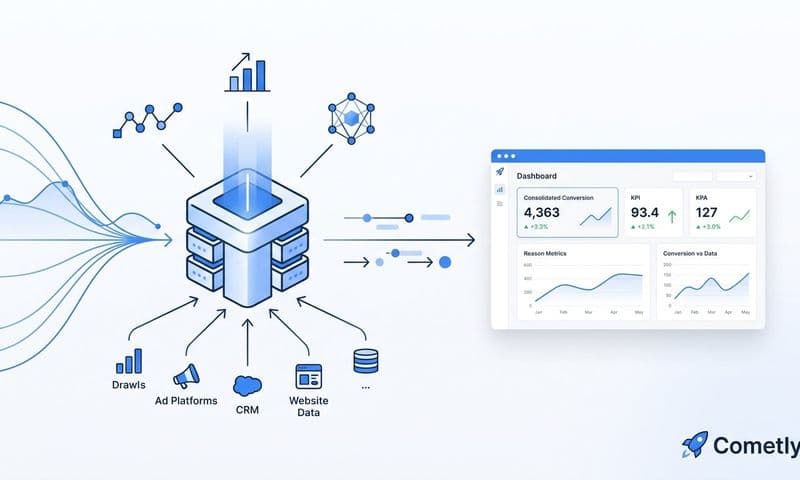
Data Integration Layer: This foundation connects all your marketing platforms, CRM systems, and customer touchpoints into a unified view. When a customer clicks a Facebook ad, opens your email, searches for your brand on Google, and finally converts, you need to see that entire journey in one place—not scattered across four different dashboards with conflicting attribution claims.
Attribution Intelligence Layer: This is where the magic happens. Advanced attribution models analyze how different touchpoints contribute to conversions, revealing the true value of each marketing channel. You discover that your blog content assists 40% of conversions that Google Ads gets credit for. Or that customers who see your YouTube ads convert at 3x higher rates when they later click paid search ads. Successfully implementing this framework starts with understanding marketing data at a fundamental level—knowing which metrics matter, how they interconnect, and what they reveal about customer behavior.
We compare the leading options in our AI YouTube ad generator roundup.
Optimization Action Layer: Analysis becomes valuable only when it drives decisions. This layer translates insights into specific actions: reallocating budget from underperforming channels, scaling high-ROI campaigns, adjusting audience targeting based on conversion patterns, or testing new creative approaches in segments that show promise.
Here's what this looks like in practice: instead of seeing that your paid social campaigns generated 89 conversions, you see that paid social primarily drives awareness that leads to branded search conversions 48 hours later. That insight changes everything about how you budget, optimize, and scale those campaigns.
The companies winning in digital marketing aren't necessarily spending more—they're making smarter decisions based on complete, accurate data about what actually drives revenue. That's the competitive advantage of true marketing data analysis.
Beyond Dashboard Metrics: What Analysis Really Means
Most marketing teams confuse data collection with data analysis. They've got Google Analytics tracking pageviews, Facebook Ads Manager showing click-through rates, and their CRM logging conversions. They're swimming in metrics. But when someone asks "Which campaigns actually drive revenue?", they're still guessing.
Real digital marketing data analysis isn't about having more dashboards—it's about transforming disconnected metrics into strategic intelligence that tells you exactly where to invest next. It's the difference between knowing your cost per click and understanding which keywords attract customers who spend 3x more over their lifetime.
Think about it this way: your ad platforms show you what happened. Analysis shows you why it happened and what to do about it. When you see that your Facebook campaign generated 200 conversions, that's data. When you discover that 80% of those conversions came from people who first saw your blog post three weeks earlier, then clicked a retargeting ad, and finally converted after receiving an email—that's analysis.
The core distinction comes down to integration and attribution. Surface-level reporting shows isolated platform performance: "This ad got 500 clicks." Deep analysis reveals the complete customer journey: "This ad assisted 127 conversions, directly drove 43 purchases, and contributed to $47,000 in revenue across customers who touched three other channels before buying."
That level of insight requires pulling together data from every touchpoint—your website, ad platforms, email system, CRM, and even offline conversions. It means tracking individual customers across devices and channels, understanding how different marketing activities work together, and attributing revenue to the campaigns that actually influenced the purchase decision.
Here's what this looks like in practice: A SaaS company running Google Ads notices their cost per lead is $45. Standard reporting stops there. But comprehensive analysis reveals that leads from certain keyword groups convert to paid customers at 3x the rate of others, making their true customer acquisition cost $150 versus $450. That insight completely changes which keywords deserve more budget.
The strategic framework for this kind of intelligence requires three critical components. First, unified data integration that connects all your marketing platforms and customer touchpoints into a single source of truth. Second, advanced attribution modeling that goes beyond last-click assumptions to show how awareness campaigns, nurture sequences, and conversion tactics work together. Third, AI-powered pattern recognition that identifies scaling opportunities you'd never spot manually.
When you get this right, analysis becomes your competitive advantage. You stop making decisions based on incomplete platform reports and start optimizing based on complete customer journey visibility. You identify which campaigns to scale with confidence, which channels work best together, and where your highest-value customers actually come from. That's when marketing shifts from educated guessing to predictable growth.
The Strategic Framework for Marketing Intelligence
Effective digital marketing data analysis isn't about collecting more metrics—it's about building a systematic framework that transforms scattered data points into strategic decisions. Think of it like the difference between owning a pile of puzzle pieces and actually seeing the complete picture they create.
The foundation starts with multi-platform data unification. Your customers don't experience your marketing in silos—they see your Facebook ad on Monday, search for your brand on Wednesday, read your email on Thursday, and convert on Friday. But if each of those touchpoints lives in a separate dashboard with its own tracking methodology, you're essentially blind to the actual customer journey. Real marketing intelligence requires connecting every touchpoint into a single, unified view that shows how channels work together rather than compete for credit.
This is where advanced attribution modeling moves beyond the oversimplified last-click approach that most platforms default to. When you rely solely on last-click attribution, you're essentially giving all the credit to the final touchpoint while ignoring everything that happened before. It's like crediting only the closing pitcher for winning a baseball game while ignoring the eight innings that came before. Companies implementing comprehensive data analysis strategies often see dramatic improvements in marketing ROI, as demonstrated in real-world case studies across various industries.
Multi-touch attribution reveals the assist value of awareness campaigns, the influence of mid-funnel content, and the true role of each channel in driving conversions. You might discover that your YouTube campaigns don't generate many direct conversions, but they assist 60% of your highest-value customers who eventually convert through paid search. Without proper attribution, you'd cut YouTube and wonder why your search campaigns suddenly stopped performing.
The third pillar is AI-powered pattern recognition that identifies scaling opportunities humans would miss. Machine learning algorithms can analyze thousands of customer journeys simultaneously, spotting patterns like "customers who engage with video content and then visit the pricing page within 48 hours convert at 3x the average rate." These insights become automated optimization recommendations—increase video ad spend, create retargeting audiences based on pricing page visits, adjust bid strategies for high-intent time windows.
Here's what this looks like in practice: A SaaS company running campaigns across Google, Facebook, LinkedIn, and email notices that LinkedIn appears to have the highest cost per acquisition. Surface-level analysis would suggest cutting LinkedIn spend. But unified attribution reveals that LinkedIn generates initial awareness for enterprise prospects who research extensively before converting through branded search weeks later. The strategic framework shows LinkedIn's true value as a top-of-funnel driver for high-value accounts, leading to increased investment rather than cuts.
The key insight? Strategic analysis requires integrated systems, not isolated platform reports. When you're making decisions based on Facebook's attribution model versus Google's attribution model versus your gut feeling, you're not doing analysis—you're guessing. Real marketing intelligence comes from a unified framework that shows the complete picture of how your marketing actually drives revenue.
Why Data-Driven Attribution Is Make-or-Break for Modern Marketing
Here's the uncomfortable truth: if you can't accurately track which marketing channels drive revenue, you're essentially burning money while hoping for the best. And in today's competitive landscape, hope isn't a strategy that keeps you employed.
The cost of attribution confusion goes far beyond frustration. When your dashboards tell conflicting stories, you make systematic mistakes that compound over time. You cut budgets from channels that are actually working because you can't see their assist value. You pour money into underperforming campaigns because they get last-click credit. You miss scaling opportunities hiding in your data because you don't trust any of it enough to act decisively.
Think about what this means in practice. Your best-performing awareness campaigns—the ones that introduce customers to your brand and start their journey—get defunded because they don't show up in last-click attribution. Meanwhile, you keep investing in bottom-funnel tactics that are simply harvesting demand created by channels you're about to cut. It's like watering the fruit while killing the roots.
The Hidden Cost of Attribution Confusion
The real damage isn't just misallocated budgets. It's the opportunity cost of not scaling what actually works. When you lack confidence in your attribution data, you make conservative decisions. You can't confidently increase spend on winning campaigns because you're not sure they're actually winning. You can't test new channels aggressively because you can't measure their true impact.
Your competitors who've solved attribution? They're scaling with confidence. They know exactly which campaigns drive their most valuable customers. They can spot a winning strategy in days, not months, because they're not waiting for conflicting reports to somehow align. They're making ten optimization decisions while you're still trying to figure out which dashboard to believe.
The Competitive Edge of Clear Marketing Intelligence
Companies with accurate attribution systems operate in a different reality. They see the complete customer journey—from first touch to final purchase—and understand how their marketing channels work together. This visibility creates a compounding advantage that's hard to overcome.
When you can see that your podcast ads don't directly drive conversions but increase branded search by 40%, you make smarter decisions. When you understand that customers who engage with your content convert at 3x the rate of cold traffic, you invest accordingly. Understanding why marketing analytics has become a non-negotiable competitive requirement helps explain why leading companies invest heavily in attribution infrastructure while competitors continue making decisions based on incomplete platform reports.
The market has evolved. Your customers interact with 6-8 touchpoints before buying. They switch devices. They research on mobile and purchase on desktop. They see your ad, visit your site, leave, get retargeted, read your content, and finally convert through organic search. If your attribution system can't track this journey, you're optimizing for a customer behavior pattern that doesn't exist anymore.
This isn't about having perfect data—that's impossible. It's about having accurate enough data to make confident decisions faster than your competition. Because in digital marketing, the team that can test, learn, and optimize fastest wins. And you can't do any of that without knowing which campaigns actually drive results.
Putting It All Together
The gap between data chaos and marketing confidence isn't as wide as it feels at 11 PM when your dashboards are contradicting each other. You've seen how professional teams solve this: unified data integration that captures every touchpoint, attribution models that reveal true campaign performance, and AI-powered insights that turn analysis into action.
The transformation doesn't require a complete overhaul overnight. Start with a data integration audit—identify where your customer journey has blind spots and which platforms aren't talking to each other. Then implement unified tracking that connects ad clicks to actual revenue, not just platform-reported conversions. Build your team's capabilities for interpreting attribution data and making optimization decisions based on evidence rather than assumptions.
Most marketing teams move from scattered platform reports to unified intelligence within 90 days. The difference shows immediately: confident budget allocation, predictable scaling, and the ability to answer your CEO's questions with data instead of guesses. You stop cutting winners and funding losers. You identify opportunities before competitors do. You make decisions that compound into sustainable competitive advantage.
Ready to transform your marketing data chaos into clear, profitable insights? Cometly's AI-powered attribution platform connects all your marketing touchpoints in one place, giving you the accurate data and intelligent recommendations you need to scale with complete confidence. Get your free demo and see exactly how we help marketing teams like yours turn attribution confusion into competitive advantage.