Growing an ecommerce business in today's crowded market requires more than just a great product. It demands a sophisticated, data-driven approach to growth that moves beyond surface-level tactics. While common advice like 'run more ads' or 'improve your website' has its place, sustainable scaling comes from a deeper, more integrated strategy. The real challenge isn't just acquiring traffic; it's understanding which channels truly drive revenue, how to maximize the value of every visitor, and how to turn one-time buyers into loyal advocates for your brand.
This guide moves past the generic advice to provide 10 actionable, advanced ecommerce growth strategies that unify your efforts across acquisition, conversion, and retention. Each strategy is designed to be implemented systematically, measured accurately, and optimized continuously. We will explore how to leverage multi-touch attribution, server-side tracking, and performance-based budgeting to not only grow faster but also smarter, ensuring every marketing dollar is invested with maximum confidence and provable ROI. For a holistic perspective on scaling your online business, consider exploring a comprehensive guide to digital marketing for ecommerce growth.
Whether you're a D2C brand optimizing ad spend, a marketing agency managing multiple clients, or a performance marketer aiming for precise results, these strategies provide the framework you need. You will learn not just what to do, but how to implement these tactics with specific steps, track key performance indicators (KPIs), and use modern analytics to connect your actions directly to revenue. This is your blueprint for accelerating growth and building a more resilient, profitable business.
1. Multi-Touch Attribution
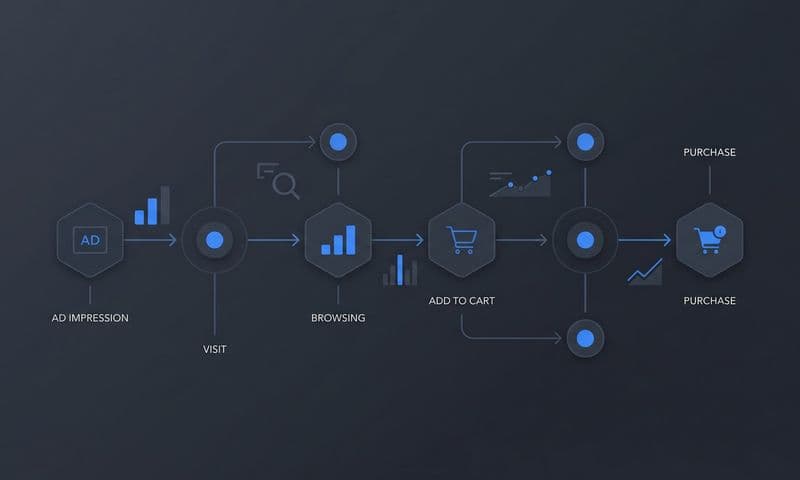
One of the most foundational ecommerce growth strategies is shifting from simplistic last-click attribution to a more holistic multi-touch model. This approach assigns credit to multiple marketing touchpoints across the entire customer journey, providing a true-to-life picture of how your channels work together to drive sales. Instead of giving 100% of the credit to the final ad a customer clicked, multi-touch attribution distributes that credit across social media ads, email newsletters, organic search visits, and more.
This comprehensive view allows you to stop guessing and start making data-driven decisions. You can identify which channels are most effective at introducing new customers versus those that excel at closing sales, enabling you to allocate your budget with surgical precision.
How to Implement Multi-Touch Attribution
- Implement Server-Side Tracking: Use tools with server-side tracking, like Cometly, to bypass data loss from iOS updates and ad blockers. This ensures you capture a more complete and accurate data set of every customer interaction.
- Sync Conversion Data: Connect your ecommerce platform (like Shopify) and CRM with your ad platforms. Syncing conversion data back to platforms like Facebook and Google Ads helps their algorithms optimize for high-value customers.
- Start with Basic Models: Begin with simpler models like linear or time-decay to understand the concept. As your data matures, you can advance to more sophisticated data-driven models that use machine learning to assign credit based on actual impact. For a deeper dive into these models, you can learn more about marketing attribution.
- Build Custom Dashboards: Visualize your data by creating dashboards that track attribution by campaign, customer segment, or product. This helps you spot trends and identify which marketing sequences produce the highest ROI.
Key Insight: A customer might discover your brand through a TikTok ad, get nurtured through an email sequence, and finally convert via a Google Shopping ad. Last-click attribution would only credit Google, while multi-touch reveals the critical roles TikTok and email played in the sale. This insight prevents you from mistakenly cutting budgets for top-of-funnel channels that are essential for growth.
2. Performance-Based Budget Allocation
A crucial evolution from static, annual planning is performance-based budget allocation. This strategy involves dynamically distributing marketing funds across channels based on real-time return on investment (ROI) data. Instead of relying on historical assumptions, you continuously measure which channels and campaigns generate the highest return per dollar spent and shift your budget toward the top performers. This creates a fluid, self-optimizing marketing system that maximizes revenue while minimizing wasted ad spend.
This agile approach allows you to capitalize on emerging opportunities and quickly pivot away from underperforming campaigns. By letting data dictate your financial decisions, you ensure every dollar is working as hard as possible to fuel growth, making this one of the most effective ecommerce growth strategies for scaling efficiently.
How to Implement Performance-Based Budget Allocation
- Establish Clear KPIs: Before you begin, define your primary success metrics. Whether it’s Return on Ad Spend (ROAS), Customer Acquisition Cost (CAC), or Lifetime Value (LTV), having clear targets is essential for measuring performance accurately.
- Utilize Real-Time Data: Implement an attribution platform that provides up-to-the-minute data on campaign performance. Static monthly reports are too slow; you need the ability to see how channels are performing daily or weekly to make timely adjustments.
- Set Allocation Rules and Guardrails: Create rules for shifting your budget, for example, "increase spend by 10% on any campaign exceeding a 3.5x ROAS for three consecutive days." Also, set guardrails to prevent over-investing in a single channel and maintain a healthy marketing mix.
- Test and Iterate: Start by reallocating small portions of your budget, such as 5-10%, between your top and bottom performers. As you gain confidence in your data and process, you can make larger, more impactful shifts. For a deeper look, you can learn more about marketing budget allocation best practices.
Key Insight: Imagine your data shows your TikTok ads are generating a 4x ROAS, while a long-running Facebook campaign has dropped to 1.5x. A performance-based model prompts you to immediately shift a portion of the Facebook budget to scale the successful TikTok campaign. This data-driven agility prevents you from pouring money into a declining channel for weeks, directly converting potential losses into profitable growth.
3. Server-Side Tracking & First-Party Data
As browser privacy restrictions and the deprecation of third-party cookies reshape the digital landscape, a critical ecommerce growth strategy is adopting server-side tracking and prioritizing first-party data. Unlike traditional browser-based pixels vulnerable to ad blockers and iOS updates, server-side tracking sends data directly from your server to marketing platforms. This method ensures more reliable and accurate data collection, giving you an uncompromised view of customer behavior.
By collecting first-party data through direct interactions like email sign-ups, account creations, and purchases, you build a valuable, proprietary asset. This data is more accurate and relevant because it comes straight from your audience, allowing for superior personalization and ad targeting that third-party data can no longer provide.
 10 Proven Ecommerce Growth Strategies to Scale Your Business in 2026
How to Implement Server-Side Tracking & First-Party Data
- Deploy a Server-Side Tracking Solution: Implement a tool like Cometly that specializes in server-side tracking for ecommerce. This will bypass client-side data gaps and send a more complete conversion picture to platforms like Facebook, Google, and TikTok.
- Collect Zero-Party and First-Party Data: Use pop-ups, quizzes, and surveys to actively collect zero-party data (information customers willingly share, like preferences). Combine this with first-party data (email, purchase history) to build robust customer profiles.
- Unify Customer IDs: Map customer identifiers from your CRM, email platform, and ecommerce store. This creates a single, unified view of each customer, allowing for precise cross-channel tracking and messaging.
- Enhance Ad Platform Algorithms: Use the rich, accurate data from server-side tracking to feed ad platform algorithms. This helps them better identify and target high-value customers, improving your ROAS and scaling potential. You can learn more about how to leverage a first-party data strategy.
Key Insight: Without server-side tracking, an ecommerce store might see its Facebook ad performance decline sharply, incorrectly assuming the ads are failing. In reality, browser-side tracking is simply missing a large percentage of conversions. By implementing server-side tracking, the store gets an accurate count, proving the ads' true ROI and preventing a disastrous budget cut based on flawed data.
If you're evaluating vendors, our ecommerce Facebook ad generator breakdown can help.
4. Omnichannel Marketing Integration
A powerful ecommerce growth strategy involves shifting from multi-channel marketing to a truly integrated omnichannel approach. This strategy creates a seamless, unified customer experience across all touchpoints, including email, SMS, social media, your website, and even in-person interactions. Instead of operating channels in silos, omnichannel marketing unifies messaging, customer data, and campaign execution.
This cohesive approach ensures customers receive consistent and contextually relevant communication, no matter where they interact with your brand. By syncing data and triggers across platforms, you can deliver highly personalized experiences that significantly improve customer lifetime value, loyalty, and retention rates.
How to Implement Omnichannel Marketing Integration
- Centralize Customer Data: Consolidate customer data from all sources into a single platform like a Customer Data Platform (CDP). This creates a unified customer profile, allowing you to track behavior and personalize interactions across every channel.
- Map the Customer Journey: Visually map out the different paths customers take across your channels. Identify key touchpoints, drop-off points, and opportunities to create a smoother, more connected experience.
- Use Behavioral Triggers: Implement automation that triggers cross-channel communications based on customer actions. For example, a customer who abandons a cart on your website could receive an SMS reminder followed by a retargeting ad on social media.
- Maintain Brand Consistency: While messaging should be adapted for each channel's format, your brand voice, tone, and core offers must remain consistent. This builds trust and reinforces brand identity across the entire ecosystem.
Key Insight: A customer might browse a product on your app, add it to their cart on your website, and then receive a push notification with a limited-time offer. Later, an email reminds them of their cart, and an SMS provides a direct link to checkout. This connected sequence feels helpful, not intrusive, and is far more effective than blasting generic messages on separate channels. It meets the customer where they are, guiding them seamlessly toward a purchase.
For a deeper dive into this space, see our Shopify product ad generator guide.
5. Conversion Rate Optimization (CRO) & Testing
One of the most powerful ecommerce growth strategies involves maximizing the value of your existing traffic through Conversion Rate Optimization (CRO). This is a systematic process of testing and refining your website experience to increase the percentage of visitors who complete a desired action, such as making a purchase or signing up for a newsletter. Instead of just pouring more money into ads to get more traffic, CRO focuses on turning more of your current visitors into customers.
This data-driven approach removes guesswork from website design and user experience. By continuously testing elements like headlines, calls-to-action, page layouts, and checkout processes, you can make incremental improvements that lead to significant lifts in revenue and a much higher return on your ad spend.
 10 Proven Ecommerce Growth Strategies to Scale Your Business in 2026
How to Implement CRO & Testing
- Establish a Baseline: Before you start testing, use analytics tools to understand your current conversion rates for key actions like adding to cart, initiating checkout, and completing a purchase. This baseline is your benchmark for success.
- Identify Friction Points: Use heatmaps, session recordings, and user surveys to identify where visitors are dropping off. Are they abandoning carts at the shipping page? Are they confused by your product descriptions? This qualitative data provides hypotheses for your A/B tests.
- Prioritize High-Impact Tests: Start by testing elements that have the biggest potential impact on your bottom line. Focus on your product page CTA, checkout form fields, and main landing page copy before worrying about minor button color changes. Optimizing your site to turn visitors into buyers is a continuous process crucial for sustainable growth. Learn how to actively improve your ecommerce conversion rate and drive sales with proven CRO tactics.
- Run Structured A/B Tests: Use tools like Google Optimize, VWO, or Optimizely to run controlled experiments. Test one variable at a time (e.g., one headline vs. another) to ensure you can attribute any change in conversions directly to your modification. For a deeper look at effective testing, explore these advanced conversion optimisation strategies.
Key Insight: Attribution data can supercharge your CRO efforts. By segmenting your website visitors by their initial touchpoint, you can run targeted tests. For example, you might discover that traffic from a TikTok awareness campaign converts best with a visual-heavy product page, while traffic from a Google Search ad prefers a text-heavy, feature-focused layout. This level of personalization dramatically increases test effectiveness and overall conversion rates.
For a deeper dive into this space, see our AI product ad generator guide.
6. Paid Ads Audience Targeting & Segmentation
One of the most powerful ecommerce growth strategies is moving beyond broad, demographic-based targeting to advanced audience segmentation. This involves using first-party and behavioral data to create highly specific customer groups, allowing you to deliver tailored messages across paid platforms like Google, Facebook, and TikTok. Instead of a one-size-fits-all ad, you can speak directly to different segments based on their lifecycle stage, past purchase behavior, and predicted value.
This precision drastically improves ad relevance, which in turn lowers your cost per acquisition (CPA) and boosts conversion rates. When a potential customer sees an ad that feels uniquely relevant to them, they are far more likely to click, engage, and ultimately purchase. This strategy transforms paid advertising from a speculative expense into a predictable revenue driver.
How to Implement Advanced Audience Targeting
- Leverage First-Party Data: Sync your customer data from your ecommerce platform (like Shopify) or CRM to your ad platforms. Use this data to create custom audiences of past purchasers, high-value customers, and one-time buyers for targeted retention or win-back campaigns.
- Build Lookalike Audiences from Value: Don't just build lookalikes from your entire customer list. Create lookalike audiences based on your best customers, identified through metrics like lifetime value (LTV) or high average order value (AOV). This tells platforms to find new users who mirror your most profitable segment.
- Use RFM Segmentation: Segment your audience using Recency, Frequency, and Monetary (RFM) analysis. This helps you prioritize your ad spend on segments like "Recent, High-Frequency Buyers" (champions) versus "Lapsed, Low-Value Customers" (at-risk).
- Create Sequential Ad Funnels: Guide users through the buying journey with sequential targeting. Show an awareness ad to a broad interest-based audience, then retarget those who engaged with a consideration-focused ad, and finally, target cart abandoners with a direct conversion offer.
Key Insight: A broad campaign might show a generic product ad to everyone. An advanced strategy would segment audiences to show a "New Customer Discount" ad to first-time visitors, a "Complete Your Collection" ad to past purchasers of a specific product category, and a "We Miss You" offer to customers who haven't purchased in 90 days. This level of personalization makes customers feel understood and significantly increases ROI.
7. Content Marketing & SEO-Driven Growth
One of the most sustainable ecommerce growth strategies is building a powerful organic presence through content marketing and SEO. This approach focuses on creating valuable, search-optimized content like blog posts, buyer's guides, and videos that answer your target audience's questions. By ranking for relevant keywords, you attract a steady stream of highly qualified, free traffic that is actively searching for solutions you provide.
Unlike paid advertising, which stops when you turn off spending, SEO-driven content is an asset that generates returns over the long term. It establishes your brand as a trusted authority, nurtures potential customers at every stage of their journey, and captures demand that you might otherwise miss. This strategy shifts your reliance away from volatile ad costs toward building a durable, owned marketing channel.
How to Implement Content Marketing & SEO-Driven Growth
- Target Commercial Intent Keywords: Perform keyword research to identify terms that signal a user is close to making a purchase, such as "best [product category] for [use case]" or "[product name] reviews." Aligning content with buyer intent ensures you attract traffic that converts.
- Create Comprehensive Pillar Content: Develop long-form, in-depth resources (2,000+ words) that cover a topic exhaustively. These "pillar pages" or "ultimate guides" are more likely to rank for competitive keywords and establish your site as an authority.
- Build an Internal Linking Structure: Strategically link from your high-traffic blog posts to important product and category pages. This passes SEO authority (link equity) to your conversion-focused pages, helping them rank higher in search results.
- Repurpose Content Across Channels: Maximize the value of each content piece by repurposing it into different formats. A detailed blog post can become a YouTube video, an email newsletter series, several social media posts, and a downloadable infographic.
Key Insight: A customer looking for a new running shoe might search "how to choose the right running shoe." Your in-depth guide ranks #1, providing immense value. Through multi-touch attribution, you can track when that user later returns via a retargeting ad or direct visit to make a purchase. This proves the content's ROI, justifying continued investment in what might otherwise be seen as a non-revenue-generating activity.
8. Customer Retention & Repeat Purchase Programs
While customer acquisition often gets the spotlight, one of the most profitable ecommerce growth strategies is focusing on the customers you already have. Customer retention centers on maximizing customer lifetime value (CLV) by encouraging repeat purchases and fostering loyalty. This approach is highly efficient, as it's widely recognized that acquiring a new customer costs 5 to 25 times more than keeping an existing one.
Effective retention programs build a durable relationship with your customer base through loyalty rewards, personalized communication, subscription models, and exclusive community perks. By turning one-time buyers into lifelong advocates, you create a stable and predictable revenue stream that fuels sustainable growth.
 10 Proven Ecommerce Growth Strategies to Scale Your Business in 2026
How to Implement Retention & Repeat Purchase Programs
- Launch a Tiered Loyalty Program: Create a points-based system where customers earn rewards for purchases, reviews, and social shares. Implement tiers (e.g., Bronze, Silver, Gold) that unlock greater benefits as spending increases, motivating customers to stay engaged.
- Implement Personalized Post-Purchase Automations: Use email and SMS to create automated follow-up sequences based on customer behavior. Trigger campaigns for cart abandonment, replenishment reminders for consumable products, and cross-sell recommendations based on past purchases.
- Offer Subscription Models: For products that are purchased regularly, introduce a "subscribe and save" option. This model provides convenience for the customer and creates predictable, recurring revenue for your business, dramatically increasing CLV.
- Build an Exclusive Community: Create a VIP group on a platform like Facebook or Discord for your best customers. Offer them early access to new products, exclusive content, and a direct line of communication with your brand to foster a strong sense of belonging.
Key Insight: Attribution data can supercharge your retention efforts. By tracking the entire customer journey, you can identify which acquisition channels bring in customers with the highest repeat purchase rates. For example, you might find that customers acquired through an influencer collaboration have a 30% higher CLV than those from a generic search ad. This insight allows you to invest more in high-value acquisition channels and tailor retention strategies specifically for those profitable segments.
9. Marketing Automation & Lead Nurturing
One of the most scalable ecommerce growth strategies is implementing marketing automation to nurture leads effectively. This approach uses technology to deliver personalized, timely communications to prospects based on their specific behaviors and triggers. Instead of manual outreach, automated workflows can send emails, SMS messages, and push notifications when a user abandons a cart, visits a key product page, or signs up for a newsletter.
This strategy bridges the gap between initial interest and final purchase by guiding potential customers with relevant information at each stage. For example, an automated email sequence can recover 15-20% of abandoned carts, while a well-crafted onboarding flow can increase user activation for new signups. By automating these crucial touchpoints, you ensure no lead falls through the cracks and can scale your nurturing efforts without increasing headcount.
How to Implement Marketing Automation & Lead Nurturing
- Start with High-Impact Triggers: Begin by automating responses to the most critical user actions. Focus on abandoned carts, welcome sequences for new subscribers, and post-purchase follow-ups to maximize immediate ROI.
- Segment Your Audience: Group users based on behavior, purchase history, or traffic source. This allows you to send highly relevant messages, such as offering a specific discount to a user who repeatedly viewed a certain product category.
- Leverage Behavioral Data for Personalization: Use data from your analytics platform to trigger workflows. If a user arrived from a specific ad campaign about "running shoes," your automated emails should feature related products and content, not generic store-wide promotions.
- A/B Test Everything: Continuously test elements within your automation sequences, including email subject lines, send times, message content, and channel (Email vs. SMS). Small optimizations can lead to significant improvements in conversion rates over time.
Key Insight: A customer signs up for your newsletter after clicking a Facebook ad. Instead of a generic welcome, attribution data shows they came from a campaign promoting your new skincare line. Your automation workflow sends them a targeted welcome series featuring skincare tips and a special offer on the exact products from the ad. This level of personalization, driven by accurate data, dramatically increases the likelihood of a first purchase.
10. Data-Driven Customer Insights & Predictive Analytics
Moving beyond basic reporting, this ecommerce growth strategy involves using advanced analytics and machine learning to uncover deep patterns in your customer data. It’s about transforming raw numbers into predictive insights that answer critical questions: Which customers are most likely to churn? What product will a specific segment buy next? Which marketing campaigns are poised for the highest return?
Predictive analytics allows you to shift from reactive to proactive decision-making. Instead of waiting for a customer to leave, you can identify at-risk signals and intervene with targeted retention offers. This forward-looking approach enables hyper-personalized marketing and more efficient resource allocation, ensuring you focus your efforts where they will generate the greatest impact.
How to Implement Data-Driven Customer Insights
- Start with Foundational Analysis: Begin with simpler, high-impact analyses like cohort analysis to track customer retention over time or funnel analysis to identify conversion drop-off points. These foundational metrics provide immediate value and build a solid base for more complex models.
- Leverage Predictive Modeling: Use historical data to build models that predict future outcomes. For example, create a Customer Lifetime Value (CLV) model to identify and acquire more high-value customers or a churn prediction model to proactively reduce customer attrition.
- Combine Quantitative and Qualitative Data: Enhance your analytical models by incorporating qualitative feedback from surveys, reviews, and customer support interactions. This combination provides the "why" behind the "what," leading to more accurate and empathetic strategies. For more on this, you can learn how to turn data into actionable insights.
- Establish Feedback Loops: Continuously validate your predictions against actual outcomes. Use this feedback to refine and improve your models over time, increasing their accuracy and reliability for future business decisions.
Key Insight: A subscription box company might use attribution data to see that customers acquired via YouTube influencer campaigns have a 30% higher lifetime value than those from paid search. Predictive analytics would then forecast the long-term ROI of shifting more budget to YouTube, justifying a higher initial cost-per-acquisition for a more valuable customer cohort. This insight prevents short-term thinking and builds a more profitable, sustainable growth engine.
10-Point Ecommerce Growth Strategy Comparison
Approach | Implementation Complexity | Resource Requirements | Expected Effectiveness | Expected Outcomes | Ideal Use Cases |
|---|---|---|---|---|---|
Multi-Touch Attribution | High — modeling and cross-platform integrations | High — data infrastructure, tracking, analytics | ⭐⭐⭐⭐ — very effective for allocation | More accurate ROI, optimized channel mix, fewer wasted ad dollars | Multi-channel ecommerce, paid-ad-heavy businesses |
Performance-Based Budget Allocation | Medium–High — automation with guardrails | Medium — ROI tracking, dashboards, operations | ⭐⭐⭐⭐ — strong when data is reliable | Dynamic budget shifts, faster scaling of top channels, improved ROAS | Agencies, fast-scaling ad campaigns, performance-focused teams |
Server-Side Tracking & First-Party Data | High — development work and privacy architecture | High — server infrastructure, consent management, CRM sync | ⭐⭐⭐⭐ — critical for tracking resilience | Accurate conversions, durable audiences, privacy compliance | Brands impacted by iOS and third-party cookie changes, Shopify stores |
Omnichannel Marketing Integration | High — cross-system synchronization | High — CDP, integrations, team coordination | ⭐⭐⭐⭐ — strong for CX and retention | Consistent experiences, higher LTV, improved retention and engagement | Retailers, subscription services, brands with many touchpoints |
CRO & Testing | Medium — testing frameworks and analysis | Medium — traffic volume, design, analytics | ⭐⭐⭐⭐ — high ROI from existing traffic | Increased conversion rates, better funnels, validated improvements | High-traffic sites, landing page optimization, funnel-focused teams |
Paid Ads Audience Targeting & Segmentation | Medium — data models and platform setup | Medium — audience data, creative, analysis | ⭐⭐⭐⭐ — very effective for efficiency gains | Lower CPA, higher CTR, improved conversion quality | Paid-focused ecommerce, ABM B2B, value-based targeting |
Content Marketing & SEO-Driven Growth | Medium — strategic planning and execution | Medium–High — content production, SEO tools | ⭐⭐⭐ — strong long-term but slower | Sustainable organic traffic, brand authority, compounding ROI | Long-term acquisition, SaaS thought leadership, content-driven brands |
Customer Retention & Repeat Purchase Programs | Medium — program design and personalization | Medium — loyalty technology, CRM integration | ⭐⭐⭐⭐ — highly effective for unit economics | Increased CLV, reduced CAC payback, recurring revenue | D2C, subscription businesses, repeat-purchase brands |
Marketing Automation & Lead Nurturing | Medium — workflow design and sequencing | Medium — automation tools, content assets | ⭐⭐⭐⭐ — effective for timely conversions | Improved activation, lead qualification, recovered revenue | SaaS onboarding, abandoned cart recovery, B2B nurture flows |
Data-Driven Customer Insights & Predictive Analytics | High — modeling, machine learning, data engineering | High — analysts, ML infrastructure, clean data | ⭐⭐⭐⭐ — powerful with high-quality data | Better forecasting, churn and LTV prediction, proactive actions | Enterprises, subscription platforms, predictive growth teams |
Turning Strategy into Sustainable Growth with Unified Data
Navigating the competitive landscape of modern commerce requires more than just a collection of tactics; it demands a cohesive, interconnected system. Throughout this guide, we've explored ten powerful ecommerce growth strategies, moving from foundational data integrity with server-side tracking and multi-touch attribution to sophisticated execution with CRO, omnichannel marketing, and predictive analytics. The journey from a startup to a market leader is not paved with siloed efforts or guesswork. Instead, it is built on a foundation of unified data that provides a crystal-clear view of the entire customer journey.
The common thread weaving through every strategy, from acquiring new customers to fostering lifelong loyalty, is the non-negotiable need for accurate measurement. You cannot optimize what you cannot accurately measure. Without understanding precisely how a customer discovered your brand, what content they engaged with, and which ads ultimately influenced their purchase, your marketing budget is leaking potential. Each strategy, whether it's refining ad audiences or implementing a customer retention program, becomes exponentially more effective when backed by reliable, first-party data.
From Disconnected Tactics to a Unified Growth Engine
The true power of these ecommerce growth strategies is unleashed when they work in concert. Imagine a system where insights from your data-driven customer analytics (Strategy #10) directly inform the segments you target with paid ads (Strategy #6). Picture your content marketing efforts (Strategy #7) seamlessly nurturing leads through automated workflows (Strategy #9), with every interaction tracked and attributed correctly. This is the difference between simply running campaigns and building a predictable, scalable growth engine.
Your immediate next steps should be grounded in this principle of integration. Don't try to implement all ten strategies at once. Instead, focus on building the foundation first.
- Step 1: Solidify Your Data Foundation. Prioritize the implementation of server-side tracking and a first-party data strategy (Strategy #3). This is the bedrock upon which all other marketing and analytics efforts will be built.
- Step 2: Gain True Visibility. Implement a multi-touch attribution model (Strategy #1) to finally understand the complete path to conversion. This will immediately expose which channels and campaigns are your true top performers.
- Step 3: Optimize Your Biggest Levers. Armed with clear data, you can now confidently tackle performance-based budget allocation (Strategy #2) and conversion rate optimization (Strategy #5), ensuring you're putting your money where it generates the highest return.
The Future Belongs to the Data-Informed
Embracing these concepts means shifting from reactive marketing to a proactive, strategic approach. It's about moving beyond vanity metrics like clicks and impressions to focus on what truly matters: customer acquisition cost (CAC), lifetime value (LTV), and return on ad spend (ROAS). This data-centric mindset empowers you to make confident decisions, prove the ROI of your marketing spend, and create a self-reinforcing cycle of insight and optimization.
The path to sustainable ecommerce growth is not a mystery; it’s a science. By meticulously implementing these strategies, tracking your KPIs with ruthless accuracy, and leveraging a unified analytics platform to connect every dot, you are not just hoping for growth, you are engineering it. The future of your brand depends on your ability to not only execute these strategies but to understand their interconnected impact, turning disparate data points into a clear roadmap for scalable success.
Ready to eliminate the guesswork and get a crystal-clear view of your marketing ROI? Cometly is the all-in-one attribution platform designed to unify your data, track every customer touchpoint, and prove exactly which ecommerce growth strategies are driving your revenue. See how top brands are optimizing their ad spend and scaling profitably by booking a demo at Cometly today.