Enterprise marketing teams are drowning in data but starving for insights. You're running campaigns across Meta, Google, LinkedIn, and a dozen other channels. Your CRM is logging thousands of leads. Your sales team is closing deals. But when the CFO asks which campaigns actually drive revenue, you're stuck piecing together fragmented reports from five different dashboards.
Traditional analytics platforms weren't built for this complexity. Google Analytics shows website traffic but can't connect ad clicks to closed deals three months later. Your ad platforms optimize for clicks and impressions, not revenue. Your CRM tracks sales but has no idea which marketing touchpoint started the journey.
The result? You're making million-dollar budget decisions based on incomplete data.
Enterprise marketing analytics platforms solve this by connecting every touchpoint across your entire marketing ecosystem—from first ad impression to final purchase. They track customer journeys across devices and channels, attribute revenue to specific campaigns, and use AI to identify your highest-performing ads before you waste budget scaling the wrong ones.
We've analyzed the leading platforms based on attribution accuracy, integration capabilities, real-time tracking, and scalability for large marketing teams. Here are the solutions that actually work for enterprise marketers who need to connect every dollar spent to revenue generated.
1. Cometly
Best for: Performance marketers and agencies who need complete attribution from ad click to revenue
Cometly is a marketing attribution and analytics platform built specifically for performance marketers and agencies who need to see exactly which ads drive revenue.
 Top 6 Enterprise Marketing Analytics Platforms That Connect Ad Spend To Revenue
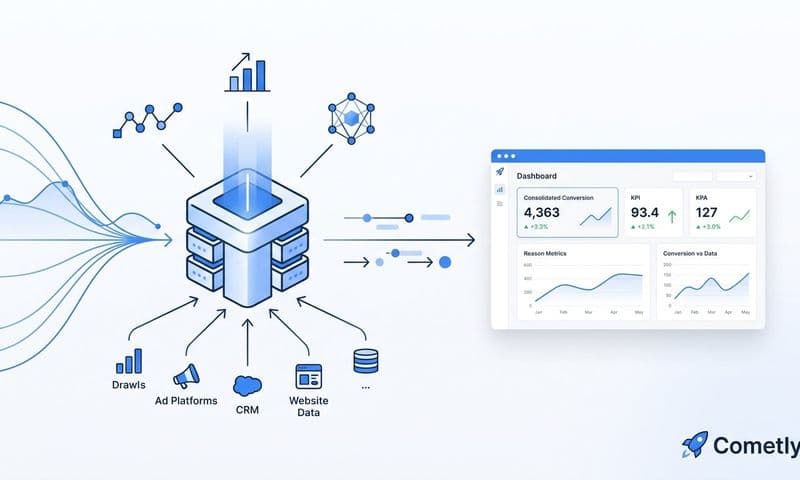
Unlike traditional analytics tools that stop at website behavior, Cometly tracks the complete customer journey from ad click through CRM events to final purchase, giving you attribution data that actually matches your revenue reports.
Where This Tool Shines
Cometly captures every touchpoint in your customer journey—ad clicks, website visits, form submissions, CRM events, and purchases—then connects them into complete attribution paths. This means you can see not just which channel gets credit, but the exact sequence of interactions that led to each conversion.
The platform tracks across devices and sessions, so when someone clicks your Facebook ad on mobile, visits your site on desktop three days later, and converts a week after that, Cometly connects all three touchpoints to show the full story. This complete visibility eliminates the guesswork from budget allocation decisions.
What sets Cometly apart is its real-time processing. While traditional analytics platforms batch-process data with 24-72 hour delays, Cometly shows conversions as they happen. This enables immediate optimization decisions rather than reacting to yesterday's performance.
The AI-powered insights layer analyzes your attribution data to identify high-performing ads and audiences before you waste budget scaling underperformers. Instead of manually reviewing hundreds of ad combinations, the platform surfaces the specific creatives, audiences, and placements driving actual revenue.
Key Features & Capabilities
Multi-Touch Attribution Modeling: Compare first-click, last-click, linear, time-decay, and custom attribution models side-by-side to understand how different perspectives change your strategy. This comparison reveals which channels drive awareness versus conversion, helping you avoid the common mistake of over-investing in last-touch channels while neglecting the awareness activities that make conversions possible.
Real-Time Conversion Tracking: See which ads drive leads and revenue as they happen, not days later in delayed reports. This immediate visibility enables proactive budget reallocation and problem detection before significant spend is wasted on underperforming campaigns.
AI-Powered Campaign Insights: Identify high-performing ads and audiences across every channel before wasting budget on underperformers. The platform analyzes patterns in your attribution data to surface winning combinations of creative, audience, and placement that drive the highest revenue per dollar spent.
Conversion API Integration: Send enriched, server-side conversion data back to Meta, Google, and TikTok to improve their AI targeting and optimization. This bypasses browser-based tracking limitations from ad blockers, iOS restrictions, and cookie deletion, giving ad platforms more accurate data to optimize campaign delivery.
CRM and Sales Integration: Connect to HubSpot, Salesforce, and other CRM platforms to track the complete journey from marketing touchpoint to closed revenue.
2. Google Analytics 4
Best for: Businesses needing comprehensive website and app analytics with Google ecosystem integration
Google Analytics 4 is the latest version of the world's most widely used analytics platform, offering event-based tracking across websites and apps with machine learning insights built in.
 10 Best Enterprise Channel Analytics Software To Maximize Marketing ROI
GA4 represents a fundamental shift from session-based to user-centric measurement, designed to track customer journeys across devices and platforms while adapting to a privacy-first world without third-party cookies.
Where This Tool Shines
GA4 excels at providing comprehensive website and app analytics at no cost, making it accessible for businesses of any size. The platform's machine learning capabilities automatically surface insights about user behavior, predict future actions like purchase probability, and identify trending patterns without manual analysis.
Its integration with Google Ads creates a seamless connection between ad performance and website behavior. When you run campaigns on Google's advertising platform, GA4 automatically imports cost data and connects it to on-site behavior, showing you which campaigns drive not just clicks but actual engagement and conversions.
The event-based tracking model offers flexibility to measure any user interaction that matters to your business. Unlike the old Universal Analytics that focused primarily on page views, GA4 treats everything as an event—page views, button clicks, video plays, scroll depth, file downloads, form submissions. This granular approach helps you understand exactly how users interact with your content.
For companies already invested in the Google ecosystem, GA4 provides deep integration with Google Tag Manager for flexible tracking implementation, Search Console for organic search insights, and BigQuery for advanced analysis of raw event data. This interconnected approach eliminates data silos and creates a unified view of your digital presence.
Key Features & Capabilities
Event-based tracking model: Measure any user interaction as an event, from page views to video plays to custom business actions. This flexibility means you can track the specific behaviors that matter to your business without being constrained by predefined metrics.
Cross-platform measurement: Track users across websites and mobile apps in a unified view. When someone visits your website on desktop and later opens your mobile app, GA4 connects these interactions into a single user journey, giving you complete visibility into cross-platform behavior.
Predictive metrics: Machine learning models predict purchase probability, churn probability, and revenue potential for user segments. These predictions help you identify high-value users before they convert and take proactive action to retain users at risk of churning.
Enhanced measurement: Automatically track scrolls, outbound clicks, site search, video engagement, and file downloads without custom code. This feature eliminates the need for manual event setup for common interactions, getting you valuable data immediately after implementation.
BigQuery integration: Export raw event data to BigQuery for advanced analysis and custom reporting. This capability is particularly valuable for data teams who need to combine GA4 data with other business data sources or perform advanced analysis.
3. Adobe Analytics
Best for: Large enterprises with dedicated analytics teams needing deep customization and sophisticated analysis
Adobe Analytics represents the enterprise tier of marketing analytics, built for organizations that need sophisticated analysis capabilities across complex digital ecosystems.
 10 Best Enterprise Channel Analytics Software To Maximize Marketing ROI
This isn't a platform you implement in an afternoon—it's a comprehensive analytics infrastructure designed for companies with dedicated analytics teams, multiple business units, and the technical resources to leverage its full power.
What sets Adobe Analytics apart is its depth. While many platforms offer pre-built reports and dashboards, Adobe gives you the raw materials to build virtually any analysis you can imagine. The platform's custom variable architecture lets you define unlimited dimensions and metrics specific to your business, then slice that data in countless ways to uncover insights that standard reports would never reveal.
The Analysis Workspace Advantage
Analysis Workspace is where Adobe Analytics truly differentiates itself from simpler analytics tools. Think of it as a blank canvas where you can drag and drop any metric, dimension, or segment to build custom reports and visualizations without writing SQL or waiting for engineering support.
The interface lets you combine data in ways that answer specific business questions. Want to see how mobile users from paid social who visited your pricing page three times behave differently from desktop users who came through organic search? You can build that analysis in minutes, save it as a template, and share it with stakeholders who can then modify it for their own needs.
This flexibility becomes crucial for enterprises with unique business models or complex customer journeys. Standard analytics platforms force you into their predefined reporting structure. Adobe lets you define the structure that matches how your business actually operates.
Attribution IQ: Beyond Single-Touch Models
Adobe's Attribution IQ feature addresses one of the most challenging aspects of enterprise marketing: understanding true channel contribution across long, complex customer journeys. The platform offers multiple attribution models—algorithmic, rules-based, and custom—that you can compare side-by-side in the same report.
This comparison capability reveals how different perspectives change your strategic decisions. You might discover that first-touch attribution shows content marketing driving significant awareness, while last-touch attribution credits retargeting. Linear attribution might reveal that email nurture plays a crucial middle-funnel role that other models miss entirely.
For enterprises with multiple marketing teams or business units, this multi-model approach helps align stakeholders who naturally view attribution through different lenses. The CMO focused on brand awareness, the demand gen team optimizing for leads, and the CFO tracking revenue can all find their perspective validated while understanding how other views complement their own.
Real-Time Monitoring at Enterprise Scale
Adobe Analytics processes data in real-time, letting marketing teams monitor campaign performance, traffic spikes, and conversion events as they happen. This becomes particularly valuable during major campaigns, product launches, or seasonal peaks when immediate visibility prevents costly mistakes.
The platform's anomaly detection uses AI to identify unexpected changes in metrics before they become serious problems. If conversion rates suddenly drop, traffic patterns shift unexpectedly, or specific segments behave differently than historical norms, automated alerts notify the right team members immediately.
4. Mixpanel
Best for: Product teams tracking user behavior and optimizing product-led growth
Mixpanel is a product analytics platform focused on understanding how users interact with your digital products, helping teams optimize user experience and drive product-led growth.
 7 Best Marketing Analytics Platforms Offer Real-Time Conversion Tracking To Scale Profitably
Unlike traditional web analytics that focus on page views and sessions, Mixpanel tracks specific user actions—button clicks, feature usage, workflow completion—to show you exactly how people use your product and where they drop off.
The platform shifts the analytics conversation from "how many people visited" to "what did people actually do." This distinction matters because traffic numbers tell you nothing about product engagement. You might have thousands of sign-ups, but if users abandon your product after the first session, that traffic is worthless.
Where This Tool Shines
Mixpanel excels at event-based tracking that reveals user behavior patterns within applications. The platform makes it easy to track any user action as an event, then analyze how those events correlate with retention, conversion, and engagement.
The funnel analysis shows exactly where users drop off in multi-step processes like onboarding or checkout. Instead of guessing why conversion rates are low, you can see that 60% of users complete step one, 40% make it to step two, but only 15% finish step three. This pinpoints exactly where to focus optimization efforts.
Cohort analysis reveals how different user groups behave over time. You can compare users who signed up in January versus February, or users who completed onboarding versus those who skipped it. This shows which acquisition channels bring higher-quality users and which product experiences drive long-term engagement.
The retention reports automatically calculate how many users come back after their first visit. For SaaS companies and mobile apps, understanding what drives users to return day after day is the difference between sustainable growth and a leaky bucket where you constantly need new users to replace churning ones.
Mixpanel's focus on user-level tracking (rather than session-level) provides the granular insights needed to optimize product experience and reduce churn. You can see the complete history of every user's actions, identify power user behaviors, and understand what separates engaged users from those who abandon your product.
Key Features & Capabilities
Event tracking: Track any user action as an event and analyze patterns across your entire user base. This goes beyond page views to capture meaningful interactions like feature usage, button clicks, form submissions, and custom business events.
Funnel analysis: Visualize multi-step conversion paths and identify exactly where users drop off. You can create funnels for any sequence of events—onboarding flows, purchase processes, feature adoption paths—and see conversion rates at each step.
Retention analysis: Measure how many users return over time and which behaviors correlate with retention. The platform automatically calculates retention curves showing what percentage of users come back after their first visit.
5. Heap
Best for: Fast-moving teams needing automatic data capture without engineering dependencies
Heap is a digital insights platform that automatically captures every user interaction on your website or app without requiring manual event tracking setup.
 Top 6 Enterprise Marketing Analytics Platforms That Connect Ad Spend To Revenue
Unlike traditional analytics tools where you must decide what to track in advance, Heap records everything—every click, tap, swipe, page view, and form submission—then lets you define events and analyze behavior retroactively.
Where This Tool Shines
Heap's automatic data capture eliminates the biggest bottleneck in analytics implementation: deciding what to track and waiting for engineering to instrument events. The platform captures all user interactions from day one, so when you later realize you need to analyze a specific button click or form field, the historical data is already there.
This retroactive analysis capability means product and marketing teams can answer questions about past behavior without having planned for those questions months ago. When your CMO asks "How many people clicked that CTA we launched three months ago?" you can answer immediately instead of saying "We'll start tracking that now."
The visual event builder lets non-technical users define events by clicking on elements in their site or app, removing the dependency on engineering for basic analytics setup. A marketing manager can create a new conversion event by simply pointing at a "Request Demo" button in the interface—no code required, no engineering ticket needed.
For fast-moving teams that need to iterate quickly, Heap's approach dramatically reduces time from question to insight. Traditional analytics requires a cycle of: identify what to track → write tracking specification → engineering implements → wait for data collection → analyze results. Heap compresses this to: ask question → define event → analyze historical data → get answer.
Key Features & Capabilities
Automatic Event Capture: Records every user interaction without manual tracking code or event planning. This "capture everything" approach means you never lose data because you forgot to track something important.
Retroactive Analysis: Define new events and analyze historical data going back to your implementation date. This turns analytics from a forward-looking activity into one where you can investigate past behavior whenever questions arise.
Visual Event Builder: Point-and-click interface to define events without writing code or creating tracking plans. Marketing and product teams can create their own events without consuming engineering resources.
Session Replay: Watch recordings of actual user sessions to understand behavior and identify friction points. When conversion rates drop, you can watch real sessions to see exactly where users struggle.
Multi-Touch Attribution: Track the complete journey across channels and touchpoints to understand conversion paths. See which combination of marketing activities leads to conversions, not just the last click.
Data Science Toolkit: SQL access, data warehouse sync, and APIs for advanced analysis and custom integrations. Technical teams can extract raw data for sophisticated modeling while non-technical users work in the visual interface.
6. Amplitude
Best for: Product teams focused on behavioral cohort analysis and predictive insights
Amplitude is a product analytics platform that helps teams understand user behavior, optimize product experiences, and drive growth through data-driven decisions.
 Top 6 Enterprise Marketing Analytics Platforms That Connect Ad Spend To Revenue
Built specifically for digital products, Amplitude focuses on answering questions about user engagement, feature adoption, and retention through behavioral cohort analysis and predictive insights.
Where This Tool Shines
Amplitude's behavioral cohort analysis reveals patterns in how different user groups interact with your product over time. Instead of looking at aggregate metrics that hide important differences, you can segment users based on the actions they've taken and see how those cohorts differ in retention, engagement, and conversion rates.
The platform's predictive analytics use machine learning to forecast which users are likely to convert, churn, or take specific actions. This enables proactive interventions before users disengage—like triggering personalized email campaigns to at-risk users or offering incentives to those predicted to upgrade.
Path analysis shows the most common journeys users take through your product, revealing unexpected usage patterns and optimization opportunities. You might discover that users who complete a specific action in their first session have 3x higher retention, or that a particular feature sequence leads to faster conversion.
The platform excels at answering complex product questions like "which combination of features drives the highest retention?" or "what do our power users do differently in their first week?" For companies focused on product-led growth, Amplitude's emphasis on behavioral patterns and user lifecycle analysis provides the insights needed to optimize every stage of the user journey.
Key Features & Capabilities
Behavioral Cohorts: Group users based on actions they've taken and analyze how cohorts differ in retention and engagement. This goes beyond basic demographic segmentation to focus on what users actually do in your product.
Predictive Analytics: Machine learning models predict user likelihood to convert, churn, or perform key actions. These predictions help teams prioritize interventions and personalize experiences for different user segments.
Path Analysis: Visualize the most common user journeys through your product to identify patterns and friction. See which paths lead to conversion and which lead to drop-off.
Experimentation Platform: Built-in A/B testing with statistical analysis to measure feature impact. Test product changes and measure their effect on key metrics without needing separate experimentation tools.
Revenue Analytics: Connect user behavior to revenue metrics to understand which actions drive monetization. Track customer lifetime value by cohort and identify which behaviors correlate with higher revenue.
Data Governance: Tracking plan management, data validation, and schema enforcement ensure data quality across your organization. This prevents the "garbage in, garbage out" problem that plagues many analytics implementations.
Choosing an enterprise marketing analytics platform is one of the most consequential technology decisions your marketing organization will make. The right choice connects your entire marketing ecosystem and transforms how you allocate budget. The wrong choice leaves you with an expensive tool that sits unused while teams continue working in spreadsheets.
The stakes are particularly high because implementation isn't quick. Enterprise analytics platforms typically require 3-6 months to fully deploy across your marketing stack, train teams, and establish reliable data flows. If you choose poorly, you've not only wasted the software investment but also lost half a year of potential insights while your competitors optimize their campaigns with better data.
Integration Capabilities Define Platform Value
Your analytics platform needs to connect with every tool in your marketing technology stack. This isn't about having a long list of integrations in the vendor's documentation—it's about how deeply and reliably those integrations actually work in production environments.
Start by mapping every system that touches customer data: your ad platforms (Meta, Google, LinkedIn, TikTok), your website and analytics tools, your CRM, your marketing automation platform, your customer data platform if you have one, and any other systems that track customer interactions. The analytics platform you choose must pull data from all of these sources and connect them into unified customer journeys.
Pay special attention to CRM integration quality. Many analytics platforms claim to integrate with Salesforce or HubSpot, but the integration only syncs basic contact information. What you actually need is the ability to track when leads progress through your sales pipeline, when opportunities are created, when deals close, and the final revenue amount. This closed-loop tracking is what lets you connect specific marketing campaigns to actual revenue rather than just leads or MQLs.
Ask vendors for specific examples of how their platform handles your exact integration requirements. Request technical documentation about data mapping, refresh frequencies, and any manual steps required to maintain integrations. Some platforms require ongoing engineering support to keep integrations running smoothly, while others handle updates automatically.
Attribution Modeling Flexibility
Different stakeholders in your organization view attribution through different lenses. Your brand team cares about first-touch attribution because they focus on awareness. Your demand generation team wants to understand mid-funnel contribution. Your CFO looks at last-touch attribution because it shows what directly drove conversions.
The platform you choose should support multiple attribution models that you can compare side-by-side in the same report. This isn't about finding the "right" model—it's about understanding how different perspectives reveal different truths about your marketing performance. When you can show leadership how the same campaign performs under different attribution lenses, you enable more sophisticated conversations about marketing strategy.
Beyond standard models like first-touch, last-touch, and linear attribution, consider whether you need custom attribution rules. Some businesses have unique customer journeys that don't fit into standard frameworks. The ability to define your own attribution logic based on your specific business model can be valuable for companies with complex sales cycles or multiple product lines.
Real-Time Data Processing vs. Batch Updates
The difference between real-time and delayed reporting fundamentally changes how your team operates. Platforms that batch-process data with 24-72 hour delays force you into a reactive mode—you're always optimizing based on yesterday's performance rather than what's happening right now.
Real-time processing enables proactive decision-making. When you can see which campaigns are converting as leads come in, you can shift budget immediately to capitalize on what's working and stop spending on what isn't. This becomes particularly valuable during high-stakes campaigns, product launches, or seasonal peaks when market conditions change rapidly.
Consider how quickly your team needs to react to performance data. If you're running aggressive growth campaigns where every hour of wasted spend matters, real-time visibility is essential. If you operate with longer planning cycles and monthly optimization reviews, delayed reporting might be acceptable.
Scalability for Enterprise Data Volumes
Enterprise marketing generates enormous data volumes. You're tracking millions of ad impressions, hundreds of thousands of website sessions, tens of thousands of leads, and thousands of conversions every month. The platform you choose must handle this scale without performance degradation or cost explosions.
Ask vendors about their data processing limits and what happens when you exceed them. Some platforms charge based on event volume, which can create surprise bills as your marketing scales. Others have hard limits that require upgrading to more expensive tiers. Understanding the cost structure at your current volume and at 2-3x growth helps you avoid budget surprises.
Performance at scale matters beyond just cost. Some platforms slow down considerably when analyzing large data sets, turning what should be quick exploratory analysis into frustrating waits. Request demos using data volumes comparable to your actual traffic to see how the platform performs under realistic conditions.
User Accessibility and Training Requirements
The most powerful analytics platform is worthless if only your data team can use it. Enterprise marketing analytics must be accessible to multiple user types: marketing managers who need daily campaign insights, executives who want high-level performance summaries, and analysts who require deep-dive capabilities.
Evaluate the platform's interface complexity relative to your team's technical sophistication. Some platforms require SQL knowledge or statistical expertise to extract meaningful insights. Others provide intuitive visual interfaces that non-technical marketers can navigate independently. Consider whether your team has the skills to fully utilize a complex platform or whether you need something more accessible.
Ask about training requirements and ongoing support. How long does it take to onboard new users? Does the vendor provide training resources, documentation, and responsive support? What happens when you need help with custom reporting or troubleshooting data issues? The quality of vendor support often determines whether a platform succeeds or fails in your organization.
Data Privacy and Compliance Considerations
Enterprise marketing analytics platforms process customer data at massive scale, making privacy and compliance non-negotiable requirements. Your platform must comply with relevant regulations in all jurisdictions where you operate—GDPR in Europe, CCPA in California, and emerging privacy laws in other regions.
Understand how the platform handles personally identifiable information (PII). Where is data stored geographically? How long is it retained? What controls exist for data deletion when customers request it? Can you configure the platform to respect user privacy preferences and consent choices? These aren't just legal requirements—they're trust factors that affect your brand reputation.
If you operate in regulated industries like healthcare, finance, or government, additional compliance requirements may apply. Verify that the vendor meets industry-specific standards and can provide necessary certifications like SOC 2, HIPAA compliance, or FedRAMP authorization if required.
Cost Structure and Total Ownership
Enterprise analytics pricing rarely fits into simple subscription tiers. Most vendors use complex pricing based on data volume, number of users, feature access, or some combination of factors. Understanding the true total cost requires looking beyond the initial quote.
Consider implementation costs including technical integration, data migration, custom configuration, and training. Some platforms require significant professional services to deploy effectively, adding tens of thousands of dollars to your first-year costs. Ask vendors for realistic implementation timelines and associated costs based on your specific requirements.
Factor in ongoing costs for maintenance, support, training new team members, and scaling as your marketing grows. Some platforms have aggressive price increases as you add data volume or users. Others maintain predictable costs that scale more gradually. Request multi-year pricing projections based on your expected growth to avoid budget surprises.
Don't forget the opportunity cost of choosing a platform that doesn't deliver on its promises. If you spend six months implementing a solution that your team ultimately can't use effectively, you've lost both the direct costs and the insights you could have gained from a better choice.
Vendor Stability and Product Roadmap
You're making a multi-year commitment to your analytics platform. The vendor's financial stability, market position, and product development trajectory all affect whether this investment pays off long-term.
Research the vendor's funding, revenue trajectory, and market position. Well-established companies offer stability but may innovate more slowly. Fast-growing startups might offer cutting-edge features but carry higher risk of being acquired or pivoting their product strategy. Consider which tradeoff aligns better with your organization's risk tolerance.
Ask about the product roadmap and how it aligns with your future needs. Are they investing in capabilities that matter to your business? Do they have a track record of delivering on promised features? How do they incorporate customer feedback into development priorities? The answers reveal whether the platform will grow with your needs or become a limitation.
Investigate how the vendor handles platform updates and migrations. When they release major new versions, what's the upgrade process? Will you need to rebuild integrations or retrain users? Companies that force disruptive upgrades create ongoing operational burden, while those that handle transitions smoothly minimize your team's time investment.
Making the Right Choice
The right enterprise marketing analytics platform depends on what you're actually trying to solve. If you need complete attribution from ad click to closed revenue with real-time optimization, Cometly delivers the most comprehensive view of your marketing performance. For teams already deep in the Google ecosystem who need solid website analytics at no cost, GA4 provides the foundation—though you'll need additional tools for true multi-touch attribution.
Adobe Analytics makes sense for large enterprises with dedicated analytics teams and complex digital properties requiring deep customization. Product-focused teams tracking user behavior within apps will find Mixpanel or Amplitude more aligned with their needs, while Heap's automatic capture removes engineering bottlenecks for fast-moving teams.
Here's the reality: most enterprise marketing teams need more than website analytics. You need to connect ad spend to actual revenue, track journeys across channels and devices, and prove ROI to leadership with data they trust. That requires a platform built specifically for marketing attribution, not adapted from web analytics.
If you're ready to stop guessing which campaigns drive revenue and start making data-driven budget decisions with confidence, get your free demo and see how Cometly connects every marketing touchpoint to the outcomes that matter most.