Enterprise marketing teams manage campaigns across dozens of platforms—paid ads, social, email, CRM, web analytics—and each one generates its own data. The challenge isn't collecting information. It's connecting it. Without a unified analytics stack, you're left with fragmented reports, conflicting attribution models, and no clear path from marketing spend to actual revenue.
Building an enterprise marketing analytics stack means choosing tools that work together to capture, store, analyze, and visualize data across every customer touchpoint. The right stack doesn't just track clicks and conversions—it shows you which channels drive pipeline, how campaigns influence each other, and where to allocate budget for maximum ROI.
Here are the top tools that form a complete enterprise marketing analytics stack in 2026.
1. Cometly
Best for: Multi-touch attribution and connecting ad performance directly to revenue
Cometly is a marketing attribution platform that tracks the complete customer journey from first ad click through CRM conversion.
 9 Best Enterprise Marketing Analytics Stack Tools in 2026
Where This Tool Shines
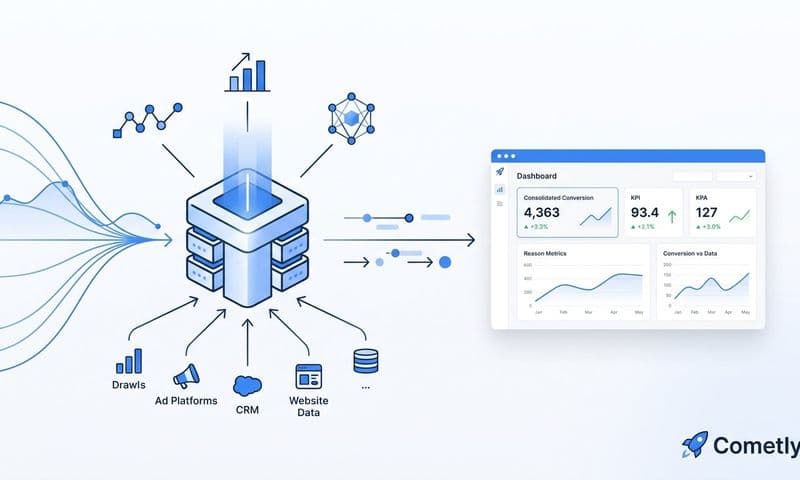
Cometly solves the core enterprise attribution problem: knowing which ads actually drive revenue, not just clicks. It connects your ad platforms, website, and CRM to build a complete view of how customers move through your funnel—across devices, channels, and time.
The platform uses server-side tracking to capture accurate data even when browser restrictions block traditional tracking methods. This means your attribution data stays reliable as privacy regulations tighten and third-party cookies disappear.
Key Features
Multi-Touch Attribution: Track every touchpoint in the customer journey and see how channels work together to drive conversions.
AI-Powered Recommendations: Get actionable insights on which ads and campaigns to scale based on actual revenue performance.
Server-Side Tracking: Capture accurate conversion data that bypasses browser limitations and ad blockers.
Conversion Sync: Feed enriched conversion data back to Meta, Google, and other ad platforms to improve their targeting algorithms.
Real-Time Dashboard: Monitor campaign performance and attribution data as it happens, not hours or days later.
Best For
Enterprise marketing teams running multi-channel paid campaigns who need to prove ROI and optimize spend across platforms. Particularly valuable for teams struggling with iOS tracking limitations or inconsistent attribution data between ad platforms and CRM.
Pricing
Custom pricing based on ad spend volume. Demo available to explore features and discuss enterprise requirements.
2. Snowflake
Best for: Central data warehouse for storing and managing enterprise marketing data
Snowflake is a cloud data platform that serves as the foundation for enterprise analytics stacks.
 9 Best Enterprise Marketing Analytics Stack Tools in 2026
Where This Tool Shines
Snowflake acts as your single source of truth—a central repository where all marketing data lives, regardless of where it originated. Unlike traditional databases, Snowflake separates storage from compute, meaning you can scale data storage independently from processing power.
For enterprise teams, this architecture matters because you can run complex queries on massive datasets without impacting other users. Multiple teams can access the same data simultaneously without performance degradation, and you only pay for the compute you actually use.
Key Features
Unlimited Scalability: Store petabytes of marketing data and scale compute resources up or down based on query demands.
Data Sharing: Share datasets securely across teams, departments, or external partners without copying data.
Multi-Format Support: Handle structured data from databases alongside semi-structured data from APIs and event streams.
Zero Maintenance: No infrastructure management required—Snowflake handles updates, patches, and optimization automatically.
Time Travel: Query historical versions of your data to analyze changes over time or recover from accidental deletions.
Best For
Enterprise organizations with high data volumes across multiple marketing platforms who need a scalable, centralized warehouse. Essential for teams building custom analytics models or combining marketing data with sales, product, and customer data.
Pricing
Usage-based pricing starting around $2 per credit. Enterprise plans include volume discounts and dedicated support.
3. Tableau
Best for: Enterprise business intelligence and interactive dashboard creation
Tableau is a visualization platform that transforms marketing data into interactive dashboards accessible to stakeholders at every level.
 11 Best Marketing Analytics Tools to Track and Optimize Campaign Performance in 2026
Where This Tool Shines
Tableau makes complex marketing data understandable for executives who don't live in spreadsheets. Its drag-and-drop interface lets analysts build sophisticated visualizations without writing code, while its governance features ensure everyone sees consistent, accurate metrics.
The platform excels at connecting to virtually any data source—from your data warehouse to individual marketing platforms—and creating dashboards that update automatically as new data flows in. This means your CMO can check campaign performance in real time without waiting for weekly reports.
Key Features
Visual Analytics Builder: Create complex dashboards with drag-and-drop functionality—no SQL or coding required.
Extensive Connectors: Connect directly to data warehouses, marketing platforms, CRMs, and hundreds of other data sources.
Enterprise Governance: Set permissions at the dashboard, data source, or field level to control who sees what.
Embedded Analytics: Embed dashboards into internal tools or customer-facing applications.
Mobile Optimization: Access and interact with dashboards on mobile devices with native apps.
Best For
Enterprise teams that need to democratize data access across marketing, sales, and executive leadership. Particularly valuable when you need sophisticated visualizations that non-technical stakeholders can explore and filter independently.
Pricing
Tableau Creator starts at $75 per user per month. Enterprise deployments with Tableau Server or advanced features require custom pricing.
4. Segment
Best for: Customer data infrastructure and routing data to analytics tools
Segment is a customer data platform that collects event data from all sources and routes it to your analytics and marketing tools.
 9 Best Cross Platform Analytics Tools for Marketing Teams in 2026
Where This Tool Shines
Segment solves the integration nightmare. Instead of implementing tracking code for every analytics tool separately, you implement Segment once. Then you can add or remove downstream tools through Segment's interface without touching your website or app code.
The platform also handles identity resolution—matching user behavior across devices and sessions to build complete customer profiles. This matters for enterprise teams tracking multi-device journeys where a customer might research on mobile, compare on desktop, and convert via email.
Key Features
Single API Integration: Implement one tracking library that feeds data to 300+ downstream tools simultaneously.
Identity Resolution: Unify user behavior across devices, sessions, and channels into single customer profiles.
Schema Controls: Enforce data quality standards and validation rules before data reaches downstream tools.
Privacy Controls: Manage consent and data deletion requests across all connected platforms from one interface.
Real-Time Streaming: Route event data to downstream tools in real time, not batch uploads hours later.
Best For
Enterprise teams managing multiple analytics and marketing tools who need consistent data collection across web, mobile, and server-side sources. Critical for organizations prioritizing data governance and privacy compliance.
Pricing
Free tier for up to 1,000 monthly tracked users. Team plan starts at $120 per month. Business and enterprise pricing based on data volume and features.
5. Google Analytics 4
Best for: Foundational web and app analytics with cross-platform tracking
Google Analytics 4 provides event-based tracking of user behavior across websites and mobile apps.
 11 Best Conversion Optimization Tools to Boost Your ROI in 2026
Where This Tool Shines
GA4 serves as the baseline analytics layer for most enterprise stacks. Its event-based model offers more flexibility than Universal Analytics ever did, and the BigQuery export gives technical teams access to raw data for custom analysis.
The platform's machine learning capabilities predict user behavior—identifying which visitors are likely to convert or churn. These predictive audiences can be pushed to Google Ads for targeting, creating a feedback loop between analytics and advertising.
Key Features
Event-Based Tracking: Track any user interaction as an event, not just pageviews, for more granular behavior analysis.
Cross-Platform Measurement: Unify web and app data to track users across platforms within a single property.
Predictive Metrics: Use machine learning to predict purchase probability, churn probability, and revenue potential.
BigQuery Export: Export raw event data to BigQuery for advanced analysis, custom reporting, and data warehousing.
Privacy-Centric Design: Built-in features for cookieless measurement and consent mode to adapt to privacy regulations.
Best For
Every enterprise marketing team needs foundational web analytics. GA4 works particularly well when integrated with Google Ads and combined with BigQuery for custom analysis beyond the standard interface.
Pricing
Free for standard use with generous limits. Google Analytics 360 for enterprise starts around $50,000 annually with higher data limits and SLA guarantees.
6. Salesforce Marketing Cloud Intelligence
Best for: Cross-channel marketing performance management and unified reporting
Salesforce Marketing Cloud Intelligence unifies marketing data from all channels into a single performance management platform.
 9 Best Enterprise Marketing Analytics Stack Tools in 2026
Where This Tool Shines
Marketing Cloud Intelligence (formerly Datorama) excels at connecting marketing spend to business outcomes when you're already in the Salesforce ecosystem. It pulls data from advertising platforms, social media, email, and your CRM to show how marketing activities influence pipeline and revenue.
The platform's AI layer surfaces insights automatically—flagging performance anomalies, identifying optimization opportunities, and recommending budget reallocation across channels. This matters for enterprise teams managing dozens of campaigns simultaneously who need automated alerts when performance shifts.
Key Features
Pre-Built Connectors: Native integrations with major advertising platforms, social networks, and marketing tools.
AI-Powered Insights: Automated anomaly detection and optimization recommendations based on performance patterns.
Unified Dashboards: View performance across all channels in standardized reports with consistent metrics.
Salesforce Integration: Connect marketing performance directly to CRM data for closed-loop attribution.
Marketing Intelligence: Benchmark your performance against industry standards and competitive intelligence.
Best For
Enterprise marketing teams already using Salesforce CRM who need to connect marketing activities to pipeline and revenue. Particularly valuable for organizations with complex campaign structures across multiple channels and regions.
Pricing
Custom enterprise pricing typically starting around $3,000 per month, varying based on data volume and features.
7. Looker
Best for: Business intelligence with semantic modeling and embedded analytics
Looker is a BI platform that uses a semantic modeling layer to ensure consistent metric definitions across your organization.
 8 Best Tools For Business Intelligence To Transform Marketing Data Into Revenue
Where This Tool Shines
Looker's LookML modeling layer solves the "multiple versions of truth" problem. Instead of analysts writing SQL queries that calculate metrics differently, LookML defines business logic once. Then everyone—from marketing analysts to executives—uses the same definitions for metrics like CAC, LTV, and conversion rates.
The platform's Git-based version control means changes to metrics and dashboards go through code review processes, preventing accidental breaks and maintaining an audit trail of who changed what and when.
Key Features
LookML Modeling: Define business logic and metric calculations in a reusable modeling layer that ensures consistency.
Embedded Analytics: Embed dashboards and reports directly into internal tools or customer-facing applications.
Version Control: Use Git to track changes, review updates, and roll back modifications to dashboards and models.
API-First Design: Build custom integrations and workflows using Looker's comprehensive API.
Data Exploration: Enable non-technical users to explore data and build ad-hoc reports without writing SQL.
Best For
Enterprise teams with technical analytics resources who need to scale self-service reporting while maintaining metric consistency. Essential for organizations where data governance and audit trails are critical.
Pricing
Custom pricing based on users and features, typically starting around $5,000 per month for enterprise deployments.
8. Fivetran
Best for: Automated data integration and pipeline management
Fivetran automatically moves data from marketing platforms to your data warehouse with zero-maintenance pipelines.
Where This Tool Shines
Fivetran eliminates the engineering bottleneck of building and maintaining data pipelines. When a marketing platform changes its API or adds new fields, Fivetran detects the changes and updates your pipeline automatically. No broken dashboards, no emergency fixes, no data engineer scrambling to update code.
The platform handles incremental syncing intelligently—only pulling new or changed data rather than full table refreshes. This keeps data fresh without consuming unnecessary warehouse resources or hitting API rate limits.
Key Features
300+ Pre-Built Connectors: Connect to major marketing platforms, databases, and SaaS tools with pre-configured pipelines.
Automatic Schema Migration: Detect and handle changes to source data structures without manual intervention.
Incremental Syncing: Pull only new or changed data to minimize warehouse costs and API usage.
Data Transformation: Transform data in your warehouse using dbt integration for clean, analysis-ready datasets.
Reliability Monitoring: Get alerts when pipelines fail or data quality issues arise.
Best For
Enterprise teams that need reliable, automated data pipelines without dedicating engineering resources to pipeline maintenance. Critical when you're pulling data from dozens of sources and can't afford downtime or data gaps.
Pricing
Free tier available for limited connectors. Standard plan starts at $1 per credit with usage-based pricing based on data volume.
9. Amplitude
Best for: Product analytics and behavioral cohort analysis
Amplitude tracks user behavior within products to bridge the gap between marketing acquisition and product engagement.
Where This Tool Shines
Amplitude answers the question marketing attribution platforms can't: what happens after users convert? It tracks how users engage with your product, which features drive retention, and where users drop off in activation flows.
For enterprise marketing teams, this matters because you can connect acquisition channels to long-term user behavior. Maybe paid search brings high-volume signups but low product engagement, while content marketing brings fewer users who activate faster and stick around longer. Amplitude surfaces these patterns.
Key Features
Behavioral Cohorts: Group users based on actions they take and track how cohorts behave over time.
Journey Mapping: Visualize the paths users take through your product and identify common drop-off points.
Funnel Analysis: Track conversion rates through multi-step flows and identify where users abandon.
Experimentation Integration: Connect A/B test results to long-term behavioral outcomes.
Real-Time Streaming: Track user actions as they happen for immediate analysis and personalization.
Best For
Enterprise SaaS and product-led growth companies that need to connect marketing acquisition to product engagement and retention. Essential when optimizing for user lifetime value rather than just initial conversion.
Pricing
Free tier up to 10 million events per month. Growth and Enterprise plans with custom pricing based on event volume and features.
Putting It All Together
Building an enterprise marketing analytics stack isn't about choosing one perfect tool. It's about selecting components that work together to capture, store, analyze, and visualize data across every stage of the customer journey.
Start with your data infrastructure layer—tools like Snowflake for warehousing and Fivetran for pipeline automation ensure data flows reliably from source systems to your analytics environment. Then add your attribution and measurement layer with platforms like Cometly that connect marketing activities to revenue outcomes.
Your visualization and reporting layer—Tableau, Looker, or both depending on use cases—makes insights accessible to stakeholders who need them. And specialized tools like Amplitude fill gaps that general analytics platforms miss, particularly around product engagement and user behavior.
The right stack depends on your specific needs. Teams running heavy paid advertising need robust attribution. Product-led companies need deep behavioral analytics. Organizations with complex reporting requirements need semantic modeling. Most enterprise teams need all of the above.
When evaluating tools, prioritize integration capabilities. The best analytics stack isn't built from the most powerful individual tools—it's built from tools that share data seamlessly and create a unified view of marketing performance.
Ready to elevate your marketing game with precision and confidence? Discover how Cometly's AI-driven recommendations can transform your ad strategy—Get your free demo today and start capturing every touchpoint to maximize your conversions.