Most marketers check their Facebook ads analytics daily—but few translate those numbers into meaningful business decisions. The gap between data collection and revenue optimization costs advertisers thousands in wasted spend. Whether you're managing campaigns for a growing SaaS company or scaling an ecommerce brand, mastering Facebook ads analytics isn't about tracking more metrics—it's about tracking the right ones and acting on insights before your budget disappears.
The reality is stark: you can have access to every data point Facebook provides and still make terrible advertising decisions. The difference between profitable campaigns and budget-draining disasters often comes down to how you interpret and act on your analytics data.
This guide breaks down seven proven strategies that transform raw Facebook data into profitable advertising decisions, helping you move beyond vanity metrics to understand what's genuinely driving your bottom line. Each strategy builds on the last, creating a comprehensive approach to Facebook ads analytics that connects directly to revenue growth.
1. Build a Revenue-Focused Metrics Framework
The Challenge It Solves
Your Facebook Ads Manager dashboard presents dozens of metrics, but not all data points deserve equal attention. Many advertisers fall into the trap of optimizing for engagement metrics—likes, comments, shares—while their actual revenue stagnates. This disconnect happens because Facebook's default reporting emphasizes top-of-funnel metrics that look impressive but don't necessarily correlate with business growth.
Without a clear metrics hierarchy, you'll waste time celebrating vanity wins while missing the signals that actually predict revenue performance.
The Strategy Explained
A revenue-focused metrics framework organizes your analytics into three tiers: revenue metrics, leading indicators, and diagnostic metrics. Revenue metrics sit at the top—these are your return on ad spend (ROAS), customer acquisition cost (CAC), and lifetime value (LTV). These numbers directly reflect business health.
Leading indicators come next: cost per purchase, conversion rate, and add-to-cart rate. These metrics predict revenue performance before it shows up in your bank account. Diagnostic metrics—click-through rate, cost per click, frequency—live at the bottom tier. They help you troubleshoot problems but shouldn't drive strategy decisions.
The key is checking metrics in order. Start with revenue metrics to understand overall performance, move to leading indicators to spot trends early, and only dive into diagnostic metrics when something needs fixing.
Implementation Steps
1. Create a custom column set in Facebook Ads Manager that displays your revenue metrics first, followed by leading indicators, with diagnostic metrics at the end or hidden entirely from your default view.
2. Establish your target benchmarks for each tier—know your minimum acceptable ROAS, your break-even CAC, and the leading indicator thresholds that historically predict success.
3. Set up weekly revenue reviews where you analyze only top-tier metrics, reserving diagnostic deep-dives for campaigns that miss revenue targets.
Pro Tips
Don't let impressive click-through rates distract you from poor conversion performance. A campaign with a 5% CTR but a 0.5% conversion rate is worse than one with a 2% CTR and a 3% conversion rate. Revenue always wins the argument.
2. Master Attribution Window Settings
The Challenge It Solves
Attribution windows determine how Facebook credits conversions to your ads, but most advertisers never adjust the default settings. This creates a fundamental problem: you're making budget decisions based on incomplete or misleading data. A campaign might appear to have a 2x ROAS on a 1-day click attribution window but actually delivers 4x ROAS when you account for 7-day click conversions.
Different attribution windows tell radically different stories about campaign performance, especially for products with longer consideration cycles.
The Strategy Explained
Facebook Ads Manager offers several attribution window options: 1-day click, 7-day click, 1-day view, and various combinations. Each window captures different parts of your customer journey. A 1-day click window only counts conversions that happen within 24 hours of someone clicking your ad. A 7-day click window extends that timeframe to a week.
For most businesses, the optimal approach involves analyzing multiple attribution windows simultaneously rather than relying on a single view. This reveals how your campaigns perform across different customer decision speeds. Quick-purchase products might show similar results across windows, while considered purchases demonstrate significant differences.
The strategy isn't picking the "right" window—it's understanding what each window reveals about your customer behavior and adjusting your optimization approach accordingly.
Implementation Steps
1. Export your last 90 days of campaign data and compare performance across 1-day click, 7-day click, and 1-day view attribution windows to identify patterns in how your customers convert.
2. Set your default reporting view to match your product's typical purchase cycle—1-day for impulse purchases, 7-day for considered purchases, and analyze both for complex sales cycles.
3. Create separate custom column sets for each attribution window and review all three weekly to spot campaigns that perform differently across timeframes.
Pro Tips
If you see massive differences between 1-day and 7-day attribution, you're likely pausing winning campaigns too early. Give campaigns with longer attribution curves more time to prove themselves before making optimization decisions.
3. Implement Server-Side Tracking
The Challenge It Solves
Browser-based tracking through the Facebook Pixel has become increasingly unreliable due to iOS privacy updates, ad blockers, and third-party cookie restrictions. This creates blind spots in your analytics where conversions happen but Facebook never sees them. When Facebook's algorithm doesn't receive accurate conversion data, it can't optimize effectively, leading to worse campaign performance and wasted budget.
Many advertisers report significant discrepancies between Facebook-reported conversions and actual sales data, particularly for longer sales cycles or mobile-heavy traffic.
The Strategy Explained
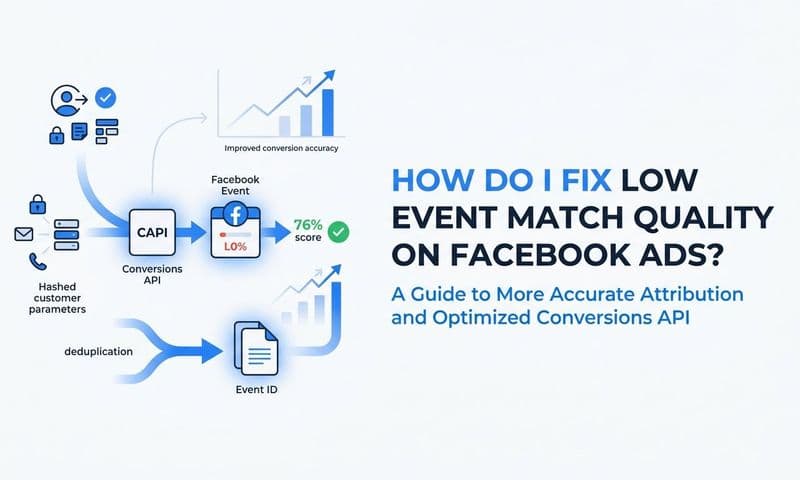
Facebook's Conversions API allows you to send conversion data directly from your server to Facebook, bypassing browser limitations entirely. Unlike the Pixel, which relies on cookies and JavaScript, server-side tracking captures events regardless of browser restrictions or user privacy settings.
This doesn't replace the Pixel—it supplements it. The combination of browser-based and server-side tracking creates redundancy that captures more conversions while improving data quality. Facebook's algorithm receives more complete information, which improves targeting and optimization over time.
Server-side tracking implementations generally improve data accuracy and can help recover conversion data lost to browser restrictions, giving you a more complete picture of campaign performance.
Implementation Steps
1. Audit your current conversion tracking to identify the gap between Pixel-reported conversions and actual sales from your backend systems—this reveals how much data you're currently losing.
2. Implement the Conversions API through your website platform, e-commerce system, or a dedicated integration tool that connects your server to Facebook's API.
3. Configure event matching to ensure server-side events properly connect with Pixel events, using parameters like email, phone number, and external ID to improve matching accuracy.
Pro Tips
After implementing server-side tracking, expect to see an increase in reported conversions as Facebook captures events previously lost to browser restrictions. Don't panic when your metrics shift—you're finally seeing accurate data, not experiencing a sudden performance change.
4. Create Custom Conversion Events
The Challenge It Solves
Facebook's standard events—Purchase, Lead, Add to Cart—work for basic tracking but miss the nuances of your specific customer journey. Every business has unique conversion milestones that matter for optimization, yet most advertisers never track them. This leaves money on the table because Facebook's algorithm can't optimize for the micro-conversions that predict macro-conversions.
Without custom events mapped to your specific funnel stages, you're optimizing in the dark, unable to identify where prospects drop off or which touchpoints drive the highest-value customers.
The Strategy Explained
Custom conversions allow you to track up to 100 custom events beyond Facebook's standard pixel events, giving you granular visibility into your unique customer journey. These might include events like "Watched Demo Video," "Visited Pricing Page," "Started Free Trial," or "Upgraded to Annual Plan."
The power comes from mapping these custom events to your conversion funnel stages, then using them as optimization events for different campaign objectives. Instead of only optimizing for purchases, you can create campaigns that optimize for high-intent actions earlier in the funnel, capturing prospects before they're ready to buy.
This approach works particularly well for businesses with longer sales cycles, where optimizing solely for final conversions limits Facebook's learning and restricts your audience size.
Implementation Steps
1. Map your complete customer journey from first touch to purchase, identifying 5-10 critical actions that indicate increasing purchase intent or customer value.
2. Configure custom conversion events in Facebook Events Manager for each identified action, using URL rules or custom event parameters to trigger tracking.
3. Create campaign variations that optimize for different funnel stages—top-of-funnel campaigns optimizing for engagement events, mid-funnel for consideration events, bottom-funnel for purchase events.
Pro Tips
Use custom conversions to create lookalike audiences based on high-intent actions rather than just purchasers. A lookalike audience of people who visited your pricing page three times often converts better than a lookalike of all purchasers combined.
5. Leverage Breakdown Reports
The Challenge It Solves
Campaign-level metrics hide crucial performance variations that could transform your results. A campaign with a mediocre 2x ROAS might contain individual ad placements delivering 5x ROAS and others losing money at 0.5x. Without granular breakdowns, you're averaging away your best opportunities and subsidizing your worst performers.
Most advertisers review top-line campaign metrics and miss the hidden patterns that reveal exactly where to scale and where to cut.
The Strategy Explained
Breakdown reports in Facebook Ads Manager offer dimensions including age, gender, placement, device, platform, and time of day. Each breakdown reveals a different layer of performance variation. You might discover that your ads convert 3x better on Instagram Stories than Facebook Feed, or that women aged 35-44 have twice the lifetime value of your average customer.
The strategy involves systematically analyzing key breakdowns to identify performance clusters, then restructuring campaigns to isolate and scale winners while eliminating losers. This moves you from broad targeting to precision optimization based on actual performance data.
Think of breakdowns as an X-ray for your campaigns—they show you what's really happening beneath the surface-level metrics.
Implementation Steps
1. Run weekly breakdown reports for your top-spending campaigns across these dimensions: placement, age and gender, device, platform, and time of day to identify your highest-performing segments.
2. Create a spreadsheet tracking ROAS by segment across all dimensions, highlighting segments that consistently outperform your account average by 50% or more.
3. Restructure campaigns to isolate top-performing segments into dedicated ad sets with increased budgets, while pausing or reducing spend on consistently underperforming segments.
Pro Tips
Don't just look at ROAS in your breakdowns—analyze volume too. A segment with 10x ROAS but only two conversions isn't scalable, while a segment with 3x ROAS and 100 conversions represents real opportunity.
6. Connect Offline Conversions
The Challenge It Solves
For businesses with sales processes that extend beyond digital transactions—phone sales, in-person consultations, contract signings—Facebook never sees the final conversion. This creates a massive attribution gap where your most valuable conversions remain invisible to Facebook's algorithm, preventing proper optimization and making your campaigns appear less effective than they actually are.
When Facebook can't see that a lead became a $50,000 customer three weeks later, it treats that lead the same as one worth $500, fundamentally breaking your optimization.
The Strategy Explained
Offline conversions allow you to upload sales data that happens outside Facebook's tracking environment back into Ads Manager, closing the attribution loop. This works by matching conversion events to the original Facebook click or impression using identifiers like email address, phone number, or a unique transaction ID.
Once connected, Facebook can see the complete customer journey from ad impression to final sale, regardless of where that sale happened. This dramatically improves algorithmic optimization because Facebook's system learns which ad interactions lead to valuable customers, not just which ones generate initial clicks or leads.
Offline conversions can be uploaded manually through CSV files or automated through CRM integrations, with automated approaches providing the fastest feedback loop for optimization.
Implementation Steps
1. Set up an offline event set in Facebook Events Manager, configuring the data parameters you'll use to match offline conversions to Facebook interactions.
2. Export your sales data with customer identifiers (email, phone, external ID) and conversion values, formatting it according to Facebook's offline conversion specifications.
3. Upload your historical offline conversions from the past 90 days to establish baseline attribution, then set up weekly or automated uploads to maintain current data flow.
Pro Tips
Include conversion value in your offline conversion uploads, not just conversion events. Facebook's algorithm optimizes much more effectively when it knows a conversion was worth $10,000 versus $100, directing budget toward audiences that generate higher-value customers.
7. Build Automated Reporting Systems
The Challenge It Solves
Manual reporting creates two critical problems: it's time-consuming, and it's reactive. By the time you manually compile weekly reports and spot a problem, you've already wasted days of budget on underperforming campaigns. The lag between performance changes and optimization actions directly impacts your bottom line.
Marketers who manually check campaigns can't possibly monitor performance at the frequency needed to catch issues before they become expensive problems.
The Strategy Explained
Automated reporting systems continuously monitor your campaigns and alert you to performance changes that require action. This shifts you from reactive to proactive campaign management, where you're notified of problems within hours rather than discovering them days later during manual reviews.
Effective automation combines three elements: real-time dashboards showing current performance against benchmarks, scheduled reports that summarize trends without requiring manual compilation, and intelligent alerts that notify you only when metrics cross meaningful thresholds.
The goal isn't eliminating human oversight—it's eliminating the manual busywork that prevents you from focusing on strategic optimization decisions.
Implementation Steps
1. Create a live dashboard using Facebook's native reporting tools or third-party platforms that displays your revenue-focused metrics framework with automatic refresh intervals.
2. Configure automated alerts for critical thresholds—campaigns that drop below your minimum ROAS, ad sets exceeding your maximum CAC, or daily spend exceeding budget by more than 20%.
3. Schedule weekly automated reports that compile performance trends, budget pacing, and month-over-month comparisons, eliminating the need for manual data compilation.
Pro Tips
Set your alert thresholds based on statistical significance, not arbitrary numbers. A campaign that drops from 3.5x to 3.2x ROAS might just be normal variance, but one that drops from 3.5x to 2.0x signals a real problem requiring immediate attention.
Taking Action on Your Analytics
Mastering Facebook ads analytics isn't about obsessing over every available metric—it's about building systems that connect ad performance to actual revenue. The seven strategies outlined here create a comprehensive framework for transforming raw data into profitable decisions.
Start by establishing your revenue-focused metrics framework and fixing your attribution setup. These foundational elements ensure you're measuring what actually matters and crediting conversions accurately. Then progressively implement server-side tracking and custom conversions to capture the full customer journey.
The marketers who win aren't those with the most data—they're the ones who act on the right insights fastest. Pick one strategy from this list, implement it this week, and measure the impact before moving to the next. Each improvement compounds, gradually transforming your Facebook advertising from an expense you tolerate into a revenue engine you can scale with confidence.
Remember that analytics excellence isn't a destination—it's an ongoing process of refinement. As Facebook's platform evolves and your business grows, your analytics approach must evolve too. The frameworks you build today create the foundation for increasingly sophisticated optimization tomorrow.
Ready to elevate your marketing game with precision and confidence? Discover how Cometly's AI-driven recommendations can transform your ad strategy—Get your free demo today and start capturing every touchpoint to maximize your conversions.