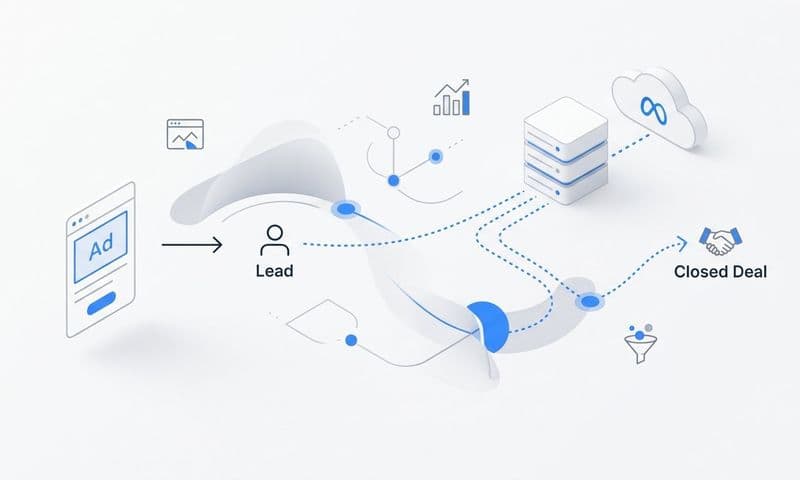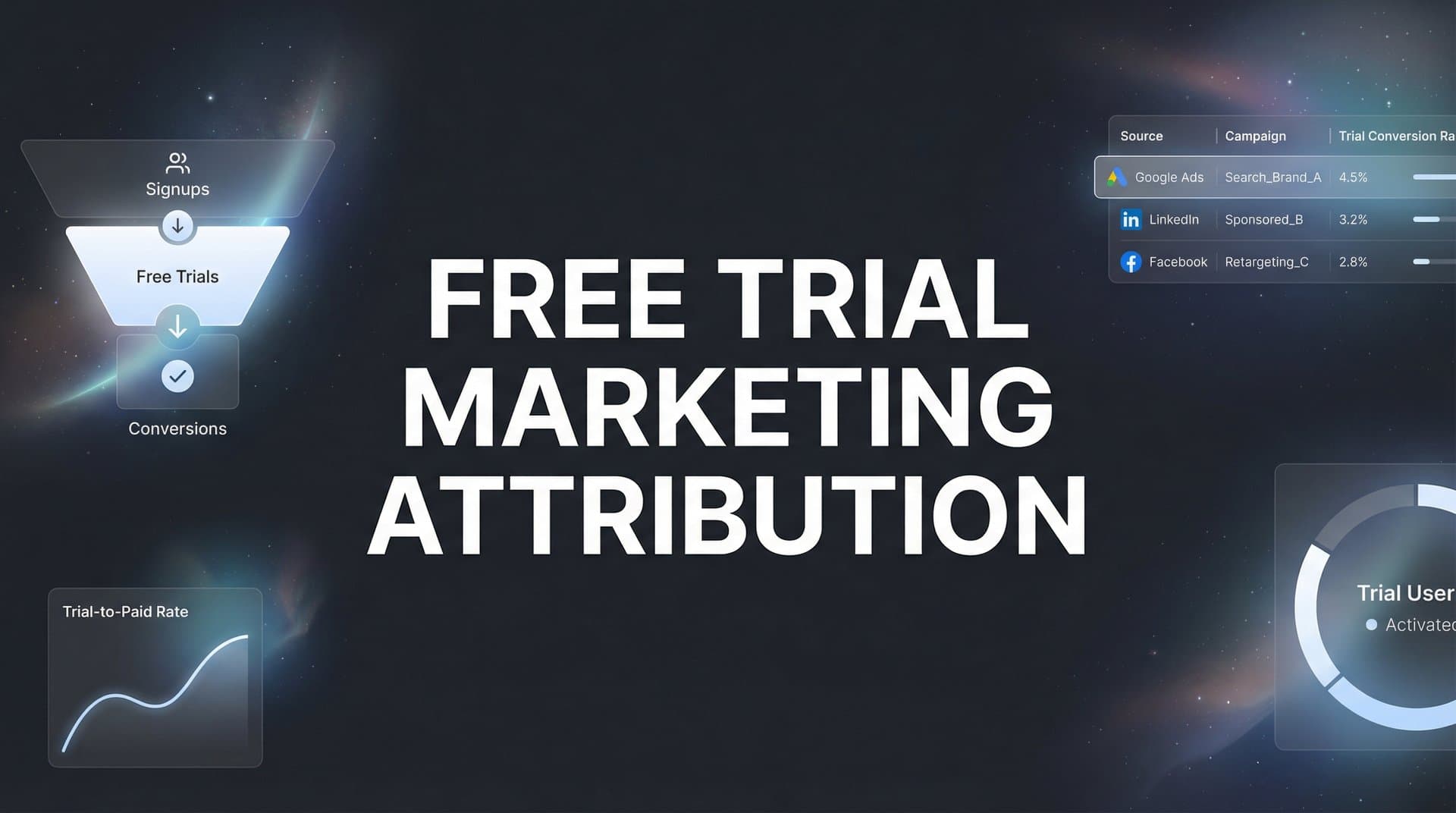
Free trials are the lifeblood of SaaS growth, but here's the frustrating reality: most marketers can't tell you which campaigns actually drive trial signups that convert to paying customers. You're spending thousands on ads across Meta, Google, and LinkedIn, watching trial numbers climb, but when it comes to connecting those trials to real revenue, you're flying blind.
The problem isn't your marketing—it's your attribution.
Without proper free trial marketing attribution, you're optimizing for vanity metrics instead of the touchpoints that create customers. You see 500 trial signups and celebrate, but three months later, only 47 became paying customers. Which campaigns drove those 47? Which channels brought tire-kickers who never logged in twice? You have no idea.
This creates a dangerous cycle. You scale the campaigns that generate the most trials, not the ones that generate the most revenue. Your CAC looks great on paper until you realize half your trials come from sources that never convert. Meanwhile, the channels quietly driving your best customers get underfunded because they don't generate flashy signup numbers.
The solution isn't more data—it's better attribution. You need to connect every trial signup back to its original source, track how users behave during the trial, and most importantly, link trial outcomes to the campaigns that started the journey. Only then can you confidently scale what works and cut what doesn't.
This guide breaks down seven proven strategies to track, measure, and optimize your free trial funnel so you can stop guessing and start knowing which campaigns actually drive revenue.
1. Map Your Complete Trial-to-Revenue Journey
The Challenge It Solves
You can't track what you haven't defined. Most teams jump straight into implementing tracking pixels and attribution tools without first documenting what their actual customer journey looks like. This creates gaps in your data from day one.
When you don't know every touchpoint between first impression and paid conversion, you miss critical moments where prospects drop off or engage. You end up with incomplete attribution that tells you someone signed up for a trial but not how they discovered you, what convinced them to try, or what happened during the trial that led to conversion.
The Strategy Explained
Before you implement any tracking, map out every single touchpoint in your trial-to-revenue journey. Start with awareness (how prospects first hear about you) and document every step through consideration, trial signup, onboarding, activation, and eventual conversion to paid customer.
Think beyond just marketing touchpoints. Include product interactions during the trial, email sequences, support conversations, and sales outreach if your model includes it. Your map should show both the marketing funnel and the product experience because both influence conversion.
This isn't a theoretical exercise. Walk through your actual systems—your ad platforms, website, CRM, email tool, and product—and document exactly what happens at each stage. Where does data live? What events get tracked? Where are the handoffs between systems?
Implementation Steps
1. Create a visual diagram showing every stage from first touch to paid conversion, including all possible paths prospects might take (direct signup, demo request, content download, etc.)
2. List every tool and platform involved at each stage (ad platforms, website analytics, CRM, product analytics, email platform, payment processor) and identify where data gaps exist between systems
3. Define the key events that matter for attribution: first touch, trial signup, activation moments (first login, feature adoption, etc.), and conversion to paid customer
4. Document your current tracking setup honestly—what's working, what's broken, and what's missing entirely
Pro Tips
Don't map your ideal journey. Map your real journey, including the messy parts where prospects bounce between channels or take unexpected paths. Interview your sales and customer success teams to understand common patterns they see that your analytics might miss. This reality-based map becomes your blueprint for implementing accurate attribution.
2. Implement Server-Side Tracking
The Challenge It Solves
Browser-based tracking is dying. iOS privacy features block tracking pixels, ad blockers strip out cookies, and users who browse in private mode leave no trail. If you're relying solely on client-side pixels, you're missing a significant portion of your trial signups.
This isn't just about incomplete data. It's about systematically undervaluing the channels where privacy-conscious users come from. Your attribution shows certain campaigns underperforming when they're actually driving conversions that your tracking simply can't see.
The Strategy Explained
Server-side tracking captures attribution data on your server rather than relying on browser pixels. When someone signs up for a trial, your server logs the conversion and associated attribution data directly, bypassing browser limitations entirely.
This approach maintains accuracy even when browsers block cookies or users have ad blockers enabled. The data flows from your server to your analytics and attribution platforms, creating a complete record of conversions that browser-based tracking would miss.
Modern attribution platforms have made server-side implementation significantly easier than it was a few years ago. You're not building custom infrastructure from scratch—you're connecting your existing systems through APIs that handle the heavy lifting.
Implementation Steps
1. Choose an attribution platform that supports server-side tracking and can connect with your existing ad platforms, CRM, and product analytics
2. Implement server-side conversion tracking for your key events (trial signup, activation milestones, conversion to paid) by sending these events from your server to your attribution platform when they occur
3. Maintain parallel client-side tracking initially to compare data quality and identify the gap between what browser pixels capture versus what server-side tracking reveals
4. Configure your attribution platform to send conversion events back to your ad platforms using their conversion APIs so they can optimize based on complete data
Pro Tips
Start with your highest-value conversion events rather than trying to track everything server-side immediately. Trial-to-paid conversions are more important than page views. Focus on getting those right first, then expand to earlier funnel stages. The data quality improvement on revenue-driving events will immediately impact your optimization decisions.
3. Use Multi-Touch Attribution Models
The Challenge It Solves
Last-click attribution is a lie. It tells you that the final touchpoint before conversion deserves all the credit, completely ignoring the awareness campaigns, nurture sequences, and consideration content that actually built the relationship.
When you optimize based on last-click data, you systematically underfund top-of-funnel campaigns and overinvest in bottom-funnel tactics. Your brand awareness suffers, your pipeline dries up, and you wonder why your "efficient" campaigns stopped working.
The Strategy Explained
Multi-touch attribution distributes credit across all touchpoints in the conversion journey rather than giving everything to the last interaction. This reveals the true role each channel plays in driving trials that convert to revenue.
Different models weight touchpoints differently. Linear attribution gives equal credit to every touchpoint. Time decay gives more credit to recent interactions. Position-based models emphasize first and last touch while acknowledging middle touchpoints. U-shaped attribution credits first touch and conversion touch most heavily.
The right model depends on your sales cycle and customer journey. SaaS products with longer consideration periods benefit from models that credit early touchpoints. Products with shorter cycles might use time decay to emphasize recent interactions.
Implementation Steps
1. Start by comparing last-click attribution against a linear model to see which campaigns are getting systematically undervalued in your current reporting
2. Analyze your typical customer journey length and complexity to choose an attribution model that reflects how prospects actually move through your funnel
3. Implement your chosen model in your attribution platform and run it parallel to last-click for at least 30 days to understand the differences in channel valuation
4. Identify campaigns that show significantly different performance under multi-touch attribution and adjust budget allocation based on these insights
Pro Tips
Don't get paralyzed choosing the "perfect" model. The biggest improvement comes from moving away from last-click to any multi-touch model. Start with linear or time decay, run it for a full sales cycle, and refine from there. The goal is better decisions, not perfect attribution.
4. Connect Trial Behavior to Traffic Sources
The Challenge It Solves
Knowing which campaign drove a trial signup is only half the story. What you really need to know is whether that trial actually used your product, activated key features, and converted to paid. Two campaigns might generate the same number of trials, but if one drives engaged users and the other attracts tire-kickers, they're not equally valuable.
Without connecting trial behavior back to traffic sources, you optimize for quantity over quality. You scale the campaign generating 200 trials per month without realizing only 3% convert, while ignoring the campaign that generates 50 trials with a 25% conversion rate.
The Strategy Explained
This strategy links product analytics to marketing attribution by connecting in-trial engagement metrics back to the original traffic source. When someone signs up from a specific campaign, you track not just the signup but their entire trial experience—first login, feature adoption, activation milestones, and ultimate conversion outcome.
This requires your attribution platform to pass user identifiers between your marketing stack and product analytics. When a user performs an action in your product, that event gets tagged with the original campaign, ad set, and creative that brought them in.
The result is attribution that shows not just trial volume but trial quality. You can see which campaigns drive users who actually activate versus those who sign up and disappear. This transforms how you evaluate channel performance.
Implementation Steps
1. Define your activation criteria—what actions during the trial indicate a user is getting value and likely to convert (examples: completing onboarding, using core features, inviting team members)
2. Ensure your attribution platform captures user identifiers that persist from signup through the trial period so product events can be connected back to marketing sources
3. Set up tracking for key in-trial events in your product analytics and configure it to include the original traffic source data for each user
4. Create reports that show trial quality metrics by channel: activation rate, feature adoption, days active during trial, and eventual conversion rate—not just signup volume
Pro Tips
Look for patterns in which campaigns drive "fast activators" versus those that need more nurturing. Some channels might bring users who activate within hours, while others bring prospects who need email sequences and support to get value. This insight helps you build channel-specific onboarding experiences that improve conversion rates.
5. Feed Conversion Events Back to Ad Platforms
The Challenge It Solves
Ad platforms like Meta and Google use machine learning to find more people like your converters. But if you're only sending them trial signup events, their algorithms optimize for people who sign up—not people who become paying customers. This creates a fundamental misalignment between what the platform optimizes for and what you actually care about.
The result is campaigns that get better at generating trials while your trial-to-paid conversion rate slowly degrades. The algorithm thinks it's winning because trial volume increases, but your revenue per trial dollar spent keeps dropping.
The Strategy Explained
Instead of optimizing ad platforms for trial signups, send them conversion events that represent actual business value: trial-to-paid conversions, activated users, or revenue milestones. This retrains the algorithm to find prospects who don't just sign up but who actually convert.
Modern attribution platforms can send these delayed conversion events back to ad platforms using their Conversion APIs. When someone who signed up 14 days ago converts to paid, that event gets sent back to Meta or Google with the original click ID, allowing the platform to connect the conversion to the specific ad that drove it.
This creates a feedback loop where ad platforms get smarter about finding high-quality prospects. Over time, your cost per trial might increase slightly, but your cost per paying customer decreases significantly because the algorithm stops wasting budget on people who never convert.
Implementation Steps
1. Identify your most valuable conversion event—typically trial-to-paid conversion—and ensure you're tracking it accurately in your CRM or payment system
2. Configure your attribution platform to send these conversion events back to your ad platforms using their Conversion APIs, including the original click identifiers that allow platforms to match conversions to specific ads
3. Set up value-based optimization by passing revenue data with conversion events so platforms can optimize not just for conversions but for high-value conversions
4. Monitor how campaign performance changes over the first 30-60 days as algorithms retrain on actual revenue data rather than just trial signups
Pro Tips
Don't turn off trial signup optimization immediately. Run both conversion events in parallel—optimize for trial signups at the campaign level but send trial-to-paid conversions for learning. This gives algorithms revenue data without disrupting campaigns that are currently working. After 30 days of data collection, shift optimization targets to focus on paid conversions.
6. Segment Attribution by Trial Outcome
The Challenge It Solves
Aggregate attribution data hides critical patterns. When you look at all trials together, you see average performance. But averages mask the reality that different channels drive completely different user behaviors and outcomes.
One channel might drive trials that convert at 30% but take 25 days to decide. Another drives trials that convert at 8% but decide within 48 hours. A third brings users who activate quickly but churn after two months. Without segmenting by trial outcome, you can't see these patterns and optimize accordingly.
The Strategy Explained
Break down your attribution data by trial outcome categories: converted to paid, churned during trial, abandoned without engaging, and active but not yet converted. This reveals which channels drive which behaviors and allows you to optimize for the outcomes that matter most to your business.
The insight comes from comparing channel performance across segments. A channel might look mediocre in aggregate but reveal that it drives an unusually high percentage of your best customers—those who convert quickly and stay long-term. Meanwhile, a channel with strong trial volume might show that most trials abandon without engaging, indicating poor targeting or messaging misalignment.
This segmentation transforms attribution from a reporting tool into a strategic asset. You can identify which channels to scale for immediate revenue, which to nurture for long-term value, and which to cut because they consistently bring low-quality prospects.
Implementation Steps
1. Define clear outcome categories based on your business model (examples: converted within trial period, requested extension, churned after first month, never activated, still evaluating)
2. Tag every trial signup with these outcome labels as they progress through your funnel, updating the category as their status changes
3. Build attribution reports that show channel performance broken down by outcome category, not just overall conversion rate
4. Calculate metrics like cost per converted customer, average time to conversion, and lifetime value by channel and outcome segment to identify true channel quality
Pro Tips
Pay special attention to channels that drive high activation rates even if conversion rates look average. These users are getting value from your product but might need different pricing, features, or sales support to convert. This insight helps you build channel-specific conversion strategies rather than applying the same approach to all trial sources.
7. Run Attribution-Informed Budget Experiments
The Challenge It Solves
Attribution data is only valuable if you act on it. Too many teams build sophisticated attribution models, discover insights about channel performance, and then continue allocating budget the same way they always have. The data becomes a reporting curiosity rather than a decision-making tool.
The problem is fear of change. Your current budget allocation is working well enough that you're hesitant to shift spend based on attribution insights alone. What if the data is wrong? What if you kill a channel that's actually contributing more than attribution shows?
The Strategy Explained
Turn attribution insights into testable hypotheses, then run structured budget experiments to validate them. If attribution shows that LinkedIn drives higher-quality trials than Meta, don't immediately reallocate your entire budget. Instead, run a 30-day test where you increase LinkedIn spend by 30% and decrease Meta spend by the same amount, measuring the impact on trial quality and conversion rates.
This approach de-risks budget decisions while building confidence in your attribution data. Small experiments prove whether attribution insights translate to real performance improvements. Successful experiments get scaled, failed experiments get reversed, and over time you develop a data-driven budget allocation process.
The key is running clean experiments with clear success metrics defined upfront. Don't change multiple variables simultaneously or you won't know what drove the results. Test one hypothesis at a time, measure rigorously, and let the data guide your next move.
Implementation Steps
1. Identify your biggest attribution insight—the channel or campaign that looks significantly better or worse under proper attribution than under last-click reporting
2. Formulate a specific hypothesis about what would happen if you reallocated budget based on this insight (example: "If we shift 20% of Meta budget to LinkedIn, we'll see 15% fewer trials but 25% more paid conversions")
3. Design a time-bound experiment with clear success metrics, control periods for comparison, and a predetermined decision framework for what results would lead to permanent changes
4. Run the experiment for at least one full sales cycle to capture the complete impact on trial quality and conversion, then analyze results and decide whether to scale, modify, or reverse the change
Pro Tips
Start with experiments that have asymmetric risk-reward. Test increasing budget to undervalued channels rather than cutting budget from established performers. If the experiment fails, you simply return to baseline. If it succeeds, you've discovered a new growth lever. This approach lets you explore attribution insights without risking your core revenue drivers.
Putting These Strategies Into Action
Start with journey mapping and server-side tracking as your foundation—you can't optimize what you can't measure accurately. These two strategies create the data infrastructure that makes everything else possible. Without them, you're building attribution on quicksand.
Then layer in multi-touch attribution to understand your full funnel, and connect trial behavior back to traffic sources to see quality, not just quantity. These strategies transform your attribution from counting signups to measuring actual value. You'll finally see which campaigns drive engaged users who convert versus those that generate empty trials.
The game-changer is feeding conversion events back to ad platforms and segmenting by trial outcome. This transforms your attribution from a reporting tool into a revenue engine. Ad platforms get smarter about finding high-quality prospects, and you gain the insights needed to allocate budget based on true channel value rather than vanity metrics.
Finally, validate everything through attribution-informed experiments. Don't just trust the data—test it. Run structured budget experiments that prove attribution insights translate to real performance improvements. This builds confidence in your attribution system while continuously optimizing your marketing mix.
The difference between teams that succeed with free trial attribution and those that struggle comes down to implementation. You need systems that connect your ad platforms, CRM, and website to track the entire customer journey in real time—showing exactly which ads drive trials that actually convert to revenue.
For teams running paid campaigns across multiple platforms, a dedicated attribution solution like Cometly can capture every touchpoint from ad clicks to CRM events, providing AI-driven recommendations to identify high-performing ads and campaigns. The platform feeds enriched, conversion-ready events back to Meta, Google, and other ad platforms—improving targeting, optimization, and ad ROI.
Stop guessing which campaigns work. Start knowing. Ready to elevate your marketing game with precision and confidence? Discover how Cometly's AI-driven recommendations can transform your ad strategy—Get your free demo today and start capturing every touchpoint to maximize your conversions.