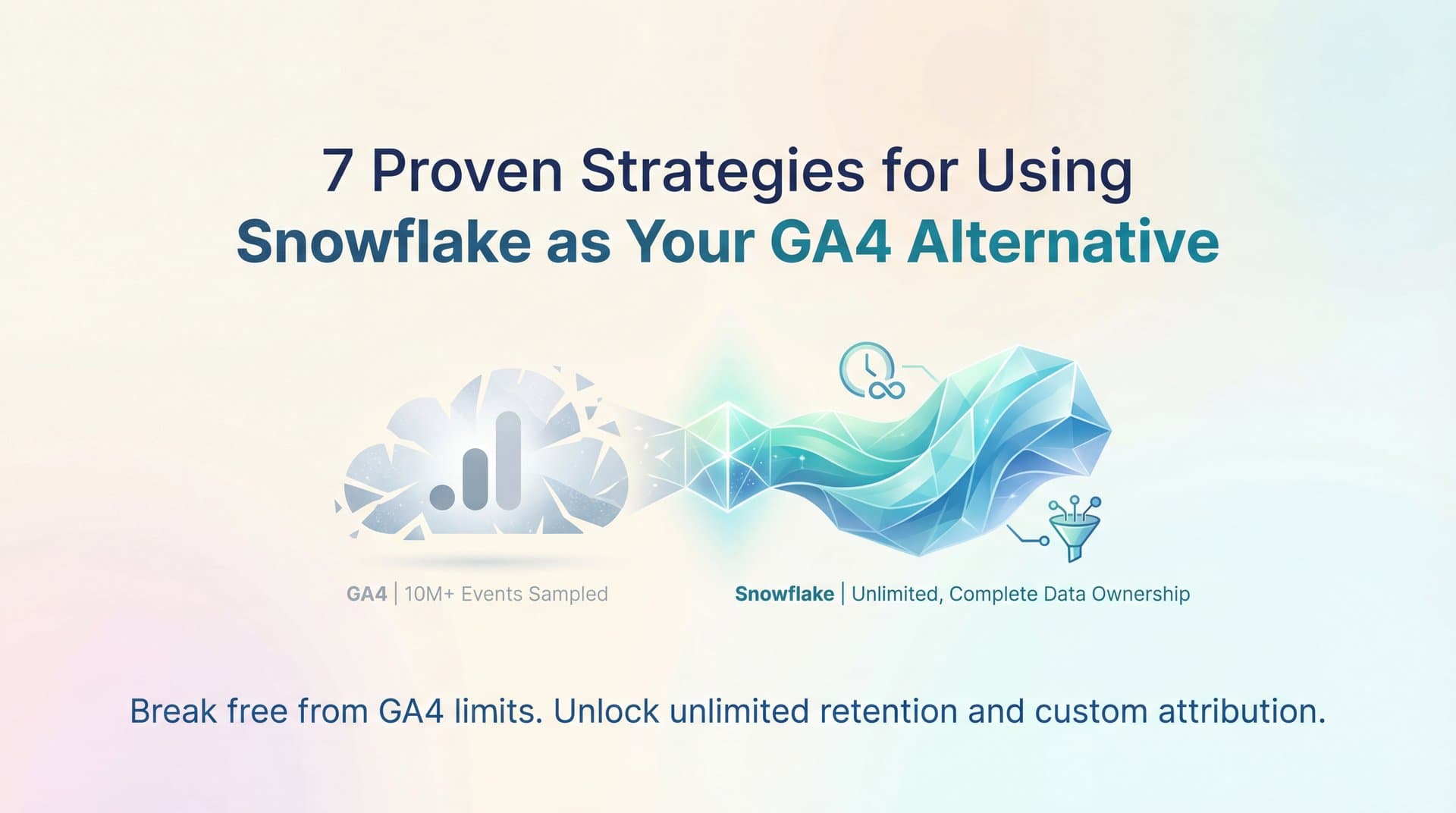
GA4's limitations are pushing marketing teams toward more flexible analytics solutions. Data sampling kicks in after 10 million events, making large-scale campaign analysis unreliable. The 14-month retention limit for standard properties means you lose historical comparison data just when seasonal trends become meaningful. And the inability to join marketing data with CRM revenue creates a permanent blind spot between ad spend and actual business outcomes.
Snowflake has emerged as a powerful alternative—not as a direct GA4 replacement, but as a data warehouse foundation that gives you complete control over your analytics infrastructure.
Unlike GA4's black-box approach, Snowflake lets you own your data completely, build custom attribution models without sampling, and connect every marketing touchpoint to closed revenue. You can retain data indefinitely, query billions of events without performance degradation, and integrate any data source into your analysis.
This guide covers seven actionable strategies for building a Snowflake-based analytics stack that surpasses GA4's capabilities for marketing attribution and campaign optimization. You'll learn how to collect data server-side, build unified marketing models, implement custom attribution, and accelerate time-to-value with specialized tools.
1. Build a Server-Side Event Collection Pipeline
The Challenge It Solves
Client-side tracking through GA4 faces increasing reliability issues. Ad blockers strip tracking scripts, iOS privacy features limit cookie persistence, and browser updates constantly change what data you can collect. By the time events reach GA4, you've already lost 20-30% of your actual traffic data.
Server-side collection bypasses these limitations entirely. Events flow from your website to your own server infrastructure, then directly into Snowflake—no browser restrictions, no sampling, no data loss.
The Strategy Explained
Server-side event collection means your website sends user interactions to a server you control, which then forwards enriched events to Snowflake. This approach captures every interaction reliably because it operates independently of browser cooperation, ad blockers, or privacy restrictions.
Your server becomes the single source of truth for user behavior. Before storing data in Snowflake, it can enrich events with valuable server-side information: user authentication status, subscription tier, or CRM details that would otherwise remain siloed. This creates a foundation for accurate attribution and measurement that client-side tracking simply cannot replicate.
The architecture typically involves three core components: a lightweight tracking endpoint that receives event payloads, a message queue that ensures reliability during traffic spikes, and a data pipeline that structures events into queryable Snowflake tables. Once implemented, you maintain complete ownership over every byte of behavioral data your users generate, with no sampling limits or retention restrictions.
Implementation Steps
1. Set up a tracking endpoint on your server infrastructure that receives event payloads from your website via POST requests, including user identifiers, event properties, and timestamps.
2. Implement a message queue system to buffer events reliably, ensuring no data loss during traffic spikes or temporary Snowflake connection issues.
3. Build a data pipeline that transforms raw events into structured tables in Snowflake, organizing data by event type, user session, and timestamp for efficient querying.
4. Deploy client-side tracking code that sends events to your endpoint instead of GA4, capturing page views, clicks, form submissions, and custom events.
5. Add server-side enrichment logic that appends CRM data, user attributes, or business context to events before they land in Snowflake.
Pro Tips
Start with page view and conversion events before expanding to detailed interaction tracking. Use batch inserts to Snowflake rather than individual event writes—this dramatically reduces compute costs. Include a fallback mechanism that queues events locally if your server endpoint is temporarily unavailable, ensuring zero data loss during deployments.
2. Create a Unified Marketing Data Model
The Challenge It Solves
Marketing data lives in silos. Ad performance sits in Meta and Google. Website behavior lives in GA4. Revenue data hides in your CRM. When you need to answer "which campaigns drove actual revenue?"—you're stuck exporting CSVs and manually joining data in spreadsheets.
This fragmentation makes accurate attribution impossible. You can see which ads got clicks, but not which clicks became customers. You know your revenue, but not which marketing touchpoints influenced it.
The Strategy Explained
A unified marketing data model in Snowflake brings every data source into a single queryable structure. You design schemas that connect ad impressions to website sessions to CRM opportunities to closed revenue—all joined by common user identifiers.
The model typically includes a user dimension table, an events fact table, an ad performance table, and a conversions table. These tables link through user IDs and timestamps, letting you trace any conversion back through every marketing touchpoint that influenced it.
This isn't just data storage—it's an analytics foundation. Once your data model exists, any question about marketing performance becomes a SQL query. "What's the ROI of our Meta campaigns?" Join ad spend to attributed revenue. "Which content drives qualified leads?" Join page views to CRM lead scores.
Implementation Steps
1. Design a user identity table that consolidates anonymous IDs, authenticated user IDs, email addresses, and CRM contact IDs into a single user record with cross-reference mappings.
2. Create an events schema that stores all website interactions with consistent structure—timestamp, user ID, event type, properties, and source attribution.
3. Build ad performance tables that import daily metrics from Meta, Google, LinkedIn, and other platforms, standardizing column names and metrics across sources.
4. Establish a conversions table that captures every meaningful action—form submissions, trial signups, purchases, qualified leads—with links back to user IDs and timestamps.
5. Implement ETL processes that continuously sync data from ad platforms, your website, and your CRM into these Snowflake tables on a regular schedule.
Pro Tips
Use Snowflake's clustering keys on timestamp and user ID columns to optimize query performance on large datasets. Implement slowly changing dimensions for user attributes that evolve over time, like subscription status or customer tier. Create views that pre-join common queries—this makes analysis faster and reduces the SQL complexity your team needs to manage.
3. Implement Custom Attribution Logic Without Sampling
The Challenge It Solves
GA4's data-driven attribution model is a black box. You can't see how credit is distributed across touchpoints, can't adjust the logic to match your business model, and can't trust the results when data sampling kicks in. For complex B2B customer journeys with dozens of touchpoints, GA4's attribution becomes effectively useless.
Marketing teams need attribution models that reflect their actual sales process—whether that's a 90-day B2B cycle with multiple stakeholders or a 24-hour e-commerce conversion path.
The Strategy Explained
Custom attribution in Snowflake means writing SQL logic that assigns conversion credit based on your business rules. You can implement any attribution model—first-touch, last-touch, linear, time-decay, position-based, or custom weighted models that reflect your unique customer journey.
Because all your data lives in Snowflake without sampling, you can analyze every touchpoint for every user. A B2B company might weight demo requests heavily, while giving partial credit to earlier content downloads. An e-commerce brand might emphasize the last three touchpoints before purchase.
The key advantage is transparency and control. You define the rules, you see exactly how credit is assigned, and you can iterate the model based on what you learn about your actual conversion patterns.
Implementation Steps
1. Create a touchpoints table that sequences every marketing interaction for each user, ordered by timestamp, including source, medium, campaign, and content details.
2. Write SQL logic that identifies conversion events and looks back at all preceding touchpoints within your attribution window (30 days, 90 days, or whatever matches your sales cycle).
3. Implement attribution weighting rules that distribute conversion credit across touchpoints according to your chosen model—equal weight for linear, exponential decay for time-decay, or custom percentages for position-based.
4. Build attribution tables that store the results of your model, showing which campaigns, channels, and specific ads receive credit for each conversion.
5. Create comparison views that show the same conversions under different attribution models, helping you understand how model choice affects campaign evaluation.
Pro Tips
Start with simple models like first-touch and last-touch to validate your data quality before implementing complex logic. Use window functions in SQL to efficiently calculate touchpoint sequences and time gaps. Build attribution models as stored procedures that can be re-run as your data grows, rather than one-time queries.
4. Connect CRM Revenue Data to Marketing Touchpoints
The Challenge It Solves
The fundamental question in marketing is "what's the ROI?" But GA4 stops at website conversions—it has no visibility into what happens after a lead enters your CRM. You can see that a campaign generated 100 leads, but not that 10 became customers worth $50,000 each.
This disconnect makes budget allocation a guessing game. You optimize for lead volume when you should optimize for revenue quality. You scale campaigns that generate junk leads while underfunding campaigns that drive actual customers.
The Strategy Explained
Connecting CRM data to marketing touchpoints in Snowflake closes the loop between ad spend and revenue. You import opportunity data, deal values, and closed-won dates from your CRM, then join this data back to the marketing touchpoints that influenced each deal.
The integration typically works through email address or contact ID matching. When someone fills out a form on your website, you capture their email. When that email becomes a customer in your CRM, you can trace back through their entire marketing journey—every ad they clicked, every page they visited, every email they opened.
This transforms your attribution from "cost per lead" to "cost per dollar of revenue." You can calculate true marketing ROI, identify which campaigns drive high-value customers, and optimize budget allocation based on actual business outcomes.
Implementation Steps
1. Set up a daily sync from your CRM to Snowflake that imports contact records, opportunity records, deal values, stages, and closed dates into dedicated tables.
2. Build identity resolution logic that matches CRM contacts to website users through email addresses, form submissions, or unique identifiers captured during lead conversion.
3. Create a revenue attribution table that links each closed deal back to all marketing touchpoints that user encountered, applying your attribution model to distribute revenue credit.
4. Implement deal stage tracking that shows which campaigns influence opportunities at different funnel stages—not just initial lead creation but also deal progression and close.
5. Build ROI calculations that compare total ad spend for each campaign against the attributed revenue it generated, accounting for your attribution model and time lag between touchpoint and close.
Pro Tips
Account for time lag between marketing touchpoint and revenue realization—B2B deals might close 90+ days after first touch. Use cohort analysis to evaluate campaign performance based on when leads were generated, not just when they closed. Track deal velocity alongside revenue to identify campaigns that drive faster sales cycles.
5. Feed Enriched Conversion Data Back to Ad Platforms
The Challenge It Solves
Ad platform algorithms optimize based on the conversion data you send them. When you only send "form submitted" events, Facebook's algorithm optimizes for form submissions—not for leads that become customers. This creates a disconnect where ad platforms scale the wrong traffic.
GA4 can send basic conversions to ad platforms, but it can't send the enriched data that lives in your CRM. It doesn't know which leads became qualified opportunities, which deals closed, or what revenue each customer generated.
The Strategy Explained
Reverse ETL sends enriched conversion data from Snowflake back to Meta, Google, and other ad platforms. Instead of reporting "lead created," you report "qualified opportunity created" or "deal closed for $10,000." This gives ad algorithms the signal they need to find more high-value customers.
The process works by monitoring your Snowflake data for qualified events—a lead reaching MQL status in your CRM, an opportunity moving to a specific stage, or a deal closing. When these events occur, reverse ETL tools send them to ad platforms as conversion events, often with enhanced data like deal value or customer lifetime value.
This feedback loop dramatically improves ad performance. Platform algorithms learn what "good traffic" looks like based on your actual business outcomes, not just surface-level website actions. Over time, campaigns automatically optimize toward the users most likely to become valuable customers.
Implementation Steps
1. Define the business events in Snowflake that should trigger ad platform conversion reporting—qualified leads, closed deals, high-value purchases, or other meaningful outcomes.
2. Set up a reverse ETL tool that monitors these tables for new events and automatically sends them to ad platform conversion APIs with proper user matching through email or click IDs.
3. Configure conversion value passing that sends deal amounts or customer lifetime value alongside conversion events, enabling value-based bidding optimization.
4. Implement deduplication logic that prevents sending the same conversion multiple times if a user has multiple marketing touchpoints or if your data processing runs multiple times.
5. Create monitoring dashboards that track conversion sync status, match rates, and any API errors to ensure your feedback loop stays healthy.
Pro Tips
Send multiple conversion events that represent different funnel stages—"lead created," "qualified opportunity," and "closed deal" all provide valuable signals. Use ad platform offline conversion imports for deals that close days or weeks after the initial click, ensuring proper attribution. Test match rates before scaling—if less than 70% of your conversions match back to ad platform users, investigate identity resolution issues.
6. Build Real-Time Dashboards for Campaign Optimization
The Challenge It Solves
Marketing decisions happen in real-time. A campaign starts underperforming at 10 AM, but you don't notice until you check GA4 at 3 PM. By then, you've wasted five hours of budget. Or a new ad creative crushes it, but you don't see the signal until the next day's report.
GA4's interface is designed for analysis, not operational decision-making. You can't customize views to match your workflow, can't combine GA4 data with ad spend in a single view, and can't set up alerts that notify you when performance shifts.
The Strategy Explained
Real-time dashboards connected to Snowflake give you operational visibility into campaign performance as it happens. You connect BI tools to your Snowflake data warehouse, building custom views that show exactly the metrics you need to make optimization decisions.
These dashboards combine data that GA4 keeps separate—ad spend next to conversion data, campaign performance across all platforms in one view, and real-time alerts when key metrics move outside expected ranges. You can drill down from campaign to ad set to individual creative, seeing performance at every level.
Because Snowflake separates storage from compute, you can query massive datasets in real-time without performance degradation. Dashboards refresh every few minutes, showing current-hour performance alongside historical trends for context.
Implementation Steps
1. Choose a BI tool that connects natively to Snowflake—options include Tableau, Looker, Mode, or Metabase—and establish a direct connection to your marketing data warehouse.
2. Design dashboard views that show the metrics you check daily—campaign spend, conversion volume, cost per conversion, attributed revenue, and ROI—organized by platform and time period.
3. Build drill-down capabilities that let you click from campaign-level metrics into ad set performance, then into individual ad creative performance, maintaining consistent metric definitions.
4. Implement automated refresh schedules that update dashboards every 15-30 minutes during business hours, ensuring you see performance shifts quickly enough to act.
5. Set up alert rules that notify you via Slack or email when critical metrics exceed thresholds—cost per conversion spikes, conversion volume drops, or daily spend exceeds budget.
Pro Tips
Use Snowflake's result caching to reduce query costs for frequently accessed dashboard views. Build separate dashboards for different use cases—one for daily optimization, one for weekly performance reviews, one for executive reporting. Include comparison metrics that show current performance against last week, last month, or the same period last year to provide context.
7. Leverage Attribution Platforms That Integrate with Snowflake
The Challenge It Solves
Building a complete analytics stack from scratch requires significant engineering resources. You need to implement server-side tracking, build data models, write attribution logic, set up reverse ETL, and create dashboards. For many marketing teams, this represents months of development work before you see any value.
Meanwhile, you're still making budget decisions based on incomplete GA4 data. The opportunity cost of waiting for your custom solution compounds daily as you optimize campaigns without accurate attribution.
The Strategy Explained
Specialized attribution platforms that integrate with Snowflake give you the benefits of warehouse-based analytics without building everything from scratch. These tools handle server-side tracking, attribution modeling, and conversion sync while storing all your raw data in your Snowflake instance.
This approach accelerates time-to-value dramatically. You get accurate attribution within days instead of months, while maintaining data ownership and the flexibility to run custom queries. The platform handles the operational complexity—tracking implementation, identity resolution, attribution calculation—while you retain full access to your underlying data.
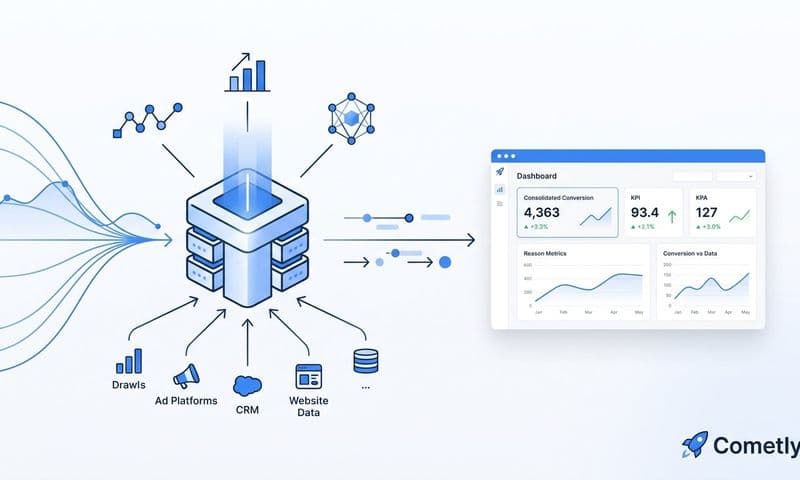
Tools like Cometly capture every touchpoint from ad clicks to CRM events, providing AI-driven recommendations for campaign optimization. The platform connects your ad platforms, website, and CRM, tracking the complete customer journey in real-time. You can analyze ad performance, compare attribution models, and make data-driven decisions to scale campaigns—all while your raw data lives in Snowflake for custom analysis.
Implementation Steps
1. Evaluate attribution platforms that offer native Snowflake integration, comparing their tracking capabilities, attribution models, and data export features against your requirements.
2. Implement the platform's tracking code on your website and connect your ad platforms and CRM through their integration interfaces, establishing data flow into the platform.
3. Configure the platform to export raw event data, attribution results, and enriched conversions into dedicated schemas in your Snowflake warehouse on a regular sync schedule.
4. Use the platform's interface for daily optimization decisions and campaign analysis, while leveraging your Snowflake data for custom reporting, advanced analysis, or integration with other business systems.
5. Set up the platform's conversion sync features to send enriched conversion data back to ad platforms, improving their optimization algorithms with your CRM outcome data.
Pro Tips
Choose platforms that export granular event data to Snowflake, not just aggregated reports—this preserves your ability to run custom analysis. Verify that the platform's attribution models match your business needs before committing. Use the platform's AI recommendations as a starting point, then validate insights with custom Snowflake queries that incorporate your unique business context.
Putting It All Together
Moving beyond GA4 to a Snowflake-based analytics stack requires upfront investment but delivers lasting advantages. You gain complete data ownership with no retention limits, the ability to build custom attribution models that reflect your actual business model, and the power to connect marketing performance directly to revenue outcomes.
Start with server-side event collection to establish reliable data capture that bypasses browser limitations. This foundation ensures you're working with complete data, not the sampled subset that GA4 provides after ad blockers and privacy features take their toll.
Next, build your unified marketing data model that brings together ad performance, website behavior, and CRM revenue. This is where the real power emerges—the ability to answer questions that span multiple systems, like "which campaigns drive customers with the highest lifetime value?"
Implement custom attribution logic that assigns conversion credit according to your business rules, not a black-box algorithm. Connect this attribution to actual closed revenue from your CRM, transforming your optimization from "cost per lead" to "cost per dollar of revenue."
Feed enriched conversion data back to ad platforms so their algorithms learn what good traffic looks like based on your business outcomes. Build real-time dashboards that give you operational visibility to catch performance shifts before they waste budget.
For teams that want these capabilities without building everything from scratch, attribution platforms that integrate with your data warehouse can accelerate time-to-value significantly. You get accurate multi-touch attribution and AI-driven optimization recommendations immediately, while maintaining data ownership and the flexibility to run custom analysis in Snowflake.
The path forward depends on your resources and timeline. If you have strong engineering capacity, building a custom stack gives you maximum control. If you need results quickly while preserving data ownership, specialized tools that complement your warehouse investment offer the fastest path to better decisions.
Ready to elevate your marketing game with precision and confidence? Discover how Cometly's AI-driven recommendations can transform your ad strategy—Get your free demo today and start capturing every touchpoint to maximize your conversions.