To get your marketing ROI, the classic formula is (Revenue - Marketing Cost) / Marketing Cost. Simple, right? But its accuracy hinges entirely on having solid numbers for both revenue and cost, which is where most marketers get tripped up. The real secret isn't the formula—it's knowing which numbers to plug in and, more importantly, how to attribute revenue correctly.
Why Your Marketing ROI Calculations Are Probably Wrong
Before we jump into advanced formulas, let's get one thing straight: most marketing ROI calculations are built on a foundation of shaky data. You might be tracking your ad spend down to the penny, but if the revenue side of the equation is off, your results are completely meaningless.
This leads to some pretty painful mistakes—wasted ad spend, shutting down campaigns that were actually working, and leaving huge growth opportunities on the table.
The problem usually starts with blindly trusting the metrics you see inside ad platforms like Meta or Google. These platforms are built to make themselves look good. Without a single source of truth, they often over-report conversions because they can't see the full customer journey.
The Disconnect Between Ad Platforms and Reality
Relying only on in-platform data gives you a warped view of what’s actually happening. Here’s why this approach is so risky:
- Inflated Conversion Counts: Ad platforms are notorious for taking credit for sales they barely influenced. This is especially true with outdated models like last-click attribution. We break down exactly how last-click attribution models can mislead your marketing decisions in our detailed guide.
- Ignoring Long Sales Cycles: For SaaS, B2B, or high-ticket e-commerce, a customer might see an ad today but not buy for another 90 days. Most ad platforms won’t connect that final sale back to the initial campaign, making your top-of-funnel efforts look like a total waste of money.
- No Single Source of Truth: When each channel—paid social, search, email—reports its own success, the numbers never add up. You end up with more "attributed" revenue in your ad dashboards than you actually have in your bank account.
The core issue isn't the formula itself; it's the quality of the data you feed into it. To get an accurate ROI, you need a unified view that connects every single marketing touchpoint directly to actual revenue data from your payment processor or CRM—not just pixel-based estimates.
Let’s quickly lay out what goes into a truly accurate ROI calculation. Think of it as the difference between a rough guess and a reliable business metric.
Core Components of an Accurate ROI Calculation
Below breaks down the key inputs you need, comparing the common (and often wrong) approach with the advanced, more accurate method we recommend.
When measuring revenue, the basic approach is to rely on the “conversions” reported inside ad platforms like Meta and Google. This is often inaccurate because those numbers can be inflated, duplicated, or missing key context. The advanced approach is to pull real sales data from your payment processor or CRM so your reporting reflects actual revenue collected, not just platform-reported conversion totals.
For cost, the basic approach is to look only at the direct ad spend shown inside the platform. That’s incomplete because it ignores the real expenses required to run campaigns. The advanced approach is to include ad spend plus agency fees, creative production costs, and software/tool subscriptions so you can calculate true profitability instead of just “cost per result.”
With attribution, the basic approach is to accept the ad platform’s default model, which is usually last-click or something close to it. That often miscredits the final touchpoint and undervalues the channels that create demand earlier in the journey. The advanced approach is to use multi-touch attribution so every meaningful touchpoint gets credit and you can see what is actually influencing conversions.
For timeframe, the basic approach is to evaluate performance in short, isolated windows like a 7-day click view. That can create misleading decisions, especially for products with longer consideration cycles. The advanced approach is to account for full customer lifetime value and longer sales cycles, which gives you a clearer picture of long-term performance and helps you scale based on sustainable growth instead of short-term noise.
See the difference? The advanced approach gives you a complete, honest picture of your performance, while the basic approach leaves you flying blind.
The old-school way of calculating ROI became popular in the late 20th century when CMOs were first pressured to justify their budgets. They used the simple formula: ROI = (Revenue Attributed to Marketing − Marketing Cost) / Marketing Cost × 100.
Yet, global benchmarks show that companies are still struggling with this. Surveys report that only 40–50% of marketers feel confident in their ROI measurement because their data is disconnected and their attribution is weak.
Platforms that unify touchpoints across ads, web, and payment tools solve this by letting teams pull accurate revenue numbers instead of trusting in-platform “conversions,” which can seriously overstate ROI. You can read more about the evolution of marketing ROI on Sprinklr.com.
Mastering the Foundational Marketing ROI Formula
Before we dive into the deep end, we have to get our hands dirty with the foundational formula for marketing ROI. It looks simple on the surface, but its real power comes from the accuracy of what you plug into it. Get the data wrong, and your results will be useless.
The classic formula is:
Marketing ROI = (Revenue Gain from Marketing – Marketing Investment) / Marketing Investment
The result is usually turned into a percentage. So, a 300% ROI means you made $3 in profit for every $1 you spent.
Let's break down each piece of that puzzle so you can actually use it with confidence.
Defining Your Marketing Investment
This is the "cost" side of the equation, and it's where the first common mistake happens. Many marketers only count their direct ad spend—the money paid to Meta or Google—which gives them a dangerously inflated and inaccurate ROI.
We compare the leading options in our AI advertising creative tool roundup.
To get a true picture, your Marketing Investment has to include all the related costs. A real cost breakdown looks more like this:
- Direct Ad Spend: The obvious one. This is what you pay directly to the ad platforms.
- Agency or Freelancer Fees: Any retainers or project fees you pay to outside partners managing your campaigns.
- Tool Subscriptions: The monthly cost of your marketing stack—analytics software, email platforms, creative tools, you name it.
- Content and Creative Production: The cost of making the actual ads—visuals, copy, videos, and landing pages.
Let's say a DTC brand runs a campaign for a quarter. Their investment isn't just the $30,000 they spent on ads. It's actually $30,000 (ads) + $5,000 (agency retainer) + $1,500 (creative assets) = $36,500. That is your true Marketing Investment.
If you're evaluating vendors, our Shopify advertising creative tool breakdown can help.
Pinpointing Your Revenue Gain
This is where most marketers really trip up. If you're relying on the "conversion value" reported inside your ad platforms, you're setting yourself up for failure. Those numbers are notoriously unreliable, often inflated by weird attribution models and privacy updates.
You need to pull revenue from your single source of truth—your payment processor or CRM. This is the only number that matters because it's the actual cash hitting your bank account. Connect your sales data from something like Shopify, Stripe, or Salesforce to get a revenue figure you can trust.
This whole process is a chain reaction. Bad data leads to using the wrong formula, which leads directly to wasted money.
 How to Calculate ROI for Marketing the Right Way
As you can see, an accurate ROI is impossible if your cost and revenue data aren't rock-solid from the start.
A Practical ROI Calculation Example
Let's circle back to our DTC brand. They've correctly calculated their true marketing investment at $36,500 for the quarter. After analyzing their Shopify data and using a tool like Cometly for proper attribution, they determined the campaign generated $165,000 in actual revenue.
Now we can finally plug these real numbers into the formula:
ROI = ($165,000 – $36,500) / $36,500
ROI = $128,500 / $36,500
ROI = 3.52
To make this a percentage, we just multiply by 100, which gives us a 352% ROI. Now that number tells a real story: for every dollar they invested, the campaign generated $3.52 in profit. This is a world away from the misleading numbers you’d get by confusing ROI with a simpler metric like ROAS. If you need a refresher, our breakdown of https://www.cometly.com/post/roas-vs-roi clears things up.
Key Takeaway: Your marketing ROI is only as reliable as the data you feed it. Always tally up your total investment—not just ad spend—and pull your revenue figures from your financial source of truth, never from ad platform estimates.
For more hands-on advice, you can also check out these simple strategies to measure marketing ROI to help solidify your approach.
Using Customer Lifetime Value for a Long-Term View
Measuring the return on a single sale is a good first step, but it often tells a dangerously incomplete story. A customer's real value isn't just their first purchase; it’s the total revenue they generate over their entire relationship with your brand. This is where Customer Lifetime Value (CLV) comes in, transforming your ROI analysis from a short-term snapshot into a long-term strategic compass.
This shift is especially critical for any business built on repeat purchases or subscriptions. If you're running an e-commerce brand or a SaaS company, a campaign that looks like a money-loser on day one might actually be your most valuable asset. You're not just acquiring a single transaction; you're acquiring a predictable stream of future revenue.
Looking at your marketing through this lens helps you avoid the classic mistake: prematurely cutting campaigns that have a high initial acquisition cost but attract incredibly loyal, high-value customers down the line.
From Simple ROI to the CLV to CAC Ratio
The most powerful way to put this long-term view into action is by comparing your Customer Lifetime Value to your Customer Acquisition Cost (CAC). This isn't just another metric—it's a direct indicator of your business's health and scalability.
Here’s a quick breakdown of how the two work together:
- Customer Lifetime Value (CLV): This is the total profit you expect to earn from an average customer over their entire relationship with you. For a deeper dive, we have a complete guide on how to calculate CLTV that walks through the various formulas.
- Customer Acquisition Cost (CAC): This is the total sales and marketing cost required to acquire one new customer. Make sure you include everything—ad spend, salaries, software tools, and agency fees—to get an accurate number.
The goal is to calculate the CLV to CAC ratio, which is just a simple division:
CLV / CAC = Your Ratio
For many businesses, a healthy ratio is 3:1 or higher. This means for every dollar you spend to get a customer, you make three dollars back in lifetime profit. A ratio of 1:1 means you're just breaking even on marketing costs, which is rarely sustainable once you factor in the other costs of running a business.
A high CLV to CAC ratio is the ultimate proof of a sustainable marketing engine. It shows that you're not just making sales; you're building a profitable customer base that fuels long-term growth.
A Real-World SaaS Example
Let's walk through an example. Imagine a SaaS company is running LinkedIn ads to get new subscribers for its $100/month plan.
Campaign Costs and Initial Results:
- Total Marketing Investment: $30,000
- New Customers Acquired: 100
- CAC per Customer: $30,000 / 100 = $300
- Immediate Revenue (First Month): 100 customers × $100 = $10,000
If we stop here and only look at the first month, the ROI is negative. We spent $30,000 to make $10,000. The campaign looks like a total failure, and many marketers would be tempted to pull the plug immediately.
Now, Let's Bring in CLV:
But this company knows its numbers. Based on historical data, the average customer stays subscribed for 24 months. Let’s calculate the CLV.
- Average Customer Lifespan: 24 months
- Monthly Revenue per Customer: $100
- Total Revenue per Customer: 24 × $100 = $2,400
- Profit Margin: We'll assume a healthy 75% profit margin on their service.
- CLV: $2,400 × 0.75 = $1,800
With a CLV of $1,800 and a CAC of $300, the ratio is now $1,800 / $300 = 6:1.
All of a sudden, that "unprofitable" campaign is a massive long-term winner. By investing $300 to acquire customers who will generate $1,800 in profit over their lifetime, the company has found a highly scalable acquisition channel. This long-term perspective completely flips the script, turning what looked like a loss into a strategic victory.
Gaining True ROI Clarity with Multi-Touch Attribution
The customer journey is rarely a straight line anymore. A single sale today is often the result of a dozen different interactions spread across multiple channels—a blog post they skimmed weeks ago, a Meta ad they saw last Tuesday, and a retargeting ad that finally brought them back.
If you’re still relying on outdated attribution models like last-click, you’re giving all the credit to the final salesperson who closed the deal while ignoring the entire team that warmed up the lead.
This simplistic view creates a massive blind spot in your ROI calculations. It consistently overvalues bottom-of-the-funnel activities (like branded search or retargeting) and completely ignores the top-of-funnel efforts that introduced the customer to your brand in the first place. This leads to terrible budget decisions, like cutting the very campaigns that are filling your pipeline.
To really understand how to calculate ROI for marketing, you need to see the whole picture. This is where multi-touch attribution comes in, distributing credit across all the touchpoints that influenced a sale.
 How to Calculate ROI for Marketing the Right Way
Different Ways to Distribute Credit
There’s no single “perfect” multi-touch model; the right one depends on your business goals and how long it takes to turn a prospect into a customer. Each model assigns value differently, giving you a unique lens to view your marketing performance.
Let's break down the most common models:
- Linear Attribution: This is the simplest approach. It gives equal credit to every single touchpoint in the customer's journey. It’s a decent starting point for acknowledging that multiple interactions matter, but it treats a quick glance at an ad the same as attending an in-depth webinar.
- Time-Decay Attribution: This model gives more credit to the interactions that happened closer to the conversion. The logic here is that the touchpoints right before the sale were likely the most influential. This works well for businesses with shorter sales cycles where recent activities are the main drivers.
- U-Shaped (Position-Based) Attribution: This model splits the credit between the first touch (what introduced the customer) and the last touch (what closed them), typically giving 40% to each. The remaining 20% is distributed evenly among all the interactions in the middle. This recognizes that both discovery and conversion are pivotal moments.
By adopting a multi-touch perspective, you shift from asking "Which single ad made this sale?" to "How did all our marketing efforts work together to create this customer?" This completely changes how you perceive campaign success and allocate your budget.
The Power of Data-Driven Attribution
While the models above are a huge step up, the gold standard is data-driven attribution. Instead of following a fixed rule, this model uses machine learning to analyze all converting and non-converting paths to figure out the actual contribution of each touchpoint. It finds patterns in your specific data to assign credit where it's truly due.
For instance, it might discover that for your business, customers who watch a specific product demo video are 50% more likely to convert, and it will give more weight to that interaction accordingly. This model gives you the most accurate and customized view of performance, but it requires a lot of data and a platform that can handle the analysis.
For a deeper look at the nuances of each approach, you can explore the various multi-touch attribution models in our detailed guide.
An E-commerce Brand in Action
Let’s see how this plays out for a DTC brand selling high-end running shoes.
Scenario with Last-Click Attribution:
A customer's journey looks like this:
- Sees a Meta ad for the new shoe model.
- Reads a blog post on "Choosing the Right Running Shoe."
- Receives a promotional email.
- Searches on Google for the brand name and clicks a branded ad.
- Makes a $200 purchase.
Under a last-click model, the branded Google ad gets 100% of the credit for the $200 sale. The marketing team might conclude that their top-of-funnel Meta ads and content are duds and decide to slash their budgets.
Scenario with Multi-Touch Attribution (U-Shaped):
Now, let's use a U-shaped model to distribute credit more intelligently:
- Meta Ad (First Touch): $80 (40%)
- Blog Post (Middle Touch): $20 (10%)
- Email (Middle Touch): $20 (10%)
- Google Ad (Last Touch): $80 (40%)
Suddenly, the picture is completely different. The Meta ad and blog post are revealed as crucial discovery and nurturing tools. With this clarity, the brand can confidently keep investing in top-of-funnel awareness, knowing it directly fuels their bottom line. This is the kind of insight that prevents marketers from making catastrophic budget cuts based on incomplete data.
Unifying Your ROI Tracking With Modern Tools
Knowing the right formulas and attribution models is only half the battle. Seriously. The real challenge—and where I see most marketers get stuck—is actually putting a system in place that gathers clean, reliable data without needing a whole team of developers. This is where modern analytics platforms come in, turning all that complex theory into a practical, unified dashboard.
The goal here is to finally ditch the fragmented spreadsheets and unreliable ad platform metrics for a single source of truth. Getting this right is the only way to calculate your marketing ROI with any real confidence.
The Power of Server-Side Tracking and Direct Integrations
Your first move toward accurate ROI is to capture every single piece of data correctly. The old way of doing things with client-side tracking (think the standard Meta Pixel) is getting less and less reliable because of browser restrictions and ad blockers. This leads to missing conversions and skewed data, which means your ROI calculations are wrong from the very start.
Server-side tracking fixes this by sending data directly from your website's server to your analytics and ad platforms. It's a much more robust, secure, and accurate method. When you pair that with direct integrations to your most critical business tools, you get a seamless flow of information you can actually trust.
A modern platform should plug right into your entire stack:
- E-commerce Platforms like Shopify to pull in real-time order values.
- Payment Processors like Stripe to verify actual revenue, not just "conversion events."
- CRMs like Salesforce to connect marketing touchpoints to the final closed deal.
This creates an unbreakable link between your marketing efforts and real financial outcomes, which is the bedrock of any meaningful ROI analysis. If you're curious about the impact of centralised marketing metrics on revenue growth, you can see how this approach simplifies everything.
Creating a Single Source of Truth
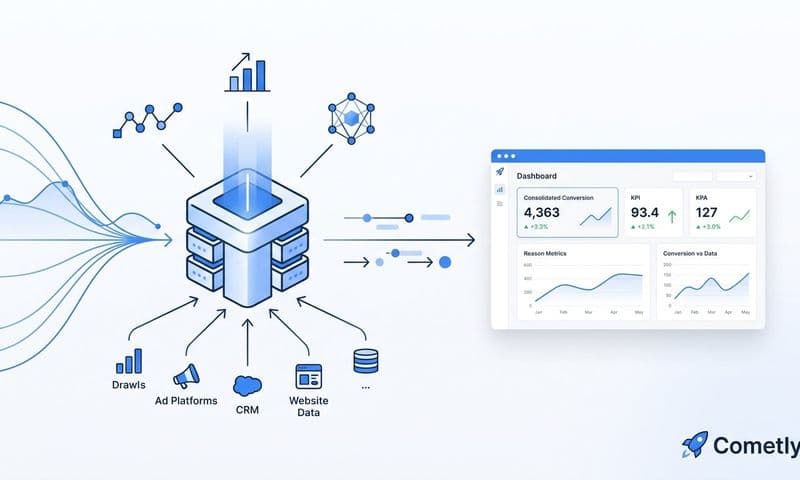
Once your data is flowing in accurately, the next step is bringing it all together. A unified dashboard is where you blend information from all your channels—paid, organic, email, and social—to see the entire customer journey. No more toggling between ten different tabs trying to piece the story together.
A central dashboard lets you answer critical questions in seconds:
- What’s our blended ROI across every marketing channel?
- How are our organic efforts influencing our paid conversions?
- Which email sequence is bringing in the highest lifetime value customers?
This is what a true single source of truth looks like in action.
 How to Calculate ROI for Marketing the Right Way
This unified view obliterates data silos. It ensures that everyone—from the marketing specialist all the way up to the CEO—is looking at the same numbers and making decisions based on the same reality.
The ultimate goal is to connect every dollar of marketing spend to a real dollar of revenue. A unified platform makes this possible by replacing guesswork and estimates with hard, verifiable data from your financial systems.
For those looking to dive deeper into connecting different data sources, our guide on effective marketing data integration offers some actionable steps and strategies.
Turning Data Into Actionable Insights With AI
Okay, so you're collecting and unifying your data. That's a huge step forward. But the final piece of the puzzle is turning all that information into smart, real-time decisions. This is where AI-powered features can become a marketer's best friend.
Instead of manually digging through reports trying to find optimization opportunities, AI can analyze your unified data and surface actionable insights for you automatically.
Imagine getting an alert that says: "Your 'New Runners' campaign on Meta is generating customers with a 30% higher LTV than your account average. Consider reallocating 15% of your budget from the underperforming 'Spring Sale' campaign to maximize long-term ROI."
This isn't just about reporting on what happened yesterday. It’s about getting clear directions on what you should do today to improve performance. By combining accurate, unified data with intelligent analysis, you can finally move from reactive reporting to proactive optimization, ensuring every marketing dollar is working as hard as it possibly can.
Common Mistakes That Are Silently Skewing Your Marketing ROI
Even with the right formulas and a solid toolset, it’s shockingly easy to fall into common traps that quietly sabotage your data. Calculating marketing ROI isn’t just about plugging numbers into a spreadsheet; it’s about making sure those numbers actually reflect reality.
Think of this section as your field guide to building bulletproof ROI reports and dodging the mistakes most marketers make.
Mismatched Timeframes
One of the most frequent errors I see is using the wrong timeframe. Marketers get into the habit of pulling 30-day reports, but this can be disastrously misleading if your company’s sales cycle is actually 90 days.
This mistake is especially costly for businesses with a longer consideration phase, like B2B SaaS or high-ticket e-commerce. A campaign might look like a total failure after one month, only to reveal its true value as leads mature and finally close over the next two. The fix is simple: align your reporting window with your average sales cycle.
Confusing Correlation With Causation
Another classic pitfall. Just because two things happened at the same time doesn’t mean one caused the other.
For instance, you might notice that whenever your organic social engagement spikes, your direct traffic and sales also tick up. It’s tempting to pat yourself on the back and conclude your social posts are directly driving sales. But the reality is often more complex. A popular PR mention could be driving both your social engagement and your direct traffic.
The social activity is correlated with the sales, but it isn't causing them. To get to the truth, you need to use incrementality testing. Run controlled experiments where you intentionally hold back marketing from a specific group to see if there’s a genuine lift in conversions compared to the group that saw your campaigns. This is how you prove causation.
Ignoring the Halo Effect of Brand Marketing
Not every marketing dollar is spent to generate an immediate sale, and treating them all the same will completely wreck your ROI analysis. Brand awareness campaigns—think podcasts, top-of-funnel content, or even billboards—create a "halo effect." They build trust and familiarity, which makes all your direct-response ads work that much better.
If you judge these campaigns solely on last-click revenue, their ROI will look terrible, and you’ll be tempted to cut them. This is a massive mistake.
The value of brand marketing often shows up indirectly—in higher conversion rates on your paid ads, more people searching for your brand by name, and shorter sales cycles. It's harder to measure, but its contribution is critical for long-term growth.
To account for this, you need to track proxy metrics alongside direct ROI. Keep an eye on trends in:
- Branded Search Volume: Are more people searching for your company by name?
- Direct Traffic: Are you seeing a lift in users coming straight to your site?
- Assisted Conversions: Use a multi-touch attribution model to see how often brand campaigns pop up as an early touchpoint in a successful customer journey.
Failing to Segment Your Data
Finally, a blended ROI for all your marketing is a useful top-line number, but it hides all the important details. An overall positive ROI might be masking a disastrously unprofitable campaign that’s being propped up by a single high-performer. Without segmentation, you have no idea where to double down or where to cut your losses.
You have to slice and dice your data to uncover the real story. Segment your ROI analysis by:
- Channel: How does Meta ROI compare to Google or LinkedIn?
- Campaign: Which specific ad campaign is driving the most value?
- Audience/Persona: Are you more profitable with new customers or returning ones?
- Geography: Do certain regions deliver a better return?
By breaking down your numbers, you move from a vague, high-level metric to actionable insights. This granular view is how you find pockets of hidden profitability and identify areas of wasted spend, allowing you to make smart, surgical budget moves.
Ready to stop guessing and start getting crystal-clear ROI on every dollar you spend? Cometly unifies all your marketing data into a single source of truth, giving you the attribution clarity and actionable insights you need to scale with confidence. See how Cometly can transform your marketing measurement.