Scaling your Facebook ads isn't just about cranking up the budget and hoping for the best. True scaling is a disciplined process. It means strategically pouring fuel on your winning campaigns to pull in more customers, all while keeping your Return on Ad Spend (ROAS) in the green. It’s all built on accurate data, a smart campaign structure, and relentless testing.
Building a Bulletproof Foundation for Ad Scaling
 A Guide on How to Scale Facebook Ads Profitably
Before you even think about raising your ad spend, you need to build a solid foundation. Trying to scale on shaky ground is the fastest way I’ve seen advertisers burn through their budget with absolutely nothing to show for it.
This initial phase has nothing to do with finding new audiences or creatives. It’s all about putting the right systems in place that make profitable scaling possible in the first place. Too many advertisers get distracted by vanity metrics like clicks or impressions, but successful scaling comes down to tracking the numbers that actually hit your bottom line. You need total clarity on your key performance indicators (KPIs).
Defining Your Core Scaling Metrics
Your entire scaling strategy is going to hinge on a handful of critical metrics. These aren't just numbers on a screen; they're the guardrails telling you when to floor it and when to pump the brakes. Before you do anything else, you must have crystal-clear targets for these three:
- Cost Per Acquisition (CPA): How much can you afford to pay for a new customer? Knowing your maximum allowable CPA is non-negotiable for staying profitable as you spend more.
- Return on Ad Spend (ROAS): For every dollar you put into ads, how many dollars are you getting back? A target ROAS ensures your ad spend is a profitable investment, not just another expense.
- Lifetime Value (LTV): Knowing what a customer is worth over their entire relationship with your brand is a game-changer. It can justify a higher upfront CPA, which unlocks entirely new levels of scale.
Once you’ve defined these goals, your next move is to establish a reliable performance baseline. Dig into your best-performing ad sets from the past 14-30 days to figure out what a "good" day really looks like. This data becomes your benchmark for success moving forward.
The biggest mistake advertisers make is scaling based on unreliable platform data. iOS updates and browser tracking restrictions have made Facebook's native reporting increasingly inaccurate. You might think a campaign is profitable when it's actually losing money.
The Critical Role of Server-Side Tracking
This brings us to the single most important piece of your foundation: robust, accurate tracking. Without trustworthy data, every decision you make is a shot in the dark. This is where server-side tracking becomes a non-negotiable tool for anyone serious about scaling their ads.
Unlike the old browser-based pixels that get blocked or restricted, server-side tracking sends conversion data directly from your server to Facebook. This method bypasses most of the data loss issues that plague standard setups, giving you a much more accurate picture of how your campaigns are actually performing. To get a deeper look at this, you can explore the nuances of modern Facebook ad tracking and attribution in our detailed guide.
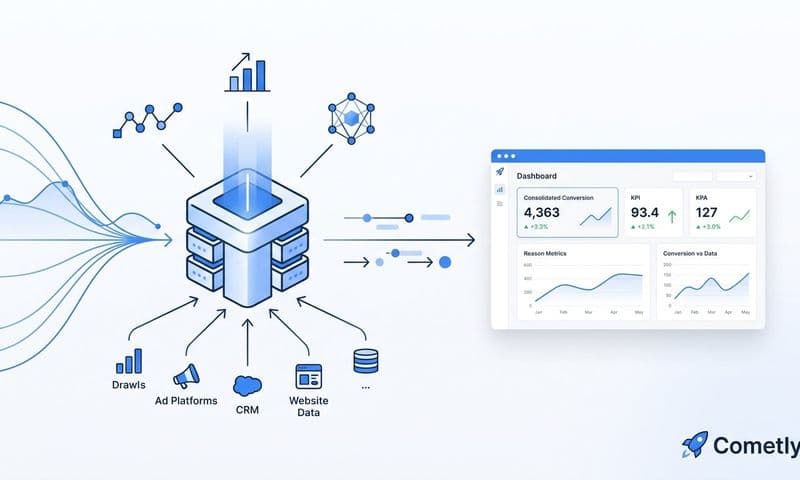
Platforms like Cometly take this a step further with conversion sync, ensuring the data you see is the single source of truth. By unifying data from your ad platforms, website, and CRM, you can finally make scaling decisions with confidence, knowing your strategy is built on reality—not on flawed platform estimates.
Structuring Your Campaigns for Aggressive Growth
Scaling successfully isn't just about throwing more money at your ads; it’s about building an ad account that can actually handle the pressure without falling apart. A messy, disorganized setup will absolutely crumble the moment you try to ramp up spend, leading to wasted budget and wildly unpredictable results.
On the other hand, a structured approach gives you clarity, control, and the confidence to double down on what’s working.
The most effective blueprint for this is what I call the 'Test vs. Scale' methodology. The core idea is simple: create completely separate campaigns for two very different jobs—finding new winners and milking your existing ones for all they're worth. Mixing these two activities in the same campaign is a recipe for disaster. It confuses the algorithm and makes it impossible to know what’s truly driving performance.
Isolate Your Testing Efforts
Think of your "Testing" campaigns as your lab. This is where you get to play—experimenting with new audiences, fresh ad creative, different hooks, and unique offers. The goal here isn't immediate profit; it's buying data.
By isolating all your tests, you accomplish a few critical things:
- Protect Your Winners: You stop a new, unproven ad from cannibalizing the budget or disrupting the performance of a campaign that's already a cash cow.
- Get Clear Data: You get clean, unambiguous feedback on what works and what bombs. If a test ad set fails, you know exactly which variable was the problem without it dragging down your core campaigns.
- Algorithm Efficiency: You let the algorithm focus its learning on a specific, controlled variable, which leads to faster and more accurate insights.
For truly aggressive growth, merely driving traffic isn't enough; explore robust B2B sales funnel optimization strategies to ensure your ad campaigns translate into maximum conversions and profitability. A well-structured account feeds a well-optimized funnel.
Think of it like a restaurant kitchen. You wouldn't test a brand-new, experimental dish during the Saturday night dinner rush. You'd perfect it during a quiet afternoon. The same logic applies to your ad account; test in a controlled environment so you can serve proven winners at scale.
Build Your Scaling Campaigns with Proven Assets
Once an audience or creative has proven its worth in your testing campaign—meaning it has hit your target CPA or ROAS consistently for 3-5 days—it graduates. You then move that winning asset into a dedicated "Scaling" campaign.
These scaling campaigns are the workhorses of your entire ad account. They should only contain your most reliable, high-performing ad sets and creatives. Because you’ve already validated these assets, you can crank up the budget with much more confidence, knowing you're pouring fuel on a fire that's already roaring.
This separation also makes your day-to-day management a breeze. You can quickly glance at your scaling campaigns to check on core profitability and then dive into your testing campaigns to see which new experiments are showing promise.
Segmenting for Maximum Control
Within both your testing and scaling frameworks, you need to segment even further. At an absolute minimum, you should separate your campaigns based on audience temperature.
- Prospecting Campaigns: These target cold audiences—people who have never heard of your brand. This is where your lookalike audiences and interest-based groups live.
- Retargeting Campaigns: These focus on your warm and hot audiences, like website visitors, email subscribers, or people who have engaged with your social media profiles.
This segmentation is non-negotiable. These audiences behave completely differently and require their own unique messaging, offers, and budgets. Mashing them together just hides valuable insights and prevents you from putting your money where it will have the biggest impact.
Proper segmentation is a cornerstone of effective Facebook ads optimization, as it lets you tailor your strategy to each stage of the customer journey. This structured, methodical approach is what turns your ad account from a chaotic liability into a predictable growth engine.
Related reading: our complete guide to AI UGC ads.
Finding New Customers With Smart Audience Expansion
Sooner or later, your first winning audience is going to tap out. It happens to everyone. You’ll saturate that initial group of high-intent buyers, your frequency will creep up, and performance will start to dip.
This isn’t a sign of failure; it’s a signal that you’re ready to scale. The real art of scaling is about methodically expanding from a small, proven audience into much larger segments without torching your ROAS. It's a structured approach to finding millions of new customers who look and act just like your best ones.
Broadening Your Horizons With Lookalike Audiences
One of the most reliable ways to start expanding is with Facebook's Lookalike Audiences. If you've got a winning 1% Lookalike built from a high-quality source (like your customer list or high-value purchasers), you’re already sitting on a goldmine.
But here’s the trap: just pumping more budget into that same tiny 1% segment is a recipe for disaster. You’ll hit audience fatigue fast. The same people will see your ad over and over, your frequency will skyrocket, CPMs will climb, and your ROAS will plummet.
The fix? Gradually widen your net. A proven vertical scaling strategy is to expand from that initial 1% lookalike to a broader 3-5% lookalike audience. This lets you reach more people who share traits with your best buyers while keeping ad fatigue in check.
Don't make the leap from a 1% to a 10% Lookalike all at once. Test them incrementally. I like to set up separate ad sets for a 1-3% LAL, a 3-5% LAL, and a 5-10% LAL. Let the data show you which one is hitting your KPIs at your current spend level before you commit the big bucks.
This tiered progression allows you to tap into larger and larger pools of potential customers. Each step up introduces your ads to a slightly less similar, but much larger, group. For a deeper dive into what to expect from these audiences, check out our guide on lookalike audience performance.
As you scale, your ad structure needs to support this process. The goal is to move winning assets through your account in a deliberate way.
 A Guide on How to Scale Facebook Ads Profitably
This simple flow—Test, Isolate, Scale—is the backbone of smart expansion. It ensures only your absolute best creative gets the significant budget required to reach these new, broader audiences.
Trusting the Algorithm With Broad Targeting
Lookalikes are a fantastic tool, but the ultimate form of audience expansion is handing the reins over to Facebook's algorithm. I'm talking about broad targeting—setting up an ad set with only minimal demographic constraints (like age and location) and no specific interests or Lookalikes at all.
I know, it sounds terrifying. But it’s one of the most effective strategies for scaling to massive budgets, as long as you have one critical element in place: rock-solid conversion data.
When you feed the algorithm a steady, accurate stream of real-time conversion signals, it gets incredibly good at finding your ideal customer within a massive audience. It learns exactly who is converting and then goes out and finds more people just like them.
To make this strategy work, you need high-fidelity data. This is where tools like Cometly become your secret weapon. With server-side tracking and conversion sync, Cometly ensures Facebook receives the clean, reliable data it needs to optimize at a high level. You're not relying on a flawed browser pixel; you're sending a pure signal directly from your server.
This table shows how your audience strategy can evolve as your data quality improves and your budget grows.
Audience Expansion Stages and Signals
Scaling StagePrimary Audience TypeRequired Data Signal (Example)Audience SizeEarly Stage1% Lookalike Audience500+ Purchase Events (Pixel)~2.8MGrowth Stage3-5% Lookalike Audience1,000+ High-Value Customer List~8.4M-14MMature StageBroad Targeting (No LALs)500+ weekly conversions via Server-Side Tracking50M+
This approach allows you to confidently target an audience of 50 million people because you know that accurate, server-side tracking is guiding every single ad delivery decision. You're not just throwing money at the wall; you're letting a sophisticated AI, fueled by your own first-party data, find pockets of new customers you'd never discover on your own.
With this method, your potential audience becomes nearly limitless. You can turn your entire country—or even multiple countries—into fertile ground for your best ad creative.
Managing Your Budget and Bids Like a Pro
 A Guide on How to Scale Facebook Ads Profitably
How you increase your ad spend is just as critical as where you spend it. Jamming a huge budget increase into a winning ad set is a classic rookie mistake. It can shock the algorithm, force it back into the learning phase, and completely tank performance overnight.
The key is a disciplined, incremental approach. You have to give the system time to adapt and find new pockets of customers efficiently.
This isn't about being timid; it’s about being smart. When an ad set is humming along at a lower daily spend, you have a bit more wiggle room. It's generally safe to double the daily budget up to the $200-$250 mark without causing too much chaos.
But once you cross that threshold, you need to be more methodical. Stick to a maximum daily increase of 25%. This slow-and-steady approach is how experienced advertisers scale to $5,000/day or more without "blowing up" their ad sets—where your Cost Per Acquisition (CPA) can easily jump by 2-3x.
CBO vs. ABO: When to Use Each
A core decision you'll face is whether to control your budget at the campaign level (CBO) or the ad set level (ABO). Neither is better; they are simply tools for different jobs.
- Campaign Budget Optimization (CBO): You set one central budget for the whole campaign, and Facebook automatically shifts spend to the best-performing ad sets in real time. This is your go-to for scaling. Load it up with multiple proven ad sets (like several validated lookalike audiences) and let the algorithm do the heavy lifting, pushing money toward whatever is getting you the lowest CPA.
- Ad Set Budget Optimization (ABO): With ABO, you set a specific daily budget for each individual ad set. This gives you granular control, making it perfect for testing. When you're trying to validate a new audience, you need to force a specific amount of spend to it to gather enough data. ABO lets you do exactly that.
A battle-tested pro strategy is to use ABO for all your testing campaigns. Once an ad set proves itself by consistently hitting your KPI targets, duplicate it into a CBO "Scaling" campaign alongside your other proven winners.
Aligning Bid Strategies With Your Goals
Your bid strategy is your way of telling Facebook what you value most, and it directly influences how the algorithm spends your money. Picking the right one is crucial for scaling profitably and depends entirely on what you're trying to achieve. To really nail this, you have to understand your campaign performance and overall return, a central theme in Unlocking ROI with Analytics in Advertising.
Here’s a quick breakdown of the most common options:
Highest Value is best for e-commerce brands that sell products with different price points. Instead of only optimizing for the most conversions, this strategy optimizes for the most revenue. It tells Facebook to find customers who are more likely to spend more, which helps protect ROAS and keeps performance strong as you scale.
Cost Cap is best for businesses that have a strict CPA target they can’t exceed. It works by trying to drive as many conversions as possible while keeping the average CPA at or below the cap you set. This is great for stability and predictable acquisition costs, but it can restrict volume if the cap is too low.
Lowest Cost is best when you want maximum conversion volume and you’re flexible on CPA. This strategy is essentially telling Facebook to get as many conversions as possible for your budget. It’s ideal for aggressive growth phases, but CPA will usually fluctuate more as you scale, so you’ll want to monitor performance closely.
Ultimately, managing your budget and bids is about balancing control with automation. Use ABO for precise testing, move your winners into a CBO environment for efficient scaling, and always align your bid strategy with your most important business metric.
Understanding how to calculate your return on ad spend is the final piece of the puzzle, ensuring every dollar you add to your budget is working as hard as possible for you.
Fueling Your Growth with High-Velocity Creative
 A Guide on How to Scale Facebook Ads Profitably
As you start pushing your ad spend higher, you'll run into a hard truth about scaling Facebook ads: your best-performing ad will eventually die. It’s not a matter of if, but when. When you’re spending hundreds or thousands of dollars a day, creative fatigue isn’t just a risk; it’s a certainty.
The ads that got you here won't get you to the next level.
At scale, creative isn't just one piece of the puzzle—it's everything. Your ability to maintain profitable growth hinges on your capacity to consistently generate and test fresh, high-performing ads. This is where creative velocity comes in. It’s about building a system to rapidly brainstorm, produce, test, and deploy new ad concepts to stay one step ahead of audience burnout.
Letting the Algorithm Find Your Winners
One of the most powerful tools in your arsenal for this is Dynamic Creative Testing (DCT). Instead of getting bogged down manually creating dozens of ad variations, you simply feed Meta a collection of raw assets—images, videos, headlines, primary texts, and calls to action.
We compare the leading options in our UGC video generator roundup.
Then, the algorithm takes over. It mixes and matches all those components to find the most potent combinations for your audience.
This approach lets you test a massive number of variables at once, far more than you could ever manage by hand. Meta’s algorithm does the heavy lifting, pinpointing the specific images, hooks, and copy that resonate most, giving you clear signals on where to double down.
The results can be staggering. We've seen marketers drop their costs from $86 to just $13.87 per conversion within 24 hours, just by diversifying their creative assets and letting the algorithm do its thing. It's a powerhouse for scaling.
Brainstorming Diverse Ad Concepts
But effective testing isn’t just about quantity; it’s about the quality and range of your ideas. Your goal should be to systematically explore different angles, hooks, and formats to discover new pockets of performance. Never assume you know what will work best.
Here’s a simple framework to get you started:
- Test Different "Big Ideas": Don't just swap out images. Test entirely different value propositions. A skincare brand, for instance, could run angles based on anti-aging benefits, all-natural ingredients, or its cruelty-free mission. Each is a totally separate concept.
- Vary Your Hooks: The first three seconds of a video or the first line of text are everything. Test hooks that are question-based ("Tired of XYZ?"), benefit-driven ("Finally achieve ABC"), or built on social proof ("See why 10,000 people love this").
- Explore Multiple Formats: A static image, a user-generated content (UGC) video, and a polished carousel ad all appeal to different segments of your audience. Make sure you’re testing all of them to see what your customers actually respond to.
When your top-performing creative starts to falter, don't just pause it. Use it as a template. Take the winning headline and pair it with a new video. Take the successful video concept and film a new version with a different creator. This iterative process allows you to build on your successes instead of starting from scratch.
If you're evaluating vendors, our AI UGC creator breakdown can help.
Using Data to Create More Winners
As you scale, guessing what works becomes an expensive habit. You need a reliable system to understand exactly which creative elements are driving sales. While Meta's Ads Manager shows you which ad combination is working, it doesn't always tell you why. For a deeper understanding of audience burnout, our guide on what creative fatigue is and how to fight it offers valuable strategies.
This is where a dedicated attribution tool becomes essential.
Platforms like Cometly's AI Ads Manager go deeper, analyzing your performance data to give you actionable insights into your creative. It can help you identify trends that the native platform might miss.
For instance, you might discover that ads featuring a specific color palette consistently deliver a higher ROAS, or that videos under 15 seconds have a significantly lower CPA. These data-driven insights are gold. They allow you to move beyond random testing and start systematically creating more of what’s proven to work, turning your creative process from a guessing game into a predictable growth engine.
Got Questions About Scaling Ads? We've Got Answers.
Scaling Facebook ads can feel like walking a tightrope. You've finally dialed in a winning formula, but the moment you push for more, a whole new set of challenges pops up. It’s that critical stage where one wrong move can torch your budget, but the right one can unlock explosive growth.
This is where most advertisers get stuck. So, let's tackle the most common questions people ask when they're ready to go from stable performance to aggressive scaling. No fluff, just straight, actionable answers to help you navigate this phase with confidence.
How Do I Know When It’s Time to Scale a Campaign?
Knowing the exact moment to hit the gas is less about a gut feeling and more about the data. The number one signal you're looking for is consistent, profitable performance over a 3-5 day period. Don't get trigger-happy after one great day; you need stability and predictability before you start pouring more money in.
Keep an eye out for this combo of green lights:
- Stable KPIs: Your Return on Ad Spend (ROAS) or Cost Per Acquisition (CPA) is consistently hitting or smashing your targets.
- Healthy Engagement: You're seeing a solid click-through rate (CTR) and your cost per click (CPC) is staying low relative to your benchmarks.
- Low Ad Frequency: In your prospecting campaigns, your frequency should ideally be below 3.0. If it's climbing fast, that’s a huge red flag that you're already burning out your audience, and scaling will just make things worse.
Before you even think about touching that budget slider, there's one last, crucial step: verify the numbers with a reliable attribution tool. The platform data can lie. You need to confirm in your source of truth, like Cometly, that the sales are real and correctly attributed. If the data holds up, you're good to go.
Should I Scale with Lookalikes or Interests?
Ah, the classic debate. The real answer depends on where you are in your growth journey and the quality of your data. For most advertisers, the fastest and most reliable path to get things moving is with Lookalike audiences.
Start with a 1% Lookalike built from a high-quality source, like a list of your best customers or people who made high-value purchases. These audiences are absolute gold because they let Meta's algorithm do the heavy lifting, finding new people who act just like your proven buyers.
But, as you start pushing for massive budgets, even the best Lookalikes will eventually tap out. This is where broad targeting, maybe with a few huge interests layered on top, becomes the smarter play. It gives you insane reach, but it only works if you’re feeding the algorithm a ton of accurate conversion data to guide it.
Think of it this way: Lookalikes are like giving the algorithm a detailed treasure map. Broad targeting is like giving it a super-advanced metal detector and a giant field—it'll find the treasure, but only if its detector (your conversion data) is perfectly calibrated.
My ROAS Dropped After I Increased My Budget. Why?
This is, without a doubt, the most common and soul-crushing problem advertisers face when scaling. You had a winning ad set, you fed it more cash, and suddenly, performance falls off a cliff. This isn't random. It’s almost always one of three culprits.
- You Increased the Budget Too Quickly: Like we've said, jumping from $100/day to $500/day is a guaranteed way to shock the algorithm and send it right back into the learning phase. Stick to slow, steady increases—think 25% per day—for stable growth.
- Audience Saturation: You've already reached the most eager people in your audience. Now you're just paying more to show your ads to the less-interested folks on the fringe. Check your frequency. If it's shooting up, your audience is sick of seeing your ads.
- Creative Fatigue: The ad that was a rockstar for a small audience can burn out in a flash when you show it to a much bigger crowd. What was fresh and exciting is now just repetitive noise.
To figure out what’s really going on, you have to dig into your attribution data. Look at the entire customer journey and pinpoint where the drop-off is happening. The fix will be to either slow down your budget increases, expand to a fresh audience, or—most of the time—launch a new batch of creative.
How Does Server-Side Tracking Help with Scaling?
Server-side tracking isn't a "nice-to-have" anymore. For any serious advertiser, it's a non-negotiable for scaling profitably. It directly solves the massive data-loss problem created by browser tracking limits, ad blockers, and all the iOS updates.
Instead of depending on a fragile browser pixel, server-side tracking sends conversion data directly from your server to Facebook's. This creates a much cleaner, more complete data stream.
This improved data quality is what fuels your ability to scale. Here’s how:
- A Smarter Algorithm: When Facebook gets more accurate conversion data, its delivery algorithm gets way better at finding your ideal customers, even in broad audiences.
- Higher-Quality Lookalikes: The power of your Lookalike audiences is directly tied to the quality of your source data. Server-side tracking makes sure those source audiences are built from a complete list of actual conversions, which results in much more potent Lookalikes.
- Confidence to Spend: This is the big one. It gives you the confidence to actually increase your budget. When you're making decisions based on real, verifiable revenue—not inflated platform guesses—you can scale aggressively without crossing your fingers and hoping for the best.
Ready to scale your ads with confidence? Cometly provides the rock-solid attribution and server-side tracking you need to make every dollar count. Stop guessing and start growing with data you can trust. Get started with Cometly today!