When you're running campaigns across Meta, Google, TikTok, and a dozen other channels, scattered data becomes your biggest enemy. You need a marketing analytics dashboard that pulls everything together—but with so many options, how do you choose?
This comparison breaks down leading platforms by the features that actually matter: attribution accuracy, real-time reporting, cross-channel visibility, and ease of use. Whether you're an in-house marketer tracking ROAS or an agency managing multiple client accounts, you'll find the right fit for your specific needs below.
1. Cometly
Best for: Multi-channel advertisers who need accurate attribution and AI-powered optimization recommendations
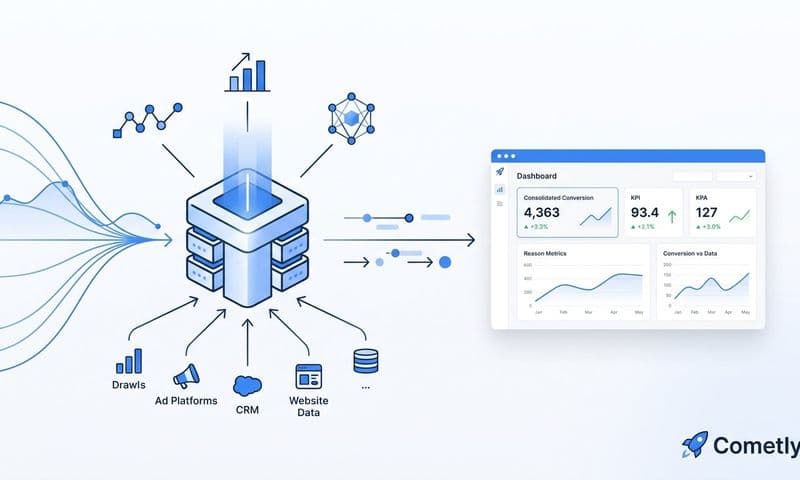
Cometly is an AI-powered marketing attribution platform that tracks the complete customer journey across ad platforms, CRM, and website to show exactly which ads drive revenue.
 9 Best Marketing Analytics Dashboards Compared: Features, Pricing & Use Cases in 2026
Where This Tool Shines
Cometly solves the attribution puzzle that keeps most marketers guessing. Instead of relying on platform-reported conversions that conflict with each other, it captures every touchpoint—from initial ad click through CRM events—and uses multi-touch attribution to show the real customer journey.
The AI Ads Manager goes beyond reporting by analyzing your data and delivering specific optimization recommendations. It identifies which ads and campaigns are actually converting across every channel, then suggests where to scale spend with confidence.
Key Features
Multi-Touch Attribution: Track customer journeys across all marketing touchpoints to understand what's really driving conversions, not just what gets last-click credit.
AI Ads Manager: Get AI-powered recommendations on which campaigns to scale, pause, or optimize based on actual revenue performance across channels.
Server-Side Tracking: Bypass iOS privacy limitations and browser blockers to capture accurate conversion data that cookie-based tracking misses.
Conversion Sync: Feed enriched conversion data back to Meta, Google, and other ad platforms to improve their algorithm optimization and targeting.
AI Chat: Ask questions about your marketing data in plain English and get instant analysis without building complex reports.
Best For
Growth-focused marketers and agencies running significant ad spend across multiple platforms who need to know exactly which campaigns drive revenue. Particularly valuable for teams dealing with iOS tracking challenges or managing complex customer journeys that span several touchpoints before conversion.
Pricing
Custom pricing based on ad spend volume. Demo available to see the platform in action and discuss pricing for your specific needs.
2. Google Analytics 4
Best for: Website and app behavior tracking with Google's machine learning insights at no cost
Google Analytics 4 is Google's free event-based analytics platform for tracking website and app user behavior with machine learning insights.
 11 Best Conversion Optimization Tools to Boost Your ROI in 2026
Where This Tool Shines
GA4 represents a fundamental shift from session-based to event-based tracking, making it more flexible for understanding user behavior across devices and platforms. The machine learning capabilities predict user actions like potential revenue from specific audiences and churn probability.
For businesses already using Google Ads, the native integration makes it simple to see how paid search and display campaigns drive site behavior. The price point—free for most businesses—makes it accessible to companies of any size.
Key Features
Event-Based Tracking Model: Track specific user interactions as events rather than pageviews, giving you flexibility to measure what matters most to your business.
Predictive Metrics: Use Google's machine learning to identify audiences likely to purchase or churn within the next seven days.
Cross-Device Tracking: Follow user journeys across devices when they're signed in, connecting mobile app usage to website visits.
Native Google Ads Integration: See how your Google Ads campaigns drive on-site behavior without additional setup or data connections.
Custom Reports and Explorations: Build detailed analysis views with segments, funnels, and path analysis to understand user behavior patterns.
Best For
Any business that needs website analytics, especially those heavily invested in Google's advertising ecosystem. Essential as a foundational analytics tool, though often supplemented with attribution platforms for multi-channel campaign tracking.
Pricing
Free for standard use. GA4 360 for enterprise features starts around $50,000 annually and includes higher data limits, advanced analysis, and dedicated support.
3. HubSpot Marketing Analytics
Best for: HubSpot users who want marketing analytics directly connected to CRM contacts and revenue
HubSpot Marketing Analytics is the built-in analytics suite for HubSpot users that connects marketing campaigns directly to CRM contacts and deals.
 10 Best Enterprise Channel Analytics Software To Maximize Marketing ROI
Where This Tool Shines
HubSpot's analytics live inside the same platform where your contacts, deals, and marketing campaigns exist. This means attribution reporting connects directly to actual revenue in your CRM, not just form fills or conversions that may or may not close.
The campaign attribution reports show which marketing efforts influenced deals throughout the buyer's journey. You can see not just which blog post someone read, but which specific email, ad, and content piece contributed to a $50,000 deal that closed last month.
Key Features
Revenue Attribution: Connect marketing touches directly to closed deals in your CRM to measure actual revenue impact, not just lead generation.
Campaign Attribution Reporting: Track how different campaigns influence contacts through their entire journey from first touch to customer.
Custom Report Builder: Create dashboards that combine marketing metrics with sales data, website analytics, and CRM information in one view.
Traffic and Conversion Analytics: Monitor website traffic sources, landing page performance, and conversion paths within the HubSpot ecosystem.
Email and Content Performance: See which emails, blog posts, and content pieces drive engagement and contribute to pipeline growth.
Best For
Companies already using HubSpot for marketing automation and CRM who want their analytics tightly integrated with their tech stack. Most valuable when sales and marketing teams need shared visibility into campaign performance and revenue impact.
Pricing
Included with HubSpot Marketing Hub. Professional tier starts at $800 per month, Enterprise at $3,600 per month. Analytics capabilities expand with higher tiers.
4. Tableau
Best for: Enterprise teams with data science resources who need highly customized visualizations from multiple sources
Tableau is an enterprise business intelligence platform for creating highly customized data visualizations from multiple sources.
 11 Best Big Data Tools for Marketing Analytics in 2026
Where This Tool Shines
Tableau excels when you need to combine data from disparate sources into a single, interactive visualization. Think marketing data from five ad platforms, sales data from your CRM, product usage from your database, and financial data from your ERP—all in one dashboard.
The platform's strength lies in its flexibility and depth. You can build calculated fields, create complex joins across data sources, and design visualizations that tell exactly the story your data reveals. For teams with analytical expertise, it's incredibly powerful.
Key Features
Advanced Data Visualization: Create interactive dashboards with drill-downs, filters, and custom chart types that go far beyond basic bar and line graphs.
Universal Data Connectivity: Connect to virtually any data source including databases, cloud services, spreadsheets, and marketing platforms through native and custom connectors.
Calculated Fields and Analysis: Build complex calculations, statistical models, and custom metrics directly within your visualizations.
Collaborative Workbooks: Share dashboards with team members, enable commenting, and maintain version control on analytical work.
Mobile-Responsive Dashboards: Automatically optimize dashboard layouts for mobile viewing or design specific mobile versions.
Best For
Enterprise marketing teams with dedicated analysts or data science resources who need to combine marketing data with broader business intelligence. Best suited for organizations where the value of deep, custom analysis justifies the learning curve and cost.
Pricing
Creator license from $75 per user per month for full authoring capabilities. Explorer at $42 per user per month for viewing and limited editing. Viewer at $15 per user per month for dashboard access only.
5. Databox
Best for: Teams who want fast dashboard setup with minimal technical work using pre-built templates
Databox is a dashboard platform designed for quick setup with pre-built integrations and templates for marketing, sales, and finance metrics.
 9 Best Marketing Analytics Dashboards Compared: Features, Pricing & Use Cases in 2026
Where This Tool Shines
Databox prioritizes speed and simplicity. You can connect your marketing platforms, choose from hundreds of pre-built dashboard templates, and have a working analytics view in minutes rather than days. The one-click integrations mean you're not wrestling with API keys or custom data connections.
The mobile app deserves special mention—it's genuinely useful for checking metrics on the go, not just a desktop dashboard crammed onto a small screen. Goal tracking with automated alerts keeps teams focused on what matters without constant dashboard checking.
Key Features
100+ One-Click Integrations: Connect marketing platforms, CRMs, and business tools without technical setup or custom development work.
Pre-Built Dashboard Templates: Start with proven dashboard layouts for common use cases like Facebook Ads performance, SEO tracking, or sales pipeline monitoring.
Goal Tracking with Alerts: Set targets for key metrics and receive automated notifications when performance exceeds or falls short of goals.
Mobile App: Access real-time metrics from your phone with a purpose-built mobile experience, not just a responsive web version.
Automated Reporting: Schedule and deliver PDF or email reports to stakeholders without manual export work.
Best For
Small to mid-sized marketing teams who want professional dashboards without dedicated data analysts. Particularly valuable for agencies who need to quickly spin up client dashboards or businesses where speed of implementation matters more than deep customization.
Pricing
Free tier available for basic use. Starter at $47 per month, Professional at $135 per month, Growth at $319 per month. Pricing scales with data sources and users.
6. Supermetrics
Best for: Pulling marketing data into spreadsheets, Looker Studio, or data warehouses for custom analysis
Supermetrics is a data pipeline tool that pulls marketing data from ad platforms into spreadsheets, Looker Studio, data warehouses, and BI tools.
 9 Best Marketing Analytics Dashboards Compared: Features, Pricing & Use Cases in 2026
Where This Tool Shines
Supermetrics isn't a dashboard itself—it's the data pipeline that feeds your dashboards and analysis tools. If you're comfortable building reports in Google Sheets, Excel, or Looker Studio, Supermetrics handles the tedious work of pulling data from dozens of marketing platforms.
The scheduled refresh capability means your spreadsheets and reports update automatically overnight. You build the analysis once, then wake up to fresh data every morning without manual exports or copy-pasting from different platforms.
Key Features
70+ Marketing Platform Connectors: Pull data from major ad platforms, social media, analytics tools, and marketing automation systems through standardized connections.
Multiple Destinations: Send data to Google Sheets, Excel, Looker Studio, BigQuery, Snowflake, or other data warehouses depending on your workflow.
Scheduled Data Refreshes: Automate data updates on your schedule so reports stay current without manual intervention.
Data Transformation: Apply filters, combine data sources, and create calculated metrics before data reaches your destination.
Team Collaboration: Share data connections and queries across team members to maintain consistency in reporting.
Best For
Marketers who prefer building custom reports in spreadsheets or Looker Studio rather than using pre-built dashboard platforms. Also valuable for data teams who need marketing data in their warehouse alongside other business data.
Pricing
Starts at $39 per month per destination. Pricing increases with the number of data connectors and destinations needed. Enterprise plans available for larger teams with multiple data sources.
7. Klipfolio
Best for: Real-time dashboards with PowerMetrics for standardizing KPIs across teams and data sources
Klipfolio is a real-time dashboard platform with PowerMetrics for standardizing KPIs across teams and data sources.
 9 Best Agency Client Reporting Dashboards in 2026
Where This Tool Shines
Klipfolio's PowerMetrics feature addresses a common enterprise problem: different teams calculating the same metric differently. It lets you define metrics once—with specific formulas, data sources, and business logic—then use those standardized metrics across all dashboards and reports.
The TV dashboard mode makes Klipfolio popular for office displays where teams want live metrics visible throughout the day. Real-time data refresh means you're seeing current performance, not yesterday's numbers.
Key Features
150+ Data Service Connections: Connect to marketing platforms, databases, spreadsheets, and business tools through native integrations and REST API support.
PowerMetrics for Metric Governance: Define company-wide metrics once with standardized calculations, then use them consistently across all dashboards and teams.
TV Dashboard Mode: Display dashboards on office screens with optimized layouts and automatic cycling through multiple views.
Custom Visualizations: Build tailored chart types and data displays using Klipfolio's formula language and visualization options.
White-Label Options: Remove Klipfolio branding and customize dashboards with your own logo and colors for client-facing reports.
Best For
Mid-sized to enterprise marketing teams who struggle with metric consistency across departments, or agencies who need white-labeled client dashboards. The TV mode makes it particularly useful for teams who value visible, real-time performance monitoring.
Pricing
Free tier available with limited features. Plus at $125 per month, Pro at $300 per month. Enterprise pricing available for larger deployments with advanced governance needs.
8. Whatagraph
Best for: Agencies creating visual, client-ready reports across multiple marketing channels
Whatagraph is a marketing reporting platform built for agencies to create visual, client-ready reports across multiple channels.
Where This Tool Shines
Whatagraph focuses on making client reporting painless for agencies. The drag-and-drop builder lets you create visually appealing reports without design skills, and the white-label options mean everything looks like it came from your agency, not a third-party tool.
The cross-channel overview widgets are particularly useful—they combine metrics from different platforms into single visualizations, so clients see their complete marketing picture instead of separate reports for each channel. Automated delivery means reports go out on schedule without manual work each month.
Key Features
40+ Marketing Integrations: Connect major ad platforms, social media, SEO tools, and analytics platforms without technical setup.
Drag-and-Drop Report Builder: Create professional-looking reports by dragging widgets onto a canvas and customizing layouts visually.
White-Label Client Reports: Add your agency branding, remove Whatagraph references, and deliver reports that look entirely custom-built.
Automated Report Delivery: Schedule reports to send automatically to clients via email or shareable links on your chosen frequency.
Cross-Channel Overview Widgets: Combine metrics from multiple platforms into single charts that show blended performance across channels.
Best For
Marketing agencies managing multiple client accounts who need to deliver professional reports efficiently. Most valuable when you're reporting on similar metrics across many clients and want to template the process without sacrificing customization.
Pricing
Professional at $223 per month, Premium at $335 per month, Custom plans for larger agencies. Pricing scales with the number of data sources and client reports needed.
9. Triple Whale
Best for: Shopify DTC brands who need ecommerce-specific attribution with first-party pixel tracking
Triple Whale is an ecommerce-focused analytics platform with pixel-based attribution designed specifically for Shopify DTC brands.
Where This Tool Shines
Triple Whale speaks the language of direct-to-consumer ecommerce brands. Instead of generic marketing metrics, you get metrics that matter for online stores: blended ROAS, customer acquisition cost by channel, lifetime value trends, and contribution margin.
The first-party pixel tracking helps recover attribution accuracy lost to iOS privacy changes. By tracking conversions through their own pixel rather than relying solely on platform pixels, Triple Whale gives DTC brands a more complete picture of which ads actually drive purchases.
Key Features
First-Party Pixel Tracking: Use Triple Whale's pixel to capture conversion data that browser-based tracking misses due to privacy restrictions.
Blended ROAS Metrics: See overall return on ad spend across all channels, not just individual platform reporting that often conflicts.
Creative Performance Analytics: Track which ad creatives drive purchases, not just clicks, to inform your creative testing and production.
Customer Journey Visualization: See the typical path customers take from first ad exposure to purchase, including touchpoints across channels.
Native Shopify Integration: Connect directly to Shopify for automatic order data, product performance, and inventory insights alongside ad metrics.
Best For
Direct-to-consumer brands running on Shopify who advertise heavily on Meta, Google, and TikTok. Particularly valuable for brands spending $50,000+ monthly on ads who need accurate attribution to make scaling decisions with confidence.
Pricing
Starts around $129 per month for smaller stores. Pricing scales based on monthly store revenue and feature needs, with higher tiers for larger DTC brands.
Making the Right Choice
The best marketing analytics dashboard depends on what you're actually trying to accomplish and where your data lives.
For multi-channel paid advertisers who need accurate attribution and AI-powered optimization, Cometly delivers the most complete picture. It captures the entire customer journey, feeds better data back to ad platforms, and gives you AI recommendations on where to scale spend. If you're managing significant ad budgets across multiple channels and need to know what's really driving revenue, it's purpose-built for that challenge.
GA4 remains essential for free web analytics and is particularly valuable if you're invested in Google's advertising ecosystem. HubSpot users should leverage their built-in analytics since the CRM integration provides revenue attribution that standalone tools can't match.
Enterprise teams with dedicated data science resources will appreciate Tableau's power and flexibility for combining marketing data with broader business intelligence. Agencies juggling multiple client reports should consider Databox for speed of setup or Whatagraph for client-ready visual reports.
If you prefer building custom analysis in spreadsheets or Looker Studio, Supermetrics handles the data pipeline work. Klipfolio fits teams who need real-time dashboards and metric standardization across departments. DTC Shopify brands advertising heavily on Meta and TikTok often find Triple Whale's ecommerce-specific metrics and first-party tracking align perfectly with their needs.
The best choice ultimately depends on your tech stack, team expertise, and whether you prioritize attribution accuracy or visualization flexibility. Most sophisticated marketers use GA4 as a foundation, then layer on specialized tools based on their specific challenges—whether that's multi-touch attribution, client reporting, or ecommerce analytics.
Ready to elevate your marketing game with precision and confidence? Discover how Cometly's AI-driven recommendations can transform your ad strategy—Get your free demo today and start capturing every touchpoint to maximize your conversions.