You're tracking clicks, impressions, and conversions across multiple platforms. But when your CEO asks which campaigns actually drove revenue last quarter, can you answer with confidence? This is where marketing analytics moves from dashboard numbers to business intelligence that shapes strategy and proves ROI.
Marketing analytics transforms raw data into actionable insights—but seeing it in practice makes all the difference. Whether you're tracking campaign performance, understanding customer journeys, or proving ROI to stakeholders, real-world examples show exactly how analytics translates to revenue.
This guide walks through eight practical marketing analytics examples that modern marketers use daily, from attribution modeling to predictive analysis. Each example includes the specific metrics to track, how to implement it, and the business impact you can expect.
By the end, you'll have a clear picture of how to apply these analytics approaches to your own campaigns and start making decisions based on complete data rather than platform-reported metrics that tell only part of the story.
1. Multi-Touch Attribution Modeling
The Challenge It Solves
Last-click attribution gives all conversion credit to the final touchpoint before purchase. This approach systematically undervalues awareness and consideration channels while overvaluing bottom-funnel tactics. The result? You cut budgets from channels that are actually driving demand, then wonder why your conversion rates drop.
Multi-touch attribution solves this by distributing credit across every touchpoint in the customer journey. When someone sees your Facebook ad, clicks a Google search ad three days later, then converts through an email campaign, each channel gets appropriate credit for its role in the conversion.
The Strategy Explained
Multi-touch attribution tracks every interaction a prospect has with your brand—from initial awareness through conversion and beyond. Different attribution models distribute credit differently: linear attribution splits credit equally, time-decay gives more weight to recent touchpoints, and position-based emphasizes first and last interactions.
The key is choosing a model that reflects your actual sales cycle. For businesses with longer consideration periods, time-decay or position-based models typically provide more accurate insights than simple linear distribution.
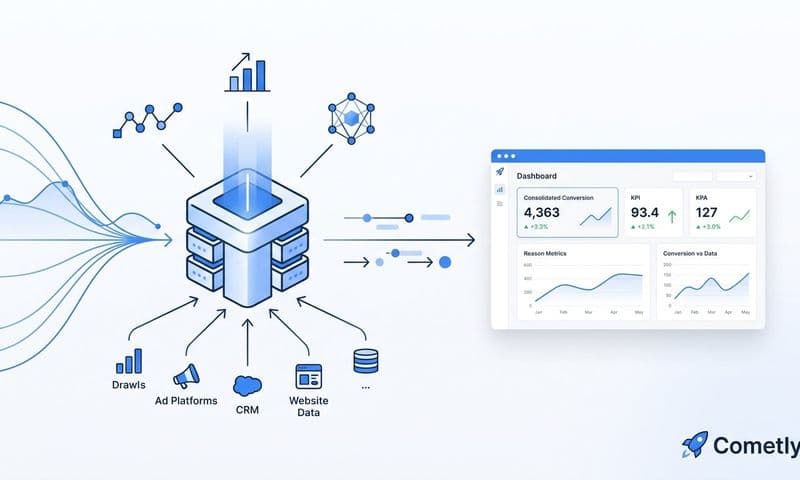
Modern attribution platforms connect data from ad platforms, your website, CRM, and other touchpoints to build a complete view of each customer journey. This comprehensive tracking reveals which channel combinations drive the highest-value customers.
Implementation Steps
1. Connect all marketing platforms and your CRM to a unified attribution system that can track the complete customer journey across channels and sessions.
2. Implement tracking that captures every touchpoint—ad clicks, website visits, email opens, form submissions, and CRM events—with consistent user identification across devices.
3. Select an attribution model that matches your sales cycle length and business objectives, then analyze how credit distribution changes compared to last-click attribution.
4. Review which channels gain or lose credit under multi-touch models, then adjust budget allocation based on true contribution to conversions rather than last-click metrics.
Pro Tips
Start by comparing your current last-click data against a multi-touch model for the same time period. The differences will reveal which channels you've been systematically over or under-investing in. Many marketers discover their awareness channels drive significantly more value than last-click attribution suggests.
Tools like Cometly provide AI-powered multi-touch attribution that connects every touchpoint to actual revenue, giving you a complete view of what's working across your entire marketing mix.
2. Customer Acquisition Cost Analysis by Channel
The Challenge It Solves
Platform dashboards show you cost per click and cost per conversion—but these metrics don't account for the full customer journey. A channel might show a high cost per conversion while actually delivering your most valuable, highest-LTV customers. Without accurate CAC by channel, you're optimizing for the wrong outcomes.
True CAC analysis reveals the actual cost to acquire a customer through each marketing source, accounting for all touchpoints in their journey and the revenue they ultimately generate.
The Strategy Explained
Customer acquisition cost analysis goes beyond platform-reported conversions to calculate the total marketing investment required to acquire each customer through different channels. This means tracking not just the last-click channel, but understanding how channels work together in the conversion path.
The calculation requires connecting marketing spend data with actual customer acquisition events in your CRM or database. For businesses with longer sales cycles, this analysis becomes even more critical—the channel that generated the initial lead might differ significantly from the one that gets last-click credit.
Accurate CAC analysis also accounts for channel-assisted conversions. When Facebook introduces a prospect who later converts through Google search, both channels contributed to that acquisition and should factor into your CAC calculation.
Implementation Steps
1. Define what constitutes a "customer" for your business—is it first purchase, subscription activation, or reaching a specific revenue threshold?
2. Connect your ad platform spend data with your CRM or customer database so you can track which marketing sources contributed to each customer acquisition.
3. Calculate CAC for each channel using multi-touch attribution to account for channel-assisted conversions, not just last-click acquisitions.
4. Compare CAC against customer lifetime value by channel to identify which sources deliver the most profitable customer relationships over time.
Pro Tips
Don't just look at average CAC—segment by customer value tiers. You might discover that one channel has a higher CAC but consistently delivers customers who spend three times more over their lifetime. That channel deserves more budget, not less.
Track CAC trends over time by channel. Rising acquisition costs often signal increasing competition or audience saturation, giving you early warning to test new channels or creative approaches before performance deteriorates significantly.
3. Conversion Path Analysis
The Challenge It Solves
You know someone converted, but do you understand the sequence of interactions that led to that decision? Conversion path analysis reveals the specific journey customers take—which channels they encounter first, how many touchpoints they need, and how much time passes between initial awareness and purchase.
This insight transforms how you structure campaigns. Instead of treating each channel as independent, you can orchestrate a coordinated strategy that guides prospects through their natural decision-making process.
The Strategy Explained
Conversion path analysis maps the sequence and timing of every touchpoint in the customer journey. This goes beyond attribution modeling to show you the actual paths customers take—revealing patterns in how different segments discover, evaluate, and ultimately purchase from your business.
The analysis identifies common conversion patterns: Do customers typically see your brand three times before converting? Do they research on mobile but convert on desktop? Do they engage with content before clicking ads, or vice versa?
These patterns inform everything from budget allocation to creative strategy. When you understand the typical path to conversion, you can structure campaigns that align with natural customer behavior rather than fighting against it.
Implementation Steps
1. Implement tracking that captures the complete sequence of touchpoints for each user, including timestamps, channels, and specific content interactions.
2. Analyze the most common paths to conversion—look for patterns in channel sequence, number of touchpoints, and time between interactions.
3. Identify where prospects drop off in the typical conversion path, then create targeted campaigns to address those friction points.
4. Segment paths by customer value to understand whether your highest-value customers follow different journeys than average customers.
Pro Tips
Look for "accelerator touchpoints"—specific interactions that significantly shorten the path to conversion. These might be particular content pieces, retargeting ads, or email sequences that move prospects forward faster than other touchpoints.
Pay attention to the time gaps between touchpoints. Long gaps might indicate when prospects are comparison shopping or seeking internal approval. Understanding these natural pauses helps you time your follow-up communications for maximum impact.
4. Return on Ad Spend (ROAS) Tracking
The Challenge It Solves
Platform-reported ROAS tells you what the algorithm sees, but it often misses conversions due to tracking limitations, cross-device behavior, and delayed purchases. The disconnect between reported performance and actual revenue creates a false picture of campaign effectiveness.
Accurate ROAS tracking connects ad spend directly to actual revenue outcomes, giving you the confidence to scale winning campaigns and cut underperformers based on real business results rather than incomplete platform data.
The Strategy Explained
True ROAS tracking requires connecting your ad platforms with your source of truth for revenue—typically your CRM, e-commerce platform, or financial system. This connection allows you to see not just platform-reported conversions, but actual revenue generated from each campaign.
The difference between platform ROAS and actual ROAS often reveals significant discrepancies. Privacy changes and tracking limitations mean platforms miss conversions, while some reported conversions don't actually generate revenue. Only by connecting to your revenue data can you see the complete picture.
Advanced ROAS analysis also accounts for customer lifetime value, not just initial purchase value. A campaign might show modest first-purchase ROAS but deliver customers who make repeat purchases at much higher rates than other channels.
Implementation Steps
1. Integrate your ad platforms with your revenue tracking system—CRM, e-commerce platform, or analytics tool that captures actual sales data.
2. Implement server-side tracking to capture conversions that browser-based tracking misses due to ad blockers, privacy settings, or cross-device behavior.
3. Calculate true ROAS by dividing actual attributed revenue by ad spend, then compare this against platform-reported ROAS to identify discrepancies.
4. Track ROAS trends over time by campaign, ad set, and creative to identify what's working and allocate budget accordingly.
Pro Tips
Set different ROAS targets for different campaign objectives. Prospecting campaigns targeting cold audiences typically show lower immediate ROAS than retargeting, but they're essential for filling your funnel with new prospects. Judge each campaign type against appropriate benchmarks.
Use server-side tracking to feed more accurate conversion data back to ad platforms. When Facebook and Google receive better conversion data, their algorithms optimize more effectively, improving performance over time. Cometly's Conversion Sync sends enriched conversion events back to ad platforms to enhance their targeting and optimization.
5. Cohort-Based Retention Analysis
The Challenge It Solves
Aggregate retention metrics hide crucial differences in customer quality across acquisition sources. A channel might deliver high conversion volumes but terrible retention, while another brings fewer customers who stick around and spend more over time. Without cohort analysis, you're flying blind on customer quality.
Cohort-based retention analysis reveals how different customer groups behave over time based on when and how they were acquired, showing you which marketing sources deliver lasting customer relationships versus one-time buyers.
The Strategy Explained
Cohort analysis groups customers by shared characteristics—typically acquisition date and marketing source—then tracks how each group behaves over subsequent time periods. This reveals patterns that aggregate metrics obscure.
For subscription businesses, cohort analysis shows which acquisition sources deliver customers with the lowest churn rates. For e-commerce, it reveals which channels bring customers who make repeat purchases versus one-time buyers. For B2B, it identifies which marketing sources generate accounts that expand over time.
The insight transforms budget allocation. Instead of optimizing purely for acquisition volume or initial conversion value, you can prioritize channels that deliver customers with strong retention and lifetime value characteristics.
Implementation Steps
1. Define your cohorts based on acquisition month and marketing source—for example, "customers acquired from Facebook in January 2026" forms one cohort.
2. Track key retention metrics for each cohort over time: repeat purchase rate, subscription renewal rate, account expansion, or whatever indicates ongoing customer value in your business.
3. Compare retention curves across different acquisition sources to identify which channels deliver customers with the strongest long-term engagement.
4. Calculate lifetime value by cohort and acquisition source, then adjust your marketing mix to prioritize channels that deliver higher-LTV customers even if their upfront acquisition costs are higher.
Pro Tips
Look for cohorts that show improving retention over time compared to earlier cohorts from the same channel. This often indicates your targeting or messaging has improved, and you should document what changed so you can replicate the improvement.
Don't wait months to act on cohort data. Even early retention signals—like 7-day or 30-day engagement—often predict long-term retention patterns. Use these early indicators to make faster optimization decisions while still validating with longer-term data.
6. Landing Page Performance Comparison
The Challenge It Solves
Traffic volume doesn't equal results. You might be driving thousands of visitors to landing pages that convert poorly while neglecting pages that turn visitors into customers at much higher rates. Without systematic performance comparison, you're wasting ad spend on ineffective pages.
Landing page performance analysis identifies which pages convert visitors and generate revenue, allowing you to direct more traffic to high-performing pages and fix or replace underperformers.
The Strategy Explained
Effective landing page analysis goes beyond conversion rate to examine the full picture: traffic quality, engagement metrics, conversion rate, and most importantly, revenue per visitor. A page might have a lower conversion rate but attract higher-intent visitors who generate more revenue per conversion.
The analysis also examines how landing page performance varies by traffic source. A page that converts well for Google search traffic might perform poorly for Facebook ads due to differences in visitor intent and awareness level.
Advanced landing page analysis tracks the post-conversion journey as well. Some pages might generate lots of conversions that don't progress through your funnel, while others deliver fewer but higher-quality leads that convert to customers at higher rates.
Implementation Steps
1. Identify all landing pages receiving significant traffic from your marketing campaigns and set up consistent tracking across all pages.
2. Track key metrics for each page: visitors, conversion rate, revenue per visitor, and downstream metrics like lead quality or customer acquisition rate.
3. Segment performance by traffic source to understand how each landing page performs with different audience types and intent levels.
4. Prioritize optimization efforts on high-traffic, low-performing pages where improvements will have the largest impact on overall campaign results.
Pro Tips
Create a landing page scorecard that weights metrics by business impact. A page with 1,000 visitors and 2% conversion rate that generates $10,000 in revenue outperforms a page with 500 visitors and 5% conversion rate that generates $5,000—even though the second page has a higher conversion rate.
Test message match between your ads and landing pages. When ad copy promises one thing but the landing page emphasizes something different, conversion rates suffer. Ensure your highest-traffic ad-to-page combinations maintain consistent messaging throughout the click path.
7. Campaign A/B Test Analysis
The Challenge It Solves
Gut-feel optimization leaves money on the table. Without rigorous testing, you're making budget and creative decisions based on assumptions rather than evidence. A/B testing transforms marketing from guesswork into a systematic process of continuous improvement.
Proper test analysis reveals not just which variant won, but why it won and how to apply those insights to future campaigns. This creates a compounding effect where each test makes your entire marketing operation more effective.
The Strategy Explained
A/B testing compares two or more variants of a marketing element—ad creative, landing page design, email subject line, or targeting strategy—to determine which performs better against your key metrics. The critical element is isolating variables so you can attribute performance differences to the specific change you tested.
Effective test analysis requires statistical rigor. You need sufficient sample size to detect meaningful differences and enough time to account for day-of-week variations and other temporal factors. Declaring a winner too early leads to false conclusions and poor decisions.
The most valuable testing programs don't just identify winners—they build a knowledge base of what works for your specific audience. Over time, patterns emerge that inform your entire creative and targeting strategy.
Implementation Steps
1. Define your hypothesis clearly before launching the test—what specific change are you testing and what outcome do you expect?
2. Determine required sample size based on your baseline conversion rate and the minimum improvement you want to detect reliably.
3. Run the test until you reach statistical significance, typically requiring at least 100 conversions per variant and a confidence level of 95% or higher.
4. Analyze not just which variant won, but examine performance across segments—some variants might perform better with certain audience types or traffic sources.
Pro Tips
Document every test with your hypothesis, results, and key learnings. This creates an institutional knowledge base that prevents repeating failed tests and helps new team members understand what works for your specific audience.
Don't stop at declaring a winner—implement it, then test again. The winning variant becomes your new control, and you test another variation against it. This creates a continuous optimization loop that compounds improvements over time.
8. Revenue Attribution by Marketing Source
The Challenge It Solves
Marketing generates leads, but sales closes revenue. Without connecting these two systems, you can't prove which marketing activities actually drive business outcomes. Revenue attribution closes this loop, showing exactly which marketing sources generate paying customers and how much revenue they deliver.
This capability transforms marketing from a cost center into a measurable revenue driver. When you can show that specific campaigns generated specific dollar amounts, budget conversations shift from "how much should we spend on marketing?" to "how much can we scale what's working?"
The Strategy Explained
Revenue attribution connects your marketing data with your CRM or financial system to track which marketing touchpoints contributed to each closed deal. This requires integrating systems that often don't communicate naturally—ad platforms, website analytics, marketing automation, CRM, and revenue tracking.
The analysis reveals patterns in what marketing activities precede revenue generation. You might discover that webinar attendees close at three times the rate of other leads, or that prospects who engage with specific content pieces have 50% higher deal values.
Advanced revenue attribution also tracks the time lag between marketing touchpoints and revenue recognition. Understanding these delays helps you set realistic expectations and prevents premature budget cuts when campaigns need time to mature.
Implementation Steps
1. Integrate your marketing platforms with your CRM so every lead carries data about their marketing source and touchpoint history.
2. Implement tracking that persists through your entire funnel—from initial website visit through lead creation, opportunity stages, and closed revenue.
3. Build reports that connect marketing sources to actual revenue outcomes, not just lead volume or opportunity creation.
4. Calculate revenue ROI by marketing source, accounting for the full cost of acquiring and nurturing customers through each channel.
Pro Tips
Track both first-touch and last-touch revenue attribution to understand which channels excel at generating new pipeline versus closing existing opportunities. This informs whether to use each channel for prospecting or nurturing.
Cometly connects every marketing touchpoint to closed revenue in your CRM, giving you complete visibility into what's actually driving business outcomes. The platform's AI analyzes these patterns to recommend where to allocate budget for maximum revenue impact.
Putting These Analytics Examples Into Action
These eight marketing analytics examples share a common thread: they all connect marketing activities to actual business outcomes. Moving beyond surface-level metrics like clicks and impressions, they reveal which campaigns drive revenue, which channels deliver valuable customers, and where to invest for maximum return.
Start with the analytics approach that addresses your most pressing question. If you're struggling to prove marketing ROI, begin with revenue attribution. If you're unsure which channels to scale, implement multi-touch attribution and CAC analysis. If you need to optimize existing campaigns, focus on A/B testing and landing page analysis.
The key is connecting your data sources—ad platforms, website analytics, CRM, and revenue systems—so you can track the complete customer journey from first touchpoint to closed revenue. This comprehensive view transforms marketing from a collection of disconnected campaigns into a coordinated revenue engine.
Remember that analytics implementation isn't one-and-done. As your marketing sophistication grows, so should your analytics capabilities. Start with foundational tracking, then layer on more advanced analysis as you build confidence in your data and processes.
Ready to elevate your marketing game with precision and confidence? Discover how Cometly's AI-driven recommendations can transform your ad strategy—Get your free demo today and start capturing every touchpoint to maximize your conversions.