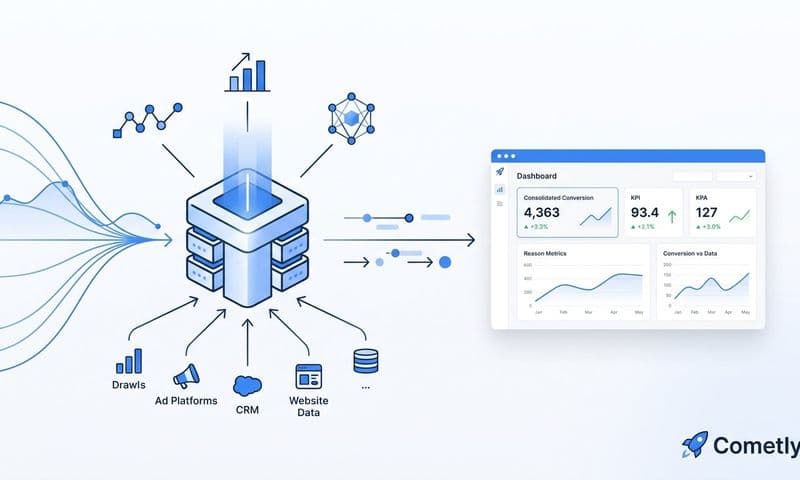
Ecommerce brands are drowning in data but starving for insights. With customers bouncing between Instagram ads, Google searches, email campaigns, and TikTok videos before making a purchase, understanding what actually drives revenue has never been more complex—or more critical.
The brands winning in 2026 aren't just collecting data. They're using marketing analytics strategically to connect every touchpoint to real business outcomes.
This guide breaks down seven battle-tested analytics strategies that help ecommerce brands move beyond vanity metrics and into revenue-driving clarity. Whether you're scaling a DTC brand or managing multi-channel campaigns, these approaches will transform how you measure, optimize, and grow.
1. Implement Full-Funnel Attribution Tracking
The Challenge It Solves
Most ecommerce brands rely on last-click attribution, which credits the final touchpoint before purchase. This creates a distorted view of marketing performance. Your Facebook ads might be introducing customers to your brand, your Google Shopping campaigns might be nurturing consideration, and your email sequence might be closing the sale—but last-click attribution only sees that final email.
The result? You undervalue top-of-funnel channels and over-invest in bottom-funnel tactics that merely capture demand your other campaigns created.
The Strategy Explained
Full-funnel attribution tracks every marketing touchpoint a customer encounters before converting. It assigns proportional credit across channels based on their actual influence throughout the journey. This means understanding which combination of touchpoints drives purchases, not just which one happened last.
Multi-touch attribution models can be position-based (giving more credit to first and last touches), time-decay (crediting recent interactions more heavily), or data-driven (using algorithms to determine optimal credit distribution). The key is moving beyond simplistic single-touch models that hide the true customer journey.
Implementation Steps
1. Deploy tracking pixels and UTM parameters consistently across all marketing channels to capture every customer interaction with your brand.
2. Connect your ad platforms, CRM, email tools, and website analytics to a unified attribution platform that can stitch together cross-device, cross-channel journeys.
3. Choose an attribution model that aligns with your business goals—position-based works well for brands focused on both acquisition and conversion, while data-driven models adapt to your specific customer behavior patterns.
4. Establish a regular cadence for reviewing attribution reports and adjusting budget allocation based on true channel contribution rather than last-click metrics.
Pro Tips
Start by comparing your current last-click attribution against a multi-touch model to quantify how much you're undervaluing certain channels. This creates internal buy-in for changing budget allocation. Focus on channels that consistently appear early in high-value customer journeys—these are often your most underinvested opportunities.
2. Build Server-Side Tracking Infrastructure
The Challenge It Solves
Browser-based tracking has become increasingly unreliable. Privacy features in Safari and Firefox block many tracking cookies by default. Ad blockers prevent pixels from firing. iOS privacy restrictions limit data sharing from mobile apps and browsers.
For ecommerce brands, this means missing conversion data, inaccurate reporting, and ad platforms making optimization decisions with incomplete information. You're essentially flying blind on a significant portion of your traffic.
The Strategy Explained
Server-side tracking sends conversion data directly from your server to analytics and ad platforms, bypassing browser limitations entirely. When a customer completes a purchase, your server communicates that event to Meta, Google, and your analytics tools—regardless of whether their browser blocks tracking scripts.
This approach captures conversion data that browser-based tracking misses, providing more accurate reporting and feeding better data to ad platform algorithms. The result is improved campaign optimization and more reliable performance measurement.
Implementation Steps
1. Set up a server-side tracking container using Google Tag Manager Server-Side or a dedicated attribution platform that handles server-to-server connections.
2. Configure your ecommerce platform to send conversion events from your server to your tracking infrastructure whenever purchases, add-to-carts, or other key actions occur.
3. Implement the Conversions API for Meta and enhanced conversions for Google Ads to send enriched conversion data that includes hashed customer information for better matching.
4. Maintain your existing browser-based tracking as a backup and for cross-verification, but prioritize server-side data when the two sources conflict.
Pro Tips
Include as much customer data as possible in your server-side events—email, phone, address, and order value all help ad platforms match conversions to users and optimize more effectively. Hash sensitive information before transmission to maintain privacy compliance while maximizing data utility.
3. Create Unified Customer Journey Dashboards
The Challenge It Solves
Your marketing data lives in silos. Facebook Ads Manager shows one set of metrics. Google Analytics shows another. Your email platform tracks its own performance. Your CRM has revenue data that doesn't connect to marketing channels.
This fragmentation forces you to manually piece together insights across platforms, wasting time and creating opportunities for misinterpretation. Worse, it makes spotting cross-channel patterns nearly impossible.
The Strategy Explained
Unified dashboards consolidate marketing data from all platforms into a single view focused on revenue metrics. Instead of logging into five different tools to understand performance, you see how each channel contributes to revenue, customer acquisition cost, and lifetime value in one place.
The key is organizing your dashboard around business outcomes rather than platform-specific metrics. Focus on questions like "Which channels drive the highest-value customers?" and "Where should we increase spending to maximize revenue?" rather than vanity metrics like impressions or clicks.
Implementation Steps
1. Identify the core metrics that actually drive business decisions—typically revenue by channel, customer acquisition cost, return on ad spend, and customer lifetime value by source.
2. Connect all marketing platforms and your ecommerce backend to a centralized analytics tool that can pull data from multiple sources and attribute revenue accurately.
3. Design dashboard views for different stakeholders—executives need high-level revenue trends, media buyers need campaign-level performance, analysts need granular data for optimization.
4. Schedule automated reports that surface key insights daily or weekly, so you're making decisions based on current data rather than outdated snapshots.
Pro Tips
Include context in your dashboards by showing trends over time and comparing current performance to previous periods. A campaign generating $50,000 in revenue means something very different if it cost $25,000 versus $75,000 to achieve. Always pair revenue metrics with efficiency metrics to maintain profitability while scaling.
4. Leverage AI-Powered Performance Analysis
The Challenge It Solves
Manual analysis of marketing data doesn't scale. With hundreds of campaigns running across multiple platforms, identifying optimization opportunities through spreadsheet analysis is time-consuming and inevitably misses patterns that aren't immediately obvious.
Human analysts naturally focus on the channels and campaigns they're most familiar with, creating blind spots. They also struggle to spot complex multi-variable patterns—like how certain creative types perform better with specific audiences on particular days of the week.
The Strategy Explained
AI-powered analytics tools automatically scan your marketing data to identify performance patterns, anomalies, and optimization opportunities at scale. Instead of manually reviewing every campaign, AI surfaces the insights that matter most—underperforming ad sets that need pausing, high-performing audiences worth expanding, or budget allocation shifts that could improve overall ROAS.
These systems analyze relationships between variables that humans would never manually test, like how weather patterns correlate with product category performance or which creative elements drive higher lifetime value customers versus one-time buyers.
Implementation Steps
1. Implement an AI-powered analytics platform that connects to your ad accounts, website analytics, and conversion data to analyze performance holistically.
2. Configure the AI to focus on your priority metrics—whether that's maximizing revenue, improving ROAS, reducing CAC, or increasing customer lifetime value.
3. Review AI-generated recommendations daily and test the highest-impact suggestions first, tracking whether implementing the recommendations actually improves performance.
4. Refine your AI configuration based on which recommendations drive results, teaching the system what types of optimizations work best for your specific business.
Pro Tips
Don't blindly implement every AI recommendation. Use AI to surface opportunities, but apply human judgment about whether a suggested change aligns with your broader strategy and brand positioning. The best results come from combining AI's pattern recognition with human strategic thinking.
5. Optimize Ad Platform Algorithms with Better Data
The Challenge It Solves
Ad platforms like Meta and Google use machine learning to optimize targeting and bidding. But their algorithms are only as good as the data you feed them. If you're only sending basic conversion events without revenue values or customer quality indicators, the algorithms optimize for any conversion—not necessarily profitable ones.
This leads to campaigns that drive volume but not value. You might hit your conversion targets while acquiring low-quality customers who never purchase again or generate negative lifetime value.
The Strategy Explained
Feeding enriched conversion data back to ad platforms improves their optimization algorithms. This means sending not just "purchase occurred" but "purchase occurred with $247 order value from a customer in our target demographic who matches patterns of high-LTV buyers."
With richer data, Meta's Advantage+ campaigns and Google's Performance Max can optimize toward the customers who actually drive business value rather than simply maximizing conversion volume. The algorithms learn to identify and target your best customers, not just any customers.
Implementation Steps
1. Configure your conversion tracking to send order value data with every purchase event, enabling value-based optimization rather than simple conversion optimization.
2. Implement the Conversions API for Meta and enhanced conversions for Google to send server-side data that includes customer information for better matching and attribution.
3. Create custom conversion events for high-value actions beyond purchases—like subscription sign-ups, high-AOV orders, or repeat purchases—so algorithms can optimize specifically for these outcomes.
4. Enable value optimization settings in your campaigns so ad platforms actively bid higher for users likely to generate more revenue, not just users likely to convert.
Pro Tips
The more conversion data you send, the faster ad platform algorithms learn. If you're running small-budget campaigns that generate few conversions, consider optimizing for a higher-funnel event initially (like add-to-cart) to give the algorithm more learning signals, then shift to purchase optimization once you have sufficient conversion volume.
6. Segment Analytics by Customer Lifetime Value
The Challenge It Solves
Most ecommerce analytics treat all customers equally. A customer who makes one $30 purchase and never returns gets counted the same as a customer who spends $500 annually for three years. This creates misleading performance metrics.
A channel might appear expensive based on initial CAC, but if it consistently drives high-LTV customers, it's actually your most profitable acquisition source. Conversely, a channel with low CAC might look efficient while quietly filling your customer base with one-time buyers.
The Strategy Explained
LTV-based analytics segment marketing performance by the long-term value of customers each channel acquires. Instead of asking "What's our CAC by channel?" you ask "What's our CAC-to-LTV ratio by channel?" and "Which channels drive customers who purchase repeatedly?"
This approach reveals which marketing investments truly build business value over time. You might discover that your expensive Google Search campaigns acquire customers who stick around for years, while your cheap social campaigns drive one-time buyers who never return.
Implementation Steps
1. Calculate current customer lifetime value by cohort, analyzing how customers acquired in different time periods perform over their relationship with your brand.
2. Connect customer acquisition source data to your CRM or customer database so you can track which marketing channels originally acquired each customer.
3. Build reports that show not just initial conversion metrics but 30-day, 90-day, and 12-month revenue per customer by acquisition channel.
4. Adjust budget allocation to favor channels that drive higher LTV customers, even if their upfront CAC appears higher than channels driving lower-quality traffic.
Pro Tips
Look beyond total LTV to understand why certain channels drive better customers. Do they have higher average order values? Purchase more frequently? Buy higher-margin products? Understanding the mechanics of LTV differences helps you replicate success across channels by targeting similar customer profiles.
7. Establish Real-Time Budget Reallocation Processes
The Challenge It Solves
Traditional marketing operates on monthly or quarterly budget cycles. You set budgets at the start of the period, maybe adjust them mid-cycle if something is obviously broken, and review performance at the end. This approach leaves money on the table.
When a campaign suddenly starts performing exceptionally well, waiting weeks to increase its budget means missing the opportunity. When performance drops, continuing to spend at the same level wastes budget that could be reallocated to better-performing initiatives.
The Strategy Explained
Real-time budget reallocation means continuously monitoring performance and shifting spending toward what's working now, not what worked last month. This requires both the analytics infrastructure to identify opportunities quickly and the operational processes to act on them without bureaucratic delay.
The goal isn't constant chaotic change, but rather systematic responsiveness. You establish clear rules for when budget shifts are warranted—like "if ROAS exceeds target by 30% for three consecutive days, increase budget by 20%"—and empower your team to execute those shifts immediately.
Implementation Steps
1. Define clear performance thresholds that trigger budget adjustments—both increases for outperformers and decreases for underperformers.
2. Set up automated alerts that notify your team when campaigns cross these thresholds, so opportunities and issues surface immediately rather than in weekly reports.
3. Create a rapid-response process where designated team members can adjust budgets without lengthy approval chains, within predefined guardrails.
4. Implement daily performance reviews focused specifically on budget allocation opportunities, asking "Where should we spend more today?" and "Where should we spend less?"
Pro Tips
Build in safeguards against overreacting to short-term fluctuations. Require performance trends to persist for multiple days before triggering major budget shifts, and cap the size of any single reallocation to prevent one decision from derailing your entire strategy. The goal is agility, not impulsiveness.
Your Roadmap to Revenue-Driven Analytics
Mastering marketing analytics for ecommerce isn't about collecting more data. It's about connecting the right data to revenue outcomes.
Start with full-funnel attribution to understand your true customer journey. Build the infrastructure—server-side tracking, unified dashboards—to capture accurate data despite browser limitations and platform silos. Layer in AI analysis and LTV segmentation to surface insights at scale that manual analysis would miss.
Close the loop by feeding better data back to ad platforms, enabling their algorithms to optimize toward your most valuable customers. Then establish real-time processes that let you act on insights immediately rather than waiting for monthly review cycles.
The brands that implement these strategies systematically will outcompete those still making decisions based on incomplete, siloed metrics. They'll know which channels truly drive revenue, not just which ones get last-click credit. They'll capture conversion data that competitors miss. They'll spot optimization opportunities before they become obvious.
Pick one strategy to implement this week. Start with attribution if you're unsure which channels deserve more investment. Choose server-side tracking if you're losing conversion data to privacy restrictions. Build unified dashboards if you're wasting hours manually pulling reports from multiple platforms.
Measure the impact. Then build from there.
Ready to elevate your marketing game with precision and confidence? Discover how Cometly's AI-driven recommendations can transform your ad strategy—Get your free demo today and start capturing every touchpoint to maximize your conversions.