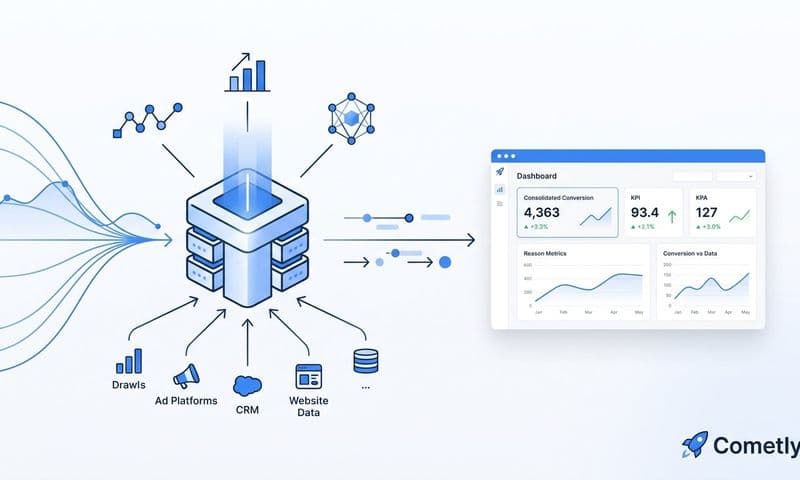
Ecommerce marketers face a unique challenge: you're running campaigns across Meta, Google, TikTok, and email simultaneously, but piecing together which channels actually drive purchases feels like solving a puzzle with missing pieces. The gap between ad platform reporting and real revenue costs stores thousands in wasted ad spend daily.
Think about your last campaign review. You probably opened Meta Ads Manager, then Google Analytics, then your Shopify dashboard, trying to reconcile three different conversion numbers for the same time period. Which one is correct? Which campaigns are actually profitable?
This guide delivers eight actionable marketing analytics strategies specifically designed for ecommerce operations. From implementing proper cross-platform tracking to using AI-powered insights for budget allocation, these approaches address the real-world challenges ecommerce teams face daily.
Whether you're scaling from six to seven figures or optimizing an established store, these strategies will help you understand your true customer acquisition costs, identify your highest-value marketing channels, and make data-driven decisions that directly impact your bottom line.
1. Implement Server-Side Tracking to Capture the Full Customer Journey
The Challenge It Solves
Browser-based pixels are fundamentally broken for ecommerce. When iOS 14.5 rolled out privacy updates, many advertisers watched their conversion tracking accuracy drop overnight. Ad blockers, cookie restrictions, and privacy settings create blind spots in your data. Your Meta pixel might report 50 conversions while your store actually processed 80 purchases.
This isn't a minor discrepancy. When your tracking only captures 60% of actual conversions, you're making budget decisions based on incomplete information. You might pause profitable campaigns or scale unprofitable ones simply because you can't see the full picture.
The Strategy Explained
Server-side tracking moves data collection from the browser to your server, bypassing the limitations that plague pixel-based tracking. Instead of relying on a customer's browser to fire tracking events (which can be blocked or restricted), your server sends conversion data directly to ad platforms.
This approach captures events that browser pixels miss. When someone uses Safari with tracking prevention enabled, your server-side implementation still records their purchase. When an ad blocker prevents a pixel from loading, your server sends the conversion data anyway.
The result is dramatically more accurate attribution. You see the real performance of your campaigns, not a filtered version limited by browser restrictions.
Implementation Steps
1. Choose a platform that handles server-side tracking infrastructure (like Cometly), or set up your own server-side tracking using Meta's Conversions API and Google's server-side tagging in Google Tag Manager.
 8 Proven Marketing Analytics Strategies to Scale Your Ecommerce Store
2. Configure your ecommerce platform to send purchase events from your server to your tracking solution, including critical data like order value, product IDs, and customer identifiers.
3. Test thoroughly by placing test orders and verifying that events appear in both your ad platforms and your analytics dashboard with matching data.
4. Run your server-side tracking parallel to your existing pixel tracking for two weeks to compare data accuracy before fully transitioning.
Pro Tips
Don't disable your browser pixels completely. Run them alongside server-side tracking for redundancy. Some customers will still be tracked via browser, giving platforms multiple data signals to work with. This dual approach provides the most complete picture of your customer journey.
2. Connect Your CRM Data to Marketing Touchpoints
The Challenge It Solves
Your ad platforms show you cost per purchase, but they don't show you cost per valuable customer. A campaign might look profitable based on first-order revenue, but if those customers never return, you're actually losing money on acquisition.
Without connecting CRM data to marketing touchpoints, you're optimizing for the wrong goal. You need to see which campaigns bring customers who make repeat purchases, have high average order values over time, and generate real lifetime value.
The Strategy Explained
Linking your CRM or customer database to your marketing attribution creates a complete revenue picture. Instead of just tracking the initial purchase, you track what happens next: the second order three months later, the third order six months after that, the total revenue generated over a year.
This connection reveals which marketing channels acquire your best customers. You might discover that Google Shopping customers have 40% higher lifetime value than TikTok customers, even if TikTok shows a better first-purchase ROAS. That insight completely changes how you allocate budget.
The integration flows both ways. Marketing data enriches your CRM records with acquisition source information, while CRM data enriches your marketing analytics with customer value metrics.
Implementation Steps
1. Ensure your ecommerce platform, CRM, and marketing attribution system can share customer identifiers (typically email addresses or customer IDs) to link records across systems.
2. Set up automated data syncing so that when a customer makes a repeat purchase in your store, that revenue gets attributed back to their original acquisition source in your analytics.
3. Create custom fields in your attribution platform to store lifetime value, purchase frequency, and average order value for each customer acquisition source.
4. Build reports that compare first-purchase metrics against 90-day and 180-day customer value by channel to identify which sources bring the most valuable long-term customers.
Pro Tips
Focus first on the 90-day window. Most ecommerce businesses see the majority of repeat purchases within three months. This timeframe gives you actionable insights faster than waiting for full year-long customer lifecycles to complete.
3. Adopt Multi-Touch Attribution Instead of Last-Click Models
The Challenge It Solves
Last-click attribution gives all the credit to the final touchpoint before purchase. This creates a distorted view of your marketing performance. Your prospecting campaigns that introduce new customers to your brand get zero credit, while your retargeting campaigns that close the sale get all the credit.
The problem compounds when you make budget decisions based on last-click data. You might cut spending on upper-funnel campaigns because they show poor ROAS, not realizing they're essential for feeding your high-performing retargeting campaigns.
The Strategy Explained
Multi-touch attribution distributes conversion credit across all the touchpoints in a customer's journey. When someone sees your Facebook ad, clicks a Google Shopping ad three days later, then converts from an email a week after that, each touchpoint receives appropriate credit for the conversion.
Different attribution models weight touchpoints differently. Linear attribution splits credit equally. Time decay gives more credit to recent touchpoints. First-touch emphasizes the initial discovery moment. The key is moving beyond the oversimplification of last-click to understand how your channels work together.
This approach reveals the true performance of your full-funnel strategy. You can see which channels excel at customer acquisition versus conversion, and you can optimize your budget allocation accordingly.
Implementation Steps
1. Choose an attribution platform that tracks users across multiple sessions and devices, capturing the complete journey from first ad impression to final purchase.
2. Start by comparing last-click attribution against linear attribution to see how dramatically the credit distribution changes across your marketing channels.
3. Analyze your typical customer journey length and touchpoint count to select the attribution model that best reflects your business reality (time decay works well for longer consideration periods).
4. Create separate reports for each attribution model rather than picking one as "truth" since different models answer different strategic questions about channel performance.
Pro Tips
Don't abandon last-click entirely. Use it alongside multi-touch attribution. Last-click tells you which channels are best at closing sales. Multi-touch tells you which channels are best at starting customer relationships. Both insights matter for different optimization decisions.
4. Build Real-Time Dashboards That Track Revenue, Not Vanity Metrics
The Challenge It Solves
Many ecommerce dashboards focus on the wrong metrics. Impressions, clicks, and click-through rates don't pay the bills. You need dashboards that immediately show you whether your marketing is profitable, which campaigns are working, and where you're losing money.
Static reports updated daily or weekly create decision lag. By the time you notice a campaign is underperforming, you've already wasted days of budget. Real-time visibility lets you catch problems within hours, not days.
The Strategy Explained
Build dashboards centered on the metrics that directly impact profitability: return on ad spend, customer acquisition cost, contribution margin per channel, and revenue per campaign. These metrics immediately tell you whether your marketing is working.
Real-time updates mean your dashboard reflects current performance, not yesterday's data. When you check your dashboard at 2 PM, you see this morning's results. This immediacy enables rapid optimization. If a new campaign is burning budget without conversions, you know within hours, not tomorrow.
The best dashboards also provide context. Instead of just showing today's ROAS, they show how it compares to your target, your seven-day average, and last month's performance. Context turns numbers into insights.
Implementation Steps
1. Define your core profitability metrics based on your business model, typically including blended ROAS, customer acquisition cost by channel, and contribution margin after ad spend and product costs.
2. Set up automated data connections between your ad platforms, ecommerce store, and analytics dashboard so data flows continuously without manual exports.
3. Design your dashboard layout with the most critical metrics prominently displayed at the top, followed by channel breakdowns and campaign-level details for deeper investigation.
4. Establish alert thresholds that notify you when key metrics fall outside acceptable ranges, such as when daily ROAS drops below your breakeven point.
Pro Tips
Include your product costs and shipping costs in your dashboard calculations. A 3X ROAS sounds great until you realize your contribution margin is only 35%, making that campaign barely profitable after all costs. True profitability metrics prevent false confidence.
5. Feed Enriched Conversion Data Back to Ad Platforms
The Challenge It Solves
Ad platform algorithms optimize based on the conversion data they receive. When iOS restrictions and tracking limitations reduce the quality and quantity of conversion data, algorithm performance suffers. Meta and Google have less signal to work with, so their automated optimization and audience targeting become less effective.
This creates a negative feedback loop. Poor conversion tracking leads to worse algorithm performance, which leads to worse campaign results, which makes you question whether the platforms still work. The platforms work fine, but they need accurate data to optimize effectively.
The Strategy Explained
Conversion sync sends your complete, accurate conversion data from your server back to ad platforms using their APIs. This enriched data includes conversions that browser pixels missed, accurate purchase values, and detailed event parameters that help algorithms understand what drives results.
When Meta's algorithm receives more complete conversion data, it better understands which audiences and creative approaches generate purchases. It can optimize delivery more effectively and identify lookalike audiences with higher accuracy. The same principle applies to Google's Smart Bidding and other automated optimization features.
This isn't about gaming the system. It's about giving platforms the accurate information they need to do their job effectively. You're correcting the data gaps created by privacy restrictions, not inflating numbers.
Implementation Steps
1. Implement server-side tracking first (Strategy 1) since conversion sync depends on having accurate server-side conversion data to send back to platforms.
2. Configure your attribution platform to send conversion events to Meta's Conversions API and Google's enhanced conversions, including purchase values and relevant event parameters.
3. Verify that platforms are receiving and matching your conversion events by checking the Events Manager in Meta and conversion tracking in Google Ads.
4. Monitor the "events matched" rate in your ad platforms to ensure your conversion data is successfully connecting with ad clicks and impressions.
Pro Tips
Send all conversion events, not just purchases. Add-to-cart events, initiate checkout events, and other micro-conversions help algorithms optimize throughout the funnel. More signal equals better optimization, even for events that aren't your ultimate goal.
6. Segment Analytics by Customer Acquisition vs. Retention Campaigns
The Challenge It Solves
Blending new customer acquisition and returning customer campaigns in your analytics creates misleading averages. Retargeting campaigns naturally show better ROAS because they target people who already know your brand. Prospecting campaigns show worse ROAS because they target cold audiences who need more convincing.
When you average these together, you lose critical insights. You can't see your true cost to acquire a new customer. You can't accurately measure the efficiency of bringing back previous purchasers. You're making budget decisions based on muddled data.
The Strategy Explained
Separate your analytics into distinct segments: new customer acquisition campaigns and returning customer campaigns. This segmentation reveals your true customer acquisition cost and shows you which channels are most efficient for each objective.
New customer acquisition metrics tell you how much it costs to bring someone into your customer base for the first time. These campaigns typically have higher CAC but are essential for growth. Retention campaign metrics show you how efficiently you can drive repeat purchases from existing customers.
This separation enables smarter budget allocation. You can invest appropriately in acquisition knowing your true CAC, while also optimizing your retention spend based on realistic performance expectations.
Implementation Steps
1. Tag all your campaigns with clear identifiers that distinguish new customer acquisition (prospecting, cold audiences, brand awareness) from retention (retargeting, email to existing customers, loyalty campaigns).
2. Set up custom segments in your analytics platform that filter data by these campaign types, creating separate views for acquisition and retention performance.
3. Calculate your blended new customer acquisition cost by dividing total acquisition campaign spend by the number of first-time customers acquired in that period.
4. Track the percentage of revenue coming from new versus returning customers to understand your business mix and ensure your acquisition efforts are feeding sustainable growth.
Pro Tips
Create a third segment for "reactivation" campaigns targeting lapsed customers who haven't purchased in 90+ days. These campaigns perform differently from both acquisition and active retention, and they deserve their own performance benchmarks and optimization approach.
7. Use AI-Powered Analysis to Identify Scaling Opportunities
The Challenge It Solves
Manual analysis of marketing data is time-consuming and prone to missing patterns. You might review your top campaigns weekly, but you're not catching subtle trends in your data. An ad set that's gradually declining in performance might go unnoticed for weeks. A product-audience combination that's showing early promise might not get the attention it deserves.
Ecommerce marketers are managing dozens of campaigns across multiple platforms simultaneously. The volume of data makes it impossible to spot every opportunity or catch every problem through manual review alone.
The Strategy Explained
AI-powered analysis continuously monitors your marketing data to surface insights you'd miss manually. These systems identify patterns across thousands of data points, flagging campaigns that are trending downward before they become major problems and highlighting scaling opportunities based on early performance signals.
Modern AI analysis goes beyond simple alerts. It provides context-aware recommendations based on your historical performance, budget constraints, and business goals. Instead of just telling you that Campaign A is underperforming, it suggests specific actions: reduce budget by 30%, test new creative, or pause entirely.
The value isn't replacing human decision-making. It's augmenting your analysis with computational power that can process more data than any team could manually review, freeing you to focus on strategic decisions rather than data processing.
Implementation Steps
1. Implement a marketing attribution platform with built-in AI analysis capabilities that can access your complete cross-channel data for comprehensive pattern detection.
2. Configure the AI system with your key performance thresholds, such as minimum acceptable ROAS, maximum acceptable CAC, and budget limits for different campaign types.
3. Set up daily or real-time notifications that alert you to AI-identified opportunities and issues, with recommendations prioritized by potential impact on revenue.
4. Review AI recommendations systematically but critically, using them as input for your decisions rather than automatically implementing every suggestion without strategic consideration.
Pro Tips
Track which AI recommendations you implement and their outcomes. This feedback loop helps you understand which types of AI insights are most valuable for your business, and it helps improve the system's recommendations over time based on your specific performance patterns.
8. Establish Weekly Analytics Review Rituals That Drive Action
The Challenge It Solves
Data without action is just numbers on a screen. Many ecommerce teams have excellent analytics infrastructure but lack systematic processes for turning insights into optimizations. You check your dashboards, notice things, but those observations don't consistently translate into documented decisions and implemented changes.
Ad hoc analysis leads to inconsistent optimization. Some weeks you dive deep into campaign performance. Other weeks you're too busy and barely glance at the numbers. This inconsistency means you're not continuously improving your marketing effectiveness.
The Strategy Explained
Create a structured weekly analytics review ritual that turns data analysis into a systematic optimization process. This isn't about scheduling another meeting. It's about establishing a repeatable framework that ensures you consistently extract insights from your data and convert them into action items.
The ritual should have a clear agenda: review performance against targets, identify top performers and underperformers, analyze why performance changed, and document specific optimization decisions with clear owners and deadlines. This structure prevents reviews from becoming unfocused data browsing sessions.
Documentation is critical. Record what you decided, why you decided it, and what results you expect. This creates a knowledge base of what works for your business and prevents you from repeating failed experiments or forgetting successful strategies.
Implementation Steps
1. Schedule a recurring 60-minute weekly review session at the same time each week, preferably early in the week so you can implement optimizations before the weekend.
2. Create a standard review template that includes sections for overall performance vs. targets, channel-level analysis, top 5 performers, bottom 5 performers, and action items with owners.
3. Prepare your dashboard views in advance so you're not spending review time pulling data, focusing the session on analysis and decision-making rather than data collection.
4. Assign clear owners to each action item with specific deadlines, and start each weekly review by checking the status of previous week's action items to ensure follow-through.
Pro Tips
Invite your creative team to monthly deep-dive sessions where you review which ad creative is driving the best performance. This cross-functional approach helps your creative strategy evolve based on data rather than gut feeling, and it helps your team understand the direct impact of their work on business results.
Putting It All Together
Implementing these eight marketing analytics strategies transforms how you make advertising decisions. The stores that win aren't necessarily spending the most. They're the ones making decisions based on complete, accurate data.
Start with the foundation: server-side tracking and CRM integration give you the accurate data everything else depends on. Without reliable tracking, you're building on quicksand. Get these two strategies implemented first, and verify that your data matches reality before moving forward.
Then layer in multi-touch attribution and real-time dashboards to understand what's actually driving revenue. These strategies shift your perspective from isolated campaign performance to holistic customer journey understanding. You'll start seeing how your channels work together rather than competing for last-click credit.
Finally, use conversion sync and AI analysis to optimize at scale. These advanced strategies amplify the value of your foundational work. With accurate data flowing to ad platforms and AI surfacing opportunities, your marketing becomes increasingly efficient over time.
The implementation timeline matters. Begin with strategy one, implement it fully, then move to the next. Trying to implement everything simultaneously leads to half-finished implementations that don't deliver results. Within 90 days of systematic implementation, you'll have a marketing analytics infrastructure that turns guesswork into confident, profitable scaling decisions.
Your weekly review ritual ties everything together. All the technology and data in the world means nothing without consistent action. Make your weekly reviews non-negotiable, and you'll compound your improvements week after week.
Ready to elevate your marketing game with precision and confidence? Discover how Cometly's AI-driven recommendations can transform your ad strategy. Get your free demo today and start capturing every touchpoint to maximize your conversions.