Marketing analytics platforms are centralized software that gathers, measures, and analyzes marketing performance data from all your different channels. These tools do more than just report numbers; they bring everything together—social media, paid ads, email campaigns, and your website—into one unified view of what's actually driving growth.
What Are Marketing Analytics Platforms Really?
 Choosing Marketing Analytics Platforms for Growth
Imagine trying to navigate a ship with just a compass. Sure, you know your general direction, but you have no idea about wind speed, ocean currents, or any obstacles in your path. Marketing without a proper analytics platform is a lot like that—you’re moving, but you're essentially flying blind.
These platforms are the complete navigation system for your marketing. They aren't just dashboards with flashy charts; they're the central nervous system for your entire strategy, translating thousands of signals from every channel into a clear, unified picture of what’s happening.
Beyond Disconnected Data
Without a central platform, your marketing data lives in silos. Facebook Ads gives you one set of numbers, Google Analytics shows another, and your CRM tells a completely different story. This fragmentation makes it nearly impossible to see the big picture.
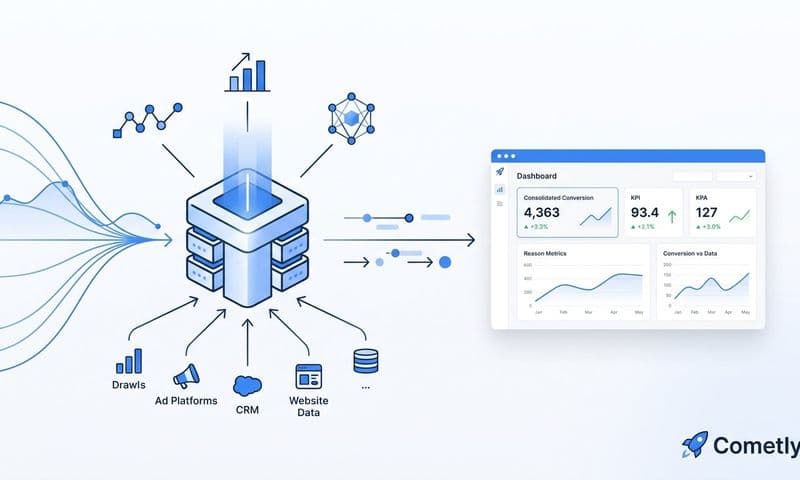
Marketing analytics platforms solve this by pulling all those separate data sources together. This integration creates a single source of truth, ending the frustrating debates that come from conflicting reports. For a deeper look at the core concepts, you can explore more about understanding the definition of marketing analytics.
This unified view empowers your entire team—not just the data scientists—to make decisions based on solid evidence instead of gut feelings.
Uncovering the Full Customer Journey
A customer’s path to making a purchase is rarely a straight line. They might see a social media post, click a paid ad a week later, and finally buy something through an email newsletter. Most traditional tools can't connect these dots.
A key function of marketing analytics platforms is to stitch together these fragmented touchpoints, revealing the entire customer journey from initial awareness to final conversion. This visibility is critical for accurate attribution and budget allocation.
By mapping this journey, you get incredible insights. You can pinpoint which channels are most effective at different stages and see how they work together to drive sales. This allows you to justify your budget with hard numbers and fine-tune your strategy for the biggest impact.
Ultimately, these platforms provide the clarity you need to:
- Attribute revenue accurately: Know exactly which campaigns and channels are delivering the best results.
- Optimize your spending: Stop wasting money on what isn't working and double down on your winners.
- Understand your customers better: Gain deep insights into your audience's behavior and what they really want.
- Foster a data-driven culture: Move your team from guesswork to confident, evidence-based decisions.
The Core Features That Drive Results
 Choosing Marketing Analytics Platforms for Growth
Not all marketing analytics platforms are built the same. Some give you basic reports, but a truly powerful platform is a growth engine for your business. The real difference comes down to a handful of core features that turn raw data into clear, actionable strategies.
Getting a handle on these capabilities is key when you're shopping around for software. It’s not just about what a feature does, but why it’s so critical for proving ROI and making every dollar you spend work harder. Let's break down the must-have features that separate a simple tool from a strategic asset.
Unified Data Integration
The bedrock of any solid analytics platform is its ability to pull all your data sources together. Think of your marketing data like ingredients for a recipe. If your flour is in the kitchen, your sugar is in the garage, and your eggs are hiding in the attic, you’re never going to bake that cake.
Data integration brings all those ingredients into one central kitchen. The best platforms lean on top data integration solutions to connect all the scattered pieces of your marketing world, pulling in data from your:
- Ad Platforms: Facebook Ads, Google Ads, TikTok Ads
- Website Analytics: Google Analytics, Adobe Analytics
- CRM Systems: Salesforce, HubSpot
- Email Providers: Mailchimp, Klaviyo
- E-commerce Stores: Shopify, Stripe
This creates a single source of truth for your performance, finally putting an end to data silos and those frustrating, conflicting reports.
Customizable Performance Dashboards
Once all your data is in one place, you need an intuitive way to see what's going on. Customizable dashboards are your cockpit, displaying the most critical metrics for your goals in real time. A great platform moves way beyond one-size-fits-all reports.
Instead, it lets you build dashboards tailored to different teams or specific objectives. Your executive team might need a high-level overview of Marketing Efficiency Ratio (MER), while your paid media team needs a granular look at Cost Per Acquisition (CPA) by campaign. With detailed visual reporting, you can dig into analytics features that turn messy data into clear stories.
Powerful dashboards don't just show you what happened; they help you ask why it happened. By drilling down into the data, you can move from simple observation to strategic action.
This flexibility ensures every stakeholder gets the exact information they need to make smart decisions without delay.
Sophisticated Attribution Modeling
Attribution is the art and science of giving credit to the touchpoints that lead to a conversion. It's one of the toughest—but most important—parts of marketing analytics. Basic tools often just credit the very last click, completely ignoring all the hard work that came before it.
For instance, a customer might first see your brand in a blog post, get hit with a retargeting ad on social media a week later, and finally buy after a branded Google search. A last-click model would give 100% of the credit to that search ad, making the blog and social ad look like total duds.
That's where advanced marketing analytics platforms change the game by offering multiple attribution models:
- First-Touch: Gives all the credit to the very first interaction.
- Linear: Spreads credit out evenly across every single touchpoint.
- Time-Decay: Gives more credit to the touchpoints closer to the final conversion.
- Multi-Touch (Algorithmic): Uses data to intelligently assign credit based on each touchpoint's actual influence.
This level of detail finally reveals the true value of your full-funnel marketing, stopping you from cutting budgets on campaigns that are quietly driving major long-term value.
To help you understand how these features translate into real-world benefits, here’s a quick breakdown.
Table: Key Features and Their Business Impact
Feature | What It Does | Why It Matters (Business Impact) |
|---|---|---|
Unified Data Integration | Connects all marketing data sources into a single platform | Eliminates data silos and creates a single source of truth for accurate cross channel reporting |
Customizable Dashboards | Lets you build visual reports using the metrics that matter most | Empowers teams with real time insights and speeds up decision making and strategy changes |
Attribution Modeling | Assigns conversion credit across marketing touchpoints | Reveals true ROI and helps allocate budget to the channels that actually drive results |
Predictive Analytics and AI | Uses AI to analyze historical data and forecast future outcomes | Moves strategy from reactive to proactive by identifying trends before competitors |
Ultimately, a platform armed with these features doesn't just report on the past; it gives you the tools to shape the future of your marketing performance.
Predictive Analytics and AI
The most forward-thinking platforms are now baking artificial intelligence right into their core. This is where your strategy shifts from being reactive to proactive. Instead of just analyzing what already happened, AI gives you a peek into the future.
This technology can:
- Forecast Future Trends: Predict which of your campaigns are most likely to pop off.
- Identify At-Risk Customers: Flag customers who are showing signs they might be about to churn.
- Automate Budget Allocation: Suggest moving your ad spend to higher-performing channels in real time.
By spotting patterns that are invisible to the human eye, AI helps you get ahead of market changes and customer needs, giving you a serious competitive edge.
How Centralized Analytics Transform Your Business
 Choosing Marketing Analytics Platforms for Growth
Bringing in one of the many marketing analytics platforms isn't just about getting fancier reports. It’s a fundamental shift in how your business runs, moving you from a world of scattered data and gut-feel decisions to one of clarity, precision, and real growth.
This transformation doesn't happen overnight, but a few powerful outcomes ripple through every department. Let's break down the four biggest ways centralized analytics can reshape your business, turning raw data into your most valuable asset.
Establish a Single Source of Truth
Without a central platform, marketing meetings can feel like a courtroom drama. The social media team has one set of conversion numbers from Facebook, the paid ads team shows conflicting data from Google, and the sales team’s CRM tells a completely different story. Who do you believe?
This constant debate over whose data is "right" grinds progress to a halt and breeds distrust. A centralized analytics platform ends the conflict by creating a single source of truth. By pulling every data stream into one place, it ensures everyone is looking at the same numbers, reported in the same way.
When your entire organization operates from a unified dataset, you stop wasting time arguing about the data and start having productive conversations about what the data actually means for your strategy.
This alignment is the foundation of a high-performing team, allowing everyone to collaborate effectively and move forward with shared confidence.
Directly Enhance Your Marketing ROI
One of the most immediate impacts is a massive improvement in your Return on Investment (ROI). When you can clearly see which channels, campaigns, and even specific ads are driving the most profitable conversions, you can stop guessing where to put your money.
Imagine an e-commerce brand that spends heavily on Google Ads because it has the highest last-click conversion volume. But after implementing a centralized analytics tool, they discover something huge: their most valuable customers—the ones with the highest lifetime value—actually start their journey by engaging with organic TikTok videos before eventually searching on Google.
Armed with this insight, they reallocate a chunk of their budget to beef up their TikTok strategy. The result? They attract more high-value customers and effectively double their ROI from that segment. This is the power of seeing the full picture. You can explore how this works in our guide to creating a unified analytics platform.
Gain a Deep Understanding of Your Customers
Your customers don't interact with you in a straight line. Their journey is a complex web of touchpoints across different devices and channels. A powerful analytics platform maps this entire journey out, giving you a profound understanding of how they behave.
You can finally answer critical questions like:
- What is the typical path from awareness to purchase for our best customers?
- Where are the friction points in the journey that cause people to drop off?
- How does offline activity, like a call center interaction, influence online conversions?
This deep knowledge allows you to personalize their experience and make it better overall. In fact, early adopters of AI-powered marketing analytics have reportedly seen up to a 35% increase in lead conversion rates, showing just how much these insights impact your bottom line.
Cultivate a Data-Driven Culture
Perhaps the most lasting transformation is cultural. When data is accessible, reliable, and easy to understand, it becomes the default language of your organization. Decisions are no longer made based on seniority, opinion, or outdated assumptions.
Instead, every strategic move is backed by real-time insights. Teams become more agile, testing new ideas, measuring the results, and quickly iterating on what works. This creates a culture of continuous improvement where everyone feels empowered to contribute to growth. A data-driven culture isn't just a buzzword; it’s a competitive advantage that lets you adapt and win in a constantly changing market.
Comparing the Different Types of Analytics Platforms
Stepping into the world of marketing analytics platforms can feel like trying to pick just one tool from a giant, overwhelming hardware store. You've got dozens of options, and they all claim to be the perfect solution, but each one is built for a slightly different job.
Figuring out which one you actually need is critical. Pick the wrong one, and you could end up paying for a complex system your team can't use or, just as bad, choosing a simple tool you'll outgrow in six months. Let’s break down the main categories to help you match your goals, budget, and team's skills with the right platform.
All-in-One Marketing Suites
Think of all-in-one suites like a Swiss Army knife. Platforms like HubSpot or Salesforce Marketing Cloud try to do a little bit of everything—CRM, email, social media, landing pages, and, of course, analytics. Their biggest selling point is pure convenience.
- Ideal Use Case: Small to mid-sized businesses that want a single, connected system to run their entire marketing and sales process without juggling a dozen different subscriptions.
- Typical User: A marketing generalist or small business owner who needs everything to just work together in one place.
- Limitation: While they cover a lot of ground, their analytics features often lack the depth of a specialized tool. The attribution modeling can be pretty basic, which makes it tough to get a truly granular view of what’s driving performance.
These suites are fantastic for teams that need operational efficiency more than they need deep, powerful analytics.
Specialized Best-of-Breed Tools
If an all-in-one suite is the Swiss Army knife, then best-of-breed tools are the master chef's santoku knife—perfectly designed for one job and exceptionally good at it. These are specialized marketing analytics platforms like Google Analytics, Mixpanel, or Cometly that focus intensely on a specific area, whether it's web analytics, product usage, or ad attribution.
Their defining strength is depth. They deliver incredibly detailed insights that all-in-one platforms just can't touch. A tool like Mixpanel, for instance, can track user behavior inside your app with surgical precision, while a dedicated attribution platform gives you a far more accurate picture of your true ROI. Our guide on the different types of marketing analytics digs deeper into these distinctions.
Web and Product Analytics Platforms
This category is home to some of the biggest names in the game, with Google Analytics as the classic example. These platforms are masters at tracking website traffic, user engagement, and conversion paths on your site or inside your app.
They're built to answer critical questions like, "Where are my visitors coming from?" and "Which pages are causing people to leave?" Their focus is almost entirely on the digital properties you own.
The catch? They often struggle to connect what happens on your site with the marketing activities that happen off your site, like your social media ad campaigns. You can see what people do once they arrive, but getting the full story of how they got there can be a real challenge.
Social Media Analytics Tools
Platforms in this camp live and breathe social media. They help you track metrics like engagement rates, follower growth, and post performance across channels like Facebook, Instagram, and LinkedIn.
Many also offer social listening features to keep an eye on brand mentions and overall sentiment. If you're curious about the difference, it's worth understanding the nuances of social listening versus monitoring.
- Ideal Use Case: Brands with a heavy social media presence or agencies managing multiple client accounts.
- Typical User: Social media managers and content creators.
- Limitation: Their analysis is locked into the world of social. They give you little to no insight into how all that social activity actually impacts website conversions or final sales unless you pair them with another tool to connect the dots.
Platform Type Comparison
Feeling a bit overwhelmed? It's completely normal. Each platform type serves a different core need. This table simplifies the decision by highlighting who each platform is best for and what its core trade-offs are.
Platform Type | Best For | Key Strength | Potential Limitation |
|---|---|---|---|
All in One Suites | Small businesses and generalist teams | Convenience through integrated tools and workflows | Basic analytics and limited attribution depth |
Best of Breed Tools | Performance marketers and specialists | Unmatched depth, accuracy, and control | Requires managing and integrating multiple tools |
Web and Product Analytics | Website and product managers | Deep insight into on site user behavior | Blind spots for off site and paid marketing channels |
Social Media Analytics | Social media managers and brand teams | Comprehensive engagement and audience metrics | Limited visibility outside social platforms |
Ultimately, there's no single "best" platform—only the one that's best for you. Use this comparison as a starting point to think about your immediate needs and where you plan to be in a year. The right tool should not only solve today's problems but also grow with you as your marketing gets more sophisticated.
Future Trends Shaping Marketing Analytics
The world of marketing analytics never sits still, and the platforms we rely on are evolving just as fast. When you choose a tool, you’re not just solving today’s problems—you’re betting on a partner that can keep up with whatever comes next.
Staying ahead of the curve means understanding the big shifts on the horizon. Let's break down the trends that are already reshaping what's possible.
The biggest game-changer by far is the deep integration of artificial intelligence and machine learning. This isn't just a buzzword anymore; it's the engine powering the shift from reactive reporting (what happened last quarter?) to proactive prediction (what's likely to happen next month?).
This is the main reason the market is exploding. The global marketing analytics platform space is on track to hit around $15 billion by 2025. It's expected to grow at a Compound Annual Growth Rate of roughly 15% through 2033, almost entirely because of AI and ML. You can read the full research on this market growth to see the numbers for yourself.
The Rise of Predictive and Prescriptive Analytics
For years, analytics was all about looking in the rearview mirror. It told a great story about your past performance, but that’s where it stopped. Now, AI-powered platforms are becoming fortune-tellers, using your historical data to forecast future outcomes with stunning accuracy.
But it doesn't stop at just predicting what will happen.
The real leap forward is prescriptive analytics. This is where the platform moves beyond forecasts and starts giving you specific, actionable advice on what to do next. Think of it like a GPS that not only predicts traffic but also suggests a better route.
- Automated Campaign Optimizations: Imagine your platform automatically shifting your ad budget to the best-performing campaigns in real-time, without you lifting a finger.
- Proactive Churn Prevention: Machine learning models can spot customers who are about to leave, flagging them so you can step in with a retention offer before it’s too late.
- Dynamic Content Personalization: The platform can predict which offer or piece of content will resonate most with a specific user and serve it up automatically.
These capabilities are changing the marketer's job from data cruncher to strategic decision-maker, guided by smart recommendations. You can explore the impact of machine learning on marketing analytics in our detailed guide.
Privacy-First Analytics in a Cookieless World
The old ways of tracking people across the web are dying. With the phase-out of third-party cookies and a growing demand for data privacy, the rulebook is being rewritten. The marketing analytics platforms of the future are being built from the ground up to respect user privacy while still delivering the insights you need.
This new reality is all about:
- First-Party Data: Platforms are now focused on helping you collect, unify, and make sense of the data you own directly from your customers.
- Server-Side Tracking: This moves tracking from a user's browser to your own server, giving you more control and much better accuracy in a privacy-friendly way.
- Aggregate and Anonymized Insights: The focus is shifting from tracking every single individual to understanding broader trends and cohort behaviors.
Any platform that isn't adapting to this privacy-first world is already on its way to becoming obsolete. A critical question to ask today is how well a tool can provide accurate attribution without leaning on third-party cookies.
Democratization of Data with Self-Service Tools
Finally, the future of analytics belongs to everyone, not just the data scientists. For too long, getting answers to complex questions meant you either needed a PhD in statistics or had to file a ticket with the analytics team and wait.
Modern platforms are tearing down those walls.
With intuitive, drag-and-drop interfaces and natural language processing (letting you ask questions in plain English), these tools are empowering every marketer to be their own analyst. This accessibility doesn't just speed up decision-making; it helps build a truly data-driven culture where insights are available to everyone, right when they need them.
How to Choose the Right Marketing Analytics Platform
Picking the right marketing analytics platform isn't about finding some mythical, perfect tool. It’s about finding the right one for your business, right now. This is the decision that turns raw data into profitable action, so walking in with a clear game plan is non-negotiable. Get this right, and you'll have a solution that not only solves today's headaches but grows with you tomorrow.
First things first: what are you actually trying to accomplish? Are you trying to figure out which ad channels are actually making you money? Do you need a better handle on customer lifetime value? Or is the goal simply to get everyone to stop arguing over whose numbers are right by creating a single source of truth?
Write down your top three to five goals. This list becomes your scorecard for every platform you look at.
Audit Your Stack and Your Team First
Before you even think about booking a demo, you need to look inward. A new platform has to slide into your current ecosystem and, just as importantly, be something your team can actually use. You're looking for a tool that plays nice with what you’ve already got, not something that forces you to rip everything out and start over.
Start by making a list of your current marketing stack. Every single tool—from your ad platforms and CRM to your e-commerce backend. The best platforms will have seamless, pre-built integrations with the tools you already rely on.
Next, get brutally honest about your team’s skills.
- Technical Chops: Do you have data analysts on staff who live and breathe SQL? Or do you need a super user-friendly, drag-and-drop interface that a busy marketer can master without writing a line of code?
- Time to Learn: How much time can your team realistically set aside to learn and manage a new piece of software? Be honest.
- Support Needs: Are you going to need some serious hand-holding during setup, or is your team the type to figure things out on their own?
Answering these questions will stop you from buying a platform that’s either too basic for your needs or so complicated that it ends up collecting digital dust.
The Key Things to Look For
Once you’ve got your goals and your internal audit squared away, you can start sizing up platforms against a real set of criteria. It’s easy to get distracted by flashy features, so stay focused on the core stuff that will actually deliver value over the long haul.
A platform's real worth isn't in how many dashboards it can spit out. It's in its ability to give you clear, trustworthy data that leads to smarter, faster decisions. Always prioritize accuracy and usability over needless complexity.
As you start comparing your options, build a simple checklist. Make sure it includes:
- Data Integration Quality: How easily does it connect to all your critical data sources? Is it a one-click setup or a month-long IT project?
- Scalability: Can this platform handle your data today and three years from now when your business has tripled in size?
- User Experience (UX): Is the interface actually intuitive, or is it going to feel like a chore every time you log in?
- Customer Support: What kind of support is included? More importantly, what are current customers really saying about their experience?
Finally, when you get on those vendor demos, come armed with tough questions. Push past the slick sales pitch and get into the nitty-gritty. Ask things like, "How does your platform handle offline conversion data?" and "Show me, step-by-step, what your onboarding process actually looks like." This approach ensures you’re choosing a long-term partner, not just buying another piece of software.
Common Questions About Marketing Analytics Platforms
Even after getting a good handle on marketing analytics platforms, a few questions always seem to pop up. Let's clear up some of the common uncertainties so you can feel completely confident moving forward.
This decision tree infographic is a great way to visualize the first questions you should be asking when you start looking for a platform.
 Choosing Marketing Analytics Platforms for Growth
As the graphic shows, getting your goals, current tech stack, and team skills aligned is the absolute first step—long before you start comparing software.
What Is the Difference Between a Marketing Analytics Platform and a CRM
Think of it this way: a CRM (Customer Relationship Management) is all about managing individual relationships and sales pipelines. It answers the "who."
A marketing analytics platform, on the other hand, pulls together data from all your marketing channels to measure campaign performance and spot broad trends in customer behavior. It answers the "why" behind your results. They often work together, but their main jobs are totally different.
Can Small Businesses Benefit from a Marketing Analytics Platform
Absolutely. You don't need a massive budget to get value from analytics. Many modern platforms have scalable plans built just for small businesses.
Even basic analytics can be a game-changer, showing you which marketing efforts are actually bringing in customers. This lets you put your limited budget where it will make the biggest impact.
Free tools like Google Analytics are a fantastic starting point, but a dedicated platform offers deeper, more integrated insights that are crucial for growth. It helps you stop wasting money on what isn't working and double down on what is.
How Long Does It Take to Implement a Marketing Analytics Platform
This really depends on the complexity of the platform and how many data sources you're connecting. A simple, cloud-based tool might be up and running in a few hours or days.
But a more comprehensive, enterprise-level system that needs to integrate with a dozen custom data sources could take several weeks or even a couple of months to get fully dialed in. Always ask potential vendors for a realistic timeline based on your specific setup.
Ready to get crystal-clear attribution and stop wasting ad spend? Cometly unifies all your marketing data into one powerful platform, giving you the insights to scale with confidence. See how Cometly can transform your analytics.