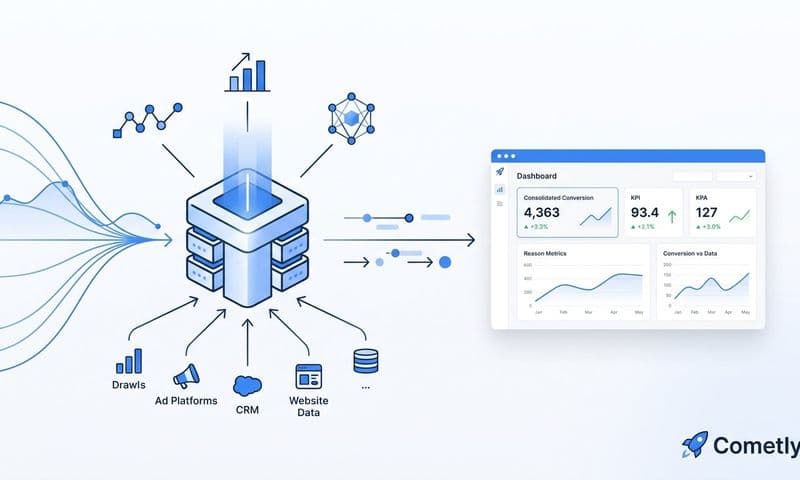
Most marketing teams are running campaigns across multiple platforms but struggling to connect the dots between ad spend and actual revenue. You have Google Ads data in one dashboard, Meta metrics in another, and CRM conversions living in a spreadsheet somewhere. The result is decisions based on incomplete data, wasted budget on underperforming channels, and no clear picture of what is actually driving growth.
Sound familiar? You are not alone. As advertising has spread across more channels and privacy changes have fragmented tracking, the gap between "we're collecting data" and "we understand what's working" has grown wider for most marketing teams.
A properly configured marketing analytics setup service solves this by connecting every touchpoint into a single, unified view of your customer journey. Instead of guessing which campaigns deserve more budget, you can see exactly which ads, channels, and messages are generating real revenue.
Whether you are building this capability in-house or evaluating external solutions, this guide walks you through the exact steps to get your marketing analytics infrastructure right from the start. By the end, you will have a clear roadmap for connecting your ad platforms, website, CRM, and conversion events into one system that shows you precisely which campaigns generate revenue and which ones drain your budget.
Let's get into it.
Step 1: Audit Your Current Data Sources and Identify the Gaps
Before you build anything new, you need an honest picture of what you already have. This step is less glamorous than standing up a new dashboard, but it is the foundation everything else rests on. Skip it, and you will spend months optimizing a system built on blind spots.
Start by mapping out every platform where marketing data currently lives. This typically includes your ad platforms (Google Ads, Meta, TikTok, LinkedIn), your website analytics tool, your CRM, your email marketing platform, and if applicable, your payment processor or e-commerce platform. Write them all down in one place.
Next, ask a harder question: where does the data break down? Common failure points include missing or inconsistent UTM parameters on ad links, ad platform data that never makes it into your CRM, conversion events that fire on form fills but not on actual closed deals, and cross-device journeys where a user clicks an ad on mobile but converts on desktop days later. Each of these gaps creates a distorted picture of performance, which is why addressing unreliable marketing analytics data early is so critical.
Now look at your conversion events specifically. Many teams track a long list of events but have not stopped to ask which ones actually correlate with revenue. A lead form submission is not the same as a closed sale. If your analytics system is optimizing toward form fills while your sales team is closing a fraction of those leads, you are optimizing for the wrong thing.
Map your conversions to revenue stages: Separate your events into three categories: awareness signals (page views, video plays), engagement signals (form fills, demo requests), and revenue signals (purchases, closed deals, subscription activations). Your analytics setup should ultimately be anchored to the revenue signals.
Build your priority list: Once you know where the gaps are, rank them by business impact. Start with the connections that involve your highest ad spend platforms and your most direct revenue signals. If you are spending the majority of your budget on Meta and Google, those integrations come first. Smaller channels can follow once the core system is stable.
The output of this step is a simple document: a list of your data sources, the gaps between them, and a prioritized order for what to connect. Keep it practical. This is your blueprint for everything that follows.
Step 2: Define Your Attribution Model and Key Metrics
Here is where most marketing analytics projects go sideways. Teams rush to connect their data without deciding upfront what question they are actually trying to answer. Attribution models are not just a technical setting. They represent a fundamental choice about how you assign credit for conversions, and different models tell very different stories about the same campaigns.
The main models you will encounter are first-touch, last-touch, linear, time-decay, and multi-touch. First-touch gives all credit to the first interaction a customer had with your brand, which is useful for understanding what drives awareness. Last-touch gives all credit to the final interaction before conversion, which tends to over-reward bottom-funnel channels like branded search. Linear spreads credit equally across all touchpoints. Time-decay gives more credit to touchpoints closer to the conversion. Multi-touch attribution attempts to assign weighted credit based on the actual influence of each touchpoint in the journey. For a deeper dive, our guide on how to setup marketing attribution correctly covers the nuances of each approach.
Choosing the right model for your business: The length of your sales cycle matters here. If you are running an e-commerce store where customers typically buy within a single session, last-touch or time-decay models may give you useful signal quickly. If you are selling a B2B SaaS product where prospects research for weeks across multiple channels before requesting a demo, a multi-touch model is far more appropriate because it captures the full influence of each channel along the way.
Why comparing models side by side matters: Relying on a single attribution model can quietly mislead your budget decisions. A channel that looks weak under last-touch might be consistently appearing early in the journeys of your highest-value customers. Comparing first-touch and multi-touch views together often reveals these hidden contributors. This is one of the most valuable things a well-configured analytics setup gives you: the ability to see the same data through multiple lenses simultaneously.
Once you have decided on your primary attribution model, lock in the KPIs your system will track. The core metrics for most marketing teams running paid campaigns include return on ad spend (ROAS), cost per acquisition (CPA), customer lifetime value (LTV), and revenue by channel. These should be visible at the campaign level, not just in aggregate. Knowing your overall ROAS is helpful. Knowing which specific campaigns and ad sets are driving it is what lets you make decisions.
Document your chosen model and KPIs before moving to the technical setup. This clarity will guide every configuration decision in the steps ahead.
Step 3: Connect Your Ad Platforms and Implement Server-Side Tracking
This is where the technical work begins, and it is also where many marketing analytics setups fall short without realizing it. Connecting your ad platforms sounds straightforward, but the quality of the data flowing through those connections depends heavily on how you track conversions in the first place.
Start by linking your major ad platforms to your centralized analytics system. For most teams, this means Meta (Facebook and Instagram), Google Ads, and potentially TikTok, LinkedIn, or Pinterest depending on your channel mix. Each platform has its own API and data-sharing settings, and you will want to ensure you are using the highest-fidelity connection available, not just the default pixel setup.
Here is the issue with relying solely on browser-based tracking. Apple's App Tracking Transparency framework, introduced with iOS 14.5, significantly reduced the ability of Meta's pixel and similar client-side scripts to track conversions on Apple devices. Add browser-level cookie restrictions from Firefox and Safari, and ad blockers used by a growing share of web users, and you have a situation where browser-based pixels can miss a meaningful portion of actual conversions. You may be looking at data that understates your real results, which leads to pulling budget from campaigns that are actually working. Understanding the role of analytics in digital marketing helps frame why accurate tracking is non-negotiable.
Server-side tracking addresses this directly. Instead of relying on a pixel firing in the user's browser, a server-side setup sends conversion data directly from your server to the ad platform's API. This bypasses browser restrictions entirely. The result is more complete conversion data, which means more accurate reporting and better-informed optimization decisions.
How to verify your tracking is working: After connecting each platform, do not just assume the data is flowing correctly. Use the platform's native testing tools, such as Meta's Events Manager Test Events feature or Google's Tag Assistant, to confirm that conversion events are being received and matched correctly. Check that event deduplication is set up properly if you are running both pixel and server-side tracking simultaneously. Duplicate events will inflate your conversion counts and distort your ROAS calculations.
Cometly's server-side tracking and ad platform integrations are a practical example of how this works in a unified system. Rather than managing separate API connections for each platform, Cometly routes your conversion data server-side to Meta, Google, and other platforms from a single integration layer. This simplifies the setup and reduces the risk of gaps or misconfigurations across platforms.
The success indicator for this step is straightforward: your analytics system should be receiving conversion events that match or closely approximate what you see in your ad platform dashboards, with no major unexplained discrepancies. If the numbers are wildly different, that is a signal that something in the tracking chain needs attention before you move forward.
Step 4: Integrate Your CRM and Revenue Data
Connecting your ad platforms gives you click and conversion data. Connecting your CRM gives you something far more valuable: the ability to see which ads and campaigns are driving actual revenue, not just top-of-funnel activity.
Think about the difference this makes. Without CRM integration, your analytics system might show that Campaign A generated 200 leads at a low cost per lead, while Campaign B generated 80 leads at a higher cost. Campaign A looks like the winner. But if your CRM data shows that Campaign B's leads closed at three times the rate and at a higher average deal value, Campaign B is actually driving more revenue per dollar spent. Without that connection, you would be scaling the wrong campaign. This is exactly why understanding marketing analytics data at a deeper level separates high-performing teams from the rest.
The process of integrating your CRM starts with mapping your pipeline stages to marketing touchpoints. Identify the key milestones in your sales process, such as lead created, qualified opportunity, demo completed, and deal closed, and make sure these stages are being passed back to your analytics system as events. This allows you to see not just where leads come from, but which sources produce leads that actually move through the pipeline.
Connecting payment processors and e-commerce platforms: For businesses selling directly online, integrating Stripe, WooCommerce, Shopify, or your payment processor of choice is essential for tying actual transaction revenue back to the campaigns that drove it. This closes the loop between an ad click and a dollar in your bank account. Without this connection, you are working with proxy metrics rather than real revenue data.
Common pitfalls to watch for: CRM integrations introduce several data quality challenges that can quietly corrupt your analytics. Duplicate contact records are one of the most common issues, where the same person exists in your CRM multiple times under slightly different email addresses or names, making it impossible to accurately attribute their journey. Mismatched contact data between systems, such as different email formats or phone number conventions, can break the matching logic that ties a CRM contact to an ad click. Timezone discrepancies between your CRM, ad platforms, and analytics system can also cause conversion events to appear on the wrong date, which skews day-over-day and week-over-week comparisons.
Audit your CRM data quality before connecting it. Clean up duplicate records, standardize contact fields, and confirm that your timezone settings are consistent across all systems. A clean CRM integration is worth far more than a fast one.
Step 5: Set Up Conversion Syncing to Supercharge Ad Platform Algorithms
Most marketers focus on getting data into their analytics system. Fewer think about what happens when you send enriched data back out to your ad platforms. This bidirectional flow is what conversion syncing is about, and it is one of the most underutilized levers in modern paid advertising.
Here is the core idea. Ad platforms like Meta and Google use machine learning algorithms to optimize your campaigns. These algorithms are trying to find more people who are likely to convert based on the signals you give them. If the only conversion signal you are sending back is a browser pixel fire, you are giving the algorithm incomplete information. It is optimizing toward whoever triggers that pixel, which may or may not correlate with your actual high-value customers. Exploring the impact of machine learning on marketing analytics helps illustrate how these algorithms learn from the data you provide.
Conversion syncing changes this by sending verified, revenue-connected events back to the ad platform. Instead of telling Meta "this person submitted a form," you can tell it "this person became a paying customer worth $X." The algorithm now has a much richer signal to work with. Over time, it learns to find more people who look like your actual buyers, not just your form-fillers.
What this looks like in practice: The process involves taking conversion events from your CRM or payment processor, enriching them with customer data, and sending them back to Meta via the Conversions API or to Google via the Google Ads API. The timing matters too. If a lead closes into a customer 30 days after the initial ad click, that revenue event can still be attributed back to the original campaign and fed into the algorithm's training data.
The compounding effect: Teams that implement conversion syncing often find that their ad platform algorithms become noticeably more efficient over time. Because the algorithm is now optimizing toward higher-quality signals, it tends to surface better-matched audiences and reduce wasted spend on clicks that never convert to revenue. This is a compounding advantage: better data leads to better targeting, which leads to better results, which generates more data to learn from.
Cometly's Conversion Sync feature automates this feedback loop. It takes the verified conversion events flowing through your attribution system and routes them back to Meta, Google, and other platforms in the format each algorithm expects. This removes the manual work of managing separate API integrations for each platform and ensures your conversion data is being used to its full potential.
Step 6: Build Your Reporting Dashboard and Validate the Data
You have connected your platforms, implemented server-side tracking, integrated your CRM, and set up conversion syncing. Now you need a place to see it all working together. This step is about building the reporting layer and, critically, making sure the data in it is trustworthy before you start making decisions from it.
A well-structured marketing analytics dashboard should give you channel-level ROAS at a glance, campaign and ad set comparisons, attribution model views that let you toggle between first-touch and multi-touch perspectives, revenue trends over time, and cost per acquisition broken down by source. If you are evaluating options, our comparison of top marketing analytics dashboard companies can help you benchmark what to look for.
Organize your dashboard around decisions, not just data: Every section of your dashboard should connect to a decision you need to make. Budget allocation decisions need channel-level ROAS and CPA. Creative optimization decisions need ad-level performance data. Strategic planning needs revenue trend data and LTV by source. If a metric on your dashboard does not connect to a decision, question whether it needs to be there.
Before you trust the dashboard for real decisions, run a two-week validation process. Compare your analytics platform numbers against your CRM records and your ad platform reports. Look for significant discrepancies and investigate their cause. Common issues include delayed conversion attribution, where events are counted on the day they are recorded rather than the day they occurred; offline events that are not being captured by your server-side tracking; and cross-device gaps where a user's journey spans multiple devices that are not being stitched together correctly.
Cometly's analytics dashboard brings these views together in one place, and the AI Chat feature adds another layer of utility. Instead of building custom queries or exporting data to a spreadsheet, you can ask questions directly: "Which campaigns drove the most revenue last month?" or "What is my ROAS on Meta versus Google over the last 30 days?" The AI surfaces answers and can flag anomalies or patterns that warrant attention. This is particularly useful during the validation phase when you are trying to quickly identify where numbers do not add up.
When your analytics platform, CRM, and ad platform reports are reasonably aligned, you can move forward with confidence that your data is telling you the truth.
Step 7: Optimize Continuously Using AI-Driven Insights
Getting your marketing analytics setup service configured correctly is a significant achievement. But it is the beginning of the work, not the end. The teams that extract the most value from their analytics infrastructure are the ones that treat it as an ongoing practice rather than a one-time project.
The most immediate application of your new attribution data is budget reallocation. With channel-level ROAS and revenue data visible, you can move spend away from campaigns that are generating clicks but not revenue, and toward the ones that are consistently producing high-value customers. This sounds obvious, but it is only possible when your attribution system is connecting ad spend to actual revenue. Without that connection, you are guessing.
Where AI changes the game: Human analysts are good at reviewing dashboards and spotting obvious trends. AI is good at processing large volumes of cross-platform data and identifying patterns that are not obvious, such as which ad creatives tend to attract customers with the highest lifetime value, or which audience segments show strong early engagement signals that predict long-term retention. To understand the broader opportunity, explore why using AI in marketing analytics is becoming essential for competitive teams.
Cometly's AI Ads Manager is designed for exactly this kind of continuous optimization. It analyzes performance data across your campaigns and surfaces recommendations for scaling what is working and pulling back on what is not. Rather than spending hours manually reviewing ad sets and comparing performance across platforms, you get prioritized, AI-generated recommendations that help you act faster and with more confidence.
The mindset shift here is important. Great marketing analytics is not about having a beautiful dashboard. It is about creating a system that continuously improves your ability to make better decisions with every campaign you run. Each optimization you make generates new data. That data feeds better decisions. Over time, this cycle compounds into a significant competitive advantage.
Putting It All Together: Your Marketing Analytics Setup Checklist
Here is a quick-reference summary of the seven steps you can save and return to as you work through your setup:
1. Audit your data sources: Map every platform where marketing data lives, identify where data breaks down, and build a prioritized list of what to connect first based on ad spend and revenue impact.
2. Define your attribution model and KPIs: Choose the right model for your sales cycle, identify your core revenue metrics, and commit to comparing multiple attribution views side by side.
3. Connect ad platforms with server-side tracking: Link Meta, Google, and other platforms to a centralized system using server-side tracking to capture conversions that browser pixels miss, and verify data flow after each connection.
4. Integrate your CRM and revenue data: Map pipeline stages to marketing touchpoints, connect your payment processor or e-commerce platform, and clean up data quality issues before connecting.
5. Set up conversion syncing: Send enriched, revenue-connected events back to ad platforms to improve algorithm targeting and optimization over time.
6. Build and validate your dashboard: Create a reporting view organized around decisions, then run a two-week validation process to confirm your data is accurate before acting on it.
7. Optimize continuously with AI: Use attribution data to reallocate budget, and leverage AI-powered insights to identify patterns and scale winning campaigns with confidence.
If you cannot tackle everything at once, start with Step 1. Understanding your gaps is the foundation for every improvement that follows. A clear audit gives you the clarity to prioritize, and prioritization is what turns an overwhelming project into a manageable sequence of steps.
It is also worth noting that Steps 3 through 7, which cover server-side tracking, CRM integration, conversion syncing, dashboard reporting, and AI-driven optimization, are exactly what platforms like Cometly are built to handle in a unified system. For teams running multi-platform campaigns who want accurate attribution without stitching together a dozen separate integrations, having these capabilities in one place makes the marketing analytics setup service process significantly faster and more reliable.
Accurate attribution is not just about collecting data. It is about connecting that data in ways that reveal what is truly driving revenue. When you can see that clearly, every budget decision, every creative test, and every channel investment becomes smarter. That is the real payoff of getting your marketing analytics infrastructure right.
Ready to elevate your marketing game with precision and confidence? Discover how Cometly's AI-driven recommendations can transform your ad strategy. Get your free demo today and start capturing every touchpoint to maximize your conversions.