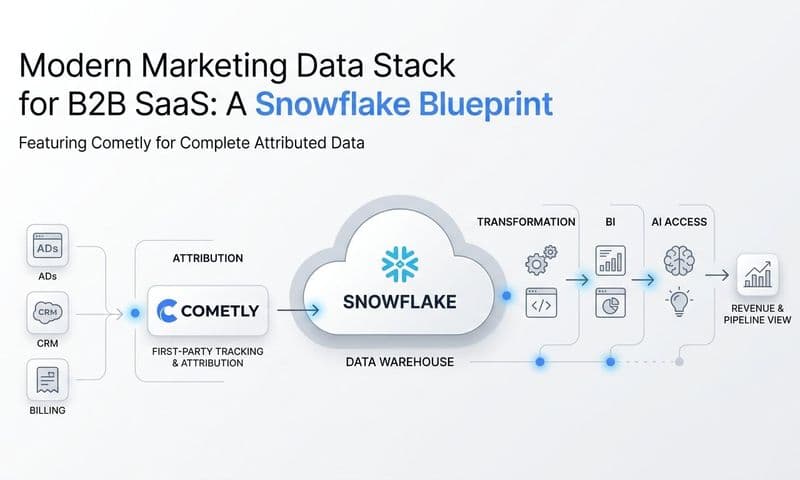

Many marketing teams have invested heavily in data warehouses, expecting unified insights and better decision-making. Instead, they often find themselves managing complex SQL queries, waiting on engineering resources, and still struggling to answer basic questions like "which ads are actually driving revenue?"
The traditional data warehouse approach—while powerful for some use cases—can be overkill for marketers who need actionable attribution insights without the technical overhead.
Think about it: You're running campaigns across Meta, Google, TikTok, and LinkedIn. Your leads flow through HubSpot or Salesforce. Your website tracks thousands of sessions daily. A data warehouse can technically unify all this information, but at what cost? You need a data engineer to write queries. You wait days for reports. You still can't easily push conversion data back to your ad platforms.
This guide explores practical alternatives that deliver the marketing analytics you need without the complexity, cost, and maintenance burden of a full data warehouse implementation. Whether you're looking to replace an existing setup or avoid building one altogether, these strategies will help you get clearer marketing insights faster.
1. Dedicated Marketing Attribution Platforms
The Challenge It Solves
Data warehouses force you to build your own attribution logic from scratch. You're piecing together ad platform data, website analytics, and CRM records—then writing custom queries to connect them. Even after investing months in setup, you still struggle to answer fundamental questions: Which specific ads drove your highest-value customers? How should you reallocate budget across channels?
Most marketing teams don't need a general-purpose data warehouse. They need attribution insights they can act on immediately.
The Strategy Explained
Purpose-built attribution platforms connect directly to your ad accounts, website, and CRM to automatically track the complete customer journey. They're designed specifically for marketers who need to understand which touchpoints drive conversions and revenue.
 7 Marketing Data Warehouse Alternatives That Simplify Your Analytics Stack
Unlike data warehouses that require you to build attribution models yourself, these platforms come with pre-built multi-touch attribution logic. They automatically capture ad clicks, website sessions, form submissions, and CRM events—then connect them to show you the path each customer took before converting.
The difference is immediate: Instead of waiting for a data analyst to run queries, you see real-time attribution dashboards showing which campaigns, ads, and keywords are actually driving revenue. You can compare first-click, last-click, and multi-touch models instantly. You get AI-powered recommendations on where to scale spend.
Implementation Steps
1. Connect your ad platforms (Meta, Google, TikTok, LinkedIn) through native integrations that automatically pull campaign performance data and match it to conversion events.
2. Install server-side tracking on your website to capture visitor behavior accurately, bypassing browser restrictions and iOS limitations that make client-side tracking unreliable.
3. Integrate your CRM to connect marketing touchpoints all the way through to closed revenue, showing not just which ads drove leads but which drove actual customers.
4. Set up Conversion Sync to send enriched conversion data back to your ad platforms, feeding their algorithms better information for targeting and optimization.
Pro Tips
Look for platforms that offer AI-powered insights, not just dashboards. The best attribution tools don't just show you data—they tell you what to do with it. Platforms like Cometly use AI to identify high-performing ads across all your channels and provide specific scaling recommendations based on your actual conversion patterns.
2. Customer Data Platforms with Built-In Analytics
The Challenge It Solves
Your customer data lives in silos: website behavior in Google Analytics, email engagement in your ESP, purchase history in Shopify, support interactions in Zendesk. A data warehouse can theoretically unify these sources, but you still need to build analytics on top of it. You're essentially solving two problems—data unification and analysis—when you really just need actionable customer insights.
The Strategy Explained
Customer Data Platforms were built specifically to unify customer data across every touchpoint and make it immediately usable. Modern CDPs combine data collection, identity resolution, and analytics capabilities in a single platform designed for marketers, not engineers.
These platforms automatically stitch together customer interactions across devices and channels, creating unified profiles without requiring you to write SQL. They include native analytics dashboards showing customer segments, journey analysis, and conversion funnels—all without needing a separate business intelligence layer.
The key advantage over data warehouses is accessibility. Your marketing team can build segments, analyze behavior, and activate audiences directly in the CDP interface. No engineering tickets required.
Implementation Steps
1. Audit your current data sources and prioritize the ones that matter most for customer understanding—typically your website, CRM, email platform, and primary transaction system.
2. Configure identity resolution rules to merge customer records across sources, ensuring that a single customer's email signup, website visits, and purchases all connect to one unified profile.
3. Build initial customer segments based on behavior patterns you want to track, such as high-intent visitors, repeat purchasers, or customers at risk of churning.
4. Set up automated data flows to your activation channels, ensuring enriched customer data reaches your ad platforms and email tools for better targeting.
Pro Tips
CDPs work best when you have diverse customer data sources and need to activate that data across multiple channels. If your primary need is understanding which marketing campaigns drive revenue, a dedicated attribution platform will give you faster answers. But if you're also personalizing website experiences, running sophisticated email campaigns, and building complex customer segments, a CDP with strong analytics capabilities can replace multiple tools.
3. Native Ad Platform Analytics with Enhanced Tracking
The Challenge It Solves
Many marketers build data warehouses because they don't trust their ad platform reporting. Meta says you got 50 conversions. Google says 42. Your CRM shows 38 actual leads. The discrepancies make it impossible to optimize with confidence, so you think you need a data warehouse to establish a "source of truth."
But the real problem isn't that you need a warehouse—it's that your tracking setup is incomplete.
The Strategy Explained
Modern ad platforms have sophisticated analytics capabilities built in. Meta's Ads Manager, Google Ads reporting, and LinkedIn Campaign Manager can provide detailed performance insights—if they're receiving accurate conversion data. The limitation isn't the platform analytics; it's the tracking infrastructure feeding them.
For a deeper dive into this space, see our AI campaign manager guide.
Server-side tracking solves the accuracy problem that drives many teams toward data warehouses. By capturing conversion events on your server and sending them directly to ad platforms via their Conversion APIs, you bypass browser restrictions, ad blockers, and iOS tracking limitations. Your ad platforms receive complete, accurate conversion data and can attribute it properly.
This approach lets you trust native platform analytics again—without building a separate data infrastructure.
Implementation Steps
1. Implement server-side tracking for all critical conversion events, ensuring events are captured on your server before being sent to ad platforms through their official APIs.
2. Configure conversion matching parameters properly, including email, phone, and external IDs that help platforms connect ad clicks to conversions even when browser tracking fails.
3. Set up conversion value tracking to pass actual revenue data to your ad platforms, enabling ROAS optimization instead of just conversion volume optimization.
4. Validate data accuracy by comparing server-side conversion counts against your CRM or transaction system, adjusting your implementation until discrepancies are minimal.
Pro Tips
Server-side tracking isn't just about accuracy—it's about feeding ad platform algorithms better data. When Meta and Google receive complete conversion information, their AI can optimize more effectively. This is why platforms like Cometly emphasize Conversion Sync: sending enriched, conversion-ready events back to ad platforms improves targeting, optimization, and overall ad ROI without requiring you to manage a data warehouse.
4. Reverse ETL Tools for Existing Data Sources
The Challenge It Solves
Sometimes the problem isn't getting data into a central location—you already have valuable data in your CRM, product database, or existing analytics tools. The challenge is getting that data to the places where you can actually use it: your ad platforms for better targeting, your email tool for personalization, your sales team for prioritization.
Building a data warehouse to solve this problem is backwards. You don't need another place to store data; you need to activate the data you already have.
The Strategy Explained
Reverse ETL flips the traditional data warehouse approach on its head. Instead of pulling all your data into a central warehouse and then building analytics on top, you sync data directly from your existing sources to the tools where it's needed. Your CRM becomes the hub, and you push enriched customer data out to activation platforms.
This approach is particularly powerful for teams who've already invested in a robust CRM or customer database. You're not replacing your data infrastructure—you're making it more useful by connecting it to your marketing tools.
The key benefit is speed. You can start syncing high-value customer segments to Meta for lookalike targeting or push product usage data to your email platform for behavioral campaigns—all without building a data warehouse first.
Implementation Steps
1. Identify your primary data source—typically your CRM or product database—that contains the most complete, accurate customer information you want to activate.
2. Map out your activation destinations: which ad platforms need better audience data, which marketing tools would benefit from enriched customer attributes, which teams need access to specific data segments.
3. Configure sync rules to push specific customer segments or attributes to each destination, such as syncing high-LTV customers to Meta for lookalike modeling or recent purchasers to Google for customer match campaigns.
4. Set up automated refresh schedules to ensure your activation platforms always have current data, updating audiences as customer behavior changes.
Pro Tips
Reverse ETL works best when you have a single source of truth that's already well-maintained. If your CRM data is incomplete or your product database doesn't track marketing touchpoints, you'll sync incomplete information to your marketing tools. For teams running paid campaigns, combining reverse ETL with a dedicated attribution platform gives you the best of both worlds: accurate attribution insights plus the ability to activate your customer data for better targeting.
5. Marketing Mix Modeling Platforms
The Challenge It Solves
Privacy regulations and platform tracking limitations have made user-level attribution increasingly difficult. iOS changes, cookie restrictions, and data privacy laws mean you can't always track individual customer journeys. Data warehouses don't solve this problem—they just give you a place to store incomplete tracking data.
You need a measurement approach that works even when individual tracking isn't possible.
The Strategy Explained
Marketing Mix Modeling takes a completely different approach to attribution. Instead of tracking individual users, it uses statistical analysis to understand how different marketing channels contribute to overall business outcomes. It analyzes aggregate data—total spend per channel, overall conversions, external factors like seasonality—to determine which marketing activities are driving results.
Modern MMM platforms have evolved significantly from the spreadsheet-heavy models of the past. Today's tools use machine learning to process data faster and provide more granular insights, sometimes updating weekly instead of quarterly.
This approach is privacy-compliant by design. You're not tracking individuals, so you don't need consent frameworks or worry about tracking restrictions. You're analyzing patterns in your overall marketing performance.
Implementation Steps
1. Aggregate your marketing spend data across all channels at a consistent time interval, typically daily or weekly, including both digital and offline channels for a complete view.
2. Collect corresponding outcome data such as revenue, conversions, or leads for the same time periods, ensuring you have enough historical data (typically at least one year) for meaningful analysis.
3. Input external variables that might influence results, such as seasonality, promotions, competitive activity, or economic factors that affect your business.
4. Run initial models to establish baseline channel effectiveness, then use ongoing analysis to optimize budget allocation based on predicted ROI for each channel.
Pro Tips
MMM is most valuable for brands with significant offline marketing spend, long sales cycles, or privacy-sensitive industries where user tracking is limited. It's less useful for direct response marketers who need real-time, campaign-level insights to optimize daily. For teams running digital campaigns across multiple platforms, combining MMM for high-level channel planning with a dedicated attribution platform for tactical optimization gives you comprehensive measurement at every level.
6. Integrated CRM Analytics
The Challenge It Solves
Your CRM already contains your most valuable data: which leads converted, which customers generated revenue, which deals closed. But that data sits disconnected from your marketing activities. You know you closed 50 deals last month, but you can't easily see which ad campaigns, content pieces, or touchpoints influenced those deals.
Building a data warehouse to connect this information is one approach. Using your CRM as the analytics hub is often simpler.
The Strategy Explained
Modern CRMs like HubSpot, Salesforce, and Pipedrive have evolved far beyond contact management. They include robust analytics capabilities, custom reporting, and increasingly sophisticated attribution features. By enriching your CRM records with marketing touchpoint data, you can analyze the complete journey from first touch to closed revenue—all within a system your team already uses daily.
The key is ensuring your marketing data flows into your CRM automatically. When a lead fills out a form, you don't just want their contact information—you want to know which ad they clicked, which landing page they visited, and every touchpoint they encountered before converting.
This approach centralizes your analytics where your revenue data lives, making it easier to connect marketing activities to actual business outcomes.
Implementation Steps
1. Configure UTM parameter tracking across all your marketing campaigns to ensure every traffic source is properly tagged and identifiable when leads enter your CRM.
2. Set up form integrations that automatically capture marketing source data when leads submit, storing first touch, last touch, and intermediate touchpoints in custom CRM fields.
3. Create custom CRM reports that connect marketing source data to opportunity value and closed revenue, showing which campaigns and channels drive your highest-value customers.
4. Build dashboards that your entire team can access, making marketing attribution insights available to sales and leadership without requiring them to learn a separate analytics platform.
Pro Tips
CRM-based analytics works well for B2B companies with longer sales cycles where understanding the full lead-to-customer journey matters more than real-time campaign optimization. The limitation is that CRMs typically only see leads who convert, missing the broader picture of ad performance and traffic that didn't convert. For comprehensive marketing measurement, integrate your CRM with a dedicated attribution platform that captures all touchpoints—not just the ones that resulted in form submissions.
7. Hybrid Approach: Lightweight Data Layer Plus Specialized Tools
The Challenge It Solves
Sometimes you need some data infrastructure, but a full data warehouse is overkill. You want to collect and store raw event data for flexibility, but you don't want to manage complex ETL pipelines or write SQL queries for every marketing question. You need something in between: enough infrastructure to capture complete data, but specialized tools to make that data actionable.
The Strategy Explained
The hybrid approach combines a simple event collection layer with purpose-built marketing tools. You use a lightweight data infrastructure to capture and store raw customer events, but instead of building analytics on top of that infrastructure yourself, you connect specialized tools that turn that data into specific insights.
Think of it as having a clean data foundation without the overhead of a full warehouse implementation. You might use a tool like Segment to collect events from your website and apps, store raw data in a simple database, then connect specialized tools for different needs: an attribution platform for understanding ad performance, a product analytics tool for user behavior, an email platform for engagement campaigns.
This approach gives you data ownership and flexibility while avoiding the complexity of building custom analytics for every use case.
Implementation Steps
1. Implement a standardized event tracking layer across your website and apps using a tool that captures clean, consistent event data without requiring you to manage the infrastructure yourself.
2. Choose specialized tools for your specific analytics needs rather than trying to build everything in-house—attribution platform for marketing performance, product analytics for user behavior, business intelligence for executive reporting.
3. Connect your event data to each specialized tool through native integrations, ensuring each platform receives the specific data it needs without duplicating effort.
4. Maintain a simple data schema that all your tools can understand, documenting your key events and properties so new tools can be added easily as your needs evolve.
Pro Tips
The hybrid approach works best for growing companies that want data flexibility without engineering overhead. You get the benefits of owning your raw data while leveraging specialized tools that are better at specific analytics tasks than anything you'd build yourself. For marketing teams, this often means using a platform like Cometly for attribution and ad optimization while maintaining a lightweight event collection layer that could feed other tools as needed. You're not locked into a single vendor, but you're also not building everything from scratch.
Finding Your Path Forward
Choosing the right marketing data warehouse alternative depends on your team's technical resources, the complexity of your marketing channels, and how quickly you need actionable insights.
Here's how to decide: If you're struggling with accuracy—your ad platforms show different conversion numbers than your CRM—start with enhanced server-side tracking. If you're overwhelmed by data silos but don't need deep analysis, a CDP might be your answer. If you're running significant offline marketing or facing strict privacy constraints, explore Marketing Mix Modeling.
But for most marketing teams running paid campaigns across multiple platforms, a dedicated attribution platform offers the fastest path to understanding what's actually driving revenue—without the engineering overhead of a traditional data warehouse.
The companies seeing the best results aren't the ones with the most sophisticated data infrastructure. They're the ones who can answer critical questions quickly: Which campaigns should we scale? Which ads are driving our highest-value customers? Where should we reallocate budget?
Start by auditing your current data challenges. Are you struggling with accuracy, speed, or accessibility? That answer will guide you toward the right alternative for your specific situation.
If your primary need is connecting ad performance to actual revenue—understanding not just which campaigns drove clicks, but which drove customers—you need a platform built specifically for that purpose. You need complete customer journey tracking, AI-powered optimization recommendations, and the ability to feed better data back to your ad platforms for improved targeting.
Ready to elevate your marketing game with precision and confidence? Discover how Cometly's AI-driven recommendations can transform your ad strategy—Get your free demo today and start capturing every touchpoint to maximize your conversions.