

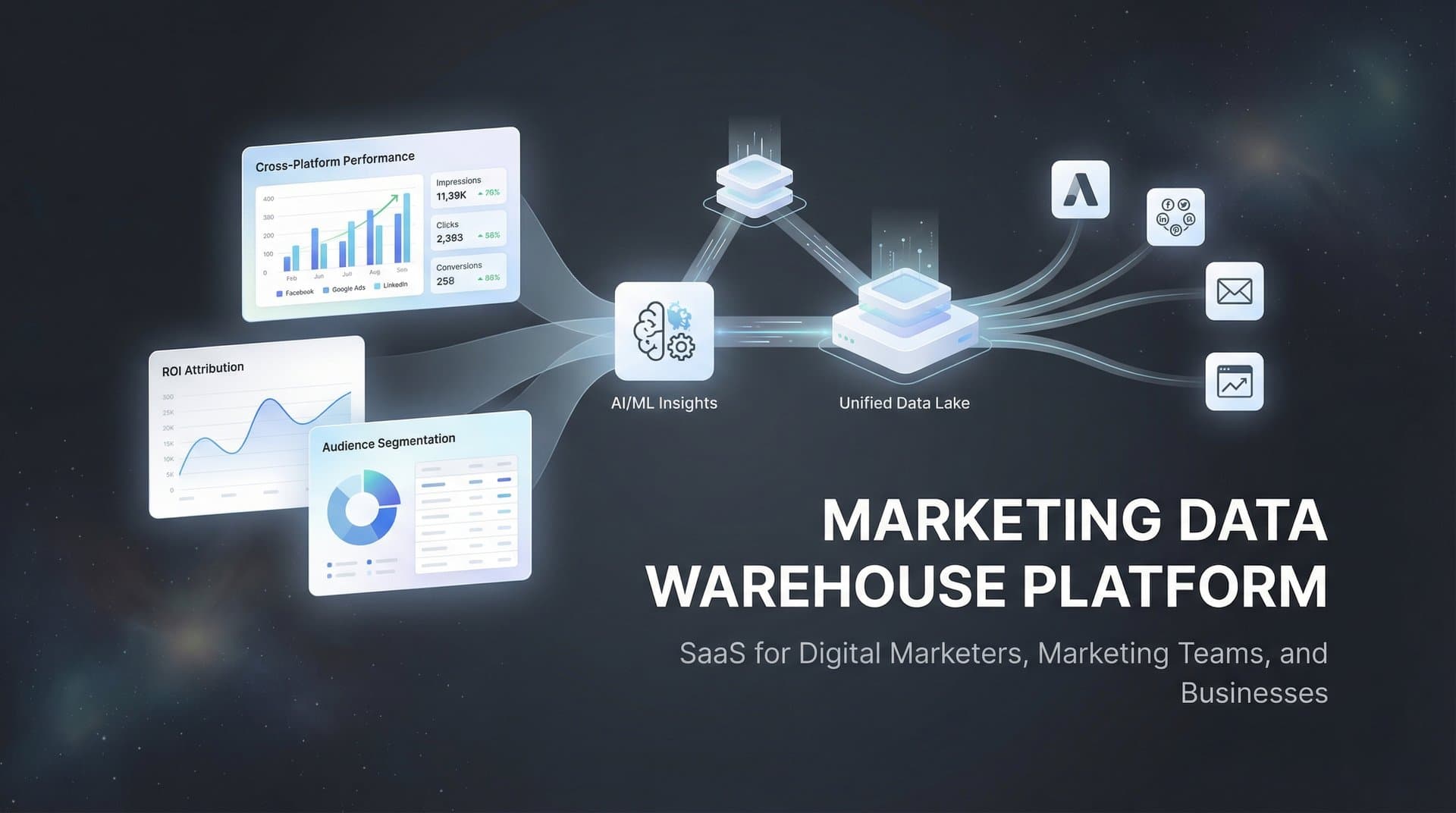
Marketing teams today generate data from dozens of sources: ad platforms, CRMs, email tools, website analytics, and more. Without a centralized place to store and analyze this data, you're left making decisions based on fragmented insights and incomplete attribution.
A marketing data warehouse platform solves this by consolidating all your marketing data into one queryable, analysis-ready location. This guide covers the top platforms for 2026, ranging from specialized marketing analytics tools to enterprise-grade data warehouses, helping you find the right fit for your team's technical capabilities and budget.
1. Cometly
Best for: Marketing teams who need attribution and data consolidation without technical complexity
Cometly is a marketing attribution platform that consolidates data from ad platforms, CRMs, and websites to track the complete customer journey and provide AI-powered optimization recommendations.
 9 Best Marketing Data Warehouse Platforms in 2026
Where This Tool Shines
Cometly stands out by combining data warehousing with built-in attribution analytics, eliminating the need for separate BI tools or custom dashboard development. The platform automatically collects data from all major ad platforms and enriches it with server-side tracking to overcome iOS limitations and tracking challenges that plague most marketing teams.
What makes Cometly particularly valuable is its AI-powered recommendations that analyze your consolidated data and suggest specific campaign optimizations. Rather than just storing data for you to analyze later, it actively identifies high-performing ads and channels, then feeds enriched conversion data back to ad platforms to improve their targeting algorithms.
Key Features
Automatic Data Collection: Connects to all major ad platforms, CRMs, and website analytics without manual setup or coding.
Server-Side Tracking: Captures accurate attribution data even when browser-based tracking fails due to iOS restrictions or ad blockers.
Multi-Touch Attribution: Tracks every customer touchpoint across the entire journey to show which channels actually drive conversions.
AI Recommendations: Analyzes campaign performance across all channels and provides specific optimization suggestions based on your data.
Conversion Sync: Sends enriched conversion events back to Meta, Google, and other ad platforms to improve their AI targeting and bidding.
Best For
Marketing teams and agencies running multi-channel paid campaigns who want accurate attribution without building custom data pipelines. Ideal for businesses spending $50,000+ monthly on ads across multiple platforms who need to understand cross-channel performance and feed better data to ad platform algorithms.
Pricing
Custom pricing based on ad spend volume. The platform scales with your business, making it accessible for mid-market teams while handling enterprise-level data volumes.
2. Snowflake
Best for: Enterprise organizations needing unlimited scalability and cross-cloud flexibility
Snowflake is an enterprise cloud data platform offering near-unlimited scalability, strong data sharing capabilities, and a broad ecosystem of marketing data connectors.
 9 Best Marketing Data Warehouse Platforms in 2026
Where This Tool Shines
Snowflake's architecture separates storage from compute, allowing you to scale each independently. This means you can store massive amounts of marketing data cost-effectively while only paying for compute power when you're actually running queries. For marketing teams dealing with years of historical campaign data, this design prevents storage costs from spiraling out of control.
The platform's data marketplace is particularly valuable for marketers who want to enrich their first-party data with third-party datasets. You can access pre-built marketing datasets, industry benchmarks, and demographic information without complex data transfer processes.
Key Features
Separation of Storage and Compute: Scale storage and processing power independently to optimize costs based on your actual usage patterns.
Data Marketplace: Access thousands of pre-built datasets to enrich your marketing data with industry benchmarks and third-party information.
Cross-Cloud Deployment: Run Snowflake on AWS, Azure, or Google Cloud, or replicate data across multiple clouds for redundancy.
Security and Governance: Enterprise-grade encryption, role-based access controls, and compliance certifications for handling sensitive customer data.
Semi-Structured Data Support: Native handling of JSON, Avro, and Parquet formats without complex transformations, ideal for API data from marketing platforms.
Best For
Large enterprises with dedicated data engineering teams who need maximum flexibility and scalability. Best suited for organizations managing petabytes of data across multiple business units who require sophisticated data sharing and governance capabilities.
Pricing
Pay-per-use model based on compute credits consumed and storage volume. Typical marketing teams can expect $2,000 to $10,000+ monthly depending on query frequency and data volume.
3. Google BigQuery
Best for: Teams heavily invested in Google's marketing and analytics ecosystem
Google BigQuery is a serverless, highly scalable data warehouse with native integrations to Google's marketing and analytics products.
 9 Best Marketing Data Warehouse Platforms in 2026
Where This Tool Shines
BigQuery's tight integration with Google Analytics 4 and Google Ads makes it the obvious choice for teams running significant Google campaigns. You can export raw GA4 data automatically and join it with Google Ads performance data without building custom connectors or dealing with API rate limits.
The serverless architecture means you never worry about infrastructure management or capacity planning. BigQuery automatically scales to handle massive queries, then scales back down when idle. This makes it particularly cost-effective for teams with variable analytical workloads who don't need dedicated database capacity running 24/7.
Key Features
Native Google Integrations: Direct data exports from Google Analytics 4, Google Ads, Campaign Manager, and other Google marketing products without third-party connectors.
Serverless Architecture: Automatic scaling handles queries of any size without manual infrastructure management or capacity planning.
Built-In Machine Learning: Create and train ML models directly in BigQuery using SQL, enabling predictive analytics without separate data science tools.
Real-Time Streaming: Insert data in real-time from websites, apps, and marketing platforms for up-to-the-second campaign analysis.
Generous Free Tier: 1TB of query processing and 10GB of storage free each month, making it accessible for smaller teams testing the platform.
Best For
Marketing teams running substantial Google Ads campaigns who want deep integration with Google's analytics products. Ideal for businesses with technical resources to write SQL queries but who don't want to manage database infrastructure.
Pricing
Pay-per-query model at $5 per TB of data processed, with a free tier covering 1TB monthly. Storage costs $0.02 per GB monthly. Flat-rate pricing available for predictable costs at higher volumes.
4. Amazon Redshift
Best for: Organizations already using AWS infrastructure who need complex analytical capabilities
Amazon Redshift is a fully managed data warehouse service optimized for complex analytical queries, with deep integration into the AWS ecosystem.
 9 Best Marketing Data Warehouse Platforms in 2026
Where This Tool Shines
Redshift excels when you're already running other services on AWS. The tight integration with AWS Glue for ETL, S3 for data storage, and Lambda for automation creates a complete data pipeline ecosystem. Marketing teams can build sophisticated workflows that automatically collect data from various sources, transform it, and load it into Redshift without leaving the AWS environment.
The platform's materialized views feature is particularly valuable for marketing dashboards that query the same data repeatedly. You can pre-compute common aggregations like campaign performance by channel or conversion rates by audience segment, dramatically speeding up dashboard load times.
Key Features
Redshift Serverless: Pay only for actual query time with automatic scaling, ideal for teams with variable analytical workloads.
AWS Glue Integration: Build automated ETL pipelines that extract data from marketing platforms, transform it, and load it into Redshift on schedules.
Materialized Views: Pre-compute common aggregations to speed up frequently-run marketing reports and dashboard queries.
Concurrency Scaling: Automatically add query processing power during peak usage times without manual intervention or performance degradation.
Federated Queries: Query data across Redshift, S3, and operational databases without moving data, enabling real-time analysis of fresh marketing data.
Best For
Marketing teams at organizations with existing AWS infrastructure and technical resources to manage data pipelines. Best suited for businesses running complex multi-step analytical workflows that benefit from tight AWS service integration.
Pricing
On-demand pricing starts at $0.25 per hour for small clusters. Reserved instances offer 75% discounts for predictable workloads. Serverless option charges based on compute capacity consumed, typically $1,000 to $5,000+ monthly for marketing teams.
5. Databricks
Best for: Teams combining marketing analytics with advanced machine learning and AI initiatives
Databricks is a unified analytics platform combining data warehousing with advanced machine learning capabilities on a lakehouse architecture.
 9 Best Marketing Data Warehouse Platforms in 2026
Where This Tool Shines
Databricks bridges the gap between traditional data warehousing and machine learning workflows. Marketing teams can store structured campaign data alongside unstructured data like ad creative images and customer support transcripts, then build ML models that analyze everything together. This is particularly powerful for teams developing predictive models for customer lifetime value or churn prediction.
The collaborative notebook environment lets data analysts, data scientists, and marketing analysts work together in the same platform. Marketers can explore campaign data using SQL while data scientists build ML models in Python, all accessing the same underlying datasets without data duplication or version control issues.
Key Features
Lakehouse Architecture: Store structured marketing data and unstructured content like ad creatives in one platform without separate databases.
MLflow Integration: Track machine learning experiments, deploy models, and monitor their performance directly within the platform.
Delta Lake: Reliable data storage with ACID transactions ensures your marketing data remains consistent even during complex transformations.
Collaborative Notebooks: Share analysis and code between team members with version control and commenting, enabling cross-functional collaboration.
Unity Catalog: Centralized data governance with fine-grained access controls to manage who can access sensitive customer and campaign data.
Best For
Marketing teams at data-driven companies who want to combine traditional analytics with machine learning initiatives. Ideal for businesses building predictive models for customer behavior, lifetime value forecasting, or automated campaign optimization.
Pricing
Pay-per-use based on Databricks Units (DBUs) consumed, which vary by compute type and cloud provider. Marketing teams typically spend $2,000 to $8,000+ monthly depending on analytical complexity and ML workloads.
6. Fivetran
Best for: Teams who need automated data pipelines without building custom integrations
Fivetran is an automated data integration platform with pre-built connectors that moves marketing data into your warehouse without coding.
 9 Best Marketing Data Warehouse Platforms in 2026
Where This Tool Shines
Fivetran eliminates the engineering work required to build and maintain data pipelines from marketing platforms. Instead of writing custom scripts to pull data from Facebook Ads, Google Ads, Salesforce, and dozens of other tools, you simply authenticate each platform and Fivetran handles the rest. The platform automatically detects schema changes when marketing platforms update their APIs, preventing broken pipelines.
The incremental syncing approach is particularly valuable for cost control. Fivetran only pulls new or changed data rather than re-downloading entire datasets on every sync. For marketing teams with years of historical campaign data, this dramatically reduces both sync times and data warehouse costs.
Key Features
300+ Pre-Built Connectors: Connect to all major marketing platforms, CRMs, and analytics tools without writing custom integration code.
Automatic Schema Migrations: Fivetran detects when source platforms change their data structure and updates your warehouse tables automatically.
Incremental Data Syncing: Pull only new or changed data to minimize sync times and warehouse storage costs.
dbt Integration: Transform raw marketing data into analysis-ready tables using dbt models that run automatically after each sync.
SOC 2 Type II Compliance: Enterprise-grade security and compliance certifications for handling sensitive customer and campaign data.
Best For
Marketing teams who have chosen a cloud data warehouse like Snowflake or BigQuery but lack the engineering resources to build custom data connectors. Ideal for organizations running 10+ marketing tools who need reliable, automated data pipelines.
Pricing
Based on monthly active rows synced across all connectors. Typical marketing teams pay $1,000 to $5,000+ monthly depending on data volume and number of connected platforms.
7. Segment
Best for: Teams prioritizing real-time customer data collection and identity resolution
Segment is a customer data platform that collects, cleans, and routes data from all customer touchpoints to your warehouse and marketing tools.
Where This Tool Shines
Segment's real-time data collection makes it uniquely valuable for marketing teams who need immediate access to customer behavior data. When a user completes a conversion on your website, Segment captures that event and routes it to your data warehouse, ad platforms, and analytics tools within seconds. This enables real-time personalization and immediate campaign optimization based on the freshest possible data.
The identity resolution capabilities solve one of marketing's biggest challenges: tracking users across devices and channels. Segment builds unified customer profiles that connect anonymous website visits with email interactions, mobile app usage, and CRM records, giving you a complete view of each customer's journey.
Key Features
Real-Time Data Collection: Capture customer interactions from websites, mobile apps, and servers, then route them to your warehouse and tools within seconds.
Identity Resolution: Automatically connect user activity across devices, channels, and platforms into unified customer profiles.
Privacy Controls: Manage consent preferences and data retention policies to comply with GDPR, CCPA, and other privacy regulations.
Protocols: Enforce data quality rules that validate events before they enter your warehouse, preventing bad data from polluting your analytics.
400+ Destination Integrations: Send collected data to your warehouse plus marketing tools, analytics platforms, and ad networks simultaneously.
Best For
Marketing teams at product-led companies who need real-time customer behavior data and unified user profiles across all touchpoints. Best suited for businesses with active mobile apps or web applications where user behavior drives marketing decisions.
Pricing
Free tier available for up to 1,000 monthly tracked users. Paid plans start around $120 monthly and scale based on the number of unique users tracked, with enterprise pricing for high-volume businesses.
8. Funnel.io
Best for: Marketing teams who want a specialized platform built specifically for advertising data
Funnel.io is a marketing data hub designed specifically for collecting, transforming, and storing data from advertising and marketing platforms.
Where This Tool Shines
Funnel.io understands the unique quirks of marketing data that general-purpose data warehouses don't handle well. The platform automatically normalizes metrics across different ad platforms, so "conversions" in Google Ads, "purchases" in Facebook Ads, and "leads" in LinkedIn Ads all map to consistent field names. This eliminates hours of manual data transformation work.
The built-in data storage option is particularly valuable for teams who want consolidated marketing data without managing their own warehouse infrastructure. You can start collecting data from all your ad platforms immediately, then export to a cloud warehouse later if your needs grow more complex.
Key Features
500+ Marketing Platform Connectors: Connect to virtually every advertising platform, analytics tool, and marketing automation system without custom development.
No-Code Transformation Rules: Normalize metric names, combine data from multiple sources, and apply business logic without writing SQL or Python.
Built-In Data Storage: Store your marketing data directly in Funnel.io without setting up a separate warehouse, with export options when needed.
Automatic Currency Conversion: Handle multi-currency campaigns with automatic conversion to your preferred currency using up-to-date exchange rates.
Data Quality Monitoring: Receive alerts when data stops flowing from connected platforms or when metrics show unexpected changes.
Best For
Marketing agencies and in-house teams managing campaigns across 20+ advertising platforms who need normalized data without technical complexity. Ideal for teams who want to start analyzing consolidated marketing data immediately without warehouse setup.
Pricing
Based on the number of data sources connected and data volume processed. Typical pricing ranges from $500 to $3,000+ monthly depending on the number of connected platforms and team size.
9. Supermetrics
Best for: Teams who want marketing data in spreadsheets and BI tools without warehouse complexity
Supermetrics is a data pipeline tool that pulls marketing data directly into spreadsheets, BI tools, and data warehouses without technical setup.
Where This Tool Shines
Supermetrics makes marketing data accessible to teams who aren't ready for full warehouse infrastructure. You can pull campaign performance data directly into Google Sheets or Excel, where most marketers already do their analysis. This eliminates the learning curve of SQL and BI tools, letting teams start analyzing cross-platform data immediately using familiar spreadsheet functions.
The scheduled refresh capability is particularly valuable for recurring reports. Set up your spreadsheet once with the metrics and dimensions you need, then Supermetrics automatically updates it daily or hourly. This transforms manual reporting processes that took hours into automated dashboards that update themselves.
Key Features
Direct Spreadsheet Exports: Pull marketing data directly into Google Sheets and Excel without intermediate databases or technical setup.
BI Tool Integrations: Connect to Looker Studio, Power BI, Tableau, and other visualization platforms for more sophisticated dashboards.
Scheduled Refreshes: Automate data updates on hourly, daily, or weekly schedules to keep reports current without manual work.
Custom Metrics: Create calculated fields and custom metrics within Supermetrics before data reaches your destination tool.
Data Blending: Combine data from multiple marketing platforms in a single query to create unified performance reports.
Best For
Small to mid-sized marketing teams who do most of their analysis in spreadsheets and aren't ready to invest in warehouse infrastructure. Ideal for agencies managing multiple client accounts who need quick access to cross-platform data without technical overhead.
Pricing
Starts at $39 monthly for basic connectors to Google Sheets. BI tool connectors and warehouse exports range from $99 to $399+ monthly per user depending on data sources and features needed.
Making the Right Choice
Choosing the right marketing data warehouse platform depends on your team's technical resources, data volume, and primary use case.
For teams focused on marketing attribution and ad optimization, Cometly offers the fastest path to actionable insights without requiring a dedicated data engineering team. The platform combines data collection, storage, and attribution analytics in one place, with AI recommendations that actively help you improve campaign performance rather than just storing data for later analysis.
Enterprise organizations with complex data needs and dedicated engineering teams may prefer Snowflake or BigQuery for their scalability and flexibility. These platforms give you complete control over data structure and analysis but require technical expertise to set up and maintain.
Mid-market teams often find success combining Fivetran or Funnel.io with a cloud warehouse for automated data pipelines. This approach provides the reliability of enterprise-grade warehouses while eliminating the engineering work of building custom connectors. If you're already invested in Google's ecosystem, BigQuery's native integrations make it the obvious choice.
For teams not ready for full warehouse infrastructure, Supermetrics or Funnel.io's built-in storage options let you start consolidating marketing data immediately using familiar tools like spreadsheets and BI platforms.
Whatever you choose, the goal remains the same: getting all your marketing data into one place where you can actually use it to make better decisions. The right platform should reduce the time you spend collecting and cleaning data while increasing the time you spend analyzing it and optimizing campaigns.
Ready to elevate your marketing game with precision and confidence? Discover how Cometly's AI-driven recommendations can transform your ad strategy. Get your free demo today and start capturing every touchpoint to maximize your conversions.


