Measuring a marketing campaign’s effectiveness isn’t something you figure out after the fact. It starts by defining exactly what a “win” looks like before you spend a single dollar. This means getting way more specific than vague goals like "more traffic." We're talking about setting concrete targets tied to real business outcomes, like hitting a specific Return on Ad Spend (ROAS) or staying under a certain Customer Acquisition Cost (CAC).
Without this foundation, you’re just collecting data for the sake of it.
Defining What Success Looks Like for Your Campaign
Jumping into a campaign without clear goals is like starting a road trip with no destination in mind. Sure, you'll burn fuel and cover some ground, but you'll have no idea if you're actually getting anywhere. Real measurement begins with a solid framework that connects every marketing action back to a tangible business objective.
It’s a simple concept, but a surprising number of businesses skip this step. In fact, nearly 47% of businesses are operating without a formal digital marketing strategy. Even for those who do measure, the focus is often on conversion rates, which just reinforces how critical it is to align every effort with outcomes that actually matter to the bottom line.
From Broad Ambitions to Concrete KPIs
The real work is translating big-picture business goals into measurable Key Performance Indicators (KPIs). "Boost brand awareness" sounds great in a meeting, but you can't measure it directly. To make it actionable, you have to break it down into things you can actually count.
For that brand awareness campaign, your KPIs might be:
- Reach: The total number of unique people who see your content.
- Impressions: The total number of times your content is displayed.
- Share of Voice (SOV): Your brand's visibility compared to your competitors.
- Engagement Rate: The percentage of people who interact with your content (likes, comments, shares).
This translation process gives every piece of data a purpose. You’re no longer just counting clicks; you're tracking real progress toward a strategic goal. For a deeper dive, check out our guide with more marketing KPI examples to help you define your metrics.
To make this clearer, let's map out how different business goals translate into actionable KPIs for various campaign types.
Translating Business Goals into Actionable Marketing KPIs
This table breaks down how to turn common business objectives into specific, measurable marketing KPIs for different campaigns.
Business GoalCampaign TypePrimary KPISecondary KPIsIncrease RevenueE-commerce SalesReturn on Ad Spend (ROAS)Conversion Rate, AOV, Cost Per PurchaseGenerate LeadsB2B Lead GenCost Per MQLMQL to SQL Rate, Form Conversion RateBoost Brand AwarenessTop-of-Funnel ContentReach & ImpressionsEngagement Rate, Video View Rate, SOVDrive Product TrialsSaaS Free TrialCost Per Trial Sign-UpSign-Up to Paid Conversion Rate
As you can see, the "right" KPI is entirely dependent on what you're trying to achieve and how your business makes money.
Real-World Scenarios and Goal Setting
Let’s see how this plays out in the real world for a couple of different business models.
A direct-to-consumer (DTC) e-commerce brand launching a new product might set a primary goal of hitting a 3.5x Return on Ad Spend (ROAS). For them, success isn't just about sales volume; it's about profitable sales volume. Their secondary KPIs would naturally be Conversion Rate, Average Order Value (AOV), and Cost Per Purchase.
Now, contrast that with a B2B SaaS company running a lead generation campaign. Their finish line looks completely different. Their main goal might be to generate 200 Marketing Qualified Leads (MQLs) in a quarter, keeping the Cost Per Lead (CPL) under $150. Here, success is all about the quality and cost-efficiency of the leads they hand over to the sales team, not immediate revenue.
Key Takeaway: Your business model dictates your primary success metrics. An e-commerce brand lives and dies by ROAS, while a SaaS business is intensely focused on the cost and quality of its lead pipeline.
By setting these clear, model-specific goals upfront, you create a powerful filter for all your data. When you’re looking at campaign performance, you can instantly see which ads, channels, and audiences are actually moving the needle on your core objective—and which are just making noise. This is the first, most critical step to measuring your marketing effectively.
Building Your Measurement and Attribution Tech Stack
Once you have your goals and KPIs locked in, it's time to build the tech stack that actually tracks everything. This isn't just about collecting data for the sake of it. You're creating a bulletproof system that captures every important customer touchpoint and ties it directly back to your marketing spend.
This is the foundation that turns a spreadsheet full of raw numbers into a clear picture of what’s actually working.
To get this right, you first need to understand how your data moves from place to place. This helpful practical guide to data pipelines breaks down how information travels from its source (like your ad platforms) to a destination for analysis. That's exactly what we're doing here—making sure the data from your website and ad accounts is collected cleanly and consistently.
It all starts with installing tracking codes on your website, often called pixels or tags. These little snippets of code are the bedrock of digital measurement. They fire every time a user takes a specific action, like viewing a product, adding it to their cart, or making a purchase.
This visual shows how you can connect a high-level goal all the way down to the specific metrics you’ll measure.
 Measuring Marketing Campaign Effectiveness
This process ensures that every metric you track is directly tied to a meaningful business objective, which is the entire point of setting up your tech stack in the first place.
Choosing Your Marketing Attribution Model
With tracking in place, the next question is a big one: how do you give credit for conversions? This is where marketing attribution models come into play. An attribution model is just a set of rules that decides how credit for a sale gets assigned to the various touchpoints a customer interacted with.
Picking the right model is critical because it directly shapes how you see campaign performance.
- First-Touch Attribution: Gives 100% of the credit to the very first ad or link a customer ever clicked. It’s great for figuring out which channels are driving initial awareness.
- Last-Touch Attribution: The opposite of first-touch. It gives all the credit to the final click before a conversion. This highlights what closes the deal but often ignores all the marketing that got them there.
- Linear Attribution: This model spreads credit out evenly across every single touchpoint in the journey. It gives you a more balanced view but might not accurately show the true influence of each interaction.
- Data-Driven Attribution: This is the most advanced model. It uses machine learning to analyze all your conversion paths and assigns credit based on the actual impact of each touchpoint. It's the most accurate but requires a lot of data and sophisticated tools.
Key Takeaway: There is no single "best" attribution model. The right choice depends on your business model and how complex your customer journey is. A B2B company with a long sales cycle might lean toward a linear model, while a DTC brand focused on quick sales might start with last-touch.
Unifying Your Data for a Single Source of Truth
The modern customer journey is a mess. The average person uses 6.7 social media platforms every month. They might see your ad on Instagram, click a link on LinkedIn, and then do a Google search before finally buying. This cross-channel chaos makes accurate measurement nearly impossible if your data is stuck in different silos.
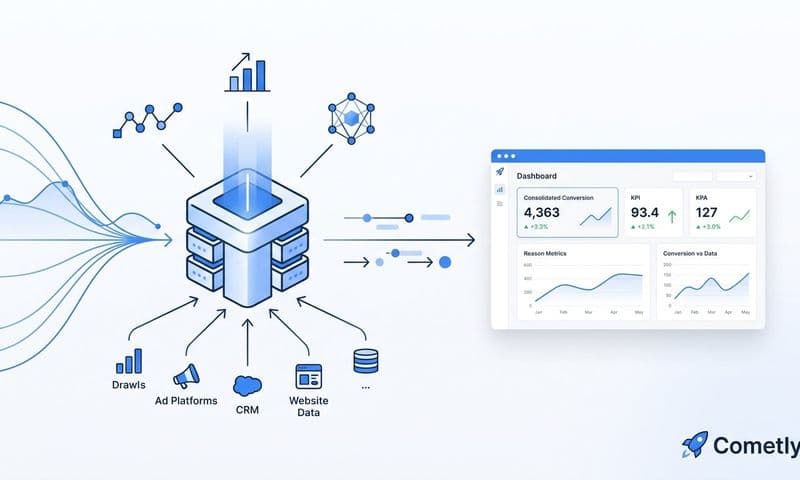
This is where a unified marketing analytics platform becomes a non-negotiable. Instead of trying to patch together reports from Facebook Ads, Google Analytics, and your CRM, a centralized platform pulls it all into one clean view.
Tools like Cometly solve this exact problem by integrating data from all your ad sources. Using its own powerful tracking, Cometly becomes your single source of truth, giving you an accurate, de-duplicated picture of your performance. This kills the frustrating discrepancies you see between platforms, letting you confidently measure what each channel is truly delivering.
If you're weighing your options, our guide on choosing a marketing analytics platform can help you sort through the noise. This unified approach is how you finally move from guessing to knowing what drives growth.
How to Ensure Your Marketing Data Is Accurate
Even with the best goals and a perfect tech stack, your efforts are wasted if the data flowing through it is flawed. Inaccurate data leads to poor decisions, wasted ad spend, and a complete misunderstanding of what’s truly driving results.
This is one of the most common hurdles I see marketers face, but it's also one you can absolutely overcome.
"Garbage in, garbage out" isn’t just a cliché; it’s a budget-killer.
 Measuring Marketing Campaign Effectiveness
The challenge of data integrity has only gotten tougher. You’ve probably seen the frustrating discrepancies yourself—Facebook Ads Manager reports 50 purchases, while Google Analytics only shows 35. This signal loss, amplified by privacy changes like Apple’s iOS 14 update, means client-side tracking (which relies on a user's browser) is becoming less reliable every day.
This gap forces you to question every metric and makes confident optimization nearly impossible.
Spotting Common Data Contamination Issues
Before you can fix your data, you have to know what to look for. Inaccurate reporting often comes from a few common culprits that can quietly inflate your results and mislead your entire strategy.
Keep an eye out for these red flags:
- Duplicate Conversions: This happens when a user reloads a "thank you" page or a tracking pixel fires multiple times, counting a single purchase as two or three. It makes your ROAS look amazing, but it’s completely artificial.
- Cross-Domain Tracking Errors: If your customer journey spans multiple domains (e.g., from your main site to a separate checkout platform like Shopify), an improper setup can cause the original traffic source to be lost. This misattributes sales to "direct" or "referral" traffic.
- Bot Traffic: Automated bots can click on your ads and visit your site, creating junk data that skews metrics like click-through rates and session durations without ever leading to a real conversion.
Regularly auditing your analytics for weird anomalies is your first line of defense. For example, if you see a sudden, inexplicable spike in conversions from a single location with a 100% bounce rate, you’re likely dealing with bot traffic, not a surge in customer interest.
Key Takeaway: Don't automatically trust the numbers you see in ad platforms. Always cross-reference data sources and investigate anomalies. A healthy dose of skepticism is your best defense against making decisions based on bad data.
The Shift to Server-Side Tracking
To fight back against signal loss and improve accuracy, the industry is moving toward a more robust solution: server-side tracking. Instead of relying on a user's browser to send data, this method sends conversion information directly from your server to ad platforms like Meta and Google.
This approach neatly bypasses many of the issues caused by ad blockers and browser privacy settings. By using a Conversions API (CAPI), you create a more stable and reliable data connection. For a detailed breakdown of this tech, you can explore the fundamentals of server-side tracking and how it improves data accuracy.
This is precisely where a tool like Cometly becomes so powerful. It doesn't just pull data from other platforms; it establishes its own first-party tracking system. By acting as the central, unbiased referee, Cometly creates a single source of truth that you can rely on.
It de-duplicates conversions across all channels and ensures that every dollar of spend is attributed correctly, restoring the confidence you need to optimize and scale effectively.
Turning Raw Data into Actionable Insights
Collecting accurate data is a huge win, but let's be honest—it's only half the battle. A spreadsheet brimming with numbers isn't going to tell you what to do next. The real magic happens when you transform that raw data into a clear story about your campaign's performance, turning metrics into momentum.
This is where a lot of marketers get stuck. In fact, a staggering 87% of marketers feel that data is the most underutilized asset in their companies. That's a massive gap between having information and actually using it to make smart decisions.
The goal is to move beyond simply reporting what happened and start explaining why it happened—and what you should do about it.
 Measuring Marketing Campaign Effectiveness
Building an Effective Marketing Dashboard
Your first stop in any analysis should be a dashboard that visualizes your most important KPIs. A good dashboard isn't a data dump; it’s a curated view designed to answer your most pressing questions at a glance. It should immediately show you trends, flag anything that looks off, and highlight opportunities you might otherwise miss.
To be truly useful, your dashboard has to be tailored to your campaign goals. An e-commerce brand will want ROAS, Cost Per Purchase, and Average Order Value front and center. A B2B lead generation campaign, on the other hand, would prioritize metrics like Cost Per Lead, MQLs, and Lead-to-Close Conversion Rate.
If you're looking to build this out, our guide on creating actionable data frameworks offers some practical steps to connect your metrics directly to business objectives.
To help you get started, here are some of the most critical metrics to include in a performance dashboard.
Essential Metrics for a Campaign Performance Dashboard
Your dashboard should provide a high-level overview while still allowing you to dig into the details. The table below breaks down some core metrics, what they mean, and why they matter for measuring campaign effectiveness.
Metric | Definition | What It Measures |
|---|---|---|
Return on Ad Spend (ROAS) | Total revenue generated for every dollar spent on advertising | Direct profitability of advertising campaigns |
Cost Per Acquisition (CPA) | Average cost to acquire one new customer from a campaign or channel | Efficiency of campaigns in driving customer conversions |
Customer Acquisition Cost (CAC) | Total marketing and sales cost required to acquire a customer over a period | Overall cost effectiveness of the customer acquisition strategy |
Customer Lifetime Value (LTV) | Total net profit expected from a customer across the full relationship | Long term value and profitability of the customer base |
Conversion Rate (CVR) | Percentage of users who complete a desired action such as a purchase or form submission | Effectiveness of ads, landing pages, and offers |
Click Through Rate (CTR) | Percentage of ad viewers who click on the ad | Relevance and persuasiveness of ad creative and messaging |
Having these metrics clearly visible helps you quickly assess campaign health and make informed decisions without getting lost in the weeds.
Key Takeaway: Your dashboard should tell a story in five seconds or less. If you have to spend ten minutes hunting for a key metric, it isn't doing its job. Focus on clarity and simplicity over cramming in every possible data point.
Platforms like Cometly simplify this by providing pre-built, customizable dashboards that pull all your most important metrics into one place. This saves you from the headache of manually exporting data from multiple ad platforms and trying to stitch it all together in a spreadsheet.
Calculating Your True Customer Acquisition Cost
One of the most critical insights you can pull from your data is your Customer Acquisition Cost (CAC). This tells you exactly how much you're spending, on average, to bring a new customer through the door. While ad platforms give you a Cost Per Purchase, a true CAC calculation is much more holistic.
To get the real number, you need to add up all your marketing and sales expenses over a specific period and divide that by the number of new customers you acquired in that same timeframe.
The CAC Formula:(Total Marketing Spend + Total Sales Spend) / Number of New Customers Acquired = CAC
For example, if you spent $8,000 on marketing and $2,000 on sales commissions last month and brought in 100 new customers, your CAC would be $100. This number is the ultimate benchmark for profitability.
Connecting CAC to Lifetime Value
Knowing your CAC is powerful, but it becomes truly game-changing when you compare it to your Customer Lifetime Value (LTV). LTV is the total revenue you can reasonably expect from a single customer over the course of their entire relationship with your brand.
The LTV to CAC ratio is the golden metric for sustainable growth. It tells you how much value you're generating for every dollar you spend acquiring a customer. A healthy ratio is generally considered to be 3:1 or higher—meaning a customer's lifetime value is at least three times what you paid to get them.
- If your LTV:CAC is 1:1: You're losing money on every new customer once you factor in other business costs.
- If your LTV:CAC is 3:1: You've built a solid, profitable marketing engine.
- If your LTV:CAC is 5:1 or higher: You're likely underinvesting in marketing and have room to grow more aggressively.
This kind of analysis is what measuring marketing campaign effectiveness is all about. It shifts the conversation from short-term ad performance to long-term business health, empowering you to make much smarter decisions about where to put your budget for sustainable growth.
Using Your Insights to Optimize and Maximize ROI
Collecting and analyzing data is crucial, but it’s just the setup for what really matters: turning those insights into action. This is where you close the loop—using what you’ve learned to actively sharpen performance, boost efficiency, and maximize your return on investment (ROI).
The goal is to build a dynamic feedback system where data directly informs your next move. Every dollar you spend should be an educated decision, not a shot in the dark. This is how you shift from being a passive observer of metrics to an active driver of growth.
Making Confident Budget Reallocation Decisions
One of the most powerful things you can do with good data is reallocate your budget on the fly. Armed with accurate, unified numbers, you can confidently pull spend from campaigns, ad sets, or creatives that are dragging you down and double down on what’s clearly working.
But this isn’t just about killing the losers and feeding the winners. It takes a more nuanced understanding of your metrics.
For example, you might have an ad set with a high Cost Per Click (CPC) that you'd normally pause. But what if your data shows it has an exceptionally high conversion rate and brings in high-value customers? Without a clear view, you might cut an ad that's actually one of your most profitable.
A unified platform like Cometly gives you that clarity. It connects ad spend directly to revenue and LTV, so you can make those tough calls with complete confidence.
Knowing When and How to Scale Your Winners
Identifying a winning ad is a thrill, but scaling it the wrong way can kill its momentum. Just pouring more money into a successful ad too quickly often backfires, leading to ad fatigue and diminishing returns.
Instead, take a more strategic approach.
- Vertical Scaling: Start by gradually increasing the budget of the winning ad set itself. A good rule of thumb is to raise it by 15-20% every 48-72 hours, but only as long as performance holds steady. This keeps you from shocking the platform's algorithm.
- Horizontal Scaling: Next, duplicate the successful ad set and start targeting new, similar audiences. This could mean expanding to lookalike audiences with different percentages (e.g., from 1% to 3%) or targeting new interest groups that share traits with your proven converters.
Key Takeaway: Scaling is a controlled experiment, not a floodgate. Use your data to guide incremental budget increases and careful audience expansion, always keeping an eye on your core KPIs like ROAS and CPA to ensure profitability remains stable as you grow.
The ability to optimize your ad spend is a core skill for any performance marketer. To build on these concepts, check out our complete guide on how to optimize marketing spend for better results.
Designing A/B Tests That Actually Improve Performance
Continuous optimization is fueled by a steady stream of A/B tests. But effective testing is more than just changing a button color; it’s about creating a structured process to learn what makes your audience tick and systematically improve your results.
The key is to test one variable at a time. This gives you clean, actionable data.
- Creative: Test wildly different concepts first. Think a static image versus a user-generated video. Only after you find a winning concept should you start testing minor variations like background colors.
- Copy: Test different hooks in your headline or the core value proposition in your main text. Do your customers care more about saving time or saving money? Your test results will tell you.
- Offers: Test different incentives. Does a 20% discount outperform a "Buy One, Get One Free" deal, even if the dollar value is similar?
By methodically testing these elements, you build a library of insights about what truly resonates. Every test—win or lose—provides valuable data that makes your next campaign that much smarter.
The Role of AI in Proactive Optimization
The optimization game is getting a lot more sophisticated, thanks to artificial intelligence. By 2025, 88% of marketers report using AI in some form, with 83% noting increased efficiency. AI-powered platforms are shifting campaign optimization from a reactive chore to a proactive strategy by spotting trends and opportunities in real time.
For advanced optimization, explore how to leverage AI Predictive Analytics to Boost Ad ROI. These tools can analyze thousands of data points to forecast which creative combinations or audience segments are most likely to pop, helping you make smarter decisions, faster.
Platforms like Cometly are already baking this intelligence right into the dashboard. Instead of manually digging through reports to find gold, you get automated recommendations on where to scale spend or which ads are showing signs of fatigue. This powerful feedback loop is the final piece of the puzzle for not just measuring, but truly improving, your marketing effectiveness.
Answering Your Top Questions About Campaign Measurement
Even with a solid framework, you're bound to run into specific questions when you're in the trenches measuring your marketing. Getting the details right is what separates marketers who just collect data from those who use it to drive real, predictable growth.
Let's tackle some of the most common questions that pop up.
How Often Should I Be Checking My Campaigns?
This is a classic "it depends" scenario, but there's a simple principle to follow: match your review frequency to your optimization speed.
For fast-paced paid channels like Meta or Google Ads, you absolutely need to be checking in daily, or at the very least, a few times a week. These platforms are real-time auctions. A bad ad can torch your budget in a weekend if you're not paying attention. Frequent check-ins let you make quick adjustments—killing a weak creative, reallocating spend to a winning ad set, or tweaking a bid strategy before things go sideways.
On the flip side, for long-game strategies like SEO or organic content, a monthly review is far more practical. These channels build momentum slowly, so daily fluctuations are usually just noise. Looking at the data monthly or even quarterly helps you spot meaningful trends in organic traffic, keyword rankings, and lead quality without overreacting to a random down day.
The goal is to find a rhythm that lets you act on significant changes without making knee-jerk decisions based on normal, day-to-day data volatility.
What’s the Single Most Important Metric to Track?
Everyone asks this, but it’s a bit of a trick question. There is no single "most important" metric that applies to every campaign, ever. The real most important KPI is always the one that’s tied directly to your primary campaign goal. Trying to optimize for everything at once is a surefire way to achieve nothing.
Instead, think in terms of a metric hierarchy.
- Running an e-commerce store? Return On Ad Spend (ROAS) is your north star. It’s a direct measure of profitability.
- Driving B2B leads? Your focus should be on Cost Per Lead (CPL) or, even better, Customer Acquisition Cost (CAC).
- Launching a brand awareness push? Softer metrics like Reach, Impressions, and Engagement Rate become your main focus.
The best practice is to pick one primary KPI that tells you, unequivocally, if you're winning or losing. Then, back that up with a few secondary KPIs that give you context and help you figure out why things are happening. For instance, if your ROAS (primary KPI) is tanking, a quick look at your Click-Through Rate and Conversion Rate (secondary KPIs) can tell you whether the problem is your ad creative or your landing page.
How Do I Even Begin to Measure Offline Marketing?
Measuring offline campaigns—think print, radio, or direct mail—just requires a little creativity to build a bridge to your digital world. Your goal is to give people a clear, trackable path to follow.
Some of the most effective ways to do this include:
- Unique URLs or QR Codes: Use a vanity URL (like
yoursite.com/podcast) or a QR code that's exclusive to that specific ad. - Dedicated Phone Numbers: Set up a unique, trackable phone number for each offline channel to see where calls are coming from.
- Exclusive Discount Codes: Offer a promo code that’s only available in that specific ad (e.g., "PRINT20").
Another great technique is to look for correlation. Analyze spikes in your direct website traffic or branded search queries that line up with your campaign’s flight dates and geographic focus. By layering this data, you can build a pretty convincing directional case for the impact your offline efforts are having on your digital results.
Ready to stop guessing and start knowing exactly what drives your growth? Cometly provides a single source of truth, unifying all your marketing data to deliver accurate attribution and actionable insights. See how Cometly can help you maximize your ROI today.