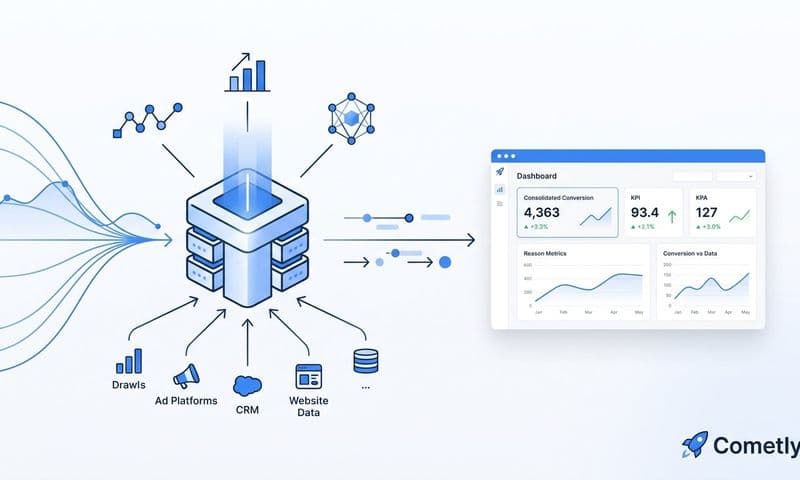
Measuring your marketing effectiveness is all about figuring out what’s actually working. It’s about looking past the vanity metrics and understanding how your campaigns are impacting the bottom line—sales, revenue, and real business growth. This isn't just about creating reports; it's about making smarter, data-backed decisions that let you optimize your ad spend and prove marketing’s value to the rest of the company.
Why Old Marketing Metrics No Longer Work
 Measuring Marketing Effectiveness a Modern Guide
If you're finding it tough to prove your marketing is actually working, you're not alone. The simple days of pointing to impressions or relying on last-click attribution are long gone. Today’s customer journey is a tangled mess, spread across a dozen different channels and devices. Trying to connect a single ad click to a final purchase with those old-school methods is next to impossible.
And if that wasn't hard enough, the entire landscape of data privacy has shifted under our feet. The slow death of third-party cookies and new platform rules, like Apple's App Tracking Transparency (ATT), have completely shattered the traditional tracking models we used to depend on. The once-clear path from an ad to a sale is now foggy, leaving a lot of marketers feeling like they’re flying blind.
The Challenge of Siloed Data
Another huge headache is the sheer number of marketing tools we all use. Each one spits out its own set of data. Your social media platform gives you one number, your ad network another, and your CRM has its own version of the truth. This creates "data silos," where no single tool has the full story. Trying to piece it all together by hand is not just a massive time sink—it’s a recipe for disaster.
This disconnected mess is the root of so many common marketing frustrations:
- Inaccurate ROI calculations: You can't confidently calculate your Return on Ad Spend (ROAS) if you're just guessing which campaigns drove which sales.
- Wasted ad spend: Without a clear picture, you’re likely pouring money into channels that look busy but aren’t actually bringing in profitable customers.
- Difficulty proving value: When your boss asks for hard proof of marketing's contribution, showing them a bunch of conflicting spreadsheets is a weak, unconvincing answer.
The core problem is that our old measurement tools were built for a much simpler marketing world. They just can't keep up with the messy, non-linear paths customers take today, and they certainly weren't designed for the new privacy-first internet.
Shifting Toward a Modern Framework
To get ahead, marketers need to adopt a more resilient, holistic way of measuring performance. This means breaking the dependency on unreliable third-party data and building a strategy around information you own. It all starts with understanding the power of first-party data, which lets you build a far more accurate and sustainable measurement system. The idea is to bring different methodologies—like multi-touch attribution and marketing mix modeling—together into one unified source of truth.
The goal here is to build a system that finally brings some clarity to the chaos. It’s about creating a comprehensive view that not only validates the struggles you're facing but also gives you a clear path forward with solutions that actually work in today’s marketing reality.
Defining Marketing KPIs That Drive Business Growth
To get a real handle on your marketing effectiveness, you first have to define what success actually looks like for your business. This is about moving past the fluff—those "vanity metrics" like impressions and page views—and homing in on Key Performance Indicators (KPIs) that directly impact the bottom line.
Without that clarity, you're just swimming in a sea of data that doesn't tell you what’s actually working.
The secret is connecting your marketing activities to tangible business outcomes. If your company's main goal is to boost profitability, then your headline marketing KPI shouldn't be website traffic. It should be Customer Lifetime Value (CLV) or Return on Ad Spend (ROAS). This simple alignment ensures every marketing dollar is aimed at driving real value.
Tying Metrics to Your Business Model
The right KPIs are completely dependent on your business model. What’s critical for a B2B SaaS company is going to be worlds apart from what an e-commerce brand should be obsessing over.
Let's break down a couple of scenarios.
For an e-commerce store selling subscription boxes, the game is all about long-term, recurring revenue. In this case, their measurement dashboard should be built around:
- Customer Lifetime Value (CLV): This is their North Star. It tells them the total revenue a single customer is expected to generate over their entire relationship with the brand.
- Customer Acquisition Cost (CAC): How much does it cost to get that valuable customer in the door? The CLV-to-CAC ratio is the lifeblood of sustainable growth.
- Repeat Purchase Rate: This metric shows how well they're retaining customers and building loyalty beyond that first box.
Now, a B2B SaaS company is playing a totally different game. They’re navigating a much longer, more complex sales cycle, and their job is to guide prospects through a deep consideration process.
For them, the money metrics would include:
- Marketing Qualified Lead (MQL) to Sales Qualified Lead (SQL) Conversion Rate: This is huge. It measures the quality of leads marketing is handing over to sales. A low rate here screams misalignment.
- Cost Per Lead (CPL): While important, this needs context. A cheap lead that never converts isn't a bargain; it's a waste of time and resources.
- Sales Cycle Length: Great marketing should actually shorten the time it takes to close a deal by educating and nurturing leads more effectively before they even talk to sales.
Building a Focused KPI Dashboard
Once you've locked in your core business objectives, you can build a tiered KPI dashboard that gives you clarity without causing data overload. The trick is to structure it from high-level business goals down to specific channel metrics. This creates a clear line of sight from a daily campaign tweak all the way up to overall company performance.
You can find more comprehensive marketing KPI examples to help build a dashboard that fits your unique business needs like a glove.
Thinking this way has a proven link to financial outcomes. Nielsen’s research found that a single-point improvement in brand metrics like awareness can lead to a 1% increase in sales. On the flip side, brands that hit pause on their advertising can lose an average of 2% of future revenue each quarter. That really highlights the measurable, long-term impact of sustained marketing.
The goal isn't to track every metric under the sun. It's to select the vital few that offer a clear, unfiltered view of your marketing's impact on business growth. A cluttered dashboard is just as useless as no dashboard at all.
To help you connect the dots between your high-level goals and the nitty-gritty metrics, I've put together a quick mapping table. This framework can help you visualize how a broad business objective translates into specific marketing actions and KPIs.
Mapping Business Goals to Marketing KPIs
Business Goal | Primary Marketing KPI | Secondary Marketing Metric | Example Tactic |
|---|---|---|---|
Increase Market Share | Share of Voice (SOV) | Brand mentions and website traffic | Launch a competitive brand awareness campaign on social media |
Boost Profitability | Return on Ad Spend (ROAS) | Customer acquisition cost | Optimize ad creatives and targeting to reduce cost per conversion |
Improve Customer Retention | Customer lifetime value | Churn rate and repeat purchase rate | Implement an email nurture sequence for existing customers |
Generate Qualified Leads | MQL to SQL conversion rate | Cost per lead | Create a gated whitepaper targeted at decision makers |
This table is a starting point. Your own version will get more granular, but it illustrates how every marketing KPI should ladder up to a core business objective. This ensures your team stays focused on what truly matters: growth.
Speaking of which, it's crucial to understand why some traditional metrics can be misleading. For instance, it's worth knowing why Share of Voice measurement is broken and how you can adapt it for more accurate insights. Picking the right KPIs means focusing on metrics that truly reflect market position and revenue impact, not just vanity stats that look good on a slide.
Choosing the Right Marketing Attribution Model
Once you've locked in your KPIs, the next big question is always the same: "Which of our marketing efforts are actually driving these results?"
This is where attribution modeling comes into play. It’s the framework you use to give credit to the different touchpoints a customer interacts with on their way to making a purchase.
Without a solid attribution model, you're basically guessing where to put your budget. You might be pouring money into a flashy social media campaign that generates likes but no sales, while underfunding a simple email sequence that’s quietly converting customers left and right. Good attribution isn't a nice-to-have; it's the key to understanding what's truly effective.
Moving Beyond Simplistic Models
For years, many marketers got by with basic, single-touch models. They're straightforward, sure, but they’re also incredibly misleading because they completely oversimplify a complex customer journey.
- First-Touch Attribution: This one gives 100% of the credit to the very first interaction someone had with your brand. It’s helpful for knowing what initially grabs attention, but it ignores every single touchpoint that came after.
- Last-Touch Attribution: On the flip side, this model gives all the credit to the final touchpoint before a conversion. It tells you what closes the deal, but it dismisses all the crucial brand-building and nurturing that happened earlier.
Relying on these models is like giving all the credit for a championship win to either the player who scored the first basket or the one who scored the last. It completely overlooks the teamwork, the assists, and all the defensive plays that made the victory possible.
To really understand performance, you need a more complete view. That’s where more advanced, multi-touch approaches come in, giving you a much richer and more accurate picture of what's working. If you want to dive deeper into these concepts, check out our comprehensive guide to attribution models.
The Two Pillars of Modern Attribution
Today, two powerful methodologies really dominate the conversation: Multi-Touch Attribution (MTA) and Marketing Mix Modeling (MMM). They tackle the problem from completely different angles, and knowing which one to use depends on your business.
Multi-Touch Attribution (MTA) is a bottom-up approach. It digs into individual user-level data, tracking a customer's digital journey touchpoint by touchpoint—from the first ad they saw to the last email they opened. MTA is fantastic for getting granular, real-time insights that help with day-to-day tactical optimization. You can see exactly which ads or keywords are performing best and tweak your strategy on the fly.
Marketing Mix Modeling (MMM), on the other hand, is a top-down approach. Instead of tracking individuals, MMM uses aggregated data to see how various marketing and non-marketing factors impact sales over a longer period. This includes everything from TV ad spend and digital campaigns to external factors like seasonality, economic trends, and what your competitors are doing.
MTA is like looking at your marketing through a microscope, giving you a detailed view of individual components. MMM is like looking through a telescope, giving you the big picture of how all the pieces fit together in the broader market.
How to Choose the Right Model
Deciding between MTA and MMM isn't about picking a winner; it's about choosing the right tool for the job. Your decision should really come down to your business model, your channel mix, and the data you have available.
Factor | Multi Touch Attribution (MTA) | Marketing Mix Modeling (MMM) |
|---|---|---|
Focus | Granular, user level digital customer paths | High level, strategic marketing impact |
Data Used | Digital touchpoints such as clicks, opens, and views | Aggregated sales and marketing data plus external factors |
Channels | Best suited for digital channels like search, social, and email | Covers both online and offline channels including TV and radio |
Speed | Real time or near real time insights | Slower cadence, typically quarterly or annually |
Use Case | Tactical campaign optimization and in flight decision making | Strategic budget allocation and long term forecasting |
Let's make this practical. A digital-first e-commerce brand that lives and breathes paid social and search ads would get immense value from MTA. It would let them optimize ad creative and targeting in real-time to squeeze every last drop out of their ROAS.
Now, think about a massive consumer packaged goods company with a huge budget in TV, print, and in-store promotions. They would lean heavily on MMM. It’s the only way for them to understand how their offline advertising is impacting overall sales—something MTA simply can't capture.
One of the biggest shifts we're seeing in marketing measurement is the comeback of MMM. It was popular before the digital boom, and now it's becoming the "new gold standard" as data privacy changes make traditional tracking harder. It helps marketers understand broad market forces and provides a durable solution in a privacy-first world.
Ultimately, the most sophisticated companies don't choose one over the other. They build a unified measurement framework that combines the strategic, big-picture insights of MMM with the tactical, granular data from MTA. This hybrid approach gives you the power to make smart high-level budget decisions and optimize your daily campaigns with total confidence.
How to Build a Unified Measurement Framework
Once you’ve locked in your KPIs and picked your attribution models, the real work begins. It's time to stop looking at them as separate tools and start building a single, cohesive system that actually tells you what’s going on. Relying on just one methodology is like trying to navigate with only a sliver of the map—you get a skewed, incomplete picture.
A truly effective measurement strategy requires a unified framework. It’s about combining different approaches to give you both the 10,000-foot view and the nitty-gritty details you need to make smart decisions.
This integrated approach is the only way to break down the data silos that plague so many marketing teams. When your Marketing Mix Model (MMM) lives in one department and your Multi-Touch Attribution (MTA) data lives in another, you're flying blind. A unified framework brings these powerful tools together, creating a single source of truth for your entire marketing organization.
Introducing Unified Marketing Measurement
The fix for all this fragmentation is what the industry calls Unified Marketing Measurement (UMM). Don't worry, this isn't just another buzzword. It's a strategic way of looking at measurement that blends top-down and bottom-up analyses to create a truly comprehensive view of your performance. It's about getting all your different models to talk to each other so you get the best of all worlds.
A solid unified framework usually brings together three key pieces:
- Marketing Mix Modeling (MMM): This gives you the high-level, strategic view. It shows how your total marketing budget impacts sales and even factors in offline channels and external market forces.
- Multi-Touch Attribution (MTA): This is your tactical tool. It delivers the granular, user-level data you need for day-to-day optimization of your digital channels.
- Incrementality Testing: Think of this as your validation layer. It uses controlled experiments (like lift tests) to prove the true causal impact of your marketing efforts.
You can see how attribution has evolved over the years, moving from simple, siloed views to this more integrated approach.
 Measuring Marketing Effectiveness a Modern Guide
This progression makes it clear: measurement has matured. We've moved beyond giving all the credit to a single touchpoint and are now embracing a more holistic, multi-faceted view.
Centralizing Your Marketing Data
The first practical step toward a unified framework? Get all your data in one place. You can't connect the dots if your data points are scattered across a dozen different platforms that don't speak the same language. This is where a powerful attribution platform becomes absolutely essential.
For example, a platform like Cometly is built to pull data from all your critical sources—ad platforms like Facebook and Google, your CRM, and your e-commerce store—into one centralized dashboard. An effective marketing data integration strategy is the foundation your entire measurement framework rests on. Without it, you’ll always be stuck with a fragmented, unreliable view of performance.
Having this consolidated view allows you to finally see how different channels interact and influence each other, moving you lightyears beyond siloed, misleading channel reports.
The real power of a unified framework comes from using different models for different decisions. Use your MMM insights to set your quarterly budgets, then use your MTA data to optimize your ad campaigns week-to-week.
Putting Incrementality to the Test
The final piece of this puzzle is incrementality testing. While attribution models are great at showing correlation, incrementality testing is what proves causation. It answers the million-dollar question: "Did this ad actually cause the sale, or would that customer have converted anyway?"
Running lift tests is a practical way to get this answer. You can serve an ad to a test group while withholding it from a statistically similar control group. By comparing the conversion rates between the two, you can measure the true "lift" your ad provided.
Let's say you're running a retargeting campaign on Facebook. Your MTA model is telling you it’s contributing to a ton of conversions. Great. But are these users who were already on their way to buy, or is the ad genuinely pushing them over the finish line?
A lift test might reveal that 80% of those conversions would have happened anyway. This doesn't mean the campaign is useless—it might be accelerating purchases—but it tells you the incremental value is far lower than your attribution model suggested. You can then use this insight to dial back your retargeting budget and invest more in channels driving truly new customers.
This holistic approach is becoming crucial for modern marketers. By combining the strategic foresight of MMM, the tactical agility of MTA, and the causal proof of incrementality testing, you build a resilient and incredibly powerful system for measuring marketing effectiveness that drives real, sustainable business growth.
Turning Marketing Data into Actionable Insights
 Measuring Marketing Effectiveness a Modern Guide
Collecting data and building sophisticated models are only half the battle. Let's be honest: a dashboard full of charts is useless if it doesn't lead to action.
The real value in measuring marketing effectiveness comes from translating those numbers into smart, strategic decisions. It’s all about creating a continuous feedback loop where your measurement directly fuels and improves your marketing strategy.
This means moving beyond simply reporting on what happened last month. It's about digging into the "why" behind the numbers and using those insights to confidently adjust your budget, refine your messaging, and optimize your entire marketing mix.
From Reporting to Strategic Analysis
The first real step is to shift your team's mindset from passive reporting to active analysis. Instead of just presenting the latest ROAS figures, you need to be asking probing questions that connect data points to real-world outcomes.
This is what transforms your measurement reports from historical documents into forward-looking strategic tools. The whole point of this analytical process is to identify meaningful trends, anomalies, and opportunities hidden within your data. It's about seeing the story the numbers are trying to tell you.
For instance, you might notice that a key channel’s ROI has been slowly declining for three consecutive weeks.
- A reporting mindset says: "Facebook ROI is down 15%."
- An analytical mindset asks: "Is this dip due to ad fatigue, a change in audience targeting, or increased competition? Let's check our creative performance and auction insights."
This subtle shift is what separates teams that just track metrics from teams that actively improve them. Creating a culture of curiosity around your data is foundational.
Building and Using Effective Dashboards
A well-designed dashboard is your command center for turning data into insights. The problem is, many dashboards become cluttered data dumps that cause more confusion than clarity. A truly effective dashboard should be built around your specific KPIs and tailored to its audience.
Your executive team doesn't need to see click-through rates for every ad variation. They need a high-level view of key business drivers like Customer Acquisition Cost (CAC) and Customer Lifetime Value (CLV). Your channel managers, on the other hand, need that granular, day-to-day data to make tactical optimizations.
A great dashboard doesn't just display data; it answers critical business questions at a glance. It should immediately tell you if you're on track to hit your goals and highlight any areas that need immediate attention.
To make your data truly useful, you need to turn it into a narrative. For a deeper dive into this, our guide on transforming raw numbers into actionable data provides a framework for telling compelling stories with your analytics.
Real-World Scenarios and Responses
Let’s explore how this works in practice with a few common scenarios. The key is to have a pre-planned response framework so you can act decisively when your data points to a problem or an opportunity.
- Your Top Channel’s ROI DeclinesYour multi-touch attribution model shows that your most reliable paid search campaign is losing steam. Instead of panicking, you dive deeper. You discover that while your conversion rate is stable, your Cost Per Click (CPC) has spiked 30% over the past month. The insight? New, aggressive competitors have entered the auction.
- Action: You reallocate a portion of the budget to test emerging, less-saturated channels your competitors haven't discovered yet. You also refine your long-tail keyword strategy to find less competitive, high-intent search terms.
- Attribution Data Reveals a Hidden HeroYour last-touch model has always credited branded search for most of your conversions. But your new linear attribution model reveals that your top-of-funnel podcast sponsorships are consistently the first touchpoint for your highest-value customers.
- Action: You confidently double down on your podcast ad spend, knowing it's a critical part of the customer journey. You also present this data to leadership to make a strong business case for increasing your brand awareness budget.
- Attribution is all about assigning credit. It looks back at a customer’s journey and divides up the credit for a sale among the various touchpoints that got them there. It answers the question, "Which channels helped make this sale happen?"
- Incrementality, on the other hand, is about measuring true impact. It digs deeper to determine if a marketing activity was the actual cause of a conversion, or if that sale would have happened anyway. It answers the question, "Did our ad cause this sale?"
By connecting specific data points to concrete actions, you create a powerful cycle of continuous improvement. This data-driven approach removes guesswork from your strategy and allows you to adapt quickly to changing market dynamics, ensuring every dollar you spend is working as hard as possible to grow your business.
Your Marketing Measurement Questions, Answered
Even with a solid framework in hand, you're bound to run into questions when you get down to the nitty-gritty of measuring your marketing. That’s totally normal.
Let's walk through some of the most common hurdles and points of confusion I see marketers face. The goal here is to give you clear, practical answers so you can move forward with confidence.
How Can Small Businesses Start Measuring Without a Big Budget?
If you’re a small business, the last thing you need is pressure to buy a pricey, complex analytics platform. The key is to start lean. Focus on the foundational tools—many of which are free—and build a solid measurement habit from day one.
First things first, get Google Analytics 4 set up. It's your baseline for tracking website traffic, user behavior, and conversions. Next, and this is non-negotiable, get into the habit of using UTM parameters for every single link in your campaigns. This simple practice is the only way to know for sure where your traffic is coming from.
Also, don't sleep on the built-in analytics inside your social media platforms. And for attribution? A simple last-click model inside Google Analytics is a perfectly fine place to begin.
The goal is consistency over complexity. Master one or two core metrics, like Cost Per Lead or Conversion Rate, before you get overwhelmed trying to track everything. As you grow, you can strategically invest in more advanced tools.
What Is the Difference Between Attribution and Incrementality?
This is a big one, and it’s a common point of confusion. But getting this right is crucial for anyone who wants to move into more advanced measurement. Attribution and incrementality answer two very different—but equally important—questions.
Think of it like this: attribution helps you optimize your marketing mix by showing you which channels play well together. Incrementality, which is often measured through lift tests, proves the true, bottom-line value of those channels.
How Often Should I Review My Measurement Strategy?
Your measurement strategy should never be a "set it and forget it" document. It needs to be a living, breathing part of your marketing operations. That said, how often you review it really depends on the metric and its purpose. A tiered approach works best.
High-level, strategic insights from something like a Marketing Mix Model (MMM) might only need a quarterly or semi-annual review to help guide long-term budget decisions. But your tactical, in-the-weeds metrics—channel performance, campaign results—demand much more frequent attention. Think weekly or bi-weekly check-ins to make timely optimizations.
As for your overall framework, including your choice of KPIs and attribution models, you should revisit it at least once a year. It's also smart to reassess whenever there's a big shift in your business strategy, like a new product launch or a major market event like a new privacy update. For readers who want a complete overview and answers to common performance questions, you can explore a clear guide on how to measure advertising effectiveness.
Ready to unify your marketing data and get crystal-clear attribution? Cometly provides a single source of truth, connecting every touchpoint to actual revenue. See how Cometly can help you optimize your ad spend and prove your marketing ROI today.