You're running campaigns across Meta, Google, TikTok, and maybe three other platforms. Traffic is flowing. Leads are coming in. But somewhere between that first click and the final purchase, you're losing people—and you can't quite figure out where or why.
Sound familiar?
Most marketers know their funnel has leaks. The challenge isn't knowing there's a problem—it's pinpointing exactly where prospects drop off and which touchpoints actually drive conversions. You're collecting data from multiple sources, but it's fragmented. Your ad platform shows one story, Google Analytics tells another, and your CRM has its own version of events.
The result? You're making optimization decisions based on incomplete information. Budget gets allocated to channels that look good on paper but don't actually convert. High-performing touchpoints get overlooked because they don't get credit in last-click attribution. And your funnel continues underperforming its potential while you're left guessing what to fix first.
This guide walks you through a systematic, six-step process for using analytics to identify funnel weaknesses, understand what's actually driving revenue, and make data-backed optimizations that improve conversion rates at every stage. Whether you're dealing with a top-of-funnel awareness problem or a bottom-of-funnel conversion issue, you'll learn how to diagnose the problem and fix it with confidence.
Let's get specific about what's broken—and how to fix it.
Step 1: Map Your Current Funnel and Define Stage-Specific Metrics
Before you can optimize anything, you need to know what you're working with. This means documenting every touchpoint in your customer journey—from the moment someone sees your ad to the moment they become a paying customer.
Start by listing every stage of your funnel. For most businesses, this looks something like: Awareness → Consideration → Decision → Conversion. But your funnel might have more nuance. Maybe you have a demo stage. Maybe there's a trial period. Maybe prospects need to engage with multiple pieces of content before they're ready to buy.
Whatever your funnel looks like, write it down. Be specific about what happens at each stage.
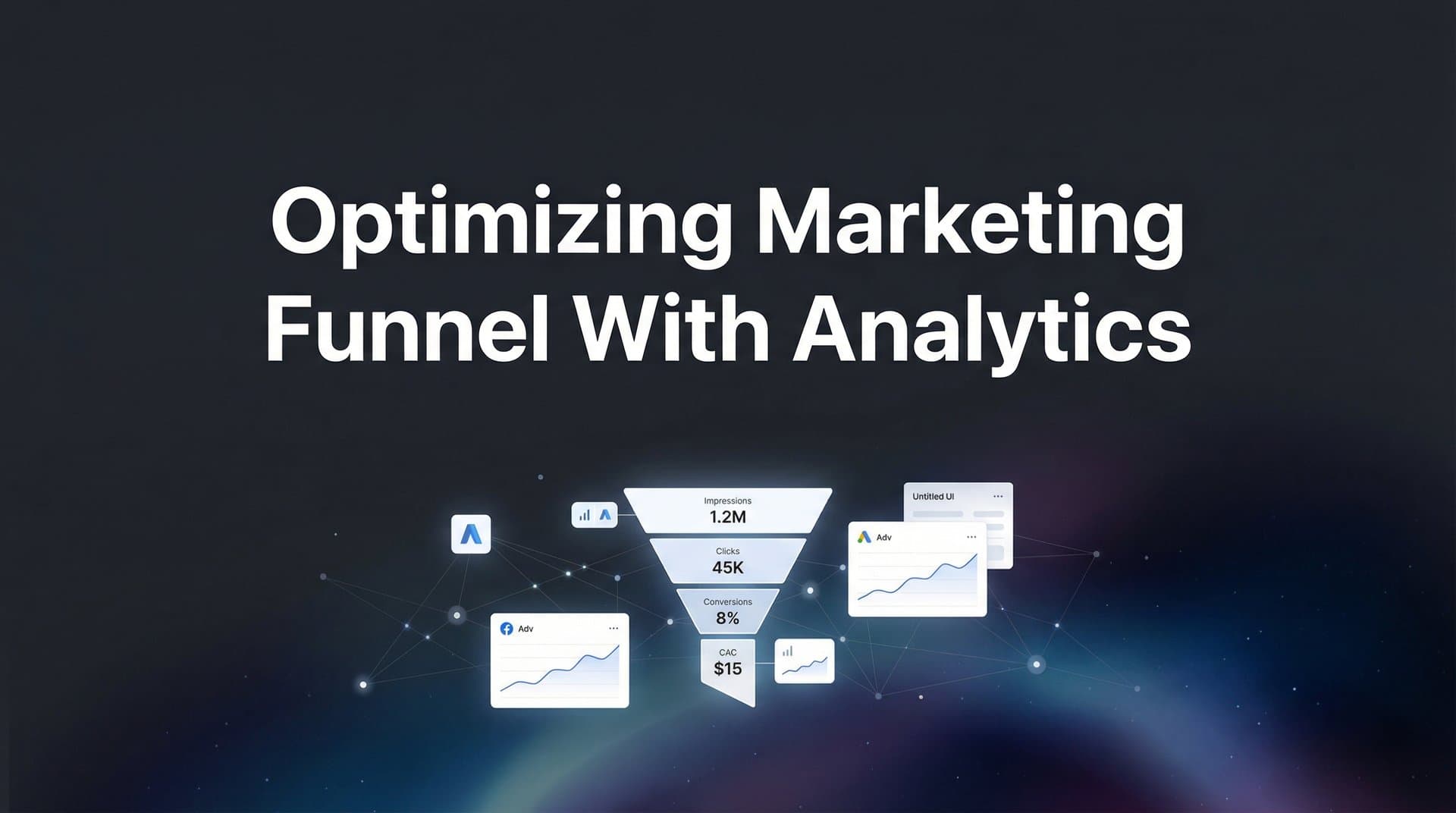
Next, assign metrics to each stage. This is where many marketers go wrong—they track vanity metrics that don't actually indicate progress toward revenue. At the awareness stage, impressions and reach matter. At consideration, you're looking at engagement rates, click-through rates, and time on site. At the decision stage, leads, demo requests, and trial sign-ups become your focus. At conversion, it's all about customers acquired and revenue generated. Understanding marketing funnel analytics is essential for getting this right.
Here's the critical part: identify your tracking gaps. Where are you losing visibility? Can you trace a customer from their first ad impression all the way to closed deal? Most marketers can't. They might know someone clicked an ad and later became a customer, but the journey in between is a black box.
Common tracking gaps include:
Cross-device tracking: Someone clicks your ad on mobile but converts on desktop—do you know that's the same person?
Offline conversions: A prospect fills out a form, then closes the deal over the phone two weeks later—is that conversion attributed correctly?
Multi-platform journeys: Someone discovers you on TikTok, researches on Google, and converts through a Facebook retargeting ad—which channel gets credit?
Document these gaps. You can't fix what you can't see, and this exercise often reveals blind spots you didn't know existed.
Success indicator: You should end this step with a visual funnel map that shows every stage, the primary metrics for each stage, and a clear list of where your tracking currently breaks down. If you can draw this on a whiteboard and explain it to someone else, you're ready to move forward.
Step 2: Connect Your Data Sources for Complete Journey Visibility
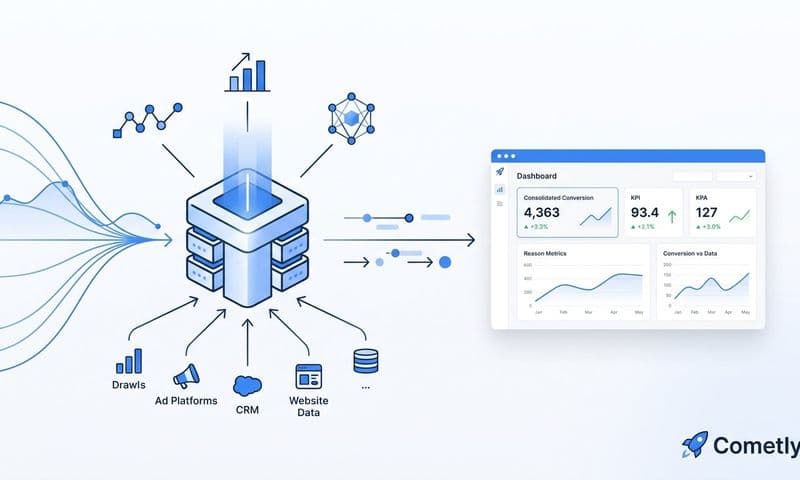
Now that you know where your tracking gaps are, it's time to fix them. This means integrating your ad platforms, website analytics, and CRM into a unified system that gives you complete visibility across the entire customer journey.
Most marketers rely on client-side tracking—pixels and cookies that fire when someone visits a page. This approach worked fine five years ago. Today, it's increasingly unreliable. Browser privacy features block cookies. iOS updates prevent cross-app tracking. Ad blockers strip out pixels. You're losing data before it even reaches your analytics platform.
Server-side tracking solves this problem by capturing data directly from your server, bypassing browser restrictions. When someone completes an action on your site, your server sends that information directly to your analytics platform and ad networks. No pixel required. No cookie dependency. No data loss from privacy features.
Setting up server-side tracking requires some technical work, but the data accuracy improvement is worth it. You'll capture conversions you were previously missing, which means better attribution and more informed optimization decisions. This is a critical component of data analytics in digital marketing.
Beyond tracking infrastructure, you need to ensure your data sources are actually talking to each other. Your ad platforms need to know when someone converts. Your CRM needs to receive lead source information. Your analytics platform needs to connect website behavior to revenue outcomes.
This integration work isn't glamorous, but it's foundational. Without it, you're optimizing based on partial information—and partial information leads to misguided decisions.
Think of it like trying to navigate with a map that's missing half the roads. You might eventually get where you're going, but you'll take wrong turns, waste time, and miss better routes entirely.
Success indicator: You should be able to pull up a single dashboard and trace a customer's complete journey from first touchpoint to closed deal. If you can see every ad they clicked, every page they visited, every form they filled out, and every email they opened—all in one place—your data sources are properly connected.
Step 3: Identify Your Biggest Drop-Off Points with Conversion Analysis
With your funnel mapped and your data connected, you can finally see where people are actually dropping off. This is where optimization opportunities become obvious.
Start by calculating conversion rates between each funnel stage. What percentage of people who become aware of your brand move to the consideration stage? What percentage of considerers become leads? What percentage of leads become customers?
Write these numbers down. They're your baseline—the starting point you'll measure future improvements against.
Next, compare your conversion rates to industry benchmarks. If your consideration-to-lead conversion rate is 2% and the industry average is 5%, you've found a problem area. If your lead-to-customer rate is 30% and the average is 15%, that stage is performing well—focus your optimization efforts elsewhere.
But don't stop at overall conversion rates. Segment your data by channel, audience, and campaign. You'll often find that your funnel performs very differently depending on how people entered it.
For example, you might discover that prospects from Google Ads convert at 8% while prospects from Facebook convert at 3%. That's valuable information. It might mean your Google targeting is more precise. It might mean your Facebook creative is attracting the wrong audience. It might mean prospects who search for you are further along in their buying journey than those who discover you through social media.
Dig deeper into high-performing and low-performing segments. What makes them different? Are certain ad creatives driving better-quality leads? Are specific landing pages converting at higher rates? Are particular audience segments moving through your funnel faster? Tracking the right marketing analytics metrics helps you answer these questions with confidence.
Create a prioritized list of optimization opportunities based on two factors: the size of the drop-off and the volume of traffic affected. A 50% drop-off that affects 10,000 monthly visitors is a bigger priority than a 70% drop-off that affects 500 visitors.
Success indicator: You should have a clear, prioritized list of funnel stages ranked by optimization opportunity. You know exactly where the biggest leaks are, which segments are underperforming, and where small improvements would have the biggest impact on overall conversion rates.
Step 4: Diagnose Why Prospects Are Dropping Off
Knowing where people drop off is useful. Understanding why they drop off is what enables you to fix it.
Start by analyzing time-to-conversion at each stage. Are prospects moving through your funnel quickly, or are they stalling? If someone typically takes two days to move from awareness to consideration but three weeks to move from consideration to decision, that decision stage needs attention.
Long conversion times often indicate friction. Maybe your pricing isn't clear. Maybe prospects need more information before they're ready to commit. Maybe your sales process is too complex or slow to respond.
Next, review the content and messaging alignment between stages. This is where many funnels break down. Your ad promises one thing, your landing page says something slightly different, and your follow-up email introduces yet another angle. Prospects get confused, lose trust, or simply don't see a consistent reason to move forward. Understanding content marketing analytics can help you identify these messaging disconnects.
Walk through your funnel as if you're a prospect. Does each stage logically lead to the next? Does the messaging stay consistent? Are you answering the questions prospects have at each stage, or are you jumping ahead to information they're not ready for yet?
Look for technical friction points that create unnecessary barriers. Common culprits include slow page load times, complex forms that ask for too much information too soon, unclear calls-to-action, and confusing navigation. Sometimes the problem isn't your offer or your messaging—it's simply that you're making it harder than necessary for people to take the next step.
Run a simple test: how many clicks does it take to go from landing on your site to completing a conversion action? Every additional click is an opportunity for someone to change their mind and leave.
Check your mobile experience separately. Many marketers optimize for desktop and forget that a significant portion of traffic comes from mobile devices. If your forms are difficult to fill out on a phone, or your pages load slowly on mobile connections, you're losing conversions you should be getting.
Success indicator: You should have specific, testable hypotheses for why prospects are dropping off at each major funnel stage. Not vague guesses like "the landing page isn't good enough," but concrete observations like "the form asks for 8 fields when we only need 3" or "the ad promises a free guide but the landing page leads with a demo request."
Step 5: Implement Targeted Optimizations Based on Attribution Insights
Now comes the part where you actually fix things. But here's where most marketers go wrong: they optimize based on last-click attribution, which gives all the credit to the final touchpoint before conversion. This leads to misguided decisions.
Someone might see your Facebook ad three times, click a Google search ad, read two blog posts, download a resource, and then convert through a retargeting ad. Last-click attribution gives all the credit to that retargeting ad. But was that really the only touchpoint that mattered? Or did all those earlier interactions play a role in moving that person toward conversion? Navigating the attribution challenges in marketing analytics is crucial for accurate optimization.
Multi-touch attribution solves this problem by distributing credit across all the touchpoints that influenced a conversion. This gives you a much more accurate picture of what's actually working in your funnel.
Use this attribution data to inform your optimizations. If your analysis shows that prospects who engage with educational content convert at higher rates, create more educational content. If video ads consistently appear early in high-value customer journeys, allocate more budget to video. If prospects who visit your pricing page are 3x more likely to convert, make that pricing page easier to find.
Reallocate budget toward high-performing touchpoints—not just high-performing channels. There's a difference. A channel might look mediocre overall but perform exceptionally well at a specific funnel stage. Facebook might not drive many direct conversions, but if it's consistently the first touchpoint in your highest-value customer journeys, it deserves budget. Learning how to leverage analytics for marketing strategy helps you make these nuanced budget decisions.
Create stage-specific content that addresses the friction points you identified in Step 4. If prospects are dropping off because they don't understand your pricing model, create a clear pricing explainer. If they're hesitating because they're not sure your solution will work for their specific use case, create case studies that address common scenarios.
Test your optimizations individually. Change one thing at a time so you can measure the impact accurately. If you redesign your landing page, simplify your form, and change your ad creative all at once, you won't know which change actually improved performance.
Success indicator: You should have a documented optimization plan with specific changes for each funnel stage, clear hypotheses about why each change will improve performance, and a testing schedule that allows you to measure impact before moving to the next optimization.
Step 6: Set Up Continuous Monitoring and Feedback Loops
Funnel optimization isn't a one-time project—it's an ongoing process. Markets change. Competitors adjust their strategies. Ad platforms update their algorithms. What works today might not work next month.
Build dashboards that track stage-by-stage conversion rates in real time. You need visibility into how your funnel is performing right now, not how it performed last week. A multi-channel marketing analytics dashboard gives you this unified view across all your platforms. Set up automated alerts that notify you when conversion rates drop significantly, so you can investigate and respond quickly rather than discovering problems weeks later when they've already cost you revenue.
Establish a regular review cadence. Weekly is ideal for most businesses. Look at your funnel metrics, identify any unexpected changes, and dig into what's causing them. Did a conversion rate suddenly drop? Check for technical issues, ad disapprovals, or changes in traffic sources. Did a conversion rate improve? Figure out what drove that improvement so you can replicate it.
Here's where things get really powerful: feed your conversion data back to your ad platforms. When you send enriched conversion data to Meta, Google, and other networks, their machine learning algorithms get better at identifying and targeting people who are likely to convert. This creates a virtuous cycle—better data leads to better targeting, which leads to better results, which generates more conversion data to feed back into the system.
Many marketers don't realize that the quality of data they send to ad platforms directly impacts campaign performance. If you're only sending basic conversion events without additional context, the platform's algorithm is working with incomplete information. But if you're sending detailed conversion data—including revenue value, customer lifetime value indicators, and which specific actions led to conversion—the algorithm can optimize much more effectively. The power of AI marketing analytics becomes fully realized when you feed these systems quality data.
This feedback loop is especially important as privacy changes continue to limit the data ad platforms can collect on their own. By sending server-side conversion data directly, you're giving these platforms the information they need to maintain targeting accuracy despite browser and OS restrictions.
Success indicator: You have real-time dashboards that show current funnel performance, automated alerts that catch problems early, and a consistent review process that turns insights into action. Your ad platforms are receiving enriched conversion data that improves their targeting algorithms, creating a continuous improvement cycle.
Putting It All Together
Let's recap the framework: Map your funnel stages with specific metrics → Connect all data sources for complete visibility → Identify drop-off points through conversion analysis → Diagnose root causes of friction → Implement attribution-informed optimizations → Monitor continuously and feed data back to ad platforms.
The marketers who consistently outperform aren't guessing. They're not making decisions based on gut feel or incomplete data. They're using complete, accurate analytics to make every funnel optimization decision with confidence. Mastering how to use data analytics in marketing separates top performers from the rest.
Start with Step 1 today. Map your current funnel and define your stage-specific metrics. You'll likely discover tracking gaps you didn't know existed—and that visibility alone often reveals quick wins worth pursuing immediately.
Remember: optimization is systematic. Diagnose before prescribing. Test changes individually. Measure impact before moving to the next optimization. This disciplined approach might feel slower than making sweeping changes all at once, but it's actually faster—because you're not wasting time on changes that don't work.
The difference between a good funnel and a great funnel often comes down to visibility. When you can see exactly where prospects drop off, why they're dropping off, and which touchpoints influence their decision to convert, optimization becomes straightforward. You're no longer guessing what to fix—you're responding to clear signals in your data.
Ready to elevate your marketing game with precision and confidence? Discover how Cometly's AI-driven recommendations can transform your ad strategy—Get your free demo today and start capturing every touchpoint to maximize your conversions.