The iOS 14 update fundamentally changed Facebook advertising by limiting tracking capabilities and disrupting attribution data. Many marketers saw their reported conversions drop significantly overnight, not because campaigns stopped working, but because tracking became fragmented.
The challenge now isn't just running effective ads—it's accurately measuring what's actually driving results.
This guide covers eight battle-tested strategies that successful advertisers are using to adapt their Facebook campaigns, recover attribution accuracy, and scale profitably in this new privacy-first landscape. Each strategy addresses a specific gap created by iOS 14's App Tracking Transparency framework, giving you practical steps to implement immediately.
1. Implement Server-Side Tracking with Facebook Conversions API
The Challenge It Solves
Browser-based tracking through the Facebook Pixel faces significant limitations when users opt out of tracking via iOS 14's App Tracking Transparency prompt. Industry reports indicate opt-in rates typically range from 15-25% depending on app category, meaning the vast majority of iOS users are invisible to traditional pixel tracking.
This creates a massive blind spot in your conversion data. Facebook's algorithm can't optimize what it can't see, leading to underreported conversions and inefficient ad delivery.
The Strategy Explained
The Facebook Conversions API (CAPI) sends conversion events directly from your server to Facebook, completely bypassing browser-based tracking limitations. When a conversion happens on your website or in your CRM, your server communicates this information to Facebook through a secure, server-to-server connection.
This approach isn't affected by ad blockers, browser restrictions, or tracking opt-outs. You're capturing conversion data at the source—your own systems—and sharing it with Facebook in a privacy-compliant way.
The most powerful implementation combines both Pixel and CAPI in what Facebook calls "redundant events." When both sources report the same conversion, Facebook deduplicates them automatically while gaining higher data quality and reliability.
Implementation Steps
1. Set up server-side infrastructure to capture conversion events from your website, checkout system, or CRM before they're sent to Facebook's API endpoint.
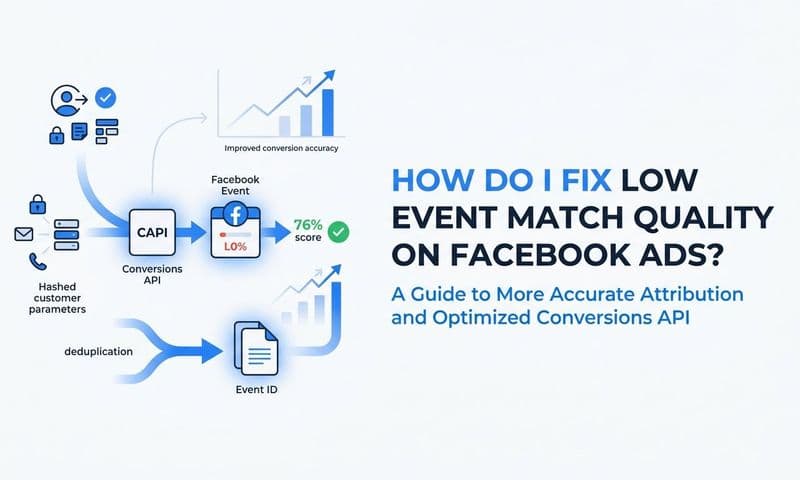
2. Configure event matching parameters including email, phone, IP address, and user agent to help Facebook match server events with user profiles while maintaining privacy standards.
3. Implement event deduplication by passing identical event IDs through both Pixel and CAPI so Facebook can recognize when both sources report the same conversion.
4. Test your implementation using Facebook's Events Manager Test Events tool to verify server events are firing correctly and matching with pixel events.
5. Monitor the Event Match Quality score in Events Manager and improve it by passing additional matching parameters like hashed email addresses when available.
Pro Tips
Pass as many customer information parameters as possible to improve event matching quality—higher match quality means better attribution and optimization. Focus on implementing CAPI for your highest-value conversion events first, particularly purchases and qualified leads. Don't disable your Pixel when implementing CAPI; the combination of both provides the most complete data picture.
2. Consolidate Campaigns to Feed the Algorithm Better Data
The Challenge It Solves
Facebook's machine learning algorithm needs sufficient conversion volume to optimize effectively. Meta recommends advertisers achieve at least 50 conversion events per ad set per week for optimal performance.
Post-iOS 14, many advertisers struggle to reach this threshold because fragmented tracking means fewer reported conversions. When you're running multiple ad sets targeting narrow audiences, each individual ad set might only see a handful of conversions weekly—nowhere near enough for the algorithm to learn effectively.
The Strategy Explained
Campaign consolidation means restructuring your account to concentrate conversion events into fewer, broader campaigns and ad sets. Instead of running ten ad sets with five conversions each per week, you run two ad sets with 25 conversions each.
This gives Facebook's algorithm the data volume it needs to identify patterns and optimize delivery. Broader targeting combined with consolidated structure allows the machine learning system to find your customers more efficiently than manually segmented audiences ever could.
Think of it like this: you're trading granular control for algorithmic efficiency. The algorithm can now see enough conversions to understand what works, rather than making decisions based on statistically insignificant data sets.
Implementation Steps
1. Audit your current campaign structure and identify ad sets receiving fewer than 50 conversion events per week based on your attribution reporting.
2. Combine similar audiences into broader ad sets—for example, merge separate interest-based audiences into one ad set with multiple interests or switch to broad targeting entirely.
3. Reduce the number of active campaigns by consolidating offers or products that appeal to similar customer segments into unified campaigns.
4. Implement Advantage+ shopping campaigns for e-commerce or Advantage+ app campaigns for app installs, which use Facebook's automated consolidation features.
5. Monitor performance for two full learning phases (typically 14 days) before making further adjustments, as the algorithm needs time to adapt to the new structure.
Pro Tips
Start consolidation with your lowest-performing campaigns first to minimize risk while testing the approach. Use Campaign Budget Optimization to let Facebook allocate budget across ad sets dynamically based on performance. Don't consolidate campaigns with fundamentally different conversion events or customer segments—a lead generation campaign should remain separate from an e-commerce purchase campaign.
3. Build First-Party Data Systems for Audience Creation
The Challenge It Solves
Pixel-based audience creation relies on tracking user behavior across the web, which iOS 14 severely limits. Your custom audiences based on website visits, product views, and cart abandonment now capture only a fraction of your actual traffic.
Lookalike audiences built from incomplete pixel data produce weaker results because Facebook's algorithm is working from a skewed sample that doesn't represent your full customer base.
The Strategy Explained
First-party data comes directly from your owned systems—email lists, CRM records, purchase databases, customer service interactions, and subscription data. This information isn't affected by iOS 14 restrictions because you collected it directly from customers who provided it willingly.
By uploading this data to Facebook as Custom Audiences, you create targeting segments based on actual customer relationships rather than tracked behavior. A customer list audience built from your CRM contains every customer, not just the ones Facebook's pixel could track.
These audiences become the foundation for high-quality lookalikes that help Facebook find new customers who genuinely resemble your best buyers, not just the trackable portion of them.
Implementation Steps
1. Export customer lists from your CRM, email platform, and transaction database including email addresses, phone numbers, and any other identifying information customers provided.
2. Create Custom Audiences in Facebook Ads Manager by uploading these lists, ensuring you hash personal information before upload if you're handling the data yourself.
3. Segment your customer data by value, recency, or behavior—create separate audiences for high-value customers, recent purchasers, and engaged email subscribers.
4. Build lookalike audiences from your best-performing customer segments, starting with 1% lookalikes in your primary geographic markets.
5. Set up automated audience syncing using Facebook's API or integration tools so your Custom Audiences update regularly as your customer database grows.
Pro Tips
Prioritize email addresses over other identifiers—they typically have the highest match rates when creating Custom Audiences. Create value-based segments by uploading customer lifetime value or purchase frequency data to build lookalikes from your most profitable customers. Refresh your customer list audiences at least monthly to ensure Facebook is working with current data, especially for retention campaigns.
4. Adopt Multi-Touch Attribution Beyond Facebook's Reporting
The Challenge It Solves
Facebook's native attribution reporting only shows conversions Facebook can track and attribute to its platform. With iOS 14 limitations and Facebook's shortened attribution window (changed from 28-day click/1-day view default to 7-day click/1-day view), you're missing significant portions of your actual conversion data.
Customers rarely convert on first touch. They might see your Facebook ad, research your product across multiple channels, receive an email, click a Google ad, and finally convert days later. Facebook's reporting only credits itself for conversions within its attribution window, leaving you blind to the complete journey.
The Strategy Explained
Multi-touch attribution platforms track every touchpoint in the customer journey across all marketing channels—Facebook, Google, email, organic search, direct traffic, and more. These systems connect the dots between initial awareness and final conversion, showing you how different channels work together to drive results.
Instead of relying on Facebook's self-reported data, you implement independent tracking that captures the full picture. This reveals which channels are truly driving revenue, not just which platforms claim credit within their limited attribution windows.
Think of it as building your own measurement infrastructure rather than trusting any single platform's version of events. You're the source of truth, not Facebook or Google.
Implementation Steps
1. Implement a marketing attribution platform that tracks customer journeys across all channels from first touch to conversion, connecting your ad platforms, website, and CRM data.
2. Set up UTM parameters consistently across all marketing channels so every traffic source is properly identified and tracked throughout the customer journey.
3. Connect your CRM and transaction data to your attribution system so conversions are matched back to the complete sequence of marketing touchpoints that influenced them.
4. Compare different attribution models—first-touch, last-touch, linear, time decay, and position-based—to understand how credit distribution changes based on methodology.
5. Use attribution insights to adjust budget allocation across channels based on their true contribution to conversions, not just last-click attribution.
Pro Tips
Start by comparing your attribution platform's Facebook conversion data against Facebook's native reporting to understand the gap and validate your tracking implementation. Focus on position-based or time decay attribution models for most businesses, as they balance awareness and conversion touchpoints more fairly than last-click attribution. Review attribution data weekly to identify trends, but make major budget decisions based on at least 30 days of data to account for longer sales cycles.
5. Optimize for Upper-Funnel Events When Conversion Data Is Limited
The Challenge It Solves
When purchase or lead conversion data becomes sparse due to tracking limitations, Facebook's algorithm doesn't have enough signal to optimize effectively. Ad sets stuck in perpetual learning mode or exiting learning with insufficient data deliver inconsistent results.
This creates a vicious cycle: limited conversion data leads to poor optimization, which leads to worse performance, which generates even fewer conversions for the algorithm to learn from.
The Strategy Explained
Upper-funnel events occur more frequently than bottom-funnel conversions, providing Facebook's algorithm with higher data volume for optimization. Events like "Add to Cart," "Initiate Checkout," "View Content," or "Lead" happen many times more often than actual purchases.
By optimizing for these higher-volume events, you give Facebook enough conversion signal to exit learning mode and optimize delivery effectively. The algorithm learns to find users likely to engage deeply with your funnel, even if you can't track every final purchase.
This approach works because users who add items to cart or initiate checkout are statistically more likely to purchase than cold traffic, even if you can't always track the final conversion. You're optimizing for strong intent signals rather than completed transactions.
Implementation Steps
1. Identify which upper-funnel events in your conversion funnel have sufficient volume—aim for events that occur at least 50 times per week per ad set.
2. Set up Facebook conversion campaigns optimizing for these higher-volume events rather than purchases, using events like "Add to Cart" for e-commerce or "Lead" for lead generation.
3. Implement value optimization by passing estimated values for upper-funnel events based on historical conversion rates, helping Facebook prioritize higher-quality actions.
4. Create separate campaigns optimizing for different funnel stages—one for "Add to Cart," another for "Initiate Checkout"—and test which produces better downstream results.
5. Monitor your actual conversion data outside of Facebook to validate that upper-funnel optimization is driving real business results, not just engagement metrics.
Pro Tips
Choose the lowest-funnel event that still gives you 50+ weekly conversions—"Initiate Checkout" is better than "Add to Cart" if volume allows. Use value optimization whenever possible by assigning estimated values to upper-funnel events based on your historical conversion rates and average order values. Run holdout tests comparing upper-funnel optimization against purchase optimization to validate which approach drives better actual revenue for your business.
6. Extend Attribution Windows with Holdout Testing
The Challenge It Solves
Facebook's shortened attribution windows mean conversions that happen beyond 7 days after ad click aren't reported in your campaign metrics. For businesses with longer consideration cycles—B2B services, high-ticket products, or complex purchases—this creates massive underreporting.
You might be driving significant conversions that occur 14, 21, or 30 days after initial ad exposure, but Facebook's reporting shows none of them. This makes profitable campaigns appear to underperform, leading to incorrect optimization decisions.
The Strategy Explained
Holdout testing measures true incrementality by comparing conversion rates between audiences exposed to your ads and control groups that aren't. This reveals the actual lift your advertising creates, regardless of attribution window limitations.
You split your target audience into two groups: one receives your ads normally, while the other is held out from ad exposure. By comparing conversion rates between these groups over extended time periods (30, 60, or 90 days), you measure the true impact of your advertising beyond Facebook's reporting windows.
This approach answers the fundamental question: "Are my ads actually driving incremental conversions, or would these customers have converted anyway?" It reveals your true return on ad spend when attribution tracking fails to capture the complete picture.
Implementation Steps
1. Set up conversion lift studies through Facebook's Experiments tool, which creates statistically valid holdout groups from your target audiences.
2. Define your measurement period based on your typical sales cycle—use 30-day windows for shorter cycles, 60-90 days for longer B2B or high-consideration purchases.
3. Select your primary conversion event and success metrics, focusing on business outcomes like purchases or qualified leads rather than engagement metrics.
4. Run the test for the full measurement period without making changes to your campaigns, as modifications during testing invalidate the statistical validity.
5. Analyze results to calculate your true conversion lift percentage and incremental cost per conversion, comparing these metrics against Facebook's native reporting.
Pro Tips
Run holdout tests on your highest-spending campaigns first to get the most valuable insights about your largest budget allocations. Size your holdout groups appropriately—typically 5-10% of your audience for holdout, 90-95% for exposed—to balance statistical validity with campaign reach. Use holdout test results to adjust your internal ROAS targets and budget decisions, accounting for conversions Facebook's attribution windows miss.
7. Leverage Creative Testing as Your New Targeting Lever
The Challenge It Solves
Detailed targeting options that once allowed precise audience segmentation have become less effective as tracking limitations reduce Facebook's ability to identify user interests and behaviors. The granular audience targeting many advertisers relied on no longer delivers the performance it once did.
Simultaneously, Facebook's algorithm has become more sophisticated at finding relevant users when given broader targeting parameters. The bottleneck has shifted from finding the right audience to showing them the right message.
The Strategy Explained
Creative testing becomes your primary optimization lever when targeting capabilities diminish. Instead of creating narrow audiences and showing them generic ads, you use broad targeting and test multiple creative variations that speak to different customer segments, pain points, and motivations.
Your creative does the segmentation work that targeting used to handle. One ad speaks to price-conscious buyers, another emphasizes premium quality, a third focuses on convenience. Facebook's algorithm learns which creative resonates with which users, effectively creating audience segments through creative performance rather than predefined targeting parameters.
This approach works because Facebook can still identify user preferences based on engagement patterns, even when it can't explicitly target those preferences. Users self-select by responding to creative that resonates with their needs.
Implementation Steps
1. Develop a creative testing framework that systematically varies core elements—messaging angles, visual styles, offers, social proof types, and calls-to-action.
2. Create ad variations that speak to different customer segments and pain points rather than relying on targeting to reach those segments separately.
3. Use Dynamic Creative or manual A/B testing to run multiple creative variations simultaneously within broad-targeting campaigns.
4. Analyze creative performance data to identify which messaging angles, visual approaches, and offers drive the best results across different audience segments.
5. Iterate rapidly on winning creative patterns by producing new variations that build on successful themes while testing new angles continuously.
Pro Tips
Test one variable at a time when possible—change the headline or the image, not both simultaneously—so you understand what drives performance differences. Refresh winning creative every 2-4 weeks to combat ad fatigue, using the same core messaging with new visual execution. Analyze creative performance by audience demographics in Facebook's breakdown reporting to understand which creative resonates with which segments, informing future creative development.
8. Sync Enriched Conversion Data Back to Facebook
The Challenge It Solves
Facebook's algorithm optimizes based on the conversion data it receives, but post-iOS 14 tracking limitations mean this data is often incomplete or delayed. Missing conversion values, partial customer information, and fragmented event data prevent Facebook from optimizing effectively for your actual business goals.
When Facebook only sees basic "purchase" events without revenue data or customer value information, it treats all conversions equally. It can't distinguish between a $20 purchase and a $2,000 purchase, leading to suboptimal optimization.
The Strategy Explained
Conversion data enrichment involves capturing complete conversion information in your own systems—CRM, analytics platform, or transaction database—then sending this enriched data back to Facebook through the Conversions API. This gives Facebook's algorithm the complete, accurate information it needs to optimize for your true business objectives.
You're closing the feedback loop: Facebook delivers ads, conversions happen in your systems where you capture complete data, then you feed that enriched information back to Facebook so it can optimize future ad delivery based on actual business value rather than incomplete tracking data.
This approach is particularly powerful for value-based optimization, where Facebook's algorithm learns to find customers likely to generate higher revenue, not just more conversions.
Implementation Steps
1. Implement conversion tracking in your CRM or analytics system that captures complete transaction data including revenue, product details, customer information, and order attributes.
2. Set up Conversions API integration that sends enriched conversion events from your systems back to Facebook, including purchase values, customer lifetime value data, and custom parameters.
3. Configure value-based optimization in your Facebook campaigns by ensuring revenue data is passed with purchase events and selecting "Value" as your optimization goal.
4. Send offline conversion data for purchases that complete outside Facebook's attribution window, such as phone sales or in-person transactions influenced by ads.
5. Monitor Event Match Quality scores and improve them by passing additional customer information parameters that help Facebook match conversions to ad exposures accurately.
Pro Tips
Pass customer lifetime value data when available, not just individual transaction values, to help Facebook optimize for long-term customer quality rather than one-time purchases. Implement conversion data syncing for post-purchase events like repeat orders or subscription renewals to give Facebook signal about which initial customers become valuable over time. Use custom conversion parameters to pass product categories, margin data, or other business-specific metrics that help Facebook optimize for your unique business model.
Putting It All Together
Adapting to post-iOS 14 advertising requires a fundamental shift from relying solely on Facebook's native reporting to building your own attribution infrastructure. The strategies covered here work together as an integrated system, not isolated tactics.
Start with server-side tracking implementation through the Conversions API. This single change recovers significant lost conversion data and forms the foundation for everything else. Without accurate conversion tracking, you're optimizing blind.
Next, consolidate your campaign structure to give Facebook's algorithm enough conversion signal to optimize effectively. Broader targeting combined with higher data volume produces better results than fragmented campaigns with sparse conversion data.
Build your first-party data assets systematically. Customer lists, email databases, and CRM records become more valuable as third-party tracking continues to erode. These owned data sources create targeting capabilities that iOS updates can't diminish.
Implement multi-touch attribution to understand the complete customer journey across all touchpoints. Facebook's reporting shows you one perspective, but independent attribution reveals the full picture of how your marketing channels work together to drive conversions.
The common thread across all these strategies is taking control of your own data and measurement rather than depending entirely on any platform's reporting. Successful advertisers in this privacy-first landscape build their own infrastructure for tracking, attribution, and optimization.
This isn't about fighting privacy changes or finding workarounds. It's about building measurement systems that work with privacy frameworks while giving you the insights needed to scale profitably. The advertisers who adapt their infrastructure will gain competitive advantage over those still relying on outdated tracking methods.
Ready to elevate your marketing game with precision and confidence? Discover how Cometly's AI-driven recommendations can transform your ad strategy—Get your free demo today and start capturing every touchpoint to maximize your conversions.