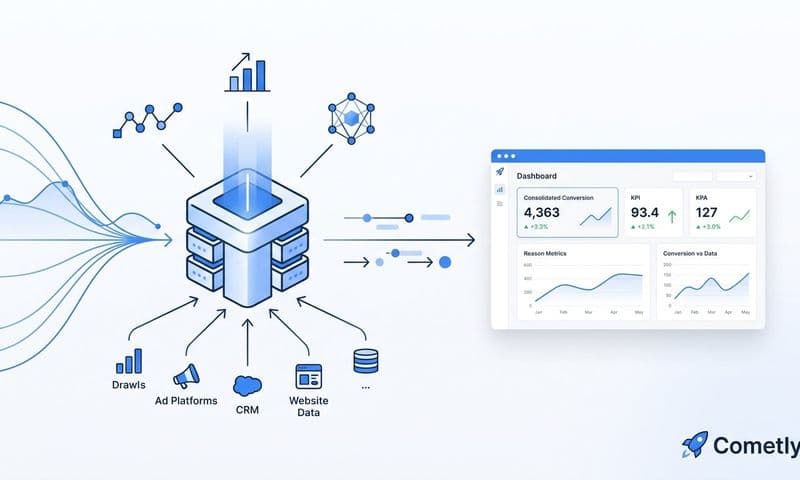
A revenue attribution model is simply a framework for figuring out which marketing touchpoints get credit for a conversion—and ultimately, for the revenue that follows. It’s a systematic way to connect your marketing spend directly to sales, moving beyond fuzzy metrics like clicks or leads so you can see what really drives your bottom line.
Your Journey from Marketing Spend to Proven Revenue
 Revenue Attribution Model: A Practical Guide to Marketing ROI
Think of your customer's journey like a line of dominoes. They might see a social media ad first, then read a blog post a week later, click an email the next day, and finally make a purchase after watching a product demo. Which domino deserves credit for toppling the last one?
This is the exact question a revenue attribution model is built to answer. It’s not just a technical term; it’s a map that connects every marketing dollar you spend to the actual revenue it brings in. Without that map, you’re just guessing, never quite sure if your budget is fueling real growth or getting wasted on channels that don't pull their weight.
The Problem with a Narrow View
Many businesses still rely on a dangerously simplistic view of this journey. For instance, a "last-click" model gives 100% of the credit to the final domino—the product demo in our example.
Imagine your marketing channels are players on a soccer team. A last-click model is like giving credit only to the player who scored the goal, completely ignoring the midfielders who made the crucial passes and assists that set up the shot. This skewed perspective can lead to terrible decisions, like cutting the budget for channels that are great at creating initial awareness but don't often close the deal. A proper attribution model avoids this by telling the full story of what drives success.
Why Attribution Is More Important Than Ever
The need for this kind of clarity is fueling massive growth in the market. The marketing attribution software market hit $1.8 billion USD in 2023 and is on track to reach $4.6 billion USD by 2030. This boom shows just how critical attribution has become, with four out of five companies now using these models to justify spend and dial in performance. You can check out more marketing attribution trends in the full report.
A revenue attribution model transforms marketing from a cost center into a proven revenue driver. It's the difference between guessing what works and knowing what works.
By understanding the complete customer journey, you can:
- Optimize Your Budget: Confidently shift more resources to the channels and campaigns delivering the highest ROI.
- Improve Customer Experience: See how customers actually interact with your brand, allowing you to create smoother, more effective paths to purchase.
- Prove Marketing's Value: Clearly show stakeholders how your team’s activities directly contribute to the company's bottom line.
Ultimately, adopting a sophisticated revenue attribution model is about making smarter, data-backed decisions that accelerate growth. It’s about giving credit where credit is due and building a more efficient marketing machine.
Comparing Single-Touch and Multi-Touch Models
When you're picking a revenue attribution model, you’re really choosing between two very different mindsets. Do you give all the credit to one single, game-changing moment? Or do you zoom out and look at the entire chain of events that led to the sale? This is the fundamental difference between single-touch and multi-touch models.
Think of single-touch models like sprinters. They’re fast, simple, and fixated on one critical point in the race—either the starting pistol or the finish line. These models give 100% of the revenue credit to just one marketing interaction, completely ignoring everything else that happened in between.
The Simplicity of Single-Touch Attribution
The two main single-touch models are First-Click and Last-Click. Their names tell you exactly what they do.
- First-Click Attribution: This model hands all the credit to the very first touchpoint a customer ever had with your brand. It’s perfect for figuring out which channels are your best lead generators and awareness-builders.
- Last-Click Attribution: The opposite is true here. This model gives all the credit to the final interaction a customer had right before they converted. It tells you which channels are your best “closers.”
While these models are super easy to set up and understand, they give you a dangerously narrow view of reality. It's like judging a movie by only watching the first scene or the final shot—you miss the entire plot. This tunnel vision can lead to some really bad budget decisions, like cutting funding for top-of-funnel channels that are essential for building your audience but rarely get that final click.
The biggest weakness of single-touch models is their built-in bias. They completely ignore the teamwork happening between your marketing channels, painting an incomplete and often misleading picture of what's actually driving revenue.
The Holistic View of Multi-Touch Attribution
Multi-touch models are the marathon runners of the attribution world. They understand that the customer journey is rarely a straight line; it's a long, winding road with multiple important stops along the way. Instead of picking one winner, these models spread the credit across several touchpoints, giving you a much more balanced and realistic view of what’s working.
This shift in perspective is no longer a niche idea—it's the industry standard. A massive 75% of companies worldwide have now adopted multi-touch attribution (MTA) models to measure their marketing performance. Why? Because modern customer journeys often involve 10-20 interactions before a purchase, making single-touch methods feel ancient.
For a deeper dive into this space, see our Shopify story ad generator guide.
Some of the most popular multi-touch models include:
- Linear: Spreads credit out evenly across every single touchpoint.
- Time-Decay: Gives more credit to the interactions that happened closer to the sale.
- U-Shaped: Puts the most weight on the first and last touchpoints, then divides the rest among the middle interactions.
If you’re ready for a deep dive on these methods, we have a whole article that explains what multi-touch attribution is and how it works.
The table below breaks down the fundamental differences between these two approaches.
Single-Touch vs. Multi-Touch Models at a Glance
Let's put the most common revenue attribution models side-by-side. This table breaks down how each one assigns credit, what it's best for, and where it can lead you astray.
Attribution Model | How It Works | Best For | Potential Pitfall |
|---|---|---|---|
First Click | Assigns one hundred percent of credit to the first marketing touchpoint | Top of funnel and lead generation focused strategies | Ignores nurturing and closing interactions that influence conversion |
Last Click | Assigns one hundred percent of credit to the final touchpoint before conversion | Short sales cycles and direct response campaigns | Overvalues bottom funnel channels and undervalues discovery efforts |
Linear | Distributes credit equally across all customer touchpoints | Marketers seeking a simple and balanced baseline view | Treats all interactions as equally influential regardless of impact |
Time Decay | Weights credit more heavily toward touchpoints closer to conversion | Long B2B sales cycles with heavy mid to late stage engagement | Can undervalue early awareness and demand generation efforts |
U Shaped | Allocates forty percent to first touch, forty percent to lead conversion, and the remainder across other touches | Teams that prioritize awareness and lead qualification milestones | Minimizes the influence of mid funnel nurturing interactions |
Ultimately, deciding between single-touch and multi-touch comes down to your goals. But for most businesses trying to get an honest read on their marketing ROI, a multi-touch model is the only way to get the depth needed to make truly smart decisions.
Diving Into Advanced Data-driven Attribution
Rule-based models like Linear and U-Shaped are a solid starting point, giving you a structured way to assign credit. But they're still based on assumptions. They assume the first and last touches are always the MVPs, or that every single interaction carries the same weight.
But what if you could stop guessing altogether? What if your actual sales data could write the rules for you?
This is exactly what advanced data-driven attribution does. Think of these models as a smart AI assistant that digs through thousands of customer journeys—both the ones that converted and the ones that didn't. Its job is to statistically figure out the true influence of each marketing touchpoint. Instead of sticking to a rigid, one-size-fits-all formula, these models learn from your unique business patterns.
They analyze the sequence of interactions that led to a sale and compare them to the paths that went cold. This process highlights which touchpoints consistently show up on the winning paths, allowing the model to assign credit with a level of precision that simpler models just can't touch.
Algorithmic Models: Unlocking Deeper Insights
Algorithmic models go way beyond just splitting up credit. They start answering the really tough questions.
They can finally uncover the hidden value of top-of-funnel activities, like that blog post someone read weeks ago or an early-stage social media ad. Simpler models often ignore these because they rarely get the final click, but algorithmic models see the bigger picture. This smarter approach leads directly to more intelligent budget allocation.
If you're evaluating vendors, our Shopify social ad generator breakdown can help.
Two of the most common advanced models are:
- Custom Attribution Models: These are the models you build yourself. You get to define your own rules based on your specific business logic, customer behavior, and marketing goals. For instance, you could give more weight to interactions with high-value content or assign extra credit to anyone who requests a product demo.
- Data-Driven Models (like Markov Chains): These models use machine learning algorithms to analyze every possible conversion path. A Markov Chain model, for example, calculates the probability of a conversion happening after a specific touchpoint occurs. In short, it measures the "lift" each channel provides.
This probabilistic approach is so powerful because it measures the true incremental impact of each touchpoint. It helps you understand not just if a channel was involved, but how much its presence actually increased the likelihood of a sale. For a deeper dive on this, check out our guide on what is incrementality in marketing.
The Power of Predictive Analytics in Attribution
The shift toward these advanced models is changing how businesses look at their entire sales and marketing stack. The focus is moving away from simple record-keeping and toward predictive intelligence that actively guides your strategy. For any business serious about growth, understanding the bigger picture of data-driven decision-making is essential.
This evolution is already delivering huge results. Revenue intelligence tools that use advanced attribution are projected to deliver up to 30% higher pipeline conversion rates. Looking ahead, Gartner predicts that by 2025, 80% of all customer interactions will be handled by AI, turning CRMs from static databases into proactive, predictive engines.
Data-driven attribution isn't about finding one "perfect" model. It's about adopting a flexible, learning-based approach that adapts to your customers and reveals what truly drives them to buy.
By letting algorithms crunch your data, you can uncover patterns you'd never spot on your own. You might find that a specific sequence of emails and social ads has a ridiculously high conversion rate, or that a particular blog category is the starting point for your most valuable customers. These are the kinds of insights that fuel serious growth and a much higher marketing ROI, turning your attribution model into a true strategic advantage.
How to Choose the Right Attribution Model for Your Business
Picking the right revenue attribution model isn’t about finding one “best” answer. It’s about finding the model that mirrors your business reality. The perfect choice for a fast-moving e-commerce store would be a terrible fit for a B2B software company with a year-long sales process. The key is to align your choice with your operational DNA.
This decision requires a clear-eyed look at how your business actually acquires and converts customers. A simple framework can guide you, starting with a few fundamental questions about your operations, your goals, and just how complex your customer's journey really is.
Start with Your Sales Cycle Length
The time it takes for someone to go from curious browser to paying customer is one of the most important factors. A short, simple sales cycle usually means fewer touchpoints are involved, making simpler models a perfectly viable option.
- Short Sales Cycles (Days to Weeks): Common in B2C e-commerce or for low-cost SaaS, these journeys are often pretty straightforward. A Last-Click or U-Shaped model can work well here, as they give proper credit to the channels that close the deal or create that first spark of awareness, all without overcomplicating things.
- Long Sales Cycles (Months to Years): Think B2B enterprise sales or big-ticket items. These journeys involve a ton of research, multiple decision-makers, and countless interactions over time. A Time-Decay or a more advanced Data-Driven revenue attribution model is pretty much essential to properly value all the nurturing touchpoints that happen along the way.
Consider Your Business Model and Channel Mix
Your business model (B2B vs. B2C) and the number of marketing channels you're juggling also heavily influence the right choice. A B2C brand focused on a couple of core channels has totally different needs than a B2B company that’s leveraging a dozen different platforms.
For example, a B2C company driving impulse buys through social media ads might find that a Last-Click model gives them all the insight they need. But a B2B organization with a complex mix of content marketing, paid search, email nurturing, and sales calls needs a multi-touch approach to see the full picture. A Linear or W-Shaped model can offer a more balanced view of how all these channels work together.
This decision tree shows how your data maturity and strategic needs can guide you toward the most suitable advanced attribution model.
 Revenue Attribution Model: A Practical Guide to Marketing ROI
As the flowchart shows, businesses with enough clean data and a need for predictive insights are best served by Data-Driven or Markov models. On the other hand, those with truly unique customer journeys should probably look into building a Custom model.
Evaluate Your Data and Resource Maturity
Finally, you have to be honest about your team's resources and data capabilities. Rolling out a sophisticated model requires clean, integrated data and the right tools to make sense of it all.
The best model on paper is useless if you can't implement it correctly. Start with a model that matches your current capabilities and evolve as your data maturity grows.
If you're just starting out, a simple model like First-Click or Last-Click can provide immediate, actionable insights without requiring a massive technical lift. As your team grows and your data gets more robust, you can graduate to multi-touch models. For an in-depth look at how these models stack up, check out this detailed comparison of attribution models for marketers.
This table sums up which models tend to align with different business scenarios.
Business Scenario | Recommended Model(s) | Primary Goal |
|---|---|---|
B2C with Short Sales Cycle | Last Click, U Shaped | Identify the channels that most directly close conversions |
B2B with Long Sales Cycle | Time Decay, Data Driven | Properly value nurturing and recent high intent touchpoints |
New Business or Market Entry | First Click, Inverse J Shaped | Understand which channels drive initial awareness and discovery |
Complex Multi Channel Mix | Linear, W Shaped, Full Path | Maintain a balanced and holistic view across all touchpoints |
Choosing the right revenue attribution model is an iterative process. Test different models, compare the insights they generate, and see which one tells the most logical and actionable story about how your marketing efforts actually translate into revenue.
Implementing Your Attribution Model Step by Step
 Revenue Attribution Model: A Practical Guide to Marketing ROI
Choosing a revenue attribution model is a huge strategic step, but an idea is only as good as its execution. Putting your chosen model into practice requires a clear, actionable roadmap. This is where you turn abstract theory into a powerful decision-making engine, but it all hinges on getting the foundations right from day one.
The entire system is built on clean, consistent data. Without it, even the most advanced model will churn out flawed insights. That's why the first and most critical step is nailing down a universal tracking framework.
Establish a Solid Tracking Foundation
Your journey starts with UTM parameters. Think of these small snippets of text added to your URLs as digital breadcrumbs. They let you track exactly where every single website visitor comes from and are the absolute bedrock of accurate source attribution.
A standardized UTM strategy is non-negotiable here. Every person on your team must use the same naming conventions for sources, mediums, and campaigns. Any inconsistency—like using "facebook," "Facebook," and "FB" interchangeably—will shatter your data into unusable fragments and make accurate analysis impossible.
Create a simple document that outlines your UTM structure and share it far and wide. This ensures every link, from a Google Ad to an email newsletter, feeds clean data into your system.
Integrate Your Core Data Sources
Once your tracking is standardized, the next step is to pull all your data into one place. A revenue attribution model needs to see the full picture, which means connecting all the different platforms that each hold a piece of the customer journey puzzle.
This usually involves integrating a few key systems:
- Your CRM: This is your source of truth for deals, revenue, and customer lifecycle stages. It's what connects marketing efforts to actual closed-won revenue.
- Ad Platforms: Tools like Google Ads and Facebook Ads provide crucial data on impressions, clicks, and ad-specific interactions that started the journey.
- Website Analytics: Platforms like Google Analytics track on-site behavior, from page views to form submissions, revealing how users engage with your content once they arrive.
Connecting these sources creates a unified view of the customer path, from the very first ad click to the final sale. For businesses dealing with massive amounts of data from dozens of channels, building a centralized data repository is key. If you're managing complex datasets, learning how to set up a datalake for marketing attribution can be a total game-changer.
Configure and Validate Your Model
With your data flowing and consolidated, you can finally configure your chosen model in your attribution software. This involves defining your key conversion events (like a demo request or a purchase) and setting the lookback window—the period during which touchpoints are considered for credit.
Implementation isn’t a one-and-done task; it’s the beginning of an ongoing process. Your first reports will generate more questions than answers, and that’s a good sign you’re on the right track.
After the initial setup, you have to validate it. Run your new model in parallel with your old one (even if it was just last-click) for a while. Compare the insights and ask some tough questions:
- Does the new data tell a more logical story about how our customers actually buy?
- Are there surprising channels now getting credit that were previously invisible?
- Do these results line up with the anecdotal feedback we hear from the sales team?
This validation phase builds confidence in the new model and helps you get buy-in from stakeholders. It proves the value of a more nuanced approach and sets the stage for turning your newfound insights into real marketing wins.
Turning Attribution Insights into Marketing Wins
Getting your revenue attribution model live and collecting data is a huge step. But the real work—and the real payoff—is just getting started. An attribution model isn't just a fancy report to glance at; it's a strategic tool designed to fuel profitable marketing decisions. The whole point is to turn these fresh insights into tangible business growth.
This is where you shift from theory to action. By digging into your attribution reports, you can finally see the complete story of your customer journeys. You'll uncover which channels are your true workhorses, not just the ones that happen to snag the final click before a sale.
Reallocating Your Budget with Confidence
One of the quickest wins you'll get from a solid revenue attribution model is the ability to reallocate your budget with data-backed confidence. Last-click models often trick marketers into overspending on bottom-of-funnel channels like branded search while completely ignoring the channels that build initial awareness.
Now, you can see which channels consistently serve as crucial "assists" early in the journey.
For instance, your data might reveal that a specific podcast sponsorship, which you previously thought was a low-performer, is actually the starting point for 25% of your highest-value customers. This insight lets you shift budget away from channels that only look valuable on the surface and invest more in the ones that are quietly filling your pipeline.
Attribution turns your marketing budget from a list of expenses into a portfolio of strategic investments. Every dollar can be allocated to the channels proven to generate the highest return.
This process isn't about finding a single "best" channel. It’s about understanding the powerful interplay between them and funding the entire customer journey, from the very first touch to the final conversion.
Optimizing Campaigns and Creative in Real Time
Beyond high-level budget shifts, attribution data gives you the granular insights you need for day-to-day campaign optimization. By drilling down into your reports, you can see exactly which ads, keywords, and content pieces are contributing the most to revenue.
Imagine you're running two different ad campaigns on Facebook. One gets tons of clicks but very few conversions, while the other has fewer clicks but is consistently present in the journeys of your closed-won deals. An attribution model helps you spot this pattern, allowing you to:
For a deeper dive into this space, see our ecommerce Facebook ad generator guide.
- Double down on winning creative: Shift spend to the ad concepts that are proven revenue drivers.
- Refine your targeting: Discover which audience segments are most responsive to your most effective ads.
- Improve your messaging: See which value propositions resonate most strongly at different stages of the funnel.
This continuous feedback loop turns campaign management from a guessing game into a precise, data-driven science. If you’re looking for more strategies on this front, our guide can show you several actionable ways to improve marketing ROI using these kinds of insights.
Attribution is not a one-and-done setup. It’s an ongoing strategic cycle of analysis, action, and refinement. By consistently using these insights, you can steadily improve performance, prove marketing's direct contribution to the bottom line, and build a more resilient, efficient growth engine.
Frequently Asked Questions About Revenue Attribution
Even after you've got the basics down, it’s normal to have a few lingering questions about how revenue attribution actually works in the real world. Let’s tackle some of the most common ones so you can move forward with confidence.
What Is the Difference Between Attribution and Marketing Mix Modeling?
It’s easy to get these two mixed up, but they’re designed to answer very different questions. Think of it like this: a revenue attribution model is a bottom-up approach. It’s all about the individual customer journey, looking at specific touchpoints like ad clicks and form fills to figure out how a single sale happened.
Marketing Mix Modeling (MMM), on the other hand, is a top-down, big-picture analysis. It uses statistical models to look at massive, aggregated datasets over long periods—things like total ad spend, overall sales figures, and even external factors like the economy or seasonal trends.
Attribution tells you which specific ad got the click that led to a sale. MMM tells you if your entire advertising budget is having an impact.
How Much Data Do I Need for a Data-Driven Model?
More data is always better, but there’s no single magic number. For a data-driven or algorithmic model to work its magic and give you statistically sound insights, you need a pretty serious amount of data to flow through it. A good rule of thumb is at least 1,000 conversions a month, plus tens of thousands of the user interactions that go along with them.
If your conversion volume is lower than that, the model will struggle to find meaningful patterns, and you’ll likely end up with shaky or just plain wrong conclusions. For businesses that aren't at that scale yet, it’s much smarter and more reliable to start with a rules-based multi-touch model like Linear or Time-Decay.
A data-driven revenue attribution model is only as smart as the data you feed it. Insufficient data volume can lead to flawed conclusions, so it's crucial to be realistic about your current scale before diving into advanced algorithmic methods.
How Often Should I Review My Attribution Model?
Your attribution model is definitely not a "set it and forget it" kind of tool. To keep it aligned with what’s actually happening in your business, you need to revisit it regularly.
For most businesses, a quarterly review is a great rhythm. This gives you a chance to:
- Check Performance: Are the insights the model is giving you still making sense? Are they actionable?
- Account for Change: Have you rolled out a new marketing channel or made a big shift in your strategy?
- Validate Accuracy: Does the story the model tells still line up with your sales data and what you’re hearing from customers?
And if you make a major business change—like launching a new product, pivoting your strategy, or entering a new market—you should review your model right away. An outdated model can be just as misleading as having no model at all.
Ready to stop guessing and start knowing exactly what drives your revenue? Cometly provides the clarity you need with powerful, easy-to-use marketing attribution. See which campaigns, ads, and channels deliver real ROI and optimize your budget with confidence. Get started with Cometly today!