Tracking marketing performance across dozens of channels while trying to connect every touchpoint to actual revenue is one of the biggest challenges SaaS teams face today. You're running campaigns on Meta, Google, LinkedIn, and more—but which channels are actually driving your highest-value customers? Without accurate attribution and unified analytics, you're making budget decisions in the dark.
The best SaaS marketing analytics platforms solve this by connecting your ad platforms, CRM, and website data into a single source of truth. They show you the complete customer journey, attribute revenue to the right sources, and give you actionable insights to optimize spend. The difference between a good platform and a great one comes down to three things: attribution accuracy in privacy-restricted environments, integration depth across your marketing stack, and the ability to turn data into clear next steps.
We evaluated platforms based on their attribution models, integration ecosystems, ease of implementation, data accuracy, and ability to connect marketing spend directly to revenue. Here are the top SaaS marketing analytics platforms that help growth teams make smarter decisions.
1. Cometly
Best for: Marketing teams that need accurate attribution and AI-powered optimization across all ad channels.
Cometly is a marketing attribution and analytics platform built specifically for marketers who run paid campaigns across multiple channels and need to know exactly which ads drive revenue.
 9 Best SaaS Marketing Analytics Platforms in 2026
Where This Tool Shines
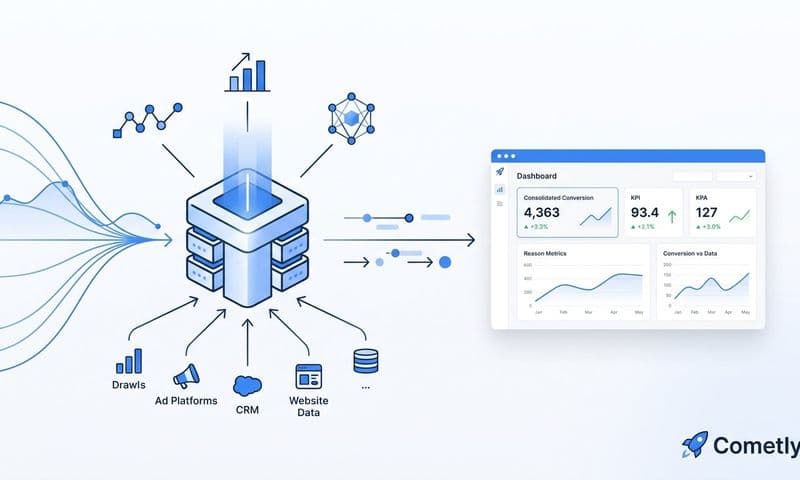
Cometly captures every touchpoint in the customer journey—from the first ad click through CRM events—and connects them to actual conversions and revenue. This complete view gives the platform's AI engine the enriched data it needs to identify your highest-performing campaigns and provide optimization recommendations you can act on immediately.
The platform's server-side tracking solves the accuracy problems that plague most attribution tools in today's privacy-restricted environment. While browser-based tracking misses conversions due to iOS limitations and cookie restrictions, Cometly's approach ensures you see the full picture of what's working.
Key Features
Multi-Touch Attribution: Track every marketing touchpoint across all channels and see how they work together to drive conversions.
AI Ads Manager: Get AI-powered recommendations on which campaigns to scale, pause, or optimize based on actual performance data.
Server-Side Tracking: Bypass browser limitations and cookie restrictions to capture accurate conversion data even in privacy-focused environments.
Conversion Sync: Send enriched conversion events back to Meta, Google, and other ad platforms to improve their targeting and optimization algorithms.
Real-Time Analytics Dashboard: Monitor campaign performance, compare attribution models, and analyze ROI across your entire marketing stack in one place.
Best For
SaaS companies and agencies running significant paid advertising budgets across multiple platforms who need to prove marketing ROI and make confident scaling decisions. Particularly valuable for teams struggling with attribution gaps or looking to feed better data back to ad platform algorithms.
Pricing
Custom pricing based on monthly ad spend volume. Contact their team for a tailored quote based on your specific needs and scale.
2. Mixpanel
Best for: Product-led SaaS companies tracking user behavior and feature adoption within their application.
Mixpanel is a product analytics platform that focuses on understanding how users interact with your SaaS application after they sign up.
 9 Best SaaS Marketing Analytics Platforms in 2026
Where This Tool Shines
Mixpanel excels at event-based tracking, letting you see exactly which features users engage with, where they drop off, and what actions correlate with retention. This granular view of in-app behavior helps product teams prioritize development and marketing teams understand which user segments are most engaged.
The platform's strength is in its ability to track individual user journeys over time. You can see the complete path a user takes from signup through activation and beyond, making it invaluable for optimizing onboarding flows and identifying friction points.
Key Features
Event-Based Tracking: Monitor specific user actions and interactions within your product to understand behavior patterns.
Funnel Analysis: Visualize conversion rates through multi-step processes and identify exactly where users drop off.
Retention Reports: Track how often users return to your product and which cohorts have the strongest long-term engagement.
User Segmentation: Create custom user segments based on behavior, properties, or actions to analyze different groups separately.
A/B Testing Integration: Connect experimentation results directly to user behavior data to measure impact accurately.
Best For
Product-led growth companies that need deep insights into how users interact with their application. Ideal for teams focused on improving activation rates, feature adoption, and user retention rather than top-of-funnel marketing attribution.
Pricing
Free tier available for up to 20 million events per year. Growth plan starts at $20/month and scales with event volume.
3. Amplitude
Best for: Enterprise SaaS companies that need predictive analytics and sophisticated behavioral analysis at scale.
Amplitude is a digital analytics platform that combines product analytics with predictive capabilities to help you understand not just what users are doing, but what they're likely to do next.
 9 Best SaaS Marketing Analytics Platforms in 2026
Where This Tool Shines
Amplitude's behavioral cohort analysis goes beyond basic segmentation to identify patterns across millions of user interactions. The platform uses machine learning to surface insights you might miss manually, like which early behaviors predict long-term retention or which user paths lead to conversion.
The cross-platform tracking capability is particularly strong, letting you follow users seamlessly across web, mobile, and other touchpoints. This unified view becomes critical as your SaaS product expands across multiple platforms.
Key Features
Behavioral Cohorts: Automatically group users based on shared behaviors and analyze how different cohorts perform over time.
Predictive Analytics: Use machine learning to forecast user behavior, identify churn risk, and spot growth opportunities.
Cross-Platform Tracking: Follow individual users across web, iOS, Android, and other platforms with unified identity resolution.
Experimentation Tools: Run feature flags and A/B tests directly within the platform and measure impact on key metrics.
Data Governance: Enterprise-grade controls for data quality, privacy compliance, and team collaboration at scale.
Best For
Mid-market to enterprise SaaS companies with complex products and large user bases. Best suited for organizations with dedicated analytics teams who can leverage the platform's advanced capabilities and predictive features.
Pricing
Free Starter plan available for up to 10 million actions per month. Growth and Enterprise tiers with custom pricing based on scale and features needed.
4. HubSpot Marketing Hub
Best for: SaaS teams wanting an all-in-one platform that combines marketing automation, CRM, and analytics.
HubSpot Marketing Hub is a comprehensive marketing platform that integrates email marketing, landing pages, social media management, and analytics with a native CRM.
 10 Best Enterprise Channel Analytics Software To Maximize Marketing ROI
Where This Tool Shines
HubSpot's biggest advantage is the tight integration between marketing activities and CRM data. You can track a lead from their first website visit through every email interaction, form submission, and sales conversation—all in one system. This closed-loop reporting makes it easy to connect marketing efforts directly to closed deals.
The platform handles both the execution and measurement sides of marketing, eliminating the need to stitch together multiple tools. For teams that want to consolidate their tech stack, HubSpot provides a complete solution from content creation through attribution reporting.
Key Features
Campaign Analytics: Track performance across email, social, ads, and content with built-in attribution to revenue.
Native CRM Integration: See complete contact timelines showing every marketing touchpoint and sales interaction in one view.
Multi-Channel Tracking: Monitor performance across website, email, social media, and paid ads from a unified dashboard.
Custom Reporting: Build tailored reports and dashboards that combine marketing metrics with sales and revenue data.
Marketing Automation: Create workflows that trigger based on user behavior and track the impact of automation on conversions.
Best For
Small to mid-sized SaaS companies that want a complete marketing platform rather than best-of-breed point solutions. Particularly valuable for teams already using or planning to use HubSpot's CRM.
Pricing
Free tools available with basic features. Starter plan at $20/month for limited contacts. Professional plan at $890/month includes advanced analytics and attribution. Enterprise tier available for larger organizations.
5. Google Analytics 4
Best for: SaaS companies needing comprehensive website and app analytics without a significant budget investment.
Google Analytics 4 is the latest version of Google's free web and app analytics platform, rebuilt with an event-based data model and machine learning capabilities.
 11 Best Conversion Optimization Tools to Boost Your ROI in 2026
Where This Tool Shines
GA4's biggest advantage is its cost—it's free for most SaaS companies, even those with significant traffic. The platform provides solid website analytics, basic conversion tracking, and increasingly sophisticated machine learning features that predict user behavior and identify trending events.
The event-based model is more flexible than Universal Analytics, letting you track custom interactions without rigid category limitations. Integration with Google Ads is seamless, and the BigQuery export (also free up to a point) gives technical teams direct access to raw data.
Key Features
Event-Based Data Model: Track any user interaction as an event without predefined categories, giving you flexibility in what you measure.
Cross-Platform Measurement: Combine website and app data into unified user journeys with identity resolution across devices.
Predictive Metrics: Use machine learning to forecast purchase probability, churn likelihood, and revenue potential for user segments.
BigQuery Integration: Export raw event data to Google BigQuery for custom analysis and integration with other data sources.
Privacy Controls: Built-in features for data retention, user deletion, and compliance with privacy regulations like GDPR.
Best For
Any SaaS company that needs website analytics and basic conversion tracking without budget constraints. Works well as a foundational analytics layer that can be supplemented with specialized tools for attribution or product analytics.
Pricing
Free for standard implementation. Google Analytics 360 available for enterprise needs with custom pricing, advanced features, and higher data limits.
6. Heap
Best for: SaaS teams that want automatic event capture without spending time on manual tracking implementation.
Heap is a digital insights platform that automatically captures every user interaction on your website or app without requiring manual event tracking setup.
 11 Best Marketing Analytics Software to Track What Actually Drives Revenue in 2026
Where This Tool Shines
Heap's automatic capture eliminates the typical implementation bottleneck where you have to decide upfront which events to track. The platform records everything—every click, form submission, page view, and interaction—then lets you retroactively define events and create analyses without needing engineering resources.
This retroactive analysis capability is particularly powerful when you realize you need data on something that happened weeks or months ago. With traditional analytics, that data is lost. With Heap, you can define the event now and immediately see historical trends.
Key Features
Automatic Event Capture: Record every user interaction automatically without manual event tracking code or tag management.
Retroactive Analysis: Define new events and segments at any time and instantly see historical data without waiting for new data collection.
Session Replay: Watch recordings of actual user sessions to understand behavior and identify usability issues.
Data Governance: Control data quality with validation rules, manage user permissions, and ensure compliance with privacy requirements.
SQL-Based Queries: Use SQL syntax to build custom analyses and extract exactly the insights you need from the complete dataset.
Best For
SaaS companies with limited engineering resources for analytics implementation or teams that frequently need to analyze user behavior they didn't anticipate tracking. Particularly valuable during rapid product iteration when requirements change quickly.
Pricing
Free tier available for startups with up to 10,000 sessions per month. Growth and Pro plans with custom pricing based on session volume and feature requirements.
7. Kissmetrics
Best for: SaaS companies focused on tracking individual customer journeys and connecting behavior to revenue.
Kissmetrics is a customer analytics platform that takes a person-based approach to tracking, following individual users across their entire lifecycle from first visit through conversion and beyond.
Where This Tool Shines
Kissmetrics focuses on people rather than sessions or pageviews, giving you a clear picture of how individual customers interact with your SaaS product over time. The platform automatically ties together multiple sessions, devices, and interactions into a single customer timeline.
The revenue tracking capabilities are particularly strong, letting you connect specific marketing campaigns and user behaviors directly to actual revenue numbers. This makes it easier to calculate customer lifetime value and identify which acquisition channels bring the most valuable customers.
Key Features
Person-Based Analytics: Track individuals across devices and sessions with automatic identity resolution and unified customer profiles.
Revenue Tracking: Connect user behavior directly to revenue data to calculate ROI and customer lifetime value accurately.
Campaign Attribution: See which marketing campaigns and channels drive your highest-value customers with multi-touch attribution.
Customer Journey Mapping: Visualize the complete path users take from first touchpoint through conversion and renewal.
Cohort Analysis: Group users by acquisition date, behavior, or properties and compare how different cohorts perform over time.
Best For
B2B SaaS companies with longer sales cycles and higher customer values where understanding individual customer journeys matters more than aggregate metrics. Best suited for teams focused on optimizing conversion rates and customer lifetime value.
Pricing
Plans start at $299/month for up to 5,000 identified users. Pricing scales with the number of identified users tracked.
8. Databox
Best for: Marketing teams that need to consolidate metrics from multiple tools into unified dashboards and reports.
Databox is a business analytics platform that pulls data from your various marketing and analytics tools into centralized dashboards, making it easy to monitor performance across your entire stack.
Where This Tool Shines
Databox excels at solving the "too many tabs" problem. Instead of logging into Google Analytics, then your ad platforms, then your CRM, then your email tool, you can see all your key metrics in one place. The platform offers pre-built dashboard templates for common use cases, getting you up and running quickly.
The goal tracking and alerting features help teams stay accountable without constant manual checking. Set targets for key metrics and receive notifications when performance dips or spikes, enabling faster responses to both problems and opportunities.
Key Features
100+ Native Integrations: Connect data from Google Analytics, ad platforms, CRMs, email tools, and more without custom development.
Custom Dashboard Builder: Create tailored dashboards with drag-and-drop widgets showing exactly the metrics your team needs to monitor.
Goal Tracking: Set targets for key metrics and track progress with visual indicators showing whether you're on track.
Automated Alerts: Receive notifications via email or Slack when metrics hit thresholds, spike, or drop significantly.
Scheduled Reports: Automatically send dashboard snapshots to stakeholders on a daily, weekly, or monthly schedule.
Best For
SaaS marketing teams and agencies that use multiple tools and need to consolidate reporting for internal stakeholders or clients. Particularly valuable for teams spending too much time manually compiling reports from various sources.
Pricing
Free tier available for up to 3 data sources and 3 users. Starter plan at $47/month includes 10 data sources. Professional and higher tiers available for larger teams and more data sources.
9. Funnel.io
Best for: Enterprise marketing teams managing hundreds of campaigns across dozens of platforms who need automated data collection and transformation.
Funnel.io is a marketing data hub that automatically collects, cleans, and exports data from advertising and marketing platforms into your data warehouse or BI tools.
Where This Tool Shines
Funnel.io is built for scale. With 500+ pre-built connectors to advertising platforms, analytics tools, and marketing systems, it handles the heavy lifting of data collection across complex marketing stacks. The platform doesn't just pull data—it transforms and standardizes it, ensuring metrics from different sources are comparable.
For data teams building custom analytics solutions, Funnel.io serves as the reliable data collection layer. It handles API changes, rate limits, and authentication issues so your data pipeline doesn't break when a platform updates its API.
Key Features
500+ Data Connectors: Automatically collect data from virtually every major advertising, analytics, and marketing platform.
Data Transformation Rules: Clean, standardize, and enrich data with custom rules before it reaches your warehouse or BI tool.
Warehouse and BI Exports: Send processed data directly to BigQuery, Snowflake, Tableau, Looker, or other analytics destinations.
Automated Collection: Schedule data pulls and handle API authentication, rate limiting, and error handling automatically.
Historical Data Import: Backfill historical data when connecting new sources to maintain complete datasets for analysis.
Best For
Enterprise SaaS companies with dedicated data teams building custom analytics solutions or large marketing departments managing complex multi-platform campaigns. The investment makes sense when manual data collection would require significant engineering resources.
Pricing
Starts at $1,000/month for a limited number of data sources. Pricing scales based on the number of connectors, data volume, and features required.
Making the Right Choice
The best SaaS marketing analytics platform for your team depends on what you're trying to solve. If accurate attribution across paid channels is your primary concern, Cometly's AI-powered approach and server-side tracking provide the clarity you need to scale with confidence. For product-led companies focused on in-app behavior, Mixpanel or Amplitude offer the depth of user-level analysis that drives retention improvements.
Teams seeking an all-in-one solution that combines execution with measurement should consider HubSpot Marketing Hub, especially if you're already using their CRM. If budget is tight and you need solid website analytics as a foundation, Google Analytics 4 provides surprising capability at no cost. For data teams building custom analytics infrastructure, Funnel.io handles the complex data collection layer so you can focus on analysis.
The common thread across successful implementations is choosing a platform that matches your current growth stage and primary analytics needs. Start with the problem you're trying to solve—whether that's proving marketing ROI, optimizing conversion funnels, or understanding user behavior—then select the tool that addresses that specific challenge most directly.
Ready to elevate your marketing game with precision and confidence? Discover how Cometly's AI-driven recommendations can transform your ad strategy—Get your free demo today and start capturing every touchpoint to maximize your conversions.