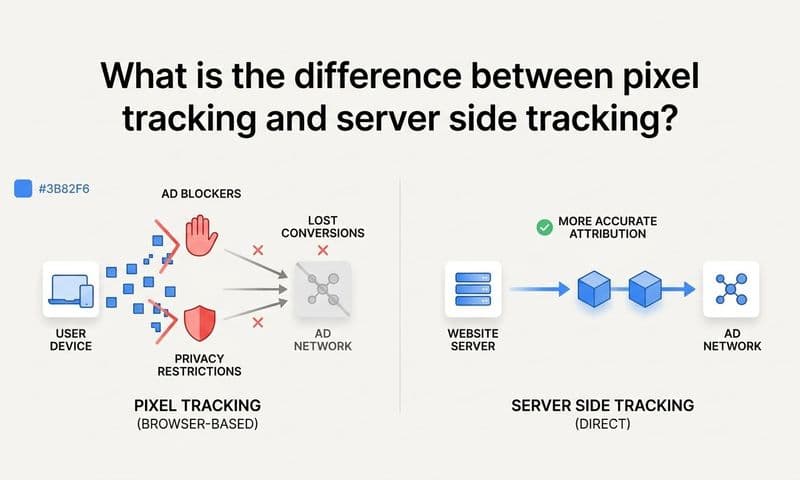
If you're running paid ads in 2025, you already know the problem: iOS 14+ privacy updates, cookie restrictions, and ad blockers have turned client-side tracking into a guessing game. Your Facebook Ads Manager shows 50 conversions while your CRM logged 120. Google Analytics reports a 2.5x ROAS, but your bank account tells a different story.
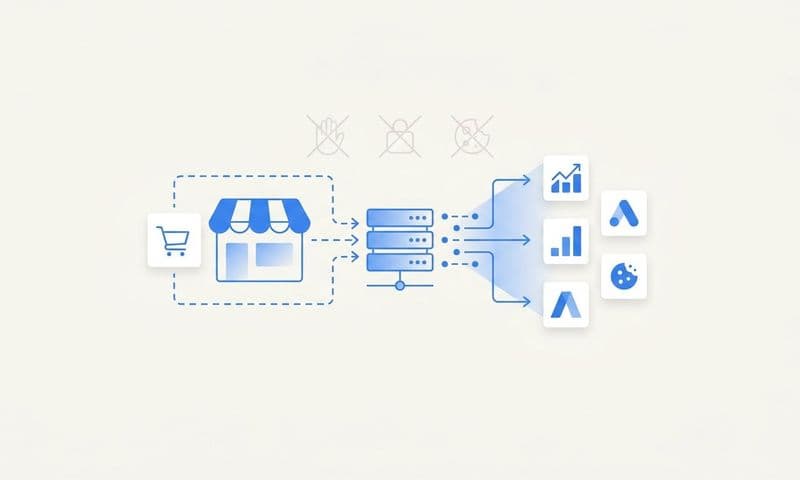
Server side tracking solves this by moving data collection from the user's browser to your server. Instead of relying on pixels that get blocked, your server sends conversion data directly to ad platforms through their APIs. The result? More accurate attribution, better ad optimization, and decisions based on real revenue data instead of incomplete browser signals.
But here's the challenge: not all server side tracking tools are built the same. Some require developer resources and weeks of setup. Others focus purely on technical implementation without connecting to your actual revenue data. The best tools combine ease of setup, accurate tracking, and deep integration with your ad platforms and CRM.
Here are seven server side tracking solutions that marketing teams actually use to capture every conversion and feed their ad platforms the data they need to optimize.
1. Cometly
Best for: Marketing teams who need complete attribution visibility with AI-powered insights and seamless server side tracking
Cometly is a marketing attribution and analytics platform that combines server side tracking with multi-touch attribution modeling and AI-driven recommendations.
 Top 7 Server Side Tracking Tools To Capture Every Conversion In 2025
Unlike tools that only handle the technical side of data collection, Cometly shows you exactly which ads and channels drive leads and revenue across the entire customer journey.
Where This Tool Shines
Cometly excels at giving marketing teams the complete picture. It captures every touchpoint—from initial ad click through CRM events—and uses AI to identify which campaigns actually convert. The platform sends enriched conversion data back to Meta, Google, and TikTok through server side tracking, improving ad platform optimization while showing you attribution across multiple models.
You're not just fixing tracking; you're getting strategic insights on where to scale. For teams tired of fragmented data across five different dashboards, Cometly consolidates everything into one source of truth that connects ad spend to actual revenue.
Key Features & Capabilities
Complete Server Side Tracking Implementation: Automatic event forwarding to Meta CAPI, Google Enhanced Conversions, and TikTok Events API without requiring developer resources.
Multi-Touch Attribution Modeling: Compare first-click, last-click, linear, time decay, and data-driven models to see how different approaches value your channels.
AI-Powered Campaign Analysis: Identifies high-performing ads and recommends scaling opportunities across all platforms based on actual conversion patterns.
Real-Time CRM Integration: Tracks leads through your entire sales funnel, connecting initial ad click to closed deals, not just website conversions.
Unified Performance Dashboard: Shows ad performance, attribution data, and revenue metrics in one place, eliminating the need to toggle between multiple platforms.
Automatic UTM Tracking: Captures UTM parameters and creates custom events without developer involvement, ensuring every touchpoint is properly tagged.
Best For / Ideal Users
Cometly is built for performance marketers, growth teams, and agencies who need accurate attribution and strategic insights, not just technical tracking. If you're spending $10K+ monthly on ads and need to know which campaigns drive revenue (not just clicks), Cometly delivers both the data infrastructure and the analytics layer.
It's especially valuable for teams running multi-channel campaigns who want AI recommendations on where to allocate budget. The platform works well for businesses with complex customer journeys where understanding the full path to conversion matters more than simple last-click attribution.
2. Elevar
Best for: Ecommerce brands on Shopify or BigCommerce who need accurate tracking without technical complexity
Elevar specializes in server side tracking for ecommerce stores, focusing on Shopify and BigCommerce integrations.
 Top 7 Server Side Tracking Tools To Capture Every Conversion In 2025
The platform automatically implements Google Analytics 4, Meta CAPI, TikTok Events API, and other tracking pixels through server side architecture, ensuring accurate data collection even when browsers block client-side scripts.
Where This Tool Shines
Elevar removes the technical burden of implementing server side tracking for ecommerce stores. Instead of hiring developers to set up conversion APIs and debug tracking issues, you connect your Shopify store and Elevar handles the implementation automatically. The platform monitors data quality in real time, alerting you when tracking breaks or data looks inconsistent.
For ecommerce brands running Facebook and Google ads, Elevar ensures purchase events, add-to-cart actions, and checkout steps flow accurately to ad platforms, improving ROAS through better optimization data. The system captures customer information at checkout and sends enriched conversion events that help ad platforms match conversions to the right users.
Key Features & Capabilities
One-Click Platform Integration: Connect your Shopify or BigCommerce store without writing code, with automatic server side tracking setup across all major ad platforms.
Pre-Built Conversion API Connections: Ready-to-use integrations with Meta CAPI, Google Enhanced Conversions, TikTok Events API, Snapchat, and Pinterest that start working immediately after setup.
Real-Time Data Quality Monitoring: Continuous tracking validation with instant alerts when events stop firing or data patterns look abnormal, preventing silent tracking failures.
Automatic Customer Data Enrichment: Captures email, phone, address, and other customer details at checkout, then sends hashed versions to ad platforms for improved conversion matching rates.
Server-Side Google Tag Manager: Includes managed sGTM container for teams who need advanced tracking customization beyond standard ecommerce events.
Revenue Reconciliation Reports: Compare what ad platforms report against actual Shopify orders to identify discrepancies and measure true tracking accuracy.
Best For / Ideal Users
Elevar works best for Shopify and BigCommerce stores spending $5K+ monthly on paid ads. If you're an ecommerce brand without a dedicated developer and you need reliable tracking that "just works," Elevar delivers plug-and-play implementation. The platform handles the technical complexity while you focus on scaling campaigns.
It's particularly valuable for DTC brands scaling Facebook and Google campaigns who've seen attribution drop after iOS 14 updates. When your ad platforms show fewer conversions than your Shopify dashboard, Elevar bridges that gap by ensuring complete conversion data reaches Meta and Google.
Pricing
Elevar pricing starts at $50/month for stores processing up to 1,000 orders monthly, scaling based on order volume. Mid-tier plans ($150-$500/month) cover most growing ecommerce brands. Enterprise pricing is available for high-volume stores requiring custom integrations and dedicated support.
3. Segment
Best for: Companies building custom data infrastructure who need flexible event routing across multiple tools
Segment is a customer data platform that collects events from websites, mobile apps, and servers, then routes that data to hundreds of downstream destinations including ad platforms, analytics systems, and data warehouses.
 Top 7 Server Side Tracking Tools To Capture Every Conversion In 2025
Where This Tool Shines
Segment excels when you need maximum flexibility in how customer data flows through your organization. Instead of implementing separate tracking codes for Google Analytics, Meta Pixel, Mixpanel, and your data warehouse, you implement Segment once and route events wherever they need to go. The platform handles server side event forwarding to Meta CAPI and Google Enhanced Conversions while simultaneously sending the same events to your analytics tools and internal databases.
For companies with engineering resources who want to own their data pipeline, Segment provides the infrastructure layer that everything else builds on. You're not locked into a specific attribution model or analytics approach—you control the raw event data and can build whatever analysis makes sense for your business.
Key Features & Capabilities
Unified Event Collection: Gather data from web, mobile, server, and cloud sources into one consistent stream.
300+ Pre-Built Integrations: Connect to major ad platforms, analytics tools, CRMs, and data warehouses without custom API work.
Server-Side Event Forwarding: Send conversion data to Meta CAPI, Google Enhanced Conversions, and other conversion APIs reliably.
Real-Time Data Validation: Monitor event quality through Protocols feature that catches tracking issues before they corrupt your data.
Identity Resolution: Merge customer activity across devices and sessions into unified profiles.
Data Warehouse Sync: Stream events to Snowflake, BigQuery, or Redshift for custom attribution modeling in SQL.
Best For / Ideal Users
Segment is built for companies with technical teams who want to build custom data infrastructure. If you have developers who can implement tracking properly and you need events flowing to multiple systems beyond just ad platforms, Segment provides the flexibility. The platform makes sense when you're treating data as a strategic asset—not just fixing attribution for ad campaigns, but building a foundation for product analytics, customer success workflows, and business intelligence.
It's overkill for small teams who just need basic server side tracking to Meta and Google. But for companies running sophisticated data operations where marketing is one of many teams consuming customer event data, Segment becomes the central nervous system.
Pricing
Segment offers a free tier for up to 1,000 monthly tracked users, suitable for testing. Paid plans start around $120/month for the Team tier (up to 10,000 MTUs), scaling significantly for Business and Enterprise tiers based on data volume and features. Enterprise pricing typically starts at $1,000+/month for companies with substantial tracking needs and custom integration requirements.
4. Stape
Best for: Technical teams who want full control over Google Tag Manager Server-side implementation
Stape provides managed server-side Google Tag Manager (sGTM) hosting with pre-built templates for major ad platforms.
 Top 7 Server Side Tracking Tools To Capture Every Conversion In 2025
Instead of setting up your own server infrastructure for sGTM, Stape handles the hosting, scaling, and maintenance while you configure tags through the familiar GTM interface.
Where This Tool Shines
Stape solves the infrastructure challenge of running server-side Google Tag Manager. While Google provides sGTM for free, you need to host it somewhere and configure server endpoints correctly. Most marketing teams don't have DevOps resources to manage server infrastructure, monitor uptime, or handle scaling during traffic spikes.
Stape eliminates that complexity with one-click deployment on Google Cloud, AWS, or their own infrastructure. The platform includes pre-built tag templates for Meta CAPI, Google Enhanced Conversions, TikTok, and dozens of other platforms, reducing setup time from days to hours. For teams already using GTM who want to move to server-side tracking without managing servers, Stape provides the middle layer between Google's free tool and the technical complexity of hosting it yourself.
Key Features & Capabilities
Managed Server-Side GTM Hosting: Automatic scaling and uptime monitoring so your tracking infrastructure stays online during traffic spikes without manual intervention.
Pre-Built Tag Templates: Over 50 platform templates including Meta CAPI, Google Ads, TikTok, Snapchat, and Pinterest, eliminating the need to write custom code for each integration.
Custom Domain Setup: Configure tracking endpoints on your domain (tracking.yourdomain.com) to improve data collection rates and extend cookie lifetime beyond browser restrictions.
Data Enrichment Tools: Built-in customer matching and data enrichment features that append additional user information before sending events to ad platforms, improving conversion API accuracy.
Real-Time Debugging: Visual debugging tools that show exactly which events are firing, what data they contain, and whether they're reaching ad platforms successfully.
Multi-Container Support: Agencies can manage multiple client implementations from one dashboard, with separate billing and access controls for each container.
Best For / Ideal Users
Stape works best for marketing teams and agencies already comfortable with Google Tag Manager who want to implement server-side tracking without hiring DevOps engineers. If you know how to configure GTM tags and triggers but don't want to manage server infrastructure, Stape bridges that gap.
The platform is particularly popular with agencies running multiple client accounts who need repeatable sGTM deployment. Instead of setting up custom server infrastructure for each client, agencies can deploy new Stape containers in minutes and configure them through the familiar GTM interface.
Technical marketers who want maximum control over their tracking implementation—without the overhead of managing servers—find Stape's approach ideal. You get the flexibility of server-side GTM with the reliability of managed hosting.
Pricing
Stape pricing starts at $20/month for basic server-side GTM hosting with limited requests, suitable for testing or low-traffic sites. Most growing businesses use the $50-100/month tiers that handle higher traffic volumes and include additional features like custom domains and advanced debugging. Enterprise plans ($200+/month) include dedicated infrastructure, priority support, and advanced features like custom data transformations for complex tracking requirements.
5. Tracify
Best for: Ecommerce brands who want attribution modeling combined with server side tracking
Tracify is an attribution platform built specifically for ecommerce that combines server side tracking with multi-touch attribution and incrementally testing.
 Top 7 Server Side Tracking Tools To Capture Every Conversion In 2025
Where This Tool Shines
Tracify goes beyond basic server side tracking by layering attribution modeling on top of accurate data collection. The platform implements Meta CAPI and Google Enhanced Conversions to capture conversions reliably, then uses that data to build multi-touch attribution models showing the true customer journey.
What makes Tracify unique is the incrementality testing feature—you can measure whether a marketing channel actually causes sales or just takes credit for conversions that would have happened anyway. For ecommerce brands questioning whether their attribution model reflects reality, Tracify provides both the tracking infrastructure and the analytical framework to answer that question.
Key Features & Capabilities
Automatic Server Side Implementation: Connects directly to Shopify and WooCommerce stores, implementing Meta CAPI and Google Enhanced Conversions without requiring developer involvement.
Multi-Touch Attribution Modeling: Compare first-click, last-click, linear, and time-decay models to understand how different approaches value your marketing channels.
Incrementality Testing: Run controlled experiments to measure true marketing impact beyond correlation, identifying which channels actually drive incremental sales.
Real-Time Profit Tracking: Accounts for product costs, shipping expenses, and ad spend to show actual profitability by channel, not just revenue.
Cohort Analysis: Track customer lifetime value by acquisition channel to identify which sources bring the most valuable long-term customers.
Best For / Ideal Users
Tracify is built for ecommerce brands spending significant amounts on ads who want strategic attribution insights, not just technical tracking. If you're questioning whether your current attribution model accurately represents which channels drive profitable growth, Tracify provides both the data infrastructure and the analytical tools to answer that question.
The platform is especially valuable for brands running multi-channel campaigns across Meta, Google, TikTok, and other platforms who need to understand the true customer journey beyond last-click attribution.
Pricing
Tracify pricing starts around €99/month for smaller ecommerce operations, scaling based on monthly revenue and tracked orders. Mid-tier plans include advanced attribution features and incrementality testing. Enterprise pricing is available for high-volume stores requiring custom integrations.
6. Littledata
Best for: Shopify stores who need accurate Google Analytics 4 and ad platform tracking with minimal setup
Littledata specializes in fixing Google Analytics 4 tracking for Shopify stores through server side implementation.
 Top 7 Server Side Tracking Tools To Capture Every Conversion In 2025
The platform automatically sends accurate ecommerce events to GA4, Meta CAPI, Google Ads, and TikTok, ensuring your analytics and ad platforms receive complete conversion data.
Where This Tool Shines
Littledata solves the specific problem of inaccurate Google Analytics 4 data for Shopify stores. Standard GA4 implementations often miss conversions, double-count events, or fail to track the complete checkout flow. Littledata's server side tracking captures every step of the customer journey—from product views through purchase—and sends that data reliably to GA4 and ad platforms.
The platform also handles customer data enrichment, sending hashed email and phone data to Meta and Google for improved conversion matching. For Shopify stores frustrated with GA4 discrepancies between reported conversions and actual sales, Littledata provides plug-and-play accuracy without requiring developer resources.
Key Features & Capabilities
One-Click Shopify Integration: Connects directly to your Shopify store with automatic GA4 ecommerce tracking setup that captures all standard events correctly.
Server Side Event Forwarding: Sends conversion data to Meta CAPI, Google Enhanced Conversions, and TikTok Events API through reliable server-to-server connections.
Automatic Customer Data Enrichment: Appends hashed PII (email, phone, address) to conversion events for better ad platform matching and optimization.
Real-Time Data Quality Monitoring: Alerts you immediately when tracking issues occur, with detailed diagnostics showing exactly what's broken.
Revenue Reconciliation Reports: Compare GA4 conversion data against actual Shopify orders to identify and quantify tracking gaps.
Shopify Plus Support: Works with checkout extensions, custom checkout flows, and headless commerce setups that break standard tracking implementations.
Best For / Ideal Users
Littledata works best for Shopify stores of any size who need accurate GA4 tracking without technical complexity. If you're seeing discrepancies between Shopify sales reports and GA4 conversion numbers, or if your Facebook ads aren't optimizing properly due to missing conversion data, Littledata fixes both problems simultaneously.
It's particularly valuable for stores that attempted manual GA4 implementation and ended up with incomplete or inaccurate data. The platform handles the technical complexity while you focus on analyzing the accurate data it provides.
Pricing
Littledata offers a 30-day free trial to test the platform with your actual store data. Paid plans start at $30/month for stores processing up to 500 orders monthly, scaling based on order volume. Most growing stores pay $80-$200/month depending on traffic and conversion volume. Enterprise plans are available for high-volume stores requiring custom integrations and priority support.
7. Hyros
Best for: High-spend advertisers who need call tracking and advanced attribution for complex sales funnels
Hyros is an ad tracking and attribution platform that combines server side tracking with call tracking and advanced funnel analysis for businesses with complex customer journeys.
 7 Best Facebook Attribution Solutions To Track Real Revenue In 2026
The platform tracks users across multiple devices and sessions, attributing conversions accurately even when customers call, book appointments, or convert through offline channels.
Where This Tool Shines
Hyros excels at tracking complex customer journeys that involve multiple touchpoints, devices, and conversion methods. Unlike tools focused purely on ecommerce checkout tracking, Hyros handles scenarios where customers see an ad on mobile, research on desktop, then call to purchase.
The platform implements server side tracking for ad platforms while also tracking phone calls, form submissions, and CRM events. For businesses selling high-ticket products or services where the customer journey spans days or weeks, Hyros provides the attribution infrastructure to connect initial ad click to final sale—even when that sale happens over the phone.
Key Features & Capabilities
Server Side Tracking Implementation: Automatic event forwarding to Meta, Google, YouTube, and other ad platforms through their conversion APIs.
Call Tracking with Attribution: Dynamic phone number insertion that attributes phone conversions back to specific ads, keywords, and campaigns.
Cross-Device Journey Tracking: Follows users across mobile, desktop, and tablet to build complete attribution paths regardless of device switching.
AI-Powered Ad Performance Analysis: Identifies which ads and campaigns drive the highest-value customers based on actual revenue data.
Print Tracking for Offline Media: Tracks conversions from print ads, direct mail, and other offline channels through unique phone numbers and URLs.
Best For / Ideal Users
Hyros is built for businesses with complex sales funnels where customers don't convert immediately. If you're selling high-ticket products, services, or anything requiring consultation calls, Hyros connects those phone conversions back to the ads that generated them.
The platform works particularly well for info product sellers, coaching businesses, agencies, and B2B companies where the path from ad click to closed deal involves multiple touchpoints and human interaction. If your average customer value justifies the platform investment and your sales process includes phone calls or appointments, Hyros provides attribution that simpler tools miss.
Pricing
Hyros pricing is customized based on ad spend volume and tracking needs. The platform typically requires a consultation to determine appropriate pricing tier, with most implementations starting in the mid-to-high three figures monthly for businesses spending $50K+ on ads.
Putting It All Together
The right server side tracking tool depends on your specific setup and goals. If you're a Shopify store needing plug-and-play accuracy, Elevar or Littledata delivers immediate results without technical complexity. For teams already using Google Tag Manager who want server-side capabilities, Stape provides managed hosting with pre-built templates. Companies building custom data infrastructure will find Segment's flexibility essential, while high-ticket businesses with complex sales funnels benefit from Hyros' call tracking and multi-device attribution.
For marketing teams who need more than just technical tracking—teams who want attribution modeling, AI-driven insights, and a unified view of what's actually driving revenue—Cometly combines server side tracking with strategic analytics. You're not just capturing conversions; you're understanding which campaigns deserve more budget and which channels contribute to your bottom line.
The tracking landscape will continue evolving as privacy regulations tighten and browsers restrict client-side scripts. Server side tracking isn't optional anymore—it's the foundation for accurate attribution and effective ad optimization. The question isn't whether to implement it, but which tool fits your team's technical capabilities and strategic needs.
Ready to see how complete attribution visibility changes your marketing decisions? Get your free demo and connect your ad platforms, CRM, and website into one unified system that shows exactly what's working.