Snapchat business advertising is a powerhouse for brands trying to connect with a young, switched-on audience through slick, mobile-first ads. It's way more than just viral filters; it’s a direct-response channel that can turn playful interactions into real, measurable revenue, especially if you're in e-commerce or have an app.
Why Snapchat Business Advertising Is A Modern Goldmine
Let's kill the idea that Snapchat is just a messaging app for teens. For marketers who know what they're doing, it's become a high-impact ad channel with a deeply engaged audience that has serious spending power. Ignoring it is like leaving money on the table.
Think of old-school advertising like a billboard on a highway—you just hope the right person drives by and happens to look up. Snapchat is completely different. It's more like getting a personal recommendation from a friend. The ads feel like they belong there, showing up right between Stories from friends and creators. This natural placement gives you a unique chance to grab attention without being annoying or disruptive.
Tapping into Unmatched Purchasing Power
The real story here is the audience. Snapchat has an incredible hold on younger consumers who aren't just scrolling—they're actively buying. This is where the opportunity for performance marketers really comes alive.
Brands that get this audience find that the right strategy can turn casual snaps into predictable profits and a killer return on investment. The secret is realizing just how much spending power this group actually has.
Snapchat reaches 75% of 13-34 year olds across more than 25 countries. This demographic commands an extraordinary $4.4 trillion in global purchasing power, making it an essential audience for any brand focused on growth. You can learn more from Snapchat's audience insights on their business site.
This isn't just about getting your name out there. It's about connecting with a generation that makes buying decisions right from their phones.
A Case Study in Explosive Growth
Take this direct-to-consumer skincare brand, for example. They were all-in on Instagram and Facebook, but their growth had flatlined and their acquisition costs were through the roof. They were skeptical about Snapchat but decided to throw a small test budget at it.
Instead of just reusing their old ads, they created content specifically for Snapchat—short, energetic videos that felt like they were shot by a real user. The results were immediate and frankly, pretty shocking. They tapped into a whole new customer segment that was not only cheaper to acquire but also had a much higher lifetime value.
Their story proves a crucial point: Snapchat isn't just another platform to check off your list. It's one of the most effective performance marketing channels out there today, if you approach it with the right strategy. Authenticity and creativity get rewarded with real business results here.
Choosing The Right Snapchat Ad Format For Your Goal
Picking the right ad format on Snapchat is a lot like choosing the right tool for a job. You wouldn't use a hammer to saw a piece of wood, right? In the same way, you shouldn't use a branding-focused ad when your goal is driving immediate sales. Winning with Snapchat business advertising all comes down to matching your campaign objective with the perfect creative format.
This isn't just a list of ad types; it's a strategic playbook. Each format is engineered to get a user to do something specific, whether that's a quick swipe-up to your store or an immersive dive into your brand's world. Getting this right is the first step toward building campaigns that actually make you money.
Single Image Or Video Ads: The Direct-Response Workhorse
Think of Single Image or Video Ads as your go-to for getting things done. These are the full-screen, vertical ads that pop up between your friends' Stories or in the Discover feed, making them feel like a natural part of the app. They are built for one thing above all else: action.
These ads are perfect for driving immediate results like website traffic, app installs, or straight-up purchases. Their biggest strength is their simplicity. All you need is a killer visual, a clear message, and a strong call-to-action (like "Swipe Up to Shop") to turn a viewer into a customer. For many performance marketers, these ads are the backbone of their entire Snapchat strategy.
Story Ads: Weaving A Bigger Narrative
While Single Image Ads are great for quick wins, Story Ads are for building a real connection. This format lets you place a branded tile in the Discover section that users can tap to watch a series of 3 to 20 Snaps. It’s your chance to tell a richer, more detailed story about your brand.
You can use Story Ads to:
- Showcase an entire product line with multiple videos and images.
- Give a behind-the-scenes look at your office or an event.
- Create a quick tutorial or how-to guide that features your product.
This format is fantastic for building brand affinity and trust. It takes you beyond a simple transaction and helps you leave a memorable impression.
The flowchart below can help you figure out if Snapchat is even the right place to start, based on your audience and business model.
 Grow with snapchat business advertising: The essential guide to ROI
As you can see, if your target demographic hangs out on Snapchat and you sell online, the platform is a solid strategic fit.
Collection Ads: Your In-App Mini-Storefront
For e-commerce brands, Collection Ads are an absolute game-changer. They basically create a shoppable, instant storefront right inside the Snapchat app. A Collection Ad starts with a main video or image, but just below it, you'll find four tappable tiles that showcase different products.
When a user swipes up, they can browse and buy your products without ever leaving Snapchat. This completely smooths out the buying process and often leads to much higher conversion rates for retailers. Nailing the creative is key here, and our guide on building ads that convert gives you a solid framework for that.
AR Lenses: Crafting Unforgettable Moments
Finally, we have AR Lenses. This is where Snapchat's creative magic really comes to life. These aren't just ads; they're interactive experiences that people actually want to play with and share with their friends. From branded games to virtual try-ons, AR Lenses create brand moments that can easily go viral.
For example, a fashion brand using virtual dressing room technology can see a massive boost in engagement. While these lenses take more time and money to develop, their potential for organic reach and brand impact is off the charts. They are an incredibly powerful tool for top-of-funnel awareness campaigns.
To help you keep these formats straight, here’s a quick-reference table summarizing the key details for each ad type.
Snapchat Ad Formats Quick Reference Guide
A Single Image/Video Ad is best for driving immediate actions like clicks, app installs, and sales. These ads are designed to be full-screen and vertical (1080x1920), and video can range from 3 to 180 seconds depending on the goal and creative style.
A Story Ad is best for telling a deeper brand narrative and building stronger audience affinity over time. Instead of relying on a single creative, Story Ads can include 3 to 20 Snaps made up of images and/or videos, allowing you to guide viewers through a longer message.
We compare the leading options in our Shopify story ad generator roundup.
A Collection Ad is best for e-commerce sales and product discovery because it lets users browse multiple items quickly. It typically includes a primary video or image at the top, paired with four tappable product tiles that drive users directly into specific product pages.
An AR Lens is best for viral brand awareness and interactive experiences that feel native to the platform. These require custom development, meaning they take more lead time to build and usually require a larger budget compared to standard ad formats.
Think of this table as your cheat sheet. When you're planning your next campaign, a quick look here will help you match your goal to the right format, ensuring your creative is perfectly aligned with what you want to achieve.
Mastering Audience Targeting On Snapchat
Killer ad creative is only half the battle. Think of it like a perfectly crafted key—it’s totally useless if you don’t know which lock to put it in. This is where Snapchat's powerful targeting tools come in, letting you move from guessing who your customers are to knowing exactly who you're talking to.
Getting this right is the single most important lever you can pull to improve your Snapchat business advertising ROI.
A classic mistake is trying to be everything to everyone right out of the gate. A much smarter strategy is to take a layered approach. You start with broader audiences to cast a wide—but intelligent—net, gathering crucial data on who’s actually engaging. Then, you use that intel to build razor-sharp, high-performance audiences that drive serious results.
 Grow with snapchat business advertising: The essential guide to ROI
This turns your advertising from a shot in the dark into a data-driven system for finding your most profitable customers.
Building Your Foundation With Predefined Audiences
When you're just starting, kick things off with Snapchat's Predefined Audiences. This is your foundation. You’re not necessarily hunting for immediate profit here; you’re gathering data and getting a feel for the landscape. These audiences are built from Snapchat’s own user data and let you target based on a few core categories.
- Demographics: This is your ground floor. Target users by age, gender, location, language, and even income or parental status. It’s the most basic way to make sure your ads are at least showing up in front of a relevant group.
- Interests & Behaviors: Now we go a level deeper. Snapchat groups users into "Snap Lifestyle Categories" based on the content they watch and engage with. This lets you target "Fashion & Style Mavens," "Gamers," or "Foodies," connecting your product directly to their passions.
- Device Targeting: You can also get granular by targeting based on the device someone uses, their connection type (Wi-Fi or cellular), and their mobile carrier. This is super handy for app-install campaigns or ads that feature high-bandwidth video.
Starting here lets you test your creative against broad but relevant segments. The real goal is to collect those first swipe-ups, clicks, and conversions. That data is gold—it’s what you’ll use to fuel your more advanced strategies.
Unlocking Performance With Custom Audiences
Once you’ve got some initial data flowing, it's time to get specific with Custom Audiences. This is where the magic happens. You start using your own business data to build super-valuable targeting groups right inside Snapchat. Think of it as moving from renting an audience to owning one.
Performance marketers lean heavily on three main types of Custom Audiences:
- Customer Lists: This is as direct as it gets. You can upload a list of your existing customers (using emails or phone numbers), and Snapchat will match them to its user base. It’s the perfect audience for retention campaigns or launching new products to your most loyal fans.
- Website Events: By placing the Snap Pixel on your site, you can create audiences based on what people do. For example, you can build an audience of everyone who added a product to their cart but didn't buy, then hit them with a retargeting ad featuring a special offer.
- Ad Engagement: This lets you group together users who have already interacted with your past Snapchat ads. Someone who swiped up on a previous video is a warm lead, and they’re way more likely to convert than someone who has never heard of you.
By combining these data sources, you move beyond simple demographics and begin targeting based on demonstrated intent and past behavior—a far more powerful signal of a future customer.
Scaling Profitably With Lookalike Audiences
Lookalike Audiences are your ticket to scalable growth. Once you've built a high-value Custom Audience (like a list of your absolute best customers), you can ask Snapchat to go find more people just like them.
The platform's algorithm crunches thousands of data points to build a new, much larger audience of people who share similar characteristics and online behaviors.
This is how you find brand-new customers who mirror your existing ones, which can dramatically boost your campaign's efficiency. But before you create any Lookalikes, you need to have a crystal-clear picture of your ideal customer profile. To get that part right, check out our complete guide on how to identify your target audience.
When you start with a strong seed audience, your Lookalikes will be incredibly effective at driving profitable growth for your brand.
Alright, you’ve nailed down your target audience and picked your ad formats. Now it’s time to go from planning to launching. Pushing your first Snapchat business advertising campaign live might seem a little daunting, but the platform’s Ads Manager is actually built to walk you through it.
But here’s the thing: launching is only half the battle. The most important part is setting up a rock-solid measurement foundation from day one.
Think of it like this—launching a campaign without proper tracking is like trying to drive across the country without a map or GPS. You might get there eventually, but you'll waste a ton of time, gas, and money on wrong turns. Accurate measurement is your GPS, making sure every dollar you spend is working for you and pushing you closer to your goal.
The campaign creation process itself is pretty straightforward, broken down into a few logical steps right inside the Ads Manager.
 Grow with snapchat business advertising: The essential guide to ROI
This interface guides you through setting your objective, budget, audience, and creative, making the whole process feel less intimidating, even if you’re new to the platform.
Your Step-By-Step Launch Checklist
Getting a campaign live is just a sequence of simple actions. Follow these steps, and you’ll know all your bases are covered before you spend your first dollar.
- Set a Clear Objective: First, tell Snapchat what you want to accomplish. Are you driving traffic to your website, pushing for app installs, or trying to make online sales? Choosing the right objective, like "Website Conversions," lets Snapchat's algorithm go to work finding people most likely to take that exact action.
- Define Your Budget and Schedule: You can set a daily budget or a lifetime budget for the campaign. A daily budget of $20-$50 is usually a good starting point for testing the waters. You can also let your ads run continuously or set them for specific dates.
- Select Your Placements: Next, decide where your ads will show up. "Automatic Placements" is a great option to let Snapchat figure out what works best. Or, you can manually choose to show ads between User Stories, Publisher Stories, or in the Spotlight feed.
- Confirm Your Audience: This is where you put all that audience strategy work into action. Select your saved Custom Audiences, Lookalikes, or build a new one from scratch using Snapchat's demographic and interest filters.
- Upload Your Creative: Finally, upload your vertical video or image ad. Double-check that it meets Snapchat’s creative specs, grabs attention in the first two seconds, and has a crystal-clear call-to-action.
Once you’ve checked all these boxes, you can submit your campaign for review. But don’t pop the champagne just yet. The work isn't over; in fact, the most critical part is just beginning.
The Non-Negotiable Foundation of Tracking
So, your campaign is live. Awesome. But how do you actually know if it's working? This is where the Snap Pixel and Conversions API (CAPI) come in. These aren’t just optional add-ons; they are the absolute must-haves for getting accurate data in today’s privacy-first world.
The Snap Pixel is a little snippet of code you install on your website. It keeps track of user actions—like page views, adds to cart, and purchases—and feeds that info back to Snapchat. This lets the platform connect conversions to your ads and helps the algorithm get smarter about finding more people who are likely to buy.
But here's the catch: thanks to browser restrictions and ad blockers, the Pixel alone can miss up to 30% of conversion events. This is why the Conversions API is an absolute game-changer for any serious advertiser.
Why Server-Side Tracking Is The Modern Standard
The Conversions API (CAPI) is the Pixel's much more reliable partner. It sends conversion data directly from your server to Snapchat’s server. This server-to-server connection is more secure and completely bypasses the browser-level tracking problems that make the Pixel less accurate.
By setting up both the Pixel and CAPI, you create a powerful, redundant tracking system. This setup ensures you're capturing the maximum amount of conversion data possible, giving you a much clearer picture of your campaign’s true performance and ROAS. To truly understand how to measure ad effectiveness, you have to look beyond what the platform tells you and build a data pipeline you can actually trust.
When you put this dual-tracking foundation in place before you launch, you give your campaigns the high-quality data they need for smart optimization. It means you can launch with total confidence, knowing you have the tools to measure every result and make sharp, data-driven decisions from the get-go.
Unlocking True ROI With Advanced Attribution
Connecting your Snapchat business advertising spend to actual business growth is the final, most important piece of the puzzle. While the metrics inside Snapchat Ads Manager are a great starting point, they don't tell the whole story. They often operate on a "last-click" basis, giving all the credit for a sale to the very last ad a customer touched.
This model is fundamentally broken. Imagine your customer journey is a basketball game. Snapchat might make the perfect assist, passing the ball down the court, but another channel—like a Google search ad—scores the final basket. Last-click attribution only sees the final shot, completely ignoring the crucial role Snapchat played in getting the ball there in the first place.
Without the right tools, you're making budget decisions with blinders on. You might mistakenly cut funding for a channel that is actually a powerful "assist" player, hurting your overall performance. This is where a more complete, multi-touch model becomes essential for understanding what's really driving sales.
Moving Beyond Last-Click Limitations
Last-click attribution is like reading only the last page of a book and trying to understand the entire plot. It’s a simple metric, but it leaves out all the important context of how a customer discovered you, considered your product, and finally decided to buy.
A customer might see your Snapchat video ad on Monday, click a retargeting ad on Facebook on Wednesday, and then make a purchase through a branded search on Friday. In a last-click world, Google gets 100% of the credit. This flawed perspective can lead you to believe your Snapchat campaigns aren't working, when in reality, they were the critical first touchpoint that started the entire journey.
The core problem with platform-reported metrics is that they are inherently biased. Each platform—Snapchat, Google, Meta—is designed to take as much credit as possible for conversions, leaving you with conflicting data and an inflated sense of performance that doesn't match your bank account.
To get an unbiased, single source of truth, you need to look outside the ad platforms themselves.
Embracing A Holistic Multi-Touch Model
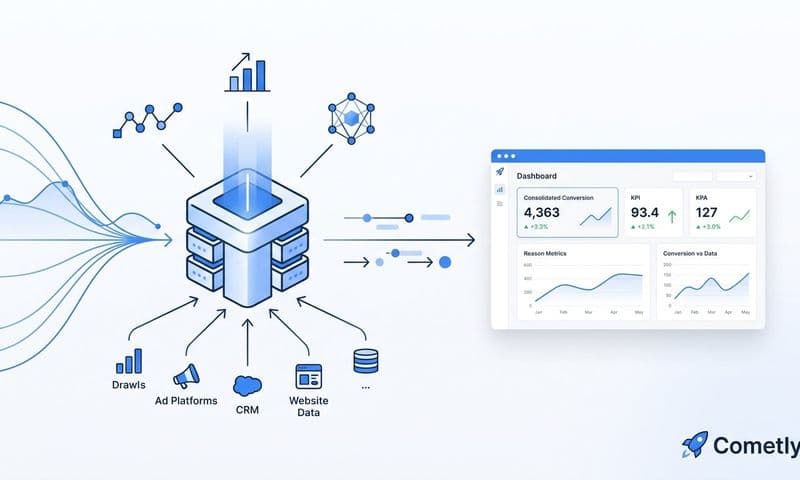
This is where advanced attribution platforms change the game. They act as an impartial referee, unifying data from all your marketing channels—Snapchat, Google, TikTok, email, and more—to map out the entire customer journey. This complete view reveals every single touchpoint that influenced a sale, from the first ad they saw to the last link they clicked.
This approach empowers you to make much smarter budget decisions. You can see which channels are best at introducing new customers (top-of-funnel) and which are better at closing deals (bottom-of-funnel). This clarity allows you to prove the full, often hidden, value of your Snapchat campaigns.
The dashboard below shows how an attribution tool visualizes this unified data, giving you a clear view of performance across all channels.
By seeing every interaction, you can confidently allocate your budget to the channels that are truly driving growth, not just the ones taking credit at the end.
This level of insight is becoming more critical as the platform grows. Snapchat's advertising revenue has seen a remarkable trajectory, with projections showing it will generate $6.11 billion in 2024 and climb to $7.26 billion by 2026. This momentum highlights advertisers' growing confidence, and with advertising making up about 96% of Snapchat's total revenue, the platform's success hinges on delivering measurable results for businesses like yours.
To truly understand the value and impact of your Snapchat ad spend, you can also delve into a practical guide to measuring social media ROI, which offers a framework applicable across platforms. Platforms that offer a unified view are no longer a "nice-to-have" but a necessity for serious performance marketers. To see how this works in practice, you can explore a demo of multi-touch attribution to understand how it can transform your marketing insights. By adopting this advanced measurement strategy, you can finally unlock the true ROI of your Snapchat business advertising efforts.
Got Questions About Snapchat Ads? We’ve Got Answers.
Even with a killer strategy ready to go, it's totally normal to have a few questions before you dive headfirst into a new ad platform. Think of this as your final pre-flight check, where we’ll clear up the most common things advertisers wonder about Snapchat business advertising. We're going to tackle these head-on so you can launch your first campaign with complete confidence.
Let's get into the stuff that’s probably on your mind, from how much this all costs to whether your business is even a good fit.
How Much Do Snapchat Ads Actually Cost?
There's no single price tag here. Snapchat runs on an auction system, which is great because it means you can get in the game with a daily budget as low as $5. What you actually end up paying for a result—whether that's a click, an install, or a sale—comes down to your campaign goal, how many other advertisers are targeting your audience, and frankly, how good your ads are.
The real key isn't your starting budget; it's how sharp you are with optimization. When you nail your audience targeting and—this is the important part—have accurate conversion tracking, you can figure out your true cost to acquire a customer. That's how you make sure every dollar you put in is bringing back a predictable, positive return.
Is My Business a Good Fit for Snapchat Ads?
Snapchat’s reputation is built on its massive Gen Z and millennial user base, but don't get it twisted—the audience is getting older and more diverse every day. It's an absolute powerhouse for DTC e-commerce brands, mobile apps, and any entertainment company that knows how to tell a story visually.
But honestly, success on Snap is less about your industry and more about your vibe. If your brand can create authentic, fun, vertical video content that feels like it belongs on the platform—and not like some polished corporate ad—you’ve got a fantastic shot. The only way to know for sure? Test it. Run a small, tightly tracked campaign and see how the audience bites.
How Do I Measure the Real ROI of My Snapchat Campaigns?
To get your true return on investment (ROI), you have to look beyond the dashboard inside Snapchat Ads Manager. Sure, the platform's numbers are a decent starting point, but they usually only give credit to the very last ad someone touched before buying. This "last-click" model gives you an incomplete, and often misleading, picture of what's really working.
To see the whole story, you need a dedicated third-party attribution platform. This means setting up solid server-side tracking to capture every single conversion, getting around browser limitations and privacy blockers. An attribution tool maps out the entire customer journey, showing you exactly how your Snapchat ads worked with your other channels—like Google or TikTok—to land that final sale. It reveals the total impact on your business, not just the final touchpoint.
What Are the Most Important KPIs to Track?
For any performance marketer worth their salt, the only Key Performance Indicators (KPIs) that truly matter are the ones tied directly to your bottom line. While engagement metrics like Swipe-Up Rate or Cost Per Click are helpful for diagnosing creative issues, your main focus should always be on the money metrics.
Here are the top KPIs you need to be watching like a hawk:
- Cost Per Purchase: This tells you exactly what you’re paying to get one customer. Simple and powerful.
- Return on Ad Spend (ROAS): This is the gross revenue you get back for every single dollar you spend on ads.
- Customer Acquisition Cost (CAC): This gives you the big-picture view of what it costs to get a new customer, factoring in all your marketing and sales expenses.
To track these with any real accuracy, you need an end-to-end attribution system that connects ad spend to actual revenue. If you want to get smarter on these critical financial metrics, you can learn more about the difference between ROAS vs ROI in our detailed guide. It's also a good idea to watch leading indicators like Add to Carts, as they can give you early clues about a campaign's health and where to optimize.
Ready to get a crystal-clear view of your Snapchat ad performance and unlock true ROI? Cometly is the marketing attribution platform that unifies your data, tracks every touchpoint, and reveals what's really driving sales. See how Cometly can transform your advertising strategy and book a demo today.