
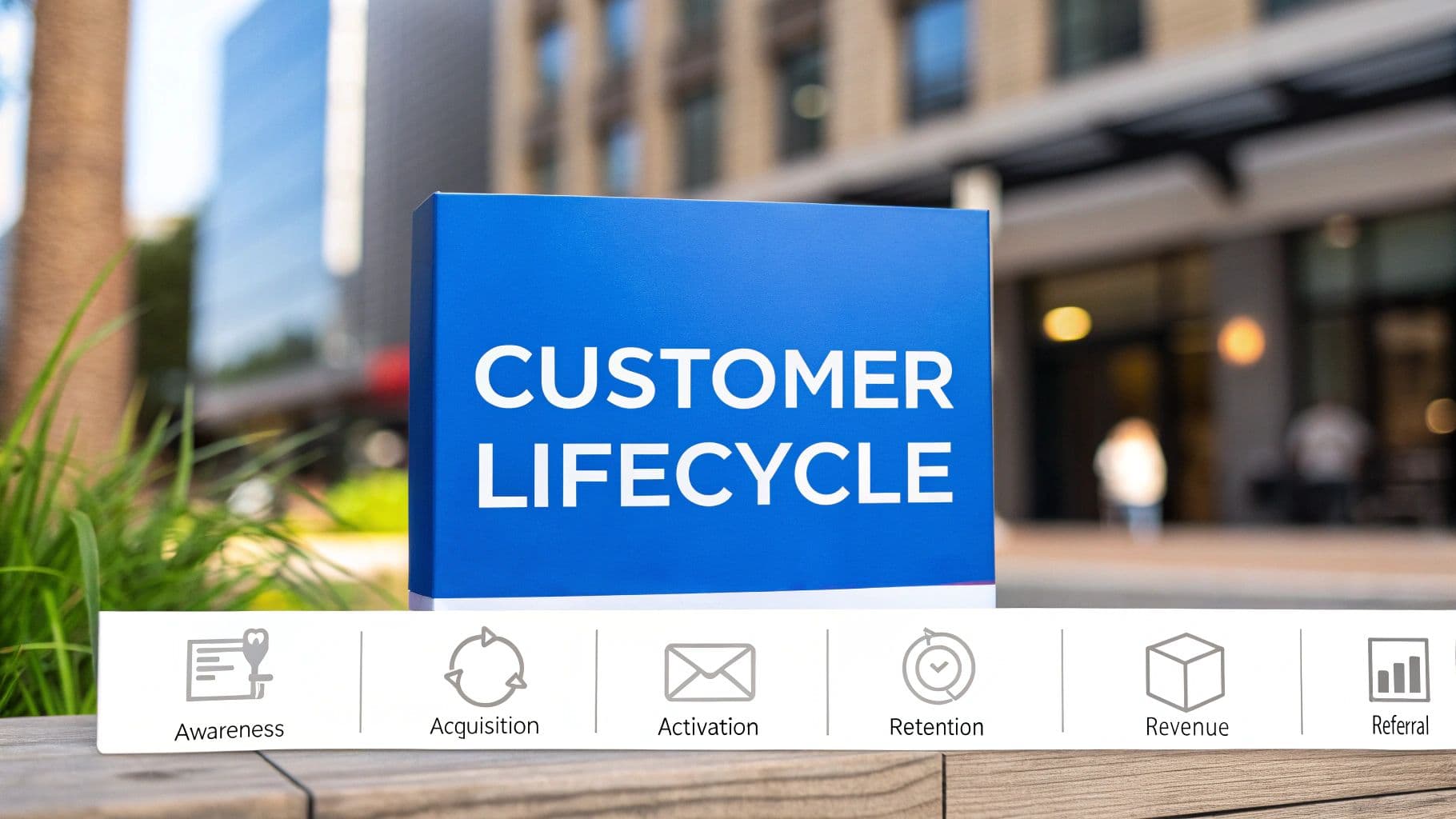
The stages of the customer lifecycle aren’t just some marketing theory—they’re a practical roadmap. This journey maps out the six key phases a person goes through with your brand, from their very first glimpse of you (Awareness) all the way to becoming a loyal fan who brings in Referrals. It’s how you turn random clicks into predictable, profitable relationships.
Your Roadmap to Customer-Led Growth
Too many businesses treat marketing like a series of disconnected campaigns. They pour money into ads without a clue what happens next, leading to wasted spend and a murky ROI. You’re left wondering which efforts actually drive sales and which ones are just making noise. The problem usually isn’t the channels you’re using; it’s the lack of a cohesive strategy that ties them all together.
When you don’t map the customer journey, you’re flying blind. You might be great at grabbing attention but terrible at turning that interest into a meaningful first experience. Or maybe you’re acquiring new customers, only to watch them churn a few weeks later because of a clunky onboarding process. Each stage of the lifecycle builds on the last, and a crack in one phase can break your entire growth engine.
This guide gives you an actionable framework to fix that. We'll walk through the six essential stages that form the backbone of sustainable growth:
- Awareness: Making that critical first impression.
- Acquisition: Turning passive interest into active engagement.
- Activation: Delivering that all-important 'Aha!' moment.
- Retention: Building long-term, profitable relationships.
- Revenue: Maximizing the lifetime value of every customer.
- Referral: Creating brand advocates who fuel your next wave of growth.
By understanding and optimizing each phase, you can build a seamless experience that guides people from discovery to loyalty. This approach gives you the clarity to make data-driven decisions that turn marketing spend into real, measurable results. It's the core idea behind any solid growth strategy, including the principles of product-led growth (PLG).
Visualizing the Customer Journey
To get a clearer picture of this progression, take a look at the roadmap below. It lays out the critical early phases where a prospect transforms into an engaged customer.
 Understanding the 6 Stages of Customer Lifecycle
This visual shows how someone moves from simply knowing your brand exists (Awareness), to actually experiencing its value (Activation), and finally developing a lasting connection (Loyalty). Each step demands a different strategic focus and its own set of metrics to track success. With modern attribution tools, you can get the clarity needed to optimize this entire flow, making sure every effort contributes directly to building a loyal customer base and predictable revenue.
Stage 1: Awareness — Making a Memorable First Impression
The customer journey doesn't kick off with a click or a purchase. It starts with a simple spark of recognition. This is the Awareness stage, where a complete stranger first bumps into your brand. Think of it as your digital billboard—that moment a potential customer is scrolling through social media, searching on Google, or reading an article and suddenly sees you for the first time.
 Understanding the 6 Stages of Customer Lifecycle
This stage isn’t about making a sale; it's about making an introduction. The goal is to get in front of the right audience and plant a seed. These first impressions are everything. In fact, a massive 85% of consumers do their own research online before ever making a purchase, which just goes to show how critical a strong, visible presence is from day one. You can read the full analysis on customer lifecycle management to see how this early research shapes the entire journey.
Key Channels for Building Awareness
Your strategy here is pretty straightforward: meet potential customers where they already hang out. Different businesses will find their sweet spot on different platforms, and the trick is to align your channel with your audience.
- Paid Advertising: Platforms like Google Ads, LinkedIn Ads, and Meta (Facebook/Instagram) are perfect for targeting specific demographics and interests with laser precision.
- Content Marketing & SEO: Creating genuinely helpful blog posts, videos, or guides that answer your audience's questions helps them discover you organically through search engines.
- Social Media: Building a community and sharing content that people actually want to see creates consistent, low-cost visibility.
- Influencer Marketing: Partnering with creators who already have a trusted relationship with your target market can give your brand an authentic introduction.
For a SaaS company, this might look like a highly targeted LinkedIn ad campaign aimed at specific job titles. An e-commerce brand, on the other hand, might partner with an Instagram influencer to show off a new product line to an engaged audience. Before you spend a dime, it’s crucial to learn how to identify your target audience to make sure your message actually lands.
Measuring What Matters in the Awareness Stage
At this early stage, you aren’t measuring sales; you’re measuring attention. Success is all about your ability to get in front of the right eyeballs and spark some interest.
The core challenge in the Awareness stage is first-touch attribution. Without clear tracking, you're just guessing which channels are truly kickstarting the most valuable customer journeys.
This is where accurate tracking becomes non-negotiable. You absolutely have to know which ad, blog post, or social share was the very first interaction that led a future customer down the path to your brand.
Here are the critical KPIs for this stage:
- Impressions: The total number of times your ad or content was displayed.
- Reach: The number of unique people who saw your content.
- Click-Through Rate (CTR): The percentage of people who saw your ad or link and actually clicked on it.
- Website Traffic: The volume of new visitors coming to your site from all your different channels.
Modern tracking tools like Cometly are built to capture every single interaction, right from the beginning. This gives you the clarity to see which channels aren't just generating impressions, but are actually starting the journeys that eventually lead to revenue. It's how you invest your budget with confidence, not just hope.
Stage 2: Acquisition – Turning Interest into Action
If the Awareness stage is catching someone's eye across the room, the Acquisition stage is when they walk over to introduce themselves. This is the moment passive interest flips into a deliberate, measurable action. It’s the handshake that officially starts a potential relationship.
This phase is all about a clear exchange of value. A prospect gives you something—usually their contact information—in return for something they want. They’re no longer just seeing your content; they’re actively engaging with it.
From Passive Viewer to Active Lead
The biggest difference between Awareness and Acquisition is intent. Someone might see your ad or read your blog in the Awareness stage and just move on. But in the Acquisition stage, they take a conscious step that signals genuine interest. This is where a visitor becomes a known lead.
Common acquisition actions include:
- Signing up for a free trial for a SaaS product.
- Downloading a resource like an ebook, whitepaper, or case study.
- Subscribing to a newsletter to get regular updates.
- Creating an account on an e-commerce site.
- Requesting a demo or consultation from an agency.
Each of these actions gives you a direct line of communication, turning an anonymous blip on an analytics chart into a real lead in your system. It's a critical step in building a predictable customer acquisition funnel.
Measuring Success in the Acquisition Stage
While Awareness is measured by reach and impressions, Acquisition is all about conversion efficiency. You’re no longer just asking, "How many people saw us?" Now, the critical question is, "How many of those people took the next step, and at what cost?"
The goal of the Acquisition stage isn't just to generate leads; it's to generate the right leads efficiently. A high volume of low-quality leads can be more damaging than a small number of high-quality ones, as it wastes sales and marketing resources down the line.
To track this effectively, you need to focus on specific, action-oriented KPIs:
- Conversion Rate: The percentage of visitors who complete a desired action (e.g., the percentage of landing page visitors who sign up for a trial).
- Cost Per Acquisition (CPA): The total cost of a marketing campaign divided by the number of conversions. This tells you exactly how much you're paying for each new lead.
- Lead Quality Score: A metric (often automated in CRMs) that grades leads based on their firmographic data and on-site behavior, helping you prioritize follow-up.
To help you keep these early stages straight, here’s a quick summary of the key metrics and goals for the first three phases of the customer lifecycle.
If you're evaluating vendors, our AI UGC creator breakdown can help.
Key Metrics Across the First Three Lifecycle Stages
In the awareness stage, the primary goal is to generate reach and spark initial interest in your brand or offer. Marketers typically track KPIs like impressions, reach, ad recall, and website traffic, and the most common channels used here include social ads, SEO, content marketing, and PR.
In the acquisition stage, the goal shifts to converting anonymous visitors into known leads that you can follow up with and nurture. Key KPIs at this stage include conversion rate, cost per acquisition (CPA), and total leads generated, with common channels including gated content, webinars, free trials, and newsletters.
In the activation stage, the focus is on getting those new leads to actually experience the product’s value as quickly as possible. Success is usually measured through product usage, feature adoption, and whether users reach the “aha!” moment, and this stage is often driven by onboarding emails, in-app guides, and demos.
If you're evaluating vendors, our AI product ad generator breakdown can help.
This table provides a high-level view, but remember that the real magic happens when you connect the dots between these stages to understand the full customer journey.
Optimizing Your Acquisition Engine
Strong acquisition performance comes down to creating a frictionless path to conversion. This is where your prospects engage directly—submitting forms, starting chats, or browsing products—and where you absolutely cannot afford to fly blind. Every click and form fill needs to be tracked precisely to avoid wasted ad spend.
For Cometly users in e-commerce and DTC, this is where one-click syncs from CRMs like Salesforce capture every touchpoint, revealing that multi-channel campaigns boost acquisition rates by 28% compared to single-source efforts.
A unified view of the customer journey is essential here. By connecting ad clicks directly to sign-ups, you can see which campaigns are acquiring high-value leads, not just generating cheap clicks. That clarity allows you to confidently reallocate your budget, cutting spend on channels that drive traffic but fail to convert, and doubling down on the ones that truly deliver results.
Stage 3 Activation Delivering the 'Aha!' Moment
Alright, so you’ve captured a lead. They’ve signed up, downloaded your app, or booked a call. What happens next is arguably the most important step in the entire customer lifecycle: Activation. This is where you have to prove your value, and fast.
Activation is all about guiding that new user to their “Aha!” moment. It’s that flash of insight where they truly get how your product solves their problem.
 Understanding the 6 Stages of Customer Lifecycle
Think of it like this: Acquisition was getting them to book a test drive. Activation is the moment they hit the gas, feel the engine roar, and think, "Yep, this is the car for me." For a SaaS tool, that might be when they create their first project and share it with a teammate. For an e-commerce brand, it could be the smooth, satisfying experience of their first purchase arriving on time.
Get this stage right, and you have a customer for life. A successful activation is the single best predictor of long-term retention. Users who feel that initial rush of value are far, far more likely to stick around.
From Sign-Up to Success Story
The main goal here is to shrink the Time to Value (TTV). That’s the time it takes for a new user to get a meaningful result from what you offer. A long, confusing, or frustrating TTV is a one-way ticket to churn. Your job is to create a frictionless path that helps them achieve something valuable as quickly as humanly possible.
To pull this off, you first need to identify the key actions that correlate with long-term customer success. These "activation milestones" are the signposts on the road to that "Aha!" moment.
- For a project management tool: It could be creating a new project, adding three tasks, and inviting one team member.
- For an e-commerce app: Maybe it’s adding an item to their cart, using a first-time buyer discount code, and completing the checkout.
- For an agency: This might be attending the kickoff call and giving the final sign-off on the project brief.
Each milestone is a small win that brings the user one step closer to fully embracing your solution. You can learn more about defining your product's Aha! Moment to start pinpointing these critical actions for your own business.
Measuring the 'Aha!' Moment
Optimizing this stage means tracking how well users are hitting these milestones. Generic metrics just won't do; you need to measure specific behaviors that signal real engagement.
The real challenge of activation is connecting your pre-acquisition marketing efforts to post-acquisition user behavior. Without this link, you might acquire thousands of users who sign up and then disappear, wasting your ad spend on audiences that never truly activate.
Here are the essential KPIs you should be watching for the Activation stage:
- Product Adoption Rate: The percentage of new users who use a key feature within a specific timeframe (e.g., the first 7 days).
- Time to Value (TTV): The average time it takes for a new user to complete a core activation milestone.
- Onboarding Completion Rate: The percentage of users who actually finish your entire onboarding flow, like tutorials or setup checklists.
- Feature Adoption Rate: This tracks the usage of specific, high-value features that go beyond the initial setup.
This is where a powerful attribution tool like Cometly connects the dots. It lets you see which of your Facebook or Google ad campaigns are driving sign-ups from users who actually complete your onboarding, adopt key features, and become loyal customers.
That clarity is everything. It allows you to shift ad spend toward acquiring users who are most likely to stick around, which dramatically improves your ROI.
Stage 4: Retention — Nurturing Profitable Relationships
Getting a customer is a huge win, but let's be honest—the journey is far from over. Sustainable growth isn’t built on a revolving door of new faces. It’s forged in the relationships you build after the initial sale. This is the Retention stage, and it’s the engine room of a truly profitable business.
 Understanding the 6 Stages of Customer Lifecycle
Think of it this way: Acquisition is like planting a seed. Activation is seeing it sprout. But Retention? That’s the consistent watering, sunlight, and care that turns it into a strong, fruit-bearing tree. If you neglect it, it withers.
This stage is all about keeping post-purchase relationships alive to prevent churn and boost lifetime value (CLV). The data doesn't lie: retaining a customer is 5-25 times more cost-effective than acquiring a new one. As ad budgets tighten, the brands that thrive are the ones with die-hard fans. In fact, a retention rate above 90% often correlates with a 95% probability of future revenue from existing customers—a vital metric for any SaaS or DTC brand.
Why Customers Stay and Why They Leave
At its core, retention is about delivering ongoing value. Customers stick around when they feel seen, supported, and confident that your product or service is still the best solution for their needs.
On the flip side, they leave because of bad service, a lack of perceived value, or—worst of all—feeling totally ignored after you’ve taken their money.
Understanding the root causes of churn is the first step toward plugging the leaks. Proactive support, personalized communication, and continuous product improvements are the pillars of a strong retention strategy. This focus helps you dodge the high costs associated with customer attrition and how to combat it.
Key Metrics for Measuring Customer Loyalty
To get a grip on retention, you need to track the right numbers. These KPIs give you a clear pulse on customer health and help you spot churn risks before it’s too late.
The Big Idea: Retention isn't a passive outcome; it's an active strategy. It requires you to continuously prove your value and build a relationship that customers don't want to leave.
Here are the essential metrics to have on your dashboard for the Retention stage:
- Customer Lifetime Value (CLV): The total revenue you can expect from a single customer over their entire relationship with you. Growing this number is the ultimate goal of retention.
- Churn Rate: The percentage of customers who cancel or don't renew their subscription in a given period. This is your primary retention health indicator.
- Net Promoter Score (NPS): A simple survey-based metric that asks customers how likely they are to recommend your brand. It’s a powerful gauge of satisfaction and loyalty.
- Repeat Purchase Rate: For e-commerce, this is the percentage of customers who come back for more. A high rate means you’ve built a product people can’t get enough of.
Actionable Strategies for Boosting Retention
Building loyalty demands a proactive, multi-faceted approach. You can't just cross your fingers and hope customers stay; you have to give them compelling reasons to do so. A SaaS company might re-engage inactive users with an automated email sequence highlighting new features, while an e-commerce brand could launch a tiered loyalty program with exclusive rewards.
Here are some proven tactics to get you started:
- Personalized Communication: Send targeted emails based on user behavior. Celebrate milestones, offer tips for features they haven't used yet, or send a special offer on their birthday.
- Proactive Support: Don't wait for them to complain. Reach out to customers whose usage has dropped or who seem to be struggling, offering help before they even have to ask.
- Loyalty Programs: Reward repeat business with points, discounts, or early access to new products. Make them feel like insiders.
- Feedback Loops: Actively ask for and act on customer feedback. Use surveys and reviews to show you're listening and that their input actually matters.
By tracking the entire customer journey, tools like Cometly allow you to attribute repeat revenue back to specific retention campaigns. This clarity helps you spot behaviors that signal a customer might be about to leave, empowering you to intervene with the right message at the right time and protect your most valuable asset: your existing customer base.
Stages 5 & 6 Revenue and Referral: Creating a Growth Flywheel
So, you’ve successfully activated and retained your customers. This is where most businesses stop, but it’s also where sustainable growth really begins. The final stages of the customer lifecycle are all about maximizing the value of the relationships you’ve built and turning that satisfaction into a powerful engine for new growth.
This is how you transform loyal users into profitable partners and brand advocates. It’s how you build a self-sustaining growth flywheel.
These last two phases—Revenue and Referral—are what close the loop. They take all the positive energy from your happiest customers and feed it right back into the Awareness stage for a whole new generation of prospects.
Stage 5: Maximizing Customer Lifetime Value
The Revenue stage is where you deepen the financial relationship with your existing customer base. Think about it: the first purchase is just the starting line. The real opportunity is in increasing the Customer Lifetime Value (CLV) of the people you’ve already worked so hard to win over.
It's way more efficient to grow revenue from a happy customer than to acquire a brand-new one from scratch.
This stage isn't about one-off transactions; it's about a continuous exchange of value. You've already proven you understand their needs, and now you're perfectly positioned to offer them more advanced solutions that help them get even better results.
Proven strategies to expand revenue from existing customers include:
- Upselling: This is all about encouraging customers to upgrade to a more advanced, feature-rich, or higher-tier version of your product. A SaaS company might offer a growing business its "Pro" plan with advanced analytics.
- Cross-selling: Here, you're offering complementary products or services that make their current experience even better. An e-commerce store could suggest a protective case to someone who just bought a new camera.
- Add-ons: This involves selling additional features, modules, or services that can be bolted onto a customer's existing plan. An agency, for instance, might offer social media management as an add-on to a client's SEO package.
Stage 6: Turning Customers into Advocates
The final and most powerful phase is the Referral stage. This is where your customer lifecycle completes its circle and becomes a true growth flywheel. A delighted customer who has experienced your value firsthand becomes your most authentic and effective marketing channel.
Honestly, their word-of-mouth recommendation carries more weight than any ad you could ever run.
When a customer becomes a brand advocate, they aren't just loyal—they're a volunteer marketer. This is the pinnacle of the customer relationship, where their success actively fuels your own.
Getting referrals isn't something you can just hope for; it requires a deliberate strategy. You have to make it easy and rewarding for happy customers to spread the word. This is how you transform passive satisfaction into active advocacy, turning one happy customer into many more.
Here are a few actionable ways to generate referrals:
- Implement a Referral Program: Offer tangible incentives like account credits, discounts, or even cash rewards for every new customer an existing user brings in.
- Request Reviews and Testimonials: Don't be shy. Actively ask satisfied customers to leave reviews on platforms like G2, Capterra, or Google. Then, use that positive feedback as social proof in your marketing.
- Create Shareable Content: Develop case studies or success stories that feature your best customers. When they share it with their network, they're not just sharing content—they're endorsing your brand.
The real challenge here is actually tracking the ROI of these efforts. With a tool like Cometly, you get full-funnel visibility. This lets you track a newly referred customer all the way back to the original advocate who sent them your way.
This closes the loop on your customer lifecycle, helping you measure the true financial impact of your referral programs and, more importantly, identify your most valuable brand champions.
Frequently Asked Questions
Even with a clear map of the customer lifecycle, a few common questions always pop up. Let's dig into some of the nuances, like how this all applies to different business models and where you should really focus your energy for the biggest impact.
How Do Lifecycle Stages Differ for B2B vs B2C?
While the core journey from Awareness to Referral is universal, the way it plays out for Business-to-Business (B2B) and Business-to-Consumer (B2C) companies is night and day. The biggest differences really boil down to the length of the sales cycle, how decisions get made, and the kinds of touchpoints that matter most.
- B2B Cycles are Longer: The B2B journey is a marathon, not a sprint. It often involves multiple stakeholders, drawn-out approval processes, and much higher stakes. This means the Awareness and Acquisition stages can stretch over months, demanding sustained nurturing with things like case studies, webinars, and detailed proposals.
- B2C Cycles are Shorter and More Emotional: A B2C purchase is usually made by one person and is often driven by emotion, brand appeal, or an immediate need. The path from seeing an ad to making a purchase can happen in a single session, which makes a frictionless checkout and powerful social proof absolutely critical.
- Touchpoints Vary: In B2B, retention is built on solid account management, dedicated support, and consistently proving ROI. For B2C, it’s often about loyalty programs, personalized email marketing, and building a community on social media.
What Is the Most Important Lifecycle Stage?
Every stage is vital for a healthy customer journey, but if you’re forced to pick just one area to focus on, the Activation and Retention stages usually offer the most leverage for long-term, profitable growth.
Think about it: Acquisition can easily become a vanity metric if new users don't actually stick around. A customer who signs up but never truly experiences the core value of your product (Activation) is just a wasted acquisition cost.
Likewise, a business that's a revolving door—constantly acquiring new customers but unable to keep them (Retention)—is stuck on a treadmill. You’re perpetually spending money just to replace what you lose.
Focusing on Activation ensures your marketing dollars lead to engaged users, not just sign-ups. Prioritizing Retention builds a stable revenue base and creates the loyal customers who will eventually become your best source of referrals.
How Can a Small Business Apply These Principles?
You don’t need a giant budget or a complicated tech stack to put these customer lifecycle principles to work. Small businesses can make a huge impact by focusing on practical, low-cost strategies that build strong relationships right from the start. The key is to be intentional and consistent.
Here are a few ideas you can act on today:
- Simple Email Automation: Use an affordable tool to set up a welcome email series that guides new leads through Activation. Show them exactly how to get started and highlight the key benefits they can achieve in the first few days.
- Focus on Excellent Service: For a small business, personal and responsive customer service is a massive competitive advantage. Quick, helpful support is one of the most powerful retention tools you have at your disposal.
- Encourage Referrals Directly: After a customer has a great experience or leaves a glowing review, don't be afraid to ask for a referral. A simple, personal request can turn a happy customer into a powerful advocate, closing the loop on the entire customer lifecycle.
Ready to gain full visibility into every stage of your customer lifecycle? Cometly provides the clear, accurate attribution you need to stop guessing and start making data-driven decisions that boost your ROI. See how Cometly can transform your marketing strategy.