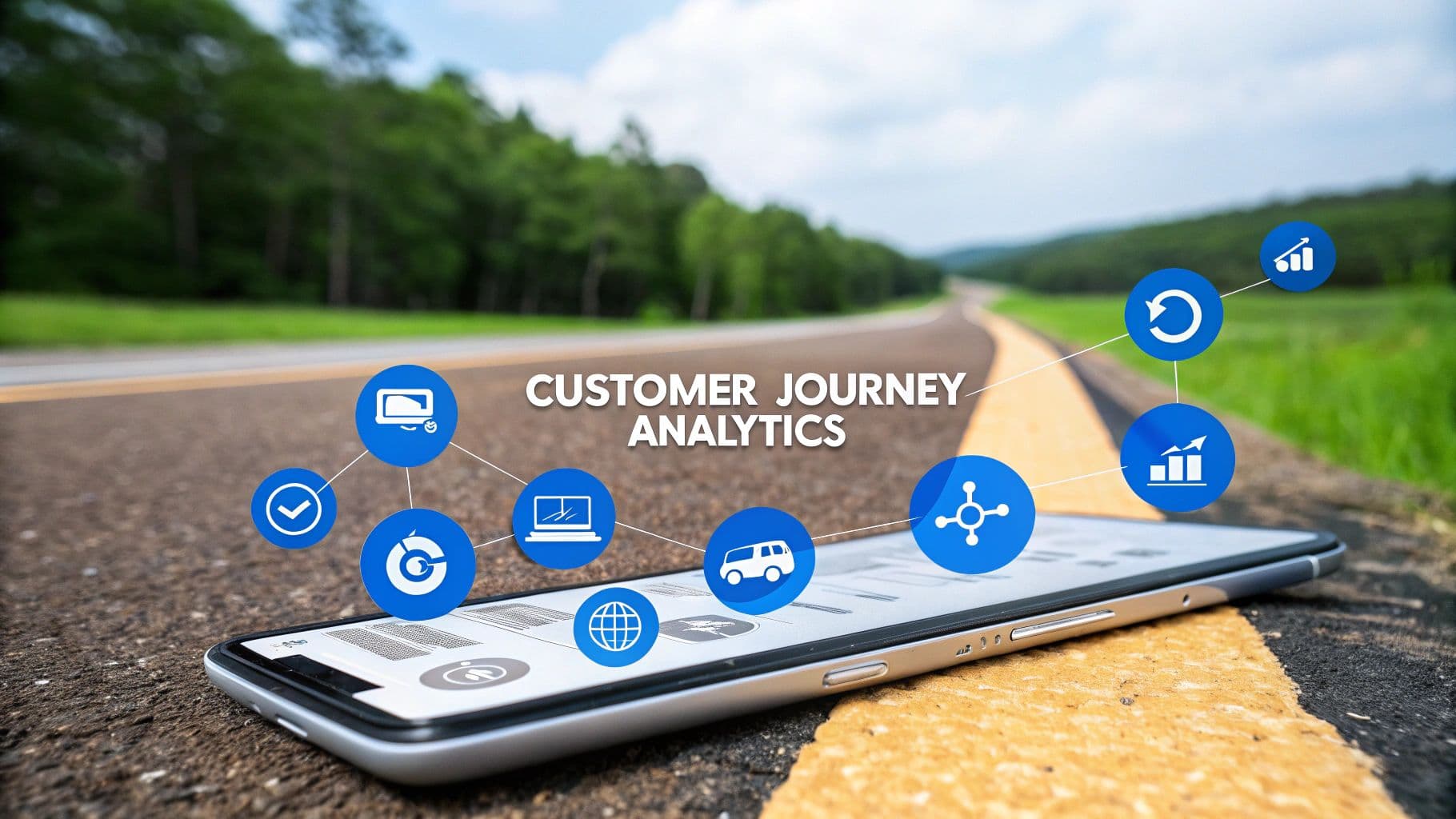
Customer Journey Analytics (CJA) is all about piecing together every single interaction a customer has with your brand—across every channel—into one chronological story. It’s about moving beyond isolated snapshots, like ad clicks or page views, to see the entire road trip a customer takes with your business. This unified view uncovers the real paths people follow, shining a light on friction points and moments of delight that traditional metrics completely miss.
Understanding the Customer’s Complete Story
Imagine trying to understand a blockbuster movie by only watching random five-second clips. You might see a car chase, a quiet conversation, and the final scene, but you’d have zero clue how they all connect. That's the huge limitation of traditional analytics; it just gives you isolated data points like website traffic, email open rates, or conversion events. While those numbers are useful, they fail to show the why behind what your customers are doing.
Customer Journey Analytics, on the other hand, is like watching the entire film from start to finish. It connects the dots between a user’s first ad view on Instagram, their multiple visits to your site, a quick chat with customer support, and their eventual purchase. It’s about seeing the full, and often messy, path customers actually take.
Beyond Simple Metrics
This approach flips the script, shifting the focus from siloed, channel-specific performance to a holistic, customer-centric view. Instead of just asking, "How many people clicked our ad?" CJA helps you answer much more powerful questions:
- Which sequence of touchpoints most often leads to a high-value purchase?
- Where do potential customers get stuck or drop off between channels?
- How do our support interactions actually influence a customer's likelihood to buy again?
- What's the true ROI of that top-of-funnel blog post someone read weeks before they finally converted?
By mapping these real-world interactions, you can finally understand the nuances of customer behavior. You'll learn more about the different customer journey touchpoints and how they all work together to drive the final outcome.
Customer Journey Analytics provides the narrative context that raw data lacks. It transforms a list of disconnected events into a coherent story about a customer's experience, revealing crucial insights for optimizing their path from awareness to advocacy.
This shift isn't just a trend; it's a fundamental change in how modern businesses compete. The global customer journey analytics market is exploding, growing from approximately $14.54 billion to $17.35 billion, which reflects a compound annual growth rate of about 19.4%. This growth is fueled by one simple truth: an exceptional customer experience is the primary competitive advantage for today's brands. Discover more insights about the future of customer journey analytics.
To really grasp the difference, let's break down how CJA stacks up against the analytics you're probably used to.
Traditional Analytics vs Customer Journey Analytics
Aspect | Traditional Analytics | Customer Journey Analytics |
|---|---|---|
Primary Focus | Channel performance such as website traffic or ad clicks | The full end to end customer experience |
Data Scope | Siloed and channel specific tools like web analytics platforms | Unified data across web, mobile, ads, support, and CRM |
Unit of Analysis | Anonymous sessions, clicks, or isolated events | A single identified customer tracked over time |
Key Question | What happened on this individual channel | Why did this customer behave the way they did |
Insights | Tactical metrics like bounce rate or click through rate | Strategic insight into behavior, friction, and lifetime value |
Goal | Optimize channels in isolation | Optimize the entire path to purchase and long term retention |
Ultimately, CJA helps your organization break free from siloed thinking. It creates a single source of truth about the customer that aligns marketing, sales, and support teams around one common goal: delivering a seamless and valuable experience at every single step.
The Pillars of an Effective CJA Strategy
A killer Customer Journey Analytics (CJA) strategy isn't something you can just buy off the shelf. It’s a structure built on four interconnected pillars. When these components click, they turn scattered data points into a powerful engine for business growth. Think of it like building a high-performance car—every single part has to work together perfectly to get you where you want to go.
This diagram shows the fundamental shift from looking at siloed, channel-specific metrics to seeing the entire customer-centric journey.
 What Is Customer Journey Analytics
It puts the individual customer front and center, analyzing their complete path instead of just isolated data sets like website traffic.
Pillar 1: Data Unification
The foundation of everything is Data Unification. Right now, your customer data is probably all over the place. Your CRM has sales interactions, Google Ads has click data, your website tracks behavior, and your support desk logs tickets. Each system tells a tiny piece of the story, leaving you with a messy, fragmented picture.
Data unification is the process of knocking down those silos. You pull information from every source and stitch it all together to create one single, cohesive profile for each customer. This unified view is the bedrock for everything else in CJA. Of course, this only works if your data is clean. A great place to start is learning how to improve data quality to ensure your foundation is solid.
Without this, you’re just analyzing channels in isolation, completely missing how a click on one platform drives an action on another.
Pillar 2: Journey Visualization
Once your data is in one place, the next pillar is Journey Visualization. This is where raw data becomes an intuitive, easy-to-read map showing the actual paths your customers take. It’s the difference between staring at a spreadsheet of coordinates and seeing a detailed GPS map of a road trip.
These visualizations reveal patterns you’d never spot in raw numbers. You can see the most common sequences of touchpoints that lead to a purchase, pinpoint where people get stuck, and discover the "happy paths" your best customers follow.
Journey visualization makes your understanding tangible. You stop guessing what customers might do and see exactly what they are doing, step by step.
This clarity makes it simple to share insights across the company. A marketer, a product manager, and a support agent can all look at the same journey map and instantly get on the same page about where the customer experience is working or failing.
Pillar 3: Advanced Attribution
The third pillar, Advanced Attribution, tackles one of marketing's oldest problems: knowing what really works. For decades, we’ve relied on simplistic models like "last-click," which gives 100% of the credit to the final touchpoint before a sale. This model is dangerously misleading because it ignores every other interaction that guided the customer’s decision.
Advanced attribution, a core part of CJA, uses smarter models (like linear, time-decay, or data-driven) to assign credit accurately across the entire journey. It recognizes the value of the first blog post a customer read, the retargeting ad they saw, and the email they opened weeks before buying. The goal is to tap into the power of customer intelligence by understanding every single contributing factor.
This lets you make much smarter budget decisions, investing in channels that have a proven impact on revenue—not just the ones that happen to get the last click.
Pillar 4: Predictive Insights
The final and most forward-thinking pillar is Predictive Insights. This is where modern CJA platforms use AI and machine learning to analyze past journey data and forecast future behavior. It’s about shifting from reactive analysis to proactive optimization.
Predictive analytics can:
- Identify Churn Risk: By spotting behavioral patterns that led to churn in the past, the system can flag at-risk customers before they leave.
- Recommend Next Best Actions: AI can analyze a customer's current path and suggest the most effective next step to nudge them toward conversion.
- Forecast Lifetime Value: The system can predict the potential long-term value of a new customer based on their early interactions.
This pillar transforms your customer journey analytics from a historical record into a strategic weapon, helping you anticipate customer needs and shape their future experiences for better results.
How CJA Drives Real Business Growth
Switching to customer journey analytics isn't just an analytics upgrade—it's a direct investment in your bottom line. When you stop looking at isolated channel metrics and start seeing the complete customer story, you uncover powerful growth opportunities that were invisible before. The result isn't just better charts; it's a healthier business.
 What Is Customer Journey Analytics
This shift is creating a massive market. In the U.S. alone, customer journey analytics was valued at around $2.4 billion and is expected to hit $8.032 billion by 2030. That rapid 16.3% CAGR is all about one thing: businesses need AI-driven personalization to keep up with the explosion of digital touchpoints.
Radically Improve Customer Experience
The most immediate win from CJA is the ability to find and eliminate hidden friction points. Old-school analytics might show you a high bounce rate on a landing page, but CJA reveals the chaotic, multi-step path users took to get there in the first place, exposing the real reason they got frustrated.
By mapping out these actual journeys, you can pinpoint exactly where customers get stuck, which steps are confusing, and what content just isn't hitting the mark. Fixing these issues leads directly to a smoother, more intuitive experience that boosts satisfaction and builds real brand loyalty.
A seamless journey isn't a luxury; it's a core expectation. CJA gives you the roadmap to find and fix the potholes your customers are hitting, turning frustrating experiences into moments of delight.
Maximize Marketing ROI with Smarter Attribution
Are your marketing dollars actually doing their job? Last-click attribution often gives you a misleading answer, giving all the credit to bottom-funnel channels while completely ignoring the interactions that started the conversation. CJA replaces that guesswork with pure clarity.
With precise, multi-touch attribution, you can finally see how every single ad, email, and social post contributes to the final sale. This lets you:
- Reallocate spend: Shift your budget away from underperforming channels and double down on the campaigns that genuinely move the needle.
- Optimize creative: Understand which messages and ad formats resonate most effectively at different stages of the journey.
- Prove your value: Clearly show the impact of your marketing efforts on revenue, not just vanity metrics like clicks or impressions.
A huge benefit here is finding opportunities to improve, which feeds directly into stronger conversion rate optimization best practices.
Increase Retention and Lifetime Value
Getting a new customer is expensive; keeping one is profitable. CJA delivers the deep behavioral insights you need to increase customer lifetime value (LTV). By understanding how your best customers engage with your brand, you can start replicating those "happy paths" for everyone else.
This understanding allows for timely, personalized interventions. For example, you can spot behaviors that signal a high risk of churn and proactively reach out with support or a special offer. You can also identify engagement patterns that point to an upsell opportunity, letting you deliver the perfect message at the perfect time. If you want to dive deeper, you can learn how to track a customer journey to capture these critical signals.
Break Down Internal Silos
Finally, CJA creates a universal, customer-focused language that gets your entire organization on the same page. When marketing, sales, and support teams are all looking at the same unified journey map, those departmental silos start to crumble.
Instead of operating with separate goals and metrics, every team can see how their work impacts the overall customer experience. This shared perspective fosters collaboration and gets everyone focused on the common goal of delivering exceptional value—driving sustainable growth from the inside out.
Your Step-By-Step CJA Implementation Roadmap
Jumping into customer journey analytics can feel like a massive undertaking. But it doesn't have to be.
By following a clear, structured roadmap, you can move from scattered data to actionable insights without getting lost in the weeds. This practical, four-step process breaks it all down into manageable stages, ensuring you build a strategy that delivers real business value from day one.
 What Is Customer Journey Analytics
Think of this as your blueprint for building a powerful, customer-centric analytics engine.
Step 1: Define Clear Objectives
This is where most businesses go wrong. They dive headfirst into data collection without a clear goal in mind. Before you track a single event, you absolutely must start with a specific business question you need to answer. This focus keeps you from drowning in irrelevant data and ties your efforts directly to business outcomes.
Don't just aim to "understand the customer journey." Get specific. Your objective should be a focused question that analytics can actually solve, like:
- Which combination of blog posts and social ads leads to the most trial sign-ups?
- What’s the average time between a customer's first website visit and their first purchase?
- Where are users dropping off most frequently during our onboarding sequence?
Starting with a clear "why" makes every other step more efficient and impactful. It gives your entire project a North Star, guiding your data collection, platform selection, and analysis.
Step 2: Consolidate Your Data Sources
With your objective locked in, it's time to gather the raw materials. Your customer data is likely spread across a dozen different tools—your CRM, ad platforms, email service, website analytics, and support desk. To build a unified view, you have to bring all these sources together.
Start by auditing your current tech stack. Identify every single platform that captures a piece of the customer story. Not all data is created equal, so prioritize the touchpoints most relevant to the objective you defined in step one. This ensures you focus on high-impact data instead of trying to boil the ocean.
This consolidation is the technical backbone of your CJA strategy. It’s all about creating a single source of truth that allows you to connect a Facebook ad click to a website session and, eventually, a Stripe payment.
Step 3: Select the Right Platform
Once you know what you want to achieve and which data you need, it's time to choose the right tools for the job. The platform you pick will be the engine that processes your data and turns it into coherent journey maps and insights. Don't get distracted by flashy features; focus on what truly matters for your goals.
Key features to look for include:
- Seamless Integrations: The platform must easily connect to your existing data sources (e.g., Shopify, Salesforce, ad networks) to make consolidation painless.
- Powerful Attribution Models: It should offer flexible, multi-touch attribution models that go beyond the simplistic last-click approach.
- Intuitive Visualization: The ability to create clear, easy-to-understand journey maps is non-negotiable for sharing insights across teams.
As you evaluate options, consider the industry-wide shift toward cloud-based solutions. Cloud deployments now command over 61% of the market share and are projected to grow at a CAGR of about 25.7% through 2030. This is because cloud platforms offer the scalable power needed for real-time analysis, often with flexible pricing. You can explore more about this market trend and its drivers on Mordor Intelligence.
For a deeper dive into specific options, check out our guide on choosing the right customer journey analytics tools.
Step 4: Turn Insights Into Action
This is the final and most crucial step: closing the loop by acting on what you've learned. Data without action is just an expensive hobby. Your goal is to analyze the visualized journey maps, identify clear opportunities for improvement, and implement changes that deliver measurable results.
An insight is only valuable when it inspires change. The true power of CJA isn't in the data it collects, but in the smarter decisions it enables.
Start by looking for patterns. Where are the friction points? What are the common paths your highest-value customers take? Use these findings to form hypotheses, like, "If we simplify our checkout form, we can reduce cart abandonment by 15%."
Then, test your hypothesis, measure the impact, and iterate. This continuous cycle of analysis, action, and measurement is what drives sustainable growth.
Navigating Common CJA Implementation Hurdles
While the payoff of customer journey analytics is huge, getting there isn't always a walk in the park. Businesses often hit the same predictable roadblocks that can stall their efforts before they even get off the ground. But here's the good news: modern platforms are built specifically to smash through these old walls, turning what used to be major headaches into clear pathways for growth.
Knowing what these hurdles are is the first step. The biggest problems usually aren't about a lack of will—they’re about the sheer difficulty of wrangling messy, complicated data and making it tell a coherent story. Let's break down the three biggest challenges you’ll face and how to get past them.
Overcoming Data Silos
The single biggest obstacle is, without a doubt, data silos. Your customer data is probably scattered across a dozen different tools that don't talk to each other. Your CRM has the sales history, your ad platforms hold the click data, and your help desk has every support ticket. Trying to understand a customer from this mess is like trying to assemble a puzzle with half the pieces missing and no box to look at.
This fragmentation creates a fractured, incomplete view of your customer. Marketing sees an ad click but has zero clue that the same user flooded support with complaints a week later. Without a unified profile, true personalization and accurate analysis are just pipe dreams.
The answer is a platform with strong, ready-to-go integrations. Instead of wrestling with custom APIs or endless CSV exports, the right CJA tool plugs directly into your tech stack. It automatically pulls data from Shopify, Salesforce, ad networks, and more into one central hub. This creates the single source of truth you need for learning how to capture every customer touchpoint in one place.
Solving Inaccurate Attribution
The second massive hurdle is inaccurate attribution. For decades, marketers clung to simplistic models like "last-click," which gives 100% of the credit for a sale to the final interaction a customer had. In today's world, where a customer might see you on TikTok, get an email, and then click a Google Ad, this model is completely broken. It ignores all the crucial steps that actually built trust and influenced the decision.
Recent privacy updates have only made this worse. Browser restrictions and the death of third-party cookies mean that old-school, client-side tracking misses a huge chunk of the story. You're left with an incomplete and misleading picture of what’s actually driving sales.
Inaccurate attribution is like only crediting the final assist for a goal, ignoring the midfielders and defenders who moved the ball down the field. You can't build a winning strategy if you don't understand how the entire team contributes.
Modern CJA platforms tackle this with two powerful technologies:
- Server-Side Tracking: This sends data directly from your server to the analytics platform, completely bypassing browser-level roadblocks like ad blockers or privacy settings. The result is a much more reliable and complete data stream.
- Advanced Attribution Models: Instead of last-click, these platforms use sophisticated, data-driven models that distribute credit intelligently across every touchpoint, giving you a far more honest look at your marketing ROI.
Curing Analysis Paralysis
Finally, there’s the all-too-common problem of analysis paralysis. A company successfully gathers a mountain of data... and then gets completely buried by it. With thousands of metrics and dozens of dashboards, it becomes impossible to figure out what actually matters. You're drowning in information but have no real direction.
This is the classic "data-rich, insight-poor" problem. Without a way to automatically surface the important stuff, teams can spend weeks digging through reports and still miss the key trends that could unlock serious growth.
AI-driven platforms are the cure. Instead of making you hunt for insights manually, these systems use machine learning to analyze all your journey data for you. They can automatically flag significant trends, pinpoint your most profitable conversion paths, and even recommend specific actions to take. This turns that confusing flood of data into a clear, actionable guide, letting you make confident, data-backed decisions in a fraction of the time.
Charting Your Path to Customer-Centric Growth
If there’s one thing to take away from all this, it’s that understanding the complete customer journey is no longer a competitive edge—it's a fundamental requirement for growth.
By moving beyond isolated metrics and embracing a holistic view of the customer experience, you shift from reactive problem-solving to proactive, intelligent optimization. You stop guessing which marketing efforts work and start knowing, backed by clear, unified data.
This guide laid out the blueprint for implementing customer journey analytics. We’ve walked through what CJA is, detailed its core components, and outlined a practical roadmap to turn scattered information into actionable insights that drive real business results.
The most successful brands don't just sell products; they orchestrate exceptional experiences. Customer journey analytics is the conductor's baton, allowing you to harmonize every touchpoint into a seamless symphony that builds loyalty and drives revenue.
Your Next Step Forward
The final step is yours. It’s time to transform your data from a confusing mess of spreadsheets and dashboards into your most powerful strategic asset. When you truly understand the why behind every customer action, you unlock the ability to build better relationships, achieve a higher return on investment, and create sustainable, customer-powered growth.
Embracing this customer-centric view is about more than just analytics; it’s about fundamentally changing how you see your business. By putting the customer's actual path at the center of your strategy, you align every team—from marketing to sales to support—around the one goal that matters most: delivering undeniable value at every single step.
The tools and strategies are here. Your path to growth is waiting to be charted.
Got Questions About CJA? We've Got Answers.
As you start exploring customer journey analytics, a few common questions always pop up. Let's clear the air and tackle them head-on so you can build your strategy with confidence.
Journey Mapping Versus Journey Analytics
People throw these terms around interchangeably, but they're completely different things. Think of it like a road trip: one is the map, the other is the GPS data from the actual drive.
Customer journey mapping is the creative, strategic part. It’s you and your team whiteboarding the ideal path you want a customer to take. It's a blueprint built on smart assumptions and qualitative feedback about the perfect customer experience.
Customer journey analytics, on the other hand, is the data-driven reality check. It shows you the actual paths customers take—all the messy detours, unexpected U-turns, and clever shortcuts. Analytics is the hard evidence that tells you if your map is brilliant or just wishful thinking.
What Data Do You Actually Need for CJA?
To get the full picture, you need to pull in data from every single place a customer interacts with your brand. A solid CJA platform is all about unifying these scattered puzzle pieces into one cohesive customer story.
Here are the essentials:
- Behavioral Data: Clicks, page views, and feature usage from your website and app. This is what they do.
- Ad Platform Interactions: Impressions, clicks, and conversions from your ads on Google Ads, Facebook, and TikTok. This is how they find you.
- CRM Updates: Sales call notes, lead status changes, and deal stages from tools like Salesforce. This is how they buy.
- Marketing Engagement: Email opens, clicks, and campaign responses from your marketing automation tools. This is how you nurture them.
- Support & Success Data: Support tickets, live chat logs, and satisfaction scores from your help desk. This is how you keep them.
Stitching these sources together is what transforms a fragmented view into a powerful, holistic one.
Is CJA Only for Huge Companies?
Not anymore. It used to be that only enterprise-level corporations with massive data science teams could afford the complexity and cost of customer journey analytics. That world is long gone.
Modern cloud-based platforms have completely changed the game, making powerful CJA tools accessible and affordable for everyone. You no longer need a huge budget or a team of engineers to get started. Today, a small e-commerce brand or a growing SaaS startup can tap into the same level of customer insight as a Fortune 500 giant.
How Does AI Make CJA Better?
Think of artificial intelligence as a powerful force multiplier for your analytics. AI takes CJA from a tool that just describes what happened and turns it into a predictive engine that tells you what to do next. It can sift through mountains of journey data at a scale and speed no human ever could.
AI is what finds the "why" in your data—automatically. It goes beyond showing you a path and starts highlighting the most important patterns, predicting what customers will do next, and even recommending your next best move.
In practice, AI spots complex patterns you'd miss, predicts which customers are about to churn, and pinpoints the most effective conversion paths out of millions of possibilities. This is what allows you to deliver the right message at the right moment, for every single customer, at scale.
Ready to stop guessing and start knowing what drives your revenue? Cometly unifies all your data into one clear view, giving you the attribution insights and AI-powered recommendations you need to optimize your marketing spend and accelerate growth. Get started with Cometly today and see the complete picture.