Marketing ROI (Return on Investment) is the ultimate scorecard for your marketing. Plain and simple, it answers the one question that really matters: for every dollar you spend on marketing, how many dollars in profit are you getting back?
This single metric is the key to proving your team's value and, more importantly, getting the budget you need to grow.
Why Marketing ROI Is the Only Metric That Matters
 What Is Marketing ROI and How Do You Actually Measure It?
In a world drowning in clicks, likes, and impressions, it’s dangerously easy to get lost in a sea of vanity metrics. While those numbers might look good on a slide deck, they don't actually pay the bills. Marketing ROI cuts straight through the noise. It’s the final, financial proof of your work.
Think of it as the universal language of business. Your CEO and CFO might not get the nuances of click-through rates, but they absolutely understand profit and loss. When you can walk into a room and say, "We spent $10,000 on this campaign and it generated $50,000 in profit," you're speaking their language. You're bridging the gap between a creative idea and the company's bottom line.
Transforming Marketing From a Cost to a Growth Engine
When you get a firm handle on marketing ROI, you fundamentally change how your department is viewed. You're no longer seen as a "cost center"—a necessary but expensive part of the business. Instead, marketing becomes a predictable, powerful growth engine.
This shift in perspective is a game-changer for a few reasons:
- Justifying Budgets: A positive ROI isn't just a request for more money; it's a business case.
- Proving Value: It shows your team’s direct contribution to the company's success.
- Driving Strategy: It helps you make smarter bets on where to put your time and money.
- Optimizing Performance: It shines a spotlight on which channels are working and which ones are just burning cash.
Understanding and proving ROI isn't optional anymore. It's the core discipline that separates high-impact marketing teams from those constantly struggling to show their worth. Accurate measurement turns marketing from guesswork into a science.
The Modern Imperative for ROI Measurement
In today's fast-moving market, proving ROI has become the ultimate battleground for budget approval. In fact, a staggering 83% of marketing leaders now rank it as their absolute top priority.
According to recent industry surveys, 64% of companies now base their future marketing budgets directly on past ROI performance. This forces teams to get serious about data-driven strategies or risk getting their budgets slashed.
Ultimately, every marketing effort should be tied to business growth, and mastering strategies to increase online sales is a direct path to a higher ROI. A relentless focus on ROI ensures every dollar is spent with purpose, maximizing impact and fueling sustainable growth. To nail this, you need a rock-solid framework for tracking your results, which is the heart of effective marketing performance measurement.
How To Calculate Your Marketing ROI Accurately
 What Is Marketing ROI and How Do You Actually Measure It?
To get a real handle on your marketing ROI, you need to start with the basics. There’s a simple, foundational formula that gives you a quick snapshot of performance. Think of it as your starting point before you dig deeper.
At its core, the formula for marketing ROI is:
(Sales Growth - Marketing Cost) / Marketing Cost
Multiply the result by 100, and you’ve got your percentage. Let's walk through how this plays out in the real world.
The Basic ROI Formula In Action
Imagine you run an e-commerce brand selling custom phone cases. You decide to launch a Facebook ad campaign to promote a new product line.
Here’s a quick breakdown of your numbers:
- Marketing Cost: You spend $2,000 on Facebook ads.
- Sales Growth: The campaign directly brings in $8,000 in new revenue.
Now, let's plug those numbers into our formula:
($8,000 - $2,000) / $2,000 = 3
To get the percentage, we multiply by 100, giving us an ROI of 300%. This means for every $1 you put into the campaign, you got $3 back after covering the ad spend. On the surface, this looks like a huge win—but this number is hiding a pretty big flaw.
This basic calculation only looks at revenue, not profit. It completely ignores what it actually cost you to produce the phone cases you sold, and that can paint a dangerously misleading picture of your marketing’s true financial impact.
Moving Beyond Revenue To True Profitability
A revenue-based ROI can easily make an unprofitable campaign look like a home run. To get a truly accurate read, you absolutely have to factor in your Cost of Goods Sold (COGS). This includes all the direct costs tied to creating your product, like raw materials and manufacturing.
Let's revisit our phone case example, but this time, we'll bring COGS into the mix.
Key Takeaway: True marketing ROI is measured in profit, not just revenue. Forgetting to include the cost of your products can lead you to scale campaigns that are secretly losing you money.
Let’s say the COGS for the phone cases sold is 40% of the revenue.
- Sales Growth: $8,000
- Cost of Goods Sold (COGS): $8,000 * 0.40 = $3,200
- Marketing Cost: $2,000
First, we need to find the gross profit by subtracting COGS from our sales growth:
Gross Profit = $8,000 - $3,200 = $4,800
Now, we can use this gross profit figure to calculate a much more honest ROI:
($4,800 - $2,000) / $2,000 = 1.4
As a percentage, your new, profit-driven ROI is 140%. It's still a healthy return, but it’s less than half of the 300% we first calculated. This is the kind of realistic number that helps you make smart budget decisions. It’s the difference between confidently scaling a profitable campaign and unknowingly pouring money into a losing one.
If you want to make these calculations even easier, using an advertising ROI calculator can streamline the whole process and make sure you’re accounting for all the right variables.
Comparing Basic vs Advanced ROI Formulas
To see just how different the picture can be, let's compare these two approaches side-by-side. The first gives you a quick directional clue, while the second gives you the financial truth.
Metric | Basic Formula (Revenue-Based) | Advanced Formula (Profit-Based) | Why It Matters |
|---|---|---|---|
Top-Line Input | Sales Growth | Gross Profit (Sales − COGS) | Using Gross Profit reflects the actual money left over to cover marketing costs. |
Primary Focus | Campaign Revenue | Campaign Profitability | Revenue is a vanity metric; profit is what pays the bills and funds growth. |
Calculation | (Sales − Cost) ÷ Cost | (Gross Profit − Cost) ÷ Cost | The advanced formula provides a far more accurate measure of financial success. |
Decision Quality | Can be misleading | High-quality and reliable | Profit-based ROI ensures you only scale campaigns that are truly making you money. |
This table makes it clear: while the basic formula is a decent start, relying on it alone is a major risk. The advanced, profit-based formula is where you gain the clarity needed to build a genuinely profitable business.
Incorporating Customer Lifetime Value For A Long-Term View
While the profit-based formula is a massive step up, it’s still focused on a single transaction. The sharpest marketers take it one step further by bringing in Customer Lifetime Value (CLV). CLV is a prediction of the total profit your business will earn from a single customer over the entire time they do business with you.
This is absolutely critical for any business that relies on repeat purchases or subscriptions. A campaign might have a modest ROI on the very first sale but successfully acquire customers who go on to spend hundreds or even thousands of dollars over the next few years.
Factoring in CLV helps you understand the long-term value your marketing creates, not just the immediate cash it generates. This forward-looking approach is how you build a sustainable—and highly profitable—growth strategy.
The Attribution Puzzle That Skews Your ROI
Nailing your marketing ROI with a profit-driven formula is a huge step up, but even the most buttoned-up calculation can be completely wrecked by one big problem: attribution. If you can't accurately connect a sale back to the marketing efforts that actually drove it, your ROI numbers will be dangerously wrong.
This is the attribution puzzle, and it's where a lot of well-meaning marketing strategies completely fall apart.
Think of your customer's journey like a soccer team scoring a goal. The final kick into the net is the purchase, sure. But what about the midfielder who stole the ball, the defender who cleared it, and the forward who made the perfect assist? Every single touch was essential to the final score.
The Flaw of Last-Click Attribution
The most common—and simplest—way to track sales is last-click attribution. This model gives 100% of the credit for a sale to the very last thing a customer clicked before they bought something. In our soccer analogy, that's like giving all the glory to the goal-scorer while ignoring everyone else on the field.
Let's see how this plays out in a real marketing scenario:
- A potential customer first sees your brand on a Facebook ad (first touch).
- A week later, they search on Google and read one of your blog posts (middle touch).
- Finally, they type your brand name directly into Google, click your branded search ad, and make a purchase (last touch).
With a last-click model, that branded search ad gets all the credit. Your analytics dashboard will show it has an incredible ROI, while the Facebook ad and the blog post look like total duds. This gives you a completely warped view of what’s actually working.
This flawed view is a recipe for disaster. It encourages you to pour more money into bottom-of-the-funnel channels that capture existing demand while convincing you to cut the very channels that created that demand in the first place.
This is a critical concept to get right. Relying only on this model is a costly mistake. For a deeper dive, our guide on the pitfalls of last-click attribution breaks down exactly why this old-school approach just doesn't cut it anymore.
How Skewed Data Leads to Bad Decisions
When your attribution is off, your budget decisions will be, too. The real danger of last-click is that it systematically overvalues channels that are great at harvesting intent (like branded search ads) and completely undervalues the channels that are brilliant at creating it (like social media, content, and video ads).
You might look at your report and think, "Our Facebook ads aren't working; let's cut the budget." But what you don't see is that those "underperforming" ads are how new customers discover you in the first place. A month after you kill that budget, your branded search volume starts to dip, and your direct traffic dries up. You've just choked off the source of your sales pipeline without even realizing it.
This isn't just a theoretical problem; it hits your bottom line hard. You end up making what feel like data-driven decisions, but they're based on a fundamentally broken picture of reality. Data discrepancies are everywhere, making accurate ROI even tougher. For example, issues like the well-documented GA4 under-reporting of ChatGPT traffic can muddy the waters even more.
Recognizing the Hidden Value of Top-Funnel Channels
To calculate your true marketing ROI, you have to accept that different channels play different roles. Not every touchpoint is designed to close a sale on the spot.
- Top-of-Funnel (Awareness): Channels like social media ads, blog content, and YouTube videos are there to introduce your brand to new people. Their job is to plant the seed.
- Middle-of-Funnel (Consideration): Retargeting ads, email newsletters, and case studies are meant to nurture interest and build trust. They keep your brand top-of-mind.
- Bottom-of-Funnel (Conversion): Branded search ads, direct email promotions, and checkout page offers are designed to capture existing intent and close the deal.
Last-click attribution only sees the value in that last category, completely ignoring the critical work done by the first two. A truly accurate ROI model has to find a way to give credit where it's due across the entire customer journey. Only then can you stop guessing and start making genuinely informed decisions about where to put your next marketing dollar.
Using Multi-Touch Attribution to Unlock True ROI
The flawed, one-dimensional view of last-click attribution is a huge problem. But it also points directly to a powerful solution. To really understand your marketing ROI, you have to see the entire customer journey, not just the last thing they clicked. This is where modern multi-touch attribution comes in, ditching simplistic models to give credit where credit is due—across every single interaction a customer has with your brand.
Think of it like a detective solving a case. A last-click model only talks to the last person who saw the victim, completely ignoring all the other witnesses and clues. A multi-touch model, on the other hand, gathers evidence from every touchpoint. It looks at the social media ad that first sparked their interest, the blog post that built trust, and the final search ad that closed the deal. It pieces together the full story of how a sale actually happened.
This comprehensive approach is how you finally see the synergy between your channels. You can understand how your top-of-funnel efforts are directly feeding your bottom-of-funnel conversions, letting you make smarter, more strategic budget decisions that grow your entire business, not just one part of it.
The infographic below really drives home the difference between these two mindsets.
 What Is Marketing ROI and How Do You Actually Measure It?
As the visual shows, last-click is a straight line to a goal. Multi-touch acknowledges that the final conversion is the result of multiple interconnected pieces all working together.
The Power of a Single Source of Truth
The single biggest headache in setting up multi-touch attribution is trying to unify data from a dozen different platforms. Your Facebook Ads manager, Google Analytics, Shopify dashboard, and CRM are all telling you slightly different versions of the same story. This creates data silos that make an accurate, holistic view feel next to impossible.
And it’s a widespread issue. A shocking 41% of marketers admit they can't effectively measure ROI across channels, a clear sign of just how chaotic fragmented data can be. In contrast, companies that use AI-driven analytics tools to unify touchpoints—from ads to CRMs—report a 5-8% higher marketing ROI than their competitors.
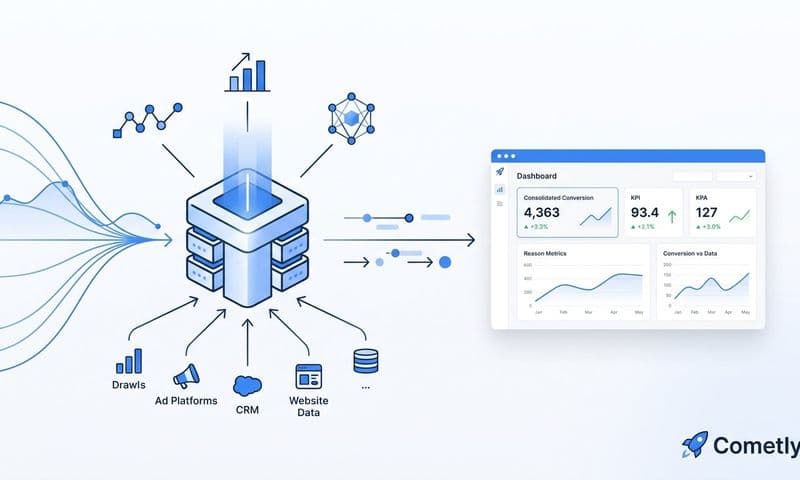
This is exactly why a dedicated attribution platform like Cometly is so crucial. It acts as your central hub, pulling in data from all your marketing tools and stitching it together into a single, reliable source of truth. By connecting every touchpoint to an individual customer profile, you can finally see the complete, unbiased journey.
How Server-Side Tracking Creates Reliable Data
One of the key technologies making this unified view possible is server-side tracking. For years, marketers relied on browser-based tracking (like the old Meta Pixel), which is notoriously flaky thanks to ad blockers, browser privacy updates like iOS 14, and cookie limitations.
Server-side tracking fixes this by sending data directly from your website's server to your marketing platforms. It's a much more accurate and durable method because it isn't disrupted by a user's browser settings.
Think of it this way: browser tracking is like sending a letter through a complex postal system where it can get lost, delayed, or blocked at any point. Server-side tracking is like having a direct, secure courier hand-deliver the message straight to the recipient. It always arrives intact.
This reliable data stream is the foundation you need for accurate multi-touch attribution. Without it, you’re still working with incomplete, flawed information, which means your ROI calculations will always be skewed.
Putting It All Together for Maximum ROI
Once you unify your data and lean on accurate tracking, you can finally see which campaigns, ads, and channels are your true heavy hitters. You can confidently answer mission-critical questions that were previously impossible to tackle:
- Which Facebook ad is best at introducing new customers who eventually buy?
- How much value is our blog content really contributing to high-ticket sales?
- What is the optimal mix of channels for driving conversions?
This level of insight completely changes your ability to optimize. You can confidently scale the campaigns that are proven to work and cut the ones that aren't, maximizing your true marketing ROI. To really master this, it helps to understand the nuances of the different attribution models. We recommend checking out our complete guide on multi-touch attribution to explore this topic further.
Ultimately, solving the attribution puzzle is the final step in moving from guessing what your marketing ROI is to knowing it with certainty.
Understanding Good Marketing ROI Benchmarks
You’ve crunched the numbers, tracked your data, and finally calculated your marketing ROI. Now for the million-dollar question every marketer inevitably asks: is my ROI any good? Answering that means looking beyond your own dashboard to see how you stack up against the rest of the industry.
The honest truth? There’s no magic number that works for everyone. You’ll often hear a 5:1 ratio—generating $5 for every $1 spent—thrown around as a solid benchmark. But think of that as a starting point, not a universal rule.
What’s considered a fantastic return for one business could be completely unsustainable for another. The real key is understanding how ROI expectations change based on your industry, business model, and the specific channels you’re putting money into.
Why Context Is Everything for ROI Goals
A company’s entire financial structure shapes what a "good" return actually looks like. A high-margin business, like a SaaS company selling software, can do great with a 3:1 ROI because the cost to deliver their product is super low.
On the other hand, a low-margin e-commerce store selling physical goods might need a 10:1 ROI just to turn a profit after factoring in the cost of goods, shipping, and fulfillment.
Key Insight: A "good" marketing ROI isn't a fixed number; it's a number that drives profitable growth for your specific business model. It must be evaluated in the context of your profit margins, customer acquisition costs, and overall financial health.
This is why you have to set ROI goals that fit your company's unique situation. It means moving past generic benchmarks and tying your marketing performance directly to the financial realities of your business. Looking at a variety of marketing KPI examples can help you figure out which metrics truly matter for your goals.
Channel-Specific ROI Benchmarks
Different marketing channels are built to do different things, so naturally, they produce different returns. You wouldn't expect a hammer and a screwdriver to do the same job, and you shouldn't expect SEO and paid social ads to deliver identical ROI figures.
Here’s a general breakdown of what you might expect from some of the most popular channels:
- Email Marketing: Often hailed as the king of ROI, email can generate returns as high as 40:1. Because it works with an audience you already own, it’s an incredibly cost-effective way to drive repeat business and nurture leads.
- SEO & Content Marketing: These are long-term plays. The initial ROI might seem low, but it compounds over time. B2B content marketing, for instance, averages a solid 3:1 return on its own. But when you pair it with a strong SEO strategy, that number can skyrocket to an incredible 748% ROI. That synergy is what builds sustainable, long-term growth.
- Paid Search (PPC): Platforms like Google Ads tend to average an ROI of around 2:1. This channel is perfect for capturing existing demand and usually delivers quick, predictable returns.
- Social Media Advertising: Paid social ROI can be all over the map, depending on the platform and your campaign goals. A reasonable target to shoot for is between 3:1 and 5:1, though this can definitely be higher for brands with killer ad creative and laser-focused targeting.
At the end of the day, these numbers are a guide, not a rigid report card. They give you a framework for setting realistic targets and seeing how your performance stacks up. This turns abstract data into real insights, helping you spot which channels are your heavy hitters and where you have opportunities to improve.
Common Mistakes That Can Destroy Your ROI
Even with the right formulas and attribution models, a few common mistakes can quietly bleed your budget dry and throw off your marketing ROI calculations entirely. Knowing what these pitfalls are is the first step to avoiding them and making sure every dollar you spend is pulling its weight.
Too many marketers get tunnel vision, chasing short-term wins while completely ignoring long-term value. They fixate on the immediate return from a single sale, forgetting all about Customer Lifetime Value (CLV). This kind of short-sightedness is a fast track to killing profitable campaigns.
I’ve seen it happen time and time again: a company axes a top-of-funnel awareness campaign because it doesn't drive sales today. A month later, their direct sales and branded search traffic mysteriously vanish. They didn't realize that "underperforming" campaign was actually filling the pipeline for weeks to come.
Ignoring Hidden Marketing Costs
Another classic mistake is forgetting to track all the hidden expenses that go into a campaign. Your ad spend is just the tip of the iceberg. A true ROI calculation has to include every single associated cost to give you an honest financial picture.
These often-overlooked costs include:
- Creative Production: The cost of designing graphics, shooting videos, and writing copy.
- Software and Tools: Fees for your analytics platforms, email marketing software, or attribution tools like Cometly.
- Agency or Freelancer Fees: The retainers or project costs for any external partners you’re working with.
- Team Salaries: A portion of the salaries for the marketing team members managing the campaigns.
Forgetting these expenses will artificially inflate your ROI, making unprofitable campaigns look like winners. You might think a campaign is delivering a 3:1 return, but once you factor in all the real costs, you could discover it’s barely breaking even—or worse, losing money.
Your marketing ROI is only as accurate as your inputs. If you don't track every single dollar spent—from ad clicks to software subscriptions—you're making decisions based on incomplete and misleading data.
Relying on Flawed Attribution
As we’ve covered, one of the most destructive mistakes is clinging to a flawed attribution model like last-click. It systematically undervalues the channels that build awareness and trust, leading you to make terrible budget decisions. It’s like giving all the credit for a championship win to the person who scored the final point, ignoring the rest of the team.
This problem gets even worse when you fail to track conversions across every single channel. If your analytics aren't set up to capture leads from social media, email, and organic search, you'll never see the full picture of how all your marketing efforts work together. A unified tracking setup isn't just a nice-to-have; it's essential for calculating your true marketing ROI.
Frequently Asked Questions About Marketing ROI
Even after you've got the formulas down, some questions about marketing ROI always seem to pop up. Let's tackle the most common ones so you can apply these concepts with confidence.
What Is the Difference Between ROI and ROAS?
This is a big one. It’s easy to mix up ROI (Return on Investment) and ROAS (Return on Ad Spend), but they tell you two very different stories.
Think of ROAS as a quick health check on your ads. It measures the gross revenue you get back for every dollar you spend on advertising. So, a 4:1 ROAS means you generated $4 in revenue for every $1 of ad spend. It’s purely about ad efficiency.
ROI, on the other hand, is the bottom line. It measures the total profit generated from your entire marketing investment after all costs are subtracted. That includes ad spend, sure, but also the cost of your products, software fees, team salaries, or agency retainers.
In short: ROAS tells you if your ads are working. ROI tells you if your business is profitable.
How Long Does It Take to See a Positive Marketing ROI?
The honest answer? It completely depends on the channel. Some marketing strategies are designed for a quick win, while others are a long game.
- Paid Ad Campaigns: If you’re running well-targeted campaigns on platforms like Google or Facebook, you can see a positive ROI in just days or weeks. These are your sprinters.
- SEO and Content Marketing: These are your marathon runners. It can easily take 6-12 months to see a significant return. But the value you build here is sticky and often grows over time, paying dividends long after you've invested.
The key is setting the right expectations for each channel. Don't judge a marathon by a sprinter's pace.
A common mistake is judging a long-term channel like SEO by a short-term metric like immediate sales. Each channel plays a different role, and its ROI must be measured over the appropriate timeframe.
How Can I Measure the ROI of Brand Awareness Campaigns?
Measuring brand awareness ROI is definitely tricky, but far from impossible. You just have to look beyond direct sales.
Instead of trying to tie a top-of-funnel campaign directly to a purchase, you track the influence it has on the customer's journey. Look for increases in proxy metrics like:
- Branded search volume: Are more people searching for your company by name?
- Direct website traffic: Are more people typing your URL directly into their browser?
- Assisted conversions: How many times did the campaign show up as an early touchpoint before an eventual sale?
This is where a modern attribution tool becomes your best friend. It helps you connect those early, brand-building touchpoints to the revenue they eventually help generate down the line.
Ready to stop guessing and start knowing your true marketing ROI? Cometly unifies all your marketing data into a single source of truth, giving you the clarity to scale what works and cut what doesn't. Get started with Cometly today and see your real ROI.