

As a media buyer, you know that gut feelings and platform-reported metrics only tell part of the story. The real challenge lies in understanding which ads actually drive revenue, not just clicks or impressions. With privacy changes, cross-platform campaigns, and increasingly complex customer journeys, tracking ad performance accurately has become both more difficult and more essential.
Think about your current setup for a moment. You're probably looking at Facebook Ads Manager showing one conversion number, Google Ads reporting something completely different, and your CRM telling yet another story about which campaigns actually closed deals. Sound familiar?
This guide walks you through building a reliable ad performance tracking system from the ground up. You'll learn how to connect your data sources, implement server-side tracking, configure attribution models, and create dashboards that show you exactly where your budget delivers results. By the end, you'll have a tracking infrastructure that gives you confidence in every scaling decision you make.
Step 1: Audit Your Current Tracking Setup and Identify Gaps
Before you build anything new, you need to understand what's already working and what's broken. Start by reviewing your existing pixel implementations across all ad platforms you're currently running. Open each platform—Meta, Google Ads, TikTok, LinkedIn—and check which conversion events are firing and which ones show inconsistent data.
Here's where it gets interesting. Pull a report from each platform showing conversions for the same time period, then compare those numbers to what actually happened in your business. Check your CRM, your payment processor, your sales records. The discrepancies you find here reveal exactly where your tracking breaks down.
Document the complete customer journey from initial ad click through to closed deal. Map out every step: someone clicks your ad, lands on your website, fills out a form, receives follow-up emails, talks to sales, and eventually converts. Now identify where data gets lost along this path. Maybe your form submissions aren't connecting back to the originating ad. Maybe phone calls aren't tracked at all. Maybe your sales team closes deals offline that never get attributed to any campaign.
Pay special attention to iOS tracking limitations. If you're running mobile campaigns, you're likely missing a significant portion of conversions due to App Tracking Transparency restrictions. Check your analytics to see what percentage of your traffic comes from iOS devices, then assume you're losing visibility into a substantial portion of those conversions.
Cookie consent is another common gap. If you're targeting European audiences or operating under privacy regulations, some visitors are declining tracking cookies. Review your consent management platform to see what percentage of users are opting out, and understand that you're flying blind on those conversions.
Create a tracking requirements document based on what you've discovered. List every conversion event that matters to your business: form submissions, phone calls, chat conversations, demo requests, purchases, subscription sign-ups. For each event, note whether it's currently tracked, which platforms receive that data, and where gaps exist. Consider using an ad performance tracking system to centralize this documentation.
This audit gives you a clear picture of your starting point. Most media buyers discover they're missing 30-50% of actual conversions when they complete this exercise. That's not a failure—it's an opportunity to make better decisions with complete data.
Step 2: Implement Server-Side Tracking for Accurate Data Collection
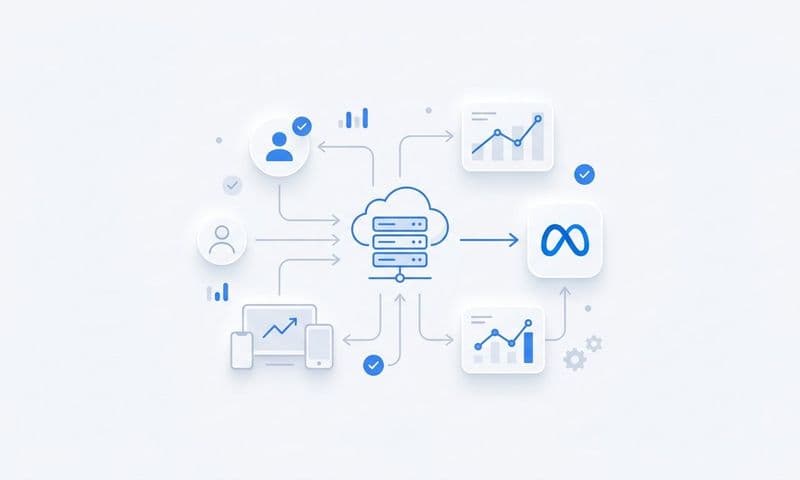
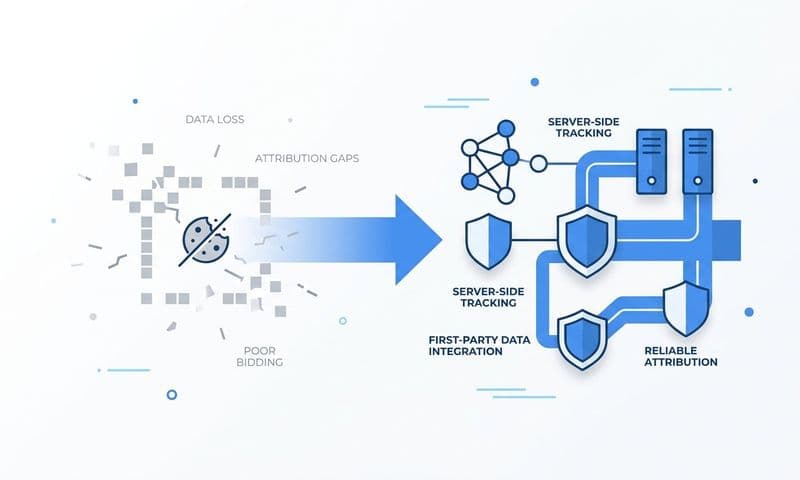
Browser-based tracking pixels worked well five years ago. In 2026, they miss significant conversion data. Ad blockers, privacy settings, browser restrictions, and cookie limitations all prevent client-side pixels from capturing the full picture. Server-side tracking solves this by sending conversion data directly from your server to ad platforms, bypassing browser-based limitations entirely.
Think of it like this: client-side tracking is like asking someone to deliver a message by shouting across a crowded room. Server-side tracking is like sending that message through a direct, private phone line. One method is unreliable and easily blocked; the other ensures the message gets through.
Start by setting up server-side event tracking for your most critical conversion events. When someone submits a form on your website, your server should immediately fire an event to your ad platforms confirming that conversion happened. This event includes all the necessary data: which user converted, what they did, and which campaign they came from.
Configure first-party data collection that respects privacy while maintaining accuracy. Your server can collect conversion data using first-party cookies and your own domain, which are much more reliable than third-party tracking methods. This approach works even when users have strict privacy settings enabled.
Connect your website events directly to ad platforms through server connections. Meta's Conversions API, Google's Enhanced Conversions, and TikTok's Events API all allow you to send conversion data server-to-server. Set up these connections so that every important conversion event flows directly from your server to each platform. The right ad performance tracking software can simplify this integration process significantly.
The technical implementation varies by platform, but the concept remains consistent: capture the conversion event on your server, enrich it with additional data like order value or customer lifetime value, then send it to your ad platforms through their server-side APIs.
Verify your server-side events are firing correctly with real-time testing. Complete a test conversion yourself—fill out a form, make a purchase, whatever your key conversion event is—then check each platform to confirm the event was received. Look for the event in Meta Events Manager, Google Ads conversion tracking, and any other platforms you're using.
Server-side tracking captures conversions that browser tracking misses, giving you a more complete view of campaign performance. Many media buyers see their tracked conversion volume increase by 20-40% after implementing server-side tracking properly, simply because they're finally seeing conversions that were always happening but never being recorded.
Step 3: Connect Your Ad Platforms, Website, and CRM Into One System
You've got data flowing from your website to ad platforms. Now you need to connect everything else. Your CRM holds the real story of what happens after someone converts—whether they became a qualified lead, how much they spent, whether they churned or stayed. Without connecting this data back to your ad campaigns, you're optimizing for leads instead of revenue.
Map out your complete data flow from ad impression to closed revenue. Start with the ad click, follow through the website visit, track the initial conversion, continue through lead nurturing, and end with the final sale or customer outcome. Every step in this journey needs to maintain a connection back to the originating campaign.
Integrate your CRM data to track leads through the entire sales cycle. When a lead converts in your CRM—they book a call, sign a contract, make a purchase—that event should connect back to the ad campaign that generated them. This connection typically happens through a unique identifier like an email address, phone number, or customer ID that flows from the initial ad click through to the CRM. Effective attribution tracking for lead generation makes this connection seamless.
Link offline conversions and sales calls back to originating ad campaigns. If your sales team closes deals over the phone or in person, those conversions need to be attributed to the campaigns that generated the leads. Set up a system where your sales team can see which campaign source each lead came from, and ensure those closed deals get reported back to your tracking system.
Set up UTM parameter standards and tracking templates across all platforms. Every ad campaign should use consistent UTM parameters that identify the source, medium, campaign name, ad set, and individual ad. Create templates for each platform so your team uses the same naming conventions every time. This consistency makes it possible to track performance across platforms in a unified way.
Test the full data pipeline to ensure touchpoints are captured accurately. Run a complete test where you click an ad, convert on the website, become a lead in the CRM, and eventually close as a customer. Follow that test conversion through every system to verify the data flows correctly and the attribution remains intact from start to finish.
The goal here is a single source of truth. When you look at campaign performance, you should see not just how many people clicked or converted, but how many became customers and how much revenue they generated. That's the difference between tracking activity and tracking results.
Step 4: Configure Multi-Touch Attribution to See the Full Customer Journey
Last-click attribution tells you which ad got the final touch before conversion. But what about the Facebook ad that introduced someone to your brand three weeks ago? Or the Google search ad they clicked before watching your YouTube video? Multi-touch attribution reveals how campaigns work together to drive conversions.
Different attribution models distribute credit differently across touchpoints. First-touch attribution gives all credit to the initial interaction. Last-touch gives everything to the final click. Linear attribution splits credit evenly across all touchpoints. Data-driven attribution uses machine learning to assign credit based on which touchpoints actually influenced the conversion.
Choose the right attribution model based on your sales cycle length and campaign goals. If you're running direct-response campaigns with same-day conversions, last-click attribution might work fine. If you have a 30-day sales cycle with multiple touchpoints, you need a model that accounts for the full journey. An attribution platform for performance marketers can help you test different models effectively.
Here's what many media buyers miss: different campaigns serve different purposes in the customer journey. Your prospecting campaigns introduce new people to your brand. Your retargeting campaigns remind them to come back. Your search campaigns capture high-intent users ready to convert. Each plays a role, and your attribution model should reflect that.
Set up attribution windows that match your actual customer buying behavior. If most customers convert within seven days of their first interaction, a seven-day window makes sense. If your sales cycle runs 30 to 60 days, you need a longer window. Review your CRM data to understand typical time-to-conversion, then configure your attribution windows accordingly.
Compare attribution model results to identify which channels assist conversions. Run reports showing the same conversions under different attribution models. You might discover that certain campaigns look weak under last-click attribution but actually play a crucial role in starting customer journeys. This insight changes how you allocate budget.
Use attribution data to understand how campaigns work together, not just individually. Look for patterns where specific channel combinations drive higher conversion rates. Maybe users who see both a Facebook ad and a Google search ad convert at twice the rate of those who only see one. That insight tells you to maintain presence across both channels rather than consolidating budget into one.
The right attribution model depends on your business. Test multiple approaches, compare the results to actual revenue outcomes, and choose the model that helps you make better budget allocation decisions.
Step 5: Build Performance Dashboards That Drive Decisions
Data without context is just noise. You need dashboards that surface the metrics media buyers actually use to make decisions. Start by defining your key performance indicators: return on ad spend, customer acquisition cost, revenue per channel, cost per qualified lead, and lifetime value by source.
Create campaign-level views that show true cost per acquisition tied to revenue. Don't just report how many conversions each campaign generated—show how much revenue those conversions produced and what you spent to get them. This view immediately reveals which campaigns are profitable and which are burning budget. A robust marketing performance tracking platform makes building these views straightforward.
Build comparison views to evaluate performance across platforms in one place. Instead of jumping between Facebook Ads Manager, Google Ads, and TikTok Ads to compare performance, create a unified dashboard that shows all platforms side by side. Use consistent metrics so you're comparing apples to apples. This is where cross platform marketing performance tracking becomes essential.
Set up alerts for performance changes that require immediate action. Configure notifications when cost per acquisition spikes above your target, when conversion volume drops significantly, or when a campaign suddenly starts scaling. These alerts let you respond to problems before they waste serious budget.
Design dashboards for different stakeholders with different needs. Your daily optimization dashboard should show real-time performance, hourly trends, and quick-action metrics. Your weekly reporting dashboard should show trends over time, week-over-week comparisons, and strategic insights. Your executive dashboard should focus on total spend, total revenue, overall ROAS, and growth trends.
The best dashboards answer specific questions without requiring additional analysis. When you look at your dashboard, you should immediately know: which campaigns are performing well, which need adjustment, where to allocate more budget, and which tests are worth scaling.
Keep your dashboards focused. It's tempting to track everything, but too many metrics create confusion rather than clarity. Choose the five to seven metrics that actually influence your decisions, then build your dashboards around those numbers.
Step 6: Feed Enriched Conversion Data Back to Ad Platforms
Here's something most media buyers overlook: the data you send back to ad platforms directly impacts how well their algorithms optimize your campaigns. When you feed platforms accurate, detailed conversion data, their machine learning systems get better at finding people likely to convert.
Ad platforms use conversion data to train their optimization algorithms. If you only send basic conversion events without value data, the platform optimizes for any conversion regardless of quality. If you send revenue data with each conversion, the platform learns to find high-value customers instead of just any customer.
Set up conversion sync to push accurate revenue data to Meta, Google, and other platforms. When someone makes a purchase, don't just send a "purchase" event—send the actual order value, the products purchased, and any other relevant data. When someone becomes a lead, send their qualification score or estimated value if you have it. Understanding tracking ROI for performance marketing helps you identify which data points matter most.
Configure value-based bidding using actual revenue data instead of proxy conversions. Instead of optimizing for "add to cart" or "lead form submission," optimize for purchase value or qualified lead value. This shift tells the platform to find people who will spend more or become better leads, not just people who will complete any conversion.
The impact of this approach becomes clear over time. As ad platforms receive better data about which conversions actually drive revenue, their algorithms improve at identifying similar high-value audiences. Your cost per acquisition might stay the same or even increase slightly, but your revenue per customer typically increases significantly.
Monitor the impact of improved data quality on campaign performance over time. Track metrics like average order value, customer lifetime value by source, and revenue per conversion before and after implementing enriched conversion data. Many media buyers see meaningful improvements in customer quality within a few weeks of feeding better data to ad platforms.
Maintain data hygiene to keep your conversion feedback loop accurate. Regularly audit the conversion data you're sending to platforms. Check for duplicate events, missing values, incorrect attribution, or technical errors that might corrupt the data. Clean, accurate data produces better optimization results than large volumes of messy data.
Putting It All Together
With these six steps complete, you now have an ad performance tracking system that shows exactly which campaigns drive revenue. Your tracking captures every touchpoint, your attribution reveals the full customer journey, and your ad platforms receive the data they need to optimize effectively.
Quick implementation checklist: audit completed, server-side tracking live, platforms and CRM connected, attribution configured, dashboards built, conversion sync active. Each piece works together to give you the complete picture you need to scale profitably.
The next step is to let your tracking run for two to four weeks, then use the insights to reallocate budget toward your highest-performing campaigns. You'll likely discover that some campaigns you thought were underperforming actually drive significant revenue when you see the full attribution picture. You might also find that some campaigns with strong last-click numbers contribute very little when you account for the complete customer journey.
Start by reviewing your current tracking setup today and documenting the gaps you need to address first. Most media buyers can complete the audit phase in a few hours, and that alone reveals opportunities to improve tracking accuracy immediately. The technical implementation of server-side tracking and platform connections might take a few days, but the improvement in data quality makes it worth the investment.
Ready to elevate your marketing game with precision and confidence? Discover how Cometly's AI-driven recommendations can transform your ad strategy—Get your free demo today and start capturing every touchpoint to maximize your conversions.