

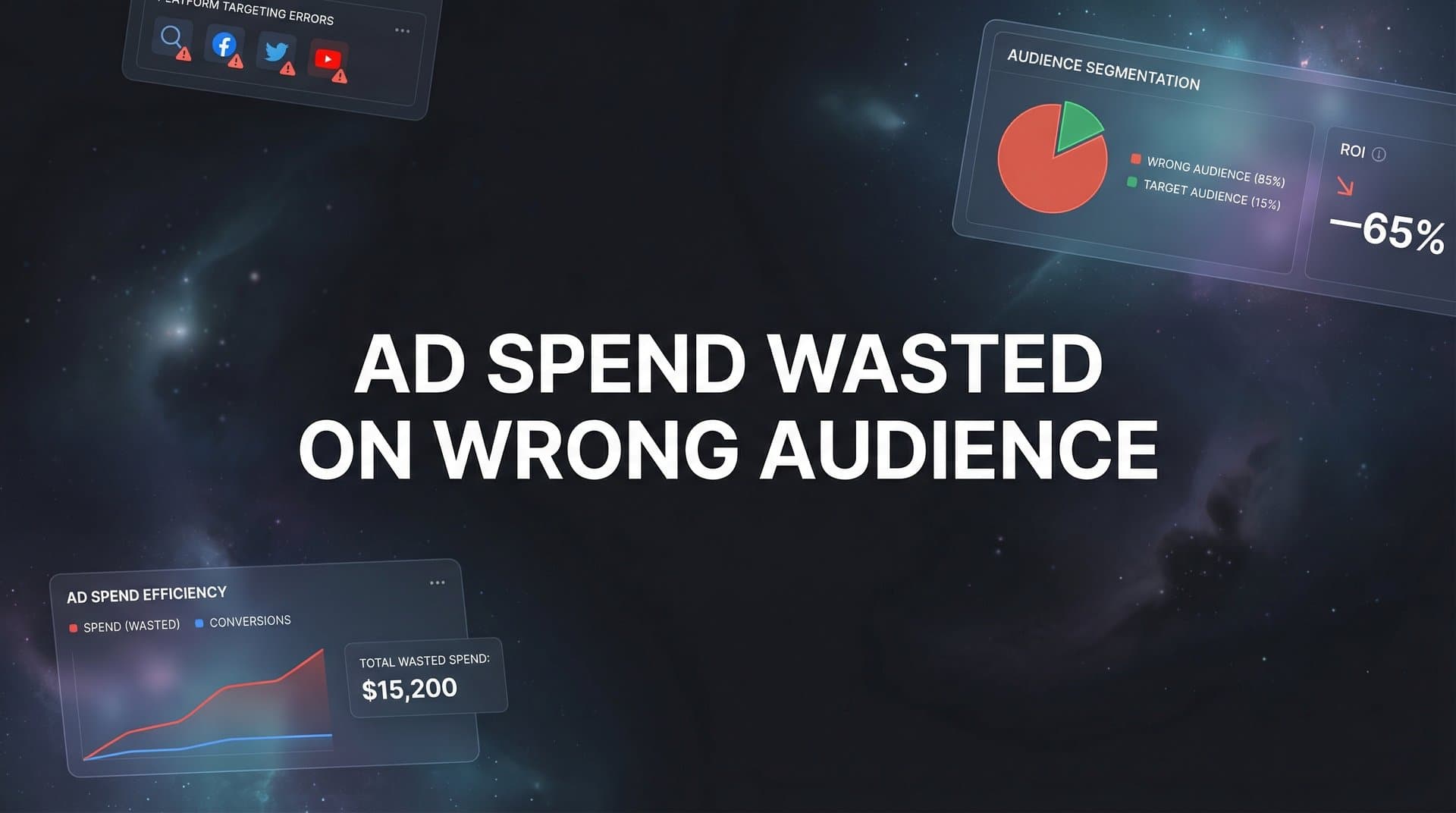
You just spent $10,000 on a Facebook campaign. The clicks looked great. Engagement was up. Your cost per click? Better than ever. Then you check your CRM and your stomach drops. Out of 500 clicks, only three became customers. And those three? They bought your lowest-tier product and churned within a month.
This is the silent budget killer that keeps marketers up at night: ad spend wasted on the wrong audience. Not fake clicks. Not bot traffic. Real people who genuinely engaged with your ad, visited your site, maybe even filled out a form—but were never going to become valuable customers.
The worst part? Every dollar you spend on the wrong people doesn't just vanish. It actively trains ad platforms to find more people just like them. Your campaign optimizes itself toward failure, one click at a time.
This guide breaks down why this happens, how to spot it in your campaigns, and most importantly, how to fix it before it drains your entire marketing budget.
The Hidden Cost of Targeting the Wrong People
When marketers talk about the "wrong audience," they're not just talking about obvious mistakes like showing B2B software ads to teenagers. The real problem is far more insidious.
The wrong audience means people who take action but deliver no value. They click your ad. They browse your site. They might even convert into leads. But they never become customers who actually matter to your business.
Think of it in two categories. First, there are people who engage but never convert at all—the curiosity clickers, the comparison shoppers who were always going to buy from your competitor, the people attracted by your creative but repelled by your price point. Second, and often worse, are people who do convert but become your least valuable customers: the coupon hunters who churn immediately, the support nightmares who cost more than they're worth, the one-time buyers who never return.
Here's where it gets expensive. Ad platforms don't know the difference between a click from your ideal customer and a click from someone who will waste your sales team's time. They see engagement and interpret it as success. So they find more people who look like those low-value clickers.
This creates a compounding effect. Your campaign starts optimizing toward the wrong signals. Facebook's algorithm thinks it's doing a great job because it's driving tons of form fills. Google Ads celebrates your improved click-through rate. Meanwhile, your actual revenue per ad dollar spent is cratering, leading to serious ad spend allocation inefficiencies across your campaigns.
The distinction between obvious targeting mistakes and subtle audience drift matters. Obvious mistakes are easy to catch: you're advertising women's products to men, or enterprise software to college students. You fix the demographics and move on.
Audience drift is harder to spot. Your campaign starts strong, reaching the right people. But over time, as the platform expands to find more conversions, it starts including people who look similar on paper but behave completely differently. Your lookalike audience based on email subscribers starts pulling in freebie seekers instead of buyers. Your retargeting campaign that worked great on past customers starts showing ads to people who visited once and bounced.
By the time you notice, you've already spent thousands teaching the algorithm to find exactly the wrong people.
Five Common Reasons Your Ads Reach the Wrong Audience
Understanding why audience mismatch happens is the first step to preventing it. These five culprits show up in campaign after campaign, often working together to drain budgets.
Trusting Platform Assumptions Without Validation: Ad platforms make educated guesses about who will convert based on their vast data. But they're guessing about your specific business using general patterns. Facebook might assume that people interested in "entrepreneurship" want your B2B software, when in reality your best customers are interested in "supply chain management." You launch a campaign, the platform serves it to its best guess, and you never validate whether those guesses align with who actually buys from you.
Lookalike Audiences Built on Garbage Data: Lookalike audiences can be powerful—when built from the right foundation. But many marketers create them from incomplete or misleading seed lists. You upload your entire email list, including people who signed up for a free guide three years ago and never opened another email. Or you build a lookalike from website visitors, not realizing 60% of that traffic came from a viral blog post that attracted people with zero buying intent. Understanding lookalike audience performance is critical to avoiding this trap.
Tracking Gaps That Hide Your Real Customers: This is the big one. When your tracking is broken or incomplete, ad platforms can't learn who your actual customers are. Someone clicks your Facebook ad, browses on their phone, thinks about it, then converts three days later on their laptop. Facebook never sees that conversion because the tracking pixel couldn't connect the dots across devices and time. So Facebook thinks that person didn't convert and adjusts its targeting away from people like them. Meanwhile, it keeps serving ads to people who convert immediately—often your least qualified, most impulsive prospects.
Interest-Based Targeting That Attracts Browsers: Interest targeting seems logical: target people interested in topics related to your product. But interests reveal what people like to read about, not what they're ready to buy. Someone interested in "luxury travel" might love browsing destination photos but have no budget for your high-end tour packages. Someone interested in "fitness" might be a casual gym-goer, not a serious athlete ready to invest in your premium training program. You end up paying for clicks from people who enjoy your content but will never become customers.
Retargeting Pools Polluted With Junk Traffic: Retargeting should be your most efficient channel—you're reaching people who already know you. But if your retargeting pool includes everyone who ever visited your site, you're wasting money on people who clicked through from a random blog mention, bounced immediately from a misclicked ad, or visited once while researching competitors. Monitoring your retargeting audience performance helps you identify when your pool has become polluted.
Each of these problems feeds into the others. Bad lookalikes generate low-quality traffic that pollutes your retargeting pool. Tracking gaps prevent platforms from learning which interests actually correlate with purchases. Interest-based targeting brings in browsers who train the algorithm to find more browsers.
The result? Your campaigns optimize themselves toward mediocrity, finding more and more people who engage just enough to cost you money but never enough to generate revenue.
How Broken Tracking Amplifies Audience Waste
If audience mismatch is the disease, broken tracking is the virus that spreads it. And in the current digital advertising landscape, tracking has never been more broken.
iOS privacy changes fundamentally disrupted how ad platforms learn from conversions. When Apple introduced App Tracking Transparency, millions of iPhone users opted out of cross-app tracking. Suddenly, Facebook and other platforms lost visibility into a massive chunk of conversions. Someone clicks your Instagram ad on their iPhone, converts on your website, and Facebook never knows it happened. The platform thinks that ad didn't work, so it stops showing ads to people like that converter.
Cookie deprecation is finishing what iOS started. Third-party cookies, which allowed tracking across websites, are disappearing. Browser restrictions keep tightening. The traditional client-side tracking pixel—the foundation of digital advertising for over a decade—is becoming less reliable every month. This is why so much ad spend is wasted due to poor tracking.
Here's what happens when conversion data goes dark. Ad platforms still need to optimize toward something. Without reliable conversion data, they fall back to proxy metrics: clicks, video views, landing page visits, form starts. These signals are easier to track but far less meaningful. The platform optimizes toward getting more clicks, not more customers.
This creates a vicious feedback loop. Missing conversion data causes the platform to target people who click easily but rarely buy. Those people generate more clicks and more missing conversions. The algorithm interprets this as confirmation that it should keep finding more people like them. Your campaign drifts further from your actual customers with each optimization cycle.
The platforms aren't trying to waste your money. They're making the best decisions they can with incomplete information. If you only tell them about 40% of your conversions because the other 60% happen in ways that client-side pixels can't track, they'll optimize for the 40% they can see—which might be your worst customers.
Think about it this way. Imagine you're teaching someone to fish, but they can only see 40% of the fish in the lake. They'll get really good at catching those visible fish. But what if the visible fish are the small, bony ones, while the big, valuable fish swim in the depths where they can't see? That's what's happening with your ad campaigns when tracking is broken.
The platforms are getting better at finding the people they can track—the impulsive clickers who convert immediately on the same device. But your best customers? They research carefully. They switch devices. They take time to decide. And every one of their conversions that goes untracked is a signal the algorithm never receives.
Diagnosing Audience Mismatch in Your Campaigns
Knowing you have an audience problem and proving it are two different things. Here's how to diagnose whether your ad spend is reaching the wrong people.
Start with the conversion rate gap. Look at your cost per click and your cost per customer. If you're paying $2 per click and your average customer costs $400 to acquire, your conversion rate is 0.5%. That means 199 out of 200 people who click your ad will never become customers. Now ask: are those 199 people genuinely unqualified, or is something else wrong? Compare this across audience segments. If your lookalike audience has a 0.3% conversion rate while your retargeting audience converts at 2%, you know the lookalike is pulling in the wrong people.
Next, analyze quality beyond conversion rate. Pull your customer data and segment by acquisition source. Calculate lifetime value by channel. You might discover that Google Ads customers spend twice as much and stick around three times longer than Facebook customers, even though Facebook delivers more conversions at a lower cost per acquisition. That's a clear signal that Facebook is attracting lower-quality customers, even if the surface metrics look good. Using a return on ad spend calculator can help quantify these differences.
Audit your customer journey to find where wrong-fit prospects enter. Map out the typical path from ad click to purchase. Then map out the path for people who clicked but never bought. Where do they drop off? If most abandon at the pricing page, your ads might be attracting people who can't afford you. If they bounce immediately after landing, your ad creative might be misleading about what you actually offer. If they engage deeply but never convert, you might be targeting people in research mode who aren't ready to buy.
Compare what ad platforms report versus what your CRM shows. Facebook says you got 50 conversions. Your CRM shows 30. That 20-conversion gap matters. Dig into those missing conversions. Are they duplicate form fills from the same person? People who provided fake information? Leads that your sales team immediately disqualified? The gap between platform-reported conversions and actual valuable leads reveals how much of your audience is wrong-fit. Understanding why your ad platform shows wrong data is essential for accurate diagnosis.
Ask these diagnostic questions. Are your best customers coming from your ads, or are they finding you through other channels? If organic search and referrals deliver better customers than paid ads, your targeting might be off. Do customers acquired through ads require more support and churn faster than other customers? That suggests your ads are attracting people who aren't truly a fit. Are you getting lots of engagement and clicks but few purchases? Classic sign of audience mismatch.
Look at time-to-conversion by source. If customers from one campaign convert immediately while another campaign's leads take months to close, you're reaching people at different stages of readiness. Neither is necessarily wrong, but if you're optimizing for immediate conversions, you might be training the algorithm away from your best long-term customers.
Run a cohort analysis. Take all customers acquired in a specific month from a specific campaign. Track their behavior over the next six months. Do they stick around? Do they buy again? Do they refer others? Then compare cohorts across campaigns. If Campaign A customers have 80% retention while Campaign B customers have 20% retention, Campaign B is attracting the wrong audience, even if its initial cost per acquisition looks better.
Fixing the Problem: Better Data, Better Audiences
Once you've diagnosed audience mismatch, fixing it comes down to improving the data that ad platforms use to learn and optimize. Better data creates better audiences. Here's how to make it happen.
Server-side tracking has emerged as the solution to broken client-side pixels. Instead of relying on browser cookies and pixels that users can block, server-side tracking captures conversion events directly from your server. When someone converts, your server sends that conversion data to ad platforms, regardless of browser settings or device switching. This means platforms finally see the full picture of who's actually converting, including the careful researchers who take time to decide and the cross-device shoppers who browse on mobile but buy on desktop.
The impact is immediate. When platforms receive complete conversion data, they stop optimizing toward the wrong signals. They learn that the person who clicked your ad, researched for three days, and converted on a different device is exactly the type of person they should find more of. Your lookalike audiences improve because they're built from actual customers, not just the fraction of customers that client-side tracking could see. This is how you reduce wasted ad spend with better data.
Feeding enriched conversion data back to platforms takes this further. Don't just tell Facebook that someone converted. Tell them the customer's lifetime value, their purchase amount, whether they're a repeat buyer. This teaches the algorithm to optimize for valuable customers, not just any customers. When the platform knows that Customer A spent $5,000 while Customer B spent $50, it can find more people who look like Customer A.
Multi-touch attribution reveals which channels and touchpoints attract your best customers versus your worst. Someone might click a Facebook ad, visit from Google, return from an email, and finally convert from a retargeting ad. Single-touch attribution would credit only the retargeting ad. But multi-touch attribution shows that Facebook played a role in introducing that valuable customer to your brand. This insight lets you allocate budget toward channels that attract high-quality prospects, even if they don't get credit for the final click.
Use this attribution data to refine your targeting. If multi-touch analysis shows that your best customers typically interact with both paid social and paid search before converting, you can create audiences that mirror that behavior. Build lookalikes from people who engaged with multiple channels. Exclude people who only interacted once and never returned.
Create custom conversion events that matter to your business. Don't just track purchases. Track high-value purchases. Track repeat purchases. Track customers who stay subscribed past 90 days. Then optimize your campaigns toward these meaningful events instead of generic conversions. When you tell Google Ads to optimize for customers who spend over $500, it learns to find people likely to spend over $500—not just people likely to buy anything.
The feedback loop between better data and better audiences compounds over time. In month one, server-side tracking captures 90% of conversions instead of 40%. The platform gets better data and adjusts targeting. In month two, targeting improves and you attract slightly better prospects. Their conversion data further refines the algorithm. By month six, your campaigns are reaching fundamentally different people than they were at the start—people who actually match your ideal customer profile.
Building a System That Protects Your Ad Budget
Fixing audience mismatch once isn't enough. You need systems that continuously protect your ad budget from drift and waste. Here's how to build those systems.
Create a feedback loop between your CRM and ad platforms that runs automatically. When someone becomes a customer in your CRM, that data should flow back to your ad platforms immediately. When a customer churns, that signal should update your targeting. When someone becomes a high-value repeat buyer, that information should enrich your lookalike audiences. This continuous flow of real business outcomes keeps your targeting aligned with reality instead of drifting toward vanity metrics.
Set up alerts that catch audience drift before it costs you thousands. Monitor conversion rate by campaign and audience segment. If a campaign that normally converts at 2% suddenly drops to 0.8%, you want to know immediately, not three weeks later when you review your monthly report. Implementing solid wasted ad spend identification strategies helps you catch problems early.
Establish regular checkpoints to audit your audiences. Every month, review your top-spending campaigns and ask: are these still reaching the right people? Pull a sample of recent conversions and check whether they match your ideal customer profile. If you're seeing a shift toward lower-value customers or longer sales cycles, investigate what changed in your targeting.
Use AI-powered recommendations to identify which audience segments deliver the best results and which are wasting budget. Modern attribution platforms can analyze thousands of data points to spot patterns you'd never catch manually. They can tell you that customers who interact with your brand on Tuesday afternoons have 40% higher lifetime value, or that lookalike audiences built from your top 5% of customers outperform those built from all customers. These insights let you reallocate spend toward segments that actually work.
Build exclusion lists as aggressively as you build targeting lists. Exclude people who visited your site but bounced in under 10 seconds. Exclude people who filled out a form but provided obviously fake information. Exclude past customers who churned or requested refunds. Every person you exclude is someone you won't waste money reaching. Watch for custom audience overlap that can cause you to bid against yourself.
Test new audiences in isolation before scaling them. When you want to try a new lookalike audience or interest-based targeting approach, run it as a separate campaign with a small budget. Track not just cost per conversion but quality of conversions. Only scale audiences that prove they can attract valuable customers, not just any customers.
Document what you learn so your team builds institutional knowledge about which audiences work. Create a simple database that tracks audience performance over time. Note which lookalikes delivered the best customer lifetime value. Record which interest combinations attracted buyers versus browsers. When you launch new campaigns, you can reference this knowledge instead of starting from scratch.
Stop Paying for the Wrong Clicks
Wasted ad spend on the wrong audience isn't a targeting problem. It's a data problem.
When ad platforms can't see your real conversions, they optimize toward the conversions they can see—which are often your worst customers. When your tracking is broken, your campaigns drift toward people who click easily but buy rarely. When you build lookalikes from incomplete data, you scale your problems instead of your successes.
The solution isn't better targeting tactics. It's better data infrastructure. Server-side tracking that captures conversions regardless of browser restrictions. Multi-touch attribution that reveals which channels attract your best customers. Enriched conversion data that teaches platforms to optimize for value, not just volume. Automated feedback loops that keep your targeting aligned with business reality.
Every dollar you spend on the wrong audience is a dollar you could have spent reaching someone who actually becomes a valuable customer. The difference compounds. Better data leads to better targeting. Better targeting attracts better prospects. Better prospects convert at higher rates and stick around longer. Your campaigns get more efficient every month instead of drifting toward waste.
The marketers who win aren't the ones with the cleverest ad creative or the biggest budgets. They're the ones who connect the full customer journey from ad click to revenue, so they know exactly which audiences drive real results.
Ready to elevate your marketing game with precision and confidence? Discover how Cometly's AI-driven recommendations can transform your ad strategy—Get your free demo today and start capturing every touchpoint to maximize your conversions.


