

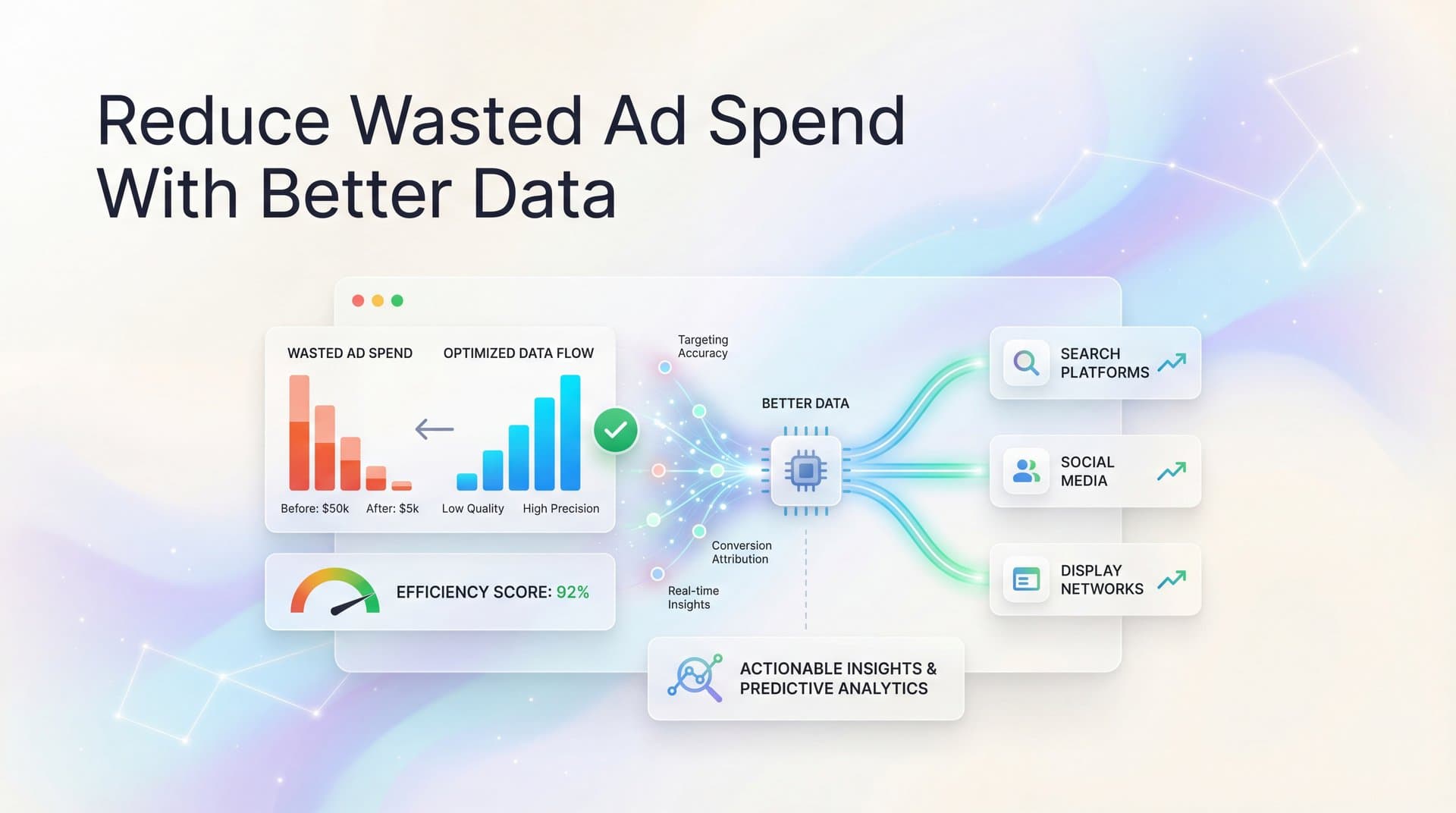
Every marketing team has experienced it: campaigns that drain budget without delivering results, ads that seem to perform well in-platform but never translate to actual revenue, and the frustrating guesswork of deciding where to allocate next month's spend. The root cause is almost always the same—incomplete or inaccurate data leading to poor decisions.
When you can't see which touchpoints actually drive conversions, you end up funding underperformers while starving your best campaigns of budget. You're flying blind, making optimization decisions based on metrics that don't tell the full story. One platform claims credit for a conversion, another platform claims the same conversion, and your actual revenue data sits disconnected in your CRM, unable to tell you what really happened.
The good news? This isn't a problem you have to live with.
This guide walks you through six actionable steps to transform your data infrastructure and eliminate wasted ad spend. You'll learn how to audit your current tracking gaps, implement server-side tracking for accuracy, connect your full customer journey from click to close, and use that enriched data to make confident optimization decisions.
Whether you're managing campaigns across Meta, Google, TikTok, or multiple platforms simultaneously, these steps will help you build a data foundation that reveals exactly where your money is working—and where it's being wasted. Let's get started.
Step 1: Audit Your Current Tracking Gaps and Data Blind Spots
Before you can fix your data problems, you need to understand exactly where they exist. This audit phase is critical—it's where you'll uncover the invisible leaks in your tracking infrastructure that are costing you visibility and budget.
Start by comparing what your ad platforms report versus what's actually happening in your CRM or sales system. Pull conversion data from Meta, Google Ads, and any other platforms you're running. Then pull your actual closed revenue data for the same time period. The discrepancies you find here reveal your tracking gaps.
Many marketers discover their platforms are reporting significantly more conversions than actually closed. This happens because platform tracking often captures form submissions or page visits as conversions, but those don't always translate to actual customers. When your data shows 200 conversions in Meta but only 150 actual sales in your CRM, you've found a 25% tracking discrepancy that's likely causing poor optimization decisions.
Next, investigate iOS privacy impacts specifically. Since Apple's App Tracking Transparency changes, browser-based tracking has become increasingly unreliable for iOS users. Check what percentage of your traffic comes from iOS devices—if it's substantial, you're almost certainly missing conversion data from that segment. Cookie blocking and privacy browser extensions create similar blind spots across all devices.
Document cross-device tracking failures as well. When someone clicks your ad on mobile but converts on desktop, can your current tracking connect those dots? For many teams, the answer is no. These cross-device journeys represent a significant portion of modern customer behavior, and if you can't track them, you can't optimize for them.
Create a spreadsheet listing each campaign with incomplete attribution data. Note which traffic sources have the largest gaps between platform-reported metrics and actual revenue. Pay special attention to campaigns that show strong engagement metrics—high click-through rates, low cost per click—but weak revenue performance. These are prime candidates for wasted spend. Understanding how to fix attribution discrepancies becomes essential once you've identified these gaps.
Success indicator: You should finish this step with a clear, documented list of tracking gaps that are costing you visibility. This becomes your roadmap for the improvements ahead.
Step 2: Implement Server-Side Tracking to Capture Accurate Data
Browser-based tracking is dying. Privacy regulations, ad blockers, and platform restrictions have made it increasingly unreliable. If you're still depending solely on pixel-based tracking, you're missing a significant portion of your conversion data—and making optimization decisions based on incomplete information.
Server-side tracking solves this by capturing conversion events directly from your server rather than relying on browser pixels. When a conversion happens, your server sends that data directly to your ad platforms and analytics tools. This bypasses ad blockers, cookie restrictions, and iOS limitations entirely.
The implementation process starts with setting up server-side event tracking through your analytics platform or attribution tool. Instead of relying on JavaScript pixels that fire in the user's browser, you'll configure your server to send conversion events whenever specific actions occur—a purchase completes, a form submits, a trial starts, or whatever constitutes a conversion for your business.
The key difference here is connecting tracking to your actual conversion events, not just page views or button clicks. When someone completes a purchase, your server knows definitively that the transaction occurred. That certainty doesn't exist with browser-based tracking, where users can close tabs, block scripts, or navigate away before pixels fire. Implementing first party data tracking ensures you maintain control over your conversion data regardless of browser limitations.
Configure your server-side tracking to capture the essential data points: which ad campaign brought the user, what actions they took, and what revenue resulted. Include user identifiers that allow you to connect this server-side data back to the original ad click. This creates an unbreakable chain of attribution from impression to revenue.
After implementation, verify everything is flowing correctly by running test conversions. Make a test purchase or complete a test form submission, then check that the conversion appears correctly in your ad platforms and analytics. Compare the timestamp, conversion value, and attribution data to ensure accuracy.
Monitor your conversion data for the first week after implementing server-side tracking. Many marketers notice an immediate increase in tracked conversions—not because performance improved, but because they're finally capturing conversions that were always happening but going untracked.
Success indicator: Your conversion data should now match your actual sales records. The discrepancies you documented in Step 1 should shrink dramatically, giving you confidence that your optimization decisions are based on reality.
Step 3: Connect Every Touchpoint from First Click to Closed Revenue
Most marketing teams can tell you which ad someone clicked. Far fewer can tell you every touchpoint that influenced the eventual purchase. This gap between first interaction and final revenue is where attribution breaks down and wasted spend hides.
The solution is integrating your ad platforms with your CRM to see the complete customer journey. When someone clicks your Facebook ad, visits your site, downloads a resource, receives nurture emails, and eventually becomes a customer, you need visibility into that entire sequence. Without it, you'll either over-credit the first touchpoint or over-credit the last one—both lead to misguided budget allocation.
Start by ensuring your CRM captures the original traffic source for every lead. When a form submission or sign-up occurs, that record should include which campaign, ad set, and specific ad brought them to your site. Many CRMs support this through hidden form fields or UTM parameter capture, but you need to verify it's configured correctly. Breaking down marketing data silos is critical for achieving this unified view.
Next, map the multi-touch paths your customers actually take. Pull data on leads who converted to customers and examine their journey. Did they click a Facebook ad, then return via Google search, then convert after an email? Understanding these patterns reveals which channel combinations drive conversions, not just which individual touchpoints exist in isolation. Exploring multi-touch attribution models helps you distribute credit accurately across these complex journeys.
The critical step is attributing revenue to specific ads and campaigns, not just leads. A campaign that generates 100 leads might seem successful until you discover those leads convert to customers at half the rate of another campaign's leads. By connecting your CRM's closed revenue data back to the original ad click, you can calculate true return on ad spend rather than estimated returns based on lead volume.
For B2B companies or any business with longer sales cycles, this connection becomes even more crucial. When deals take weeks or months to close, platform attribution typically breaks entirely. The ad platforms lose the connection between their ads and your eventual revenue. By maintaining that connection through CRM integration, you preserve accurate attribution even across extended timeframes.
Build visibility into these longer cycles by tracking progression through your funnel stages. When you can see that leads from Campaign A move through your pipeline faster and close at higher rates than leads from Campaign B, you've uncovered actionable optimization insights that surface-level metrics would never reveal.
Success indicator: You should be able to pull up any customer record and trace their journey back to the original ad click, seeing every touchpoint along the way. This complete visibility is what enables truly data-driven optimization.
Step 4: Analyze True Performance Using Revenue-Based Metrics
Clicks and impressions tell you almost nothing about whether your ads are actually working. Cost per click is meaningless if those clicks don't convert. Even leads can be a vanity metric if they're low quality. The only metrics that matter are the ones connected to actual revenue.
Shift your analysis framework to revenue-focused metrics. Instead of celebrating a campaign with a low cost per lead, calculate its cost per customer and revenue per customer. A campaign with a $50 cost per lead might seem expensive until you discover those leads convert at 40% and generate $500 in average customer value. Meanwhile, a campaign with a $20 cost per lead looks cheap until you realize those leads convert at 5% and generate $200 in customer value.
Calculate true ROAS using actual closed revenue, not platform estimates. Most ad platforms show you an estimated return based on conversion values you've assigned to different actions. These estimates are often wildly optimistic because they don't account for leads that never close, refunds, or the actual lifetime value differences between customer segments.
Pull your real revenue data from your CRM or sales system. Match it back to the campaigns that drove those customers. Divide revenue by ad spend to get your true ROAS. This number will often be significantly different from what your ad platforms report—and it's the only number that matters for business decisions. Learning how marketers use data to evaluate results provides additional frameworks for this analysis.
Compare different attribution models to understand which campaigns get over-credited or under-credited. First-touch attribution gives all credit to the initial ad click, which overvalues top-of-funnel awareness campaigns. Last-touch attribution gives all credit to the final touchpoint, which overvalues retargeting and branded search. Understanding data-driven attribution helps you move beyond these simplistic models to reveal a more accurate picture of what's actually driving conversions.
Use this analysis to identify campaigns that look good in-platform but underperform on real revenue. You might discover a campaign with strong engagement metrics—high click-through rate, low cost per click, lots of site sessions—that generates almost no actual revenue. These are your prime candidates for budget cuts.
Conversely, you might find campaigns that look mediocre in platform metrics but drive disproportionate revenue. These underappreciated campaigns deserve more investment, but you'd never know it without connecting ad data to revenue data.
Build a dashboard that shows actual revenue per campaign and channel. Update it regularly and use it as your primary source of truth for optimization decisions. When this dashboard reveals that your TikTok campaigns drive 30% of your ad spend but only 12% of your revenue, you've found wasted spend. When it shows your Google campaigns drive 25% of spend but 45% of revenue, you've found an opportunity to scale. A well-designed data analytics dashboard makes these insights immediately visible.
Success indicator: You have a clear, accurate view of which campaigns and channels drive real revenue, not just activity. Your optimization decisions are based on business outcomes rather than engagement metrics.
Step 5: Reallocate Budget Based on What Actually Converts
Now comes the payoff—using your enriched data to make smarter budget allocation decisions. This is where wasted spend gets eliminated and high performers get the fuel they deserve.
Start by identifying your top performers based on true revenue metrics. Which campaigns have the highest ROAS? Which channels drive the most revenue per dollar spent? Which ad sets or audiences consistently deliver customers who close and stay? These are your winners, and they likely deserve more budget than they're currently getting.
Next, identify the underperformers. Which campaigns drive clicks but not revenue? Which channels have respectable lead volume but terrible conversion rates? Which audiences engage with your ads but rarely become customers? These campaigns are wasting your budget, and they need to be cut or significantly restructured. Recognizing the signs of wasted ad spend on wrong channels helps you act decisively.
Make budget reallocation decisions in increments rather than dramatic swings. If a campaign is currently getting $1,000 per day and performing well, test increasing it to $1,200 per day. Monitor the results for one to two weeks. Did revenue increase proportionally? Did cost per acquisition stay stable or improve? If yes, consider another incremental increase. If performance degraded, you've found the campaign's optimal spend level.
For underperformers, don't necessarily kill them immediately. Sometimes a campaign needs restructuring rather than elimination. Test reducing budget by 30-50% while you investigate why it's underperforming. Is the creative weak? Is the targeting too broad? Is the landing page not converting? Give yourself room to diagnose and fix before making final decisions.
Document every reallocation decision and track results over a meaningful timeframe—typically two to four weeks depending on your sales cycle length. Create a simple log: date of change, what you changed, why you changed it, and what happened to performance. This documentation prevents you from making the same mistakes twice and helps you identify patterns in what works.
Pay attention to how changes in one campaign affect others. When you increase budget on a winning campaign, does it cannibalize performance from another campaign targeting similar audiences? When you cut a top-of-funnel campaign, does it hurt conversion rates on your retargeting campaigns two weeks later? These interconnections matter for optimization.
Success indicator: Your overall cost per acquisition decreases and your total ROAS increases as budget flows away from waste and toward performance. You should see measurable improvement within 4-6 weeks of implementing data-driven reallocation.
Step 6: Feed Better Data Back to Ad Platforms for Smarter Optimization
Here's where your data improvements create a compounding effect. The enriched, accurate conversion data you've built doesn't just help you make better decisions—it also helps ad platforms make better decisions on your behalf.
Ad platforms like Meta and Google use machine learning to optimize your campaigns. They analyze which types of users convert and automatically show your ads to similar prospects. But this optimization is only as good as the conversion data you feed it. When your conversion data is incomplete or inaccurate, the algorithms optimize toward the wrong goals.
Send enriched conversion events back to your ad platforms through conversion APIs or server-side integrations. Instead of just telling Meta that someone converted, send the actual revenue value, the customer quality indicators, and any other signals that distinguish high-value conversions from low-value ones.
This enriched data improves algorithmic targeting dramatically. When Meta's algorithm learns that conversions from certain demographics or interest groups produce higher revenue, it can shift delivery toward those segments automatically. When Google's algorithm sees that conversions from specific search queries lead to customers who stay longer, it can bid more aggressively on those queries. Developing a robust first party data strategy ensures you have quality signals to feed these algorithms.
Set up conversion sync to automate this data feedback loop. Rather than manually uploading conversion data or relying on delayed reporting, implement real-time or near-real-time sync that sends accurate conversion events back to platforms as they occur. This gives the algorithms fresh, accurate data to learn from continuously.
The improvement happens gradually but compounds over time. In the first week after implementing better data sync, you might not notice dramatic changes. But as the algorithms accumulate more accurate training data, their targeting improves. They waste less budget on low-quality prospects and find more high-quality ones.
Monitor how platform optimization improves as data quality increases. Check metrics like conversion rate, cost per acquisition, and revenue per campaign over time. Many marketers notice that their campaigns become more efficient without manual intervention—the algorithms are simply doing a better job because they're working with better data.
Pay particular attention to automated bidding strategies. Smart Bidding in Google Ads and Campaign Budget Optimization in Meta both rely heavily on conversion data quality. When you feed them accurate, revenue-focused conversion data, they can optimize toward actual business outcomes rather than proxy metrics.
Success indicator: Your ad platforms begin automatically targeting higher-quality prospects. You see improvements in conversion rate and customer quality even on campaigns you haven't manually optimized, because the algorithms are learning from better data.
Putting It All Together: Your Waste-Reduction Checklist
Reducing wasted ad spend isn't a one-time project—it's an ongoing practice of data hygiene and optimization. But the six steps in this guide create a foundation that makes everything else easier.
Here's your quick-reference checklist for eliminating waste and maximizing performance:
Audit Phase: Document your current tracking gaps and quantify discrepancies between platform data and actual revenue. Identify where conversions are being lost.
Infrastructure Phase: Implement server-side tracking to capture accurate data regardless of privacy restrictions. Connect your ad platforms to your CRM to see complete customer journeys.
Analysis Phase: Shift to revenue-based metrics and calculate true ROAS using actual closed revenue. Compare attribution models to understand real performance.
Action Phase: Reallocate budget away from campaigns that drive activity but not revenue, toward campaigns with proven returns. Feed enriched conversion data back to platforms to improve algorithmic optimization.
The beautiful part about this approach is how each improvement feeds the next. Better tracking gives you better data. Better data enables better analysis. Better analysis drives better budget decisions. Better budget allocation improves overall performance. And better conversion data fed back to platforms makes their optimization smarter, which further improves your results.
Most marketing teams see measurable improvements within the first month of implementing these steps. The tracking gaps get smaller. The attribution gets clearer. The optimization decisions become more confident. And the wasted spend shrinks as budget flows toward what actually works.
Ready to elevate your marketing game with precision and confidence? Discover how Cometly's AI-driven recommendations can transform your ad strategy—Get your free demo today and start capturing every touchpoint to maximize your conversions. With Cometly's attribution platform, you can implement these six steps efficiently, connecting your ad platforms, CRM, and revenue data in one unified system that reveals exactly where your budget is working and where it's being wasted.
Remember: every dollar you waste on underperforming campaigns is a dollar you could invest in scaling your winners. The data to make that distinction already exists—you just need the right infrastructure to capture it, analyze it, and act on it.



