You're staring at three browser tabs. Google Ads says your latest campaign drove 47 conversions. Meta claims 62. Your CRM shows 38 new leads from paid channels. Same campaign. Same time period. Three wildly different stories.
Which one is telling the truth?
This isn't a data entry mistake or a tracking glitch. It's the marketing data silos problem—and it's quietly sabotaging your budget decisions, conversion tracking, and ability to scale what's actually working. When your marketing platforms refuse to share information, every optimization decision becomes a gamble based on incomplete evidence.
The frustrating part? You're not dealing with bad tools. Each platform is accurately reporting what it can see. The problem is that none of them can see the whole picture. Your customer journey spans multiple touchpoints, devices, and sessions—but your data lives in isolated islands that never communicate.
Understanding why marketing data silos form, how they damage performance, and what modern solutions actually look like isn't just technical housekeeping. It's the difference between confidently scaling winners and accidentally doubling down on channels that only look good in isolation.
When Your Marketing Platforms Refuse to Talk to Each Other
Marketing data silos are isolated pockets of information trapped in separate platforms—ad channels, CRMs, analytics tools, website tracking systems—that don't communicate with each other. Each system collects its own data, stores it in its own format, and reports performance using its own methodology.
Think of it like having five people observe the same event from different angles, then write separate reports without ever comparing notes. They're all describing the same reality, but their perspectives don't align.
These silos form naturally as your marketing stack grows. You add Google Ads to reach search intent. Meta for social discovery. LinkedIn for B2B targeting. Each platform operates independently, using different tracking pixels, conversion windows, and attribution logic. Your CRM sits separately, recording leads and revenue without knowing which ads influenced those outcomes. Your analytics platform tries to piece together website behavior but can't see what happens after someone fills out a form.
Here's where it gets messy. A potential customer clicks your Meta ad on Monday morning during their commute. That evening, they search for your product on Google and click your search ad. Two days later, they receive your nurture email and finally convert.
Meta sees the initial click and claims the conversion within its attribution window. Google sees the search click right before conversion and takes credit for the sale. Your email platform reports the conversion as email-driven. Meanwhile, your website analytics might attribute everything to direct traffic if the customer typed your URL directly during their final session.
Nobody's lying. Each platform is reporting what it tracked using its own rules. But when you're trying to figure out which channel deserves more budget, you're stuck with four conflicting answers and no unified truth.
The problem compounds when platforms use different identifiers to track users. Meta relies on its pixel and browser cookies. Google uses its own tracking infrastructure. Your CRM identifies people by email addresses or phone numbers. When the same person interacts with your brand across these systems, there's often no connection between those data points—just separate records that never get reconciled. Effective marketing data integration becomes essential to bridge these gaps.
We compare the leading options in our WooCommerce Meta ad tool roundup.
The Real Cost of Fragmented Marketing Data
The marketing data silos problem isn't just annoying—it actively costs you money and opportunity every single day.
Start with misallocated budgets. When you can't see the complete customer journey, you make scaling decisions based on platform-reported performance that tells you which channel got the last click, not which channels actually influenced the conversion. A channel that initiates awareness might look terrible in last-click attribution while a channel that swoops in at the end looks like your star performer.
This leads to classic mistakes: cutting budgets from top-of-funnel channels because they don't show direct conversions, then wondering why your bottom-funnel channels suddenly have no one to convert. Or doubling spend on retargeting because it shows great ROAS, without realizing it's only converting people who were already convinced by other touchpoints you're now defunding.
Then there's the duplicate conversion problem. When platforms self-report using overlapping attribution windows, you end up with inflated numbers that make your marketing look more effective than it actually is. If Meta, Google, and your email platform all claim credit for the same 100 conversions, your reporting shows 300 conversions—but your bank account only reflects 100 actual sales.
This makes it impossible to calculate true ROAS. You think you're generating three dollars for every dollar spent when the real number might be closer to break-even. Budget planning becomes fiction, and executive reporting loses credibility when revenue doesn't match what your marketing dashboards promised. Understanding attribution challenges in marketing analytics helps explain why these discrepancies occur.
The operational burden is equally draining. Marketing teams spend hours each week manually exporting data from multiple platforms, cleaning inconsistent formats, removing duplicates, and trying to reconcile conflicting numbers in spreadsheets. By the time you've created a unified view, the data is already outdated and the market has moved on.
This manual reconciliation doesn't just waste time—it introduces errors. A mismatched date range here, a forgotten filter there, and suddenly your analysis is based on incompatible datasets. The people who should be developing creative strategy and testing new channels are instead stuck as data janitors, copying and pasting between platforms.
Perhaps most damaging is the slower optimization cycle. When it takes days or weeks to understand what's actually working, you miss the window to capitalize on winning combinations or cut losing ones. Competitors with unified data infrastructure can test, learn, and iterate while you're still trying to figure out what happened last month.
The compounding effect is what really hurts. Every misallocated budget dollar doesn't just represent wasted spend—it's an opportunity cost. That money could have gone to channels that actually drive conversions. Every delayed optimization means more time running underperforming campaigns. Over months and years, fragmented data doesn't just slow you down—it fundamentally limits how effectively you can compete.
Why Traditional Fixes Fall Short
Faced with data silos, most marketers try the obvious solutions first. Unfortunately, the traditional approaches to unifying marketing data create almost as many problems as they solve.
The spreadsheet consolidation approach is where many teams start. Export data from each platform, paste it into a master spreadsheet, manually align date ranges and metrics, then create pivot tables to compare performance. It feels productive—you're finally seeing everything in one place.
But this method is fundamentally flawed. By the time you've gathered data from five platforms, cleaned up formatting inconsistencies, and reconciled duplicate conversions, the data is already outdated. Marketing moves fast. Waiting a week to understand last week's performance means you're always optimizing based on old information. Many teams rely on a marketing campaign tracking spreadsheet as a starting point, but quickly discover its limitations.
Spreadsheet consolidation is also error-prone. Did you remember to exclude test campaigns? Are the date ranges exactly aligned across all platforms? Did someone update the Meta export format without telling you? One small mistake in your formulas and your entire analysis is wrong—but you won't know it until your budget decisions fail to deliver expected results.
For a deeper dive into this space, see our ecommerce Meta ad tool guide.
Native platform integrations seem like a better solution. Google Ads can import conversions from Google Analytics. Meta offers CRM integrations. Your email platform connects to your website tracking. Problem solved, right?
Not quite. These integrations are often surface-level connections that move data in one direction without resolving the fundamental attribution conflicts. They might sync conversion counts, but they don't reconcile which touchpoints deserve credit. They don't solve cross-device tracking. They don't connect your ad clicks to actual CRM revenue data.
Many native integrations also impose limitations. They might only share certain data fields, or update on delayed schedules, or break when either platform changes its API. You end up with partial visibility—better than nothing, but still far from the complete picture you need for confident decision-making.
Some teams try to solve data silos by going all-in on a single platform—typically Google Analytics 4 as their source of truth. If everything flows through one analytics system, surely that eliminates silos?
The challenge is that GA4, while powerful, has inherent limitations. Browser-based tracking faces increasing restrictions from iOS privacy features and cookie deprecation. Cross-device journeys are difficult to track accurately. Most critically, GA4 lives outside your CRM, so it can't connect ad clicks to actual revenue outcomes or customer lifetime value. Learning how to use GA4 for marketing attribution is valuable, but it won't solve every tracking challenge.
Relying solely on GA4 also means you're still looking at aggregated, anonymized data rather than tracking individual customer journeys. You can see that 100 people converted, but not which specific touchpoints influenced each person's decision. Attribution models in GA4 help, but they're working with incomplete data about the full customer journey from first awareness to closed revenue.
Breaking Down Silos: What Unified Attribution Actually Looks Like
The shift from fragmented to unified marketing data requires rethinking how you approach tracking entirely. Instead of trying to reconcile platform-centric reports after the fact, modern attribution starts with customer-journey-centric data from the beginning.
This means tracking individuals across touchpoints rather than aggregating channel-level metrics. When someone clicks your Meta ad, that interaction gets connected to the same person who later searches on Google, receives your email, and converts on your website. You're building a timeline of their journey, not just counting clicks in different systems.
The foundation for this approach is server-side tracking. Unlike browser-based pixels that rely on cookies and can be blocked by privacy features, server-side tracking captures data at the server level—directly from your website backend to your tracking infrastructure. This bypasses browser limitations, works across devices, and isn't affected by iOS restrictions or ad blockers.
Server-side tracking provides more complete data because it's not dependent on what a user's browser allows. When someone interacts with your brand, that event gets logged server-to-server, creating a reliable record that doesn't disappear when cookies are blocked or when someone switches from mobile to desktop. This is how ad tracking tools can help you scale ads using accurate data.
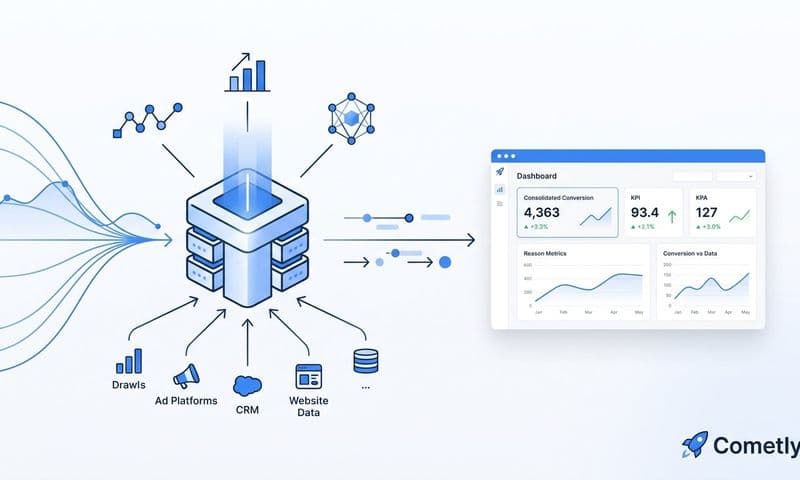
But capturing more data is only half the solution. The real power comes from connecting that data across your entire marketing ecosystem. A unified attribution platform acts as the central nervous system, ingesting data from ad platforms, website events, CRM outcomes, and offline conversions, then stitching them together into coherent customer journeys.
This connection happens through identity resolution—the process of recognizing that the anonymous website visitor, the email subscriber, the ad clicker, and the CRM contact are all the same person. By matching identifiers like email addresses, phone numbers, and user IDs across systems, you can see the complete path from first touch to closed revenue.
When your ad platforms, website tracking, and CRM all feed into a single source of truth, you finally get answers to questions that were impossible before. Which ad creative initiated the journey for your highest-value customers? How many touchpoints do people typically need before converting? Which channels work best together versus in isolation? Implementing marketing attribution platforms for revenue tracking makes these insights accessible.
This unified view also reveals patterns that siloed data hides. You might discover that LinkedIn ads rarely drive direct conversions but consistently introduce prospects who later convert through search. Or that email performs best when someone has previously engaged with both social and display ads. These multi-touch insights are invisible when each platform only reports its own contribution.
The technical architecture matters here. A proper unified attribution system doesn't just aggregate reports—it captures raw event data, maintains persistent user identities, and applies attribution models to the complete journey. This creates a foundation for accurate reporting today and flexible analysis tomorrow as your attribution questions evolve.
Turning Connected Data Into Smarter Decisions
Unified data is powerful, but its real value emerges when you transform those connected insights into better marketing decisions.
With complete customer journey visibility, you can compare attribution models to understand different aspects of channel performance. Last-click attribution shows which channels close deals. First-click reveals which channels initiate relationships. Linear attribution distributes credit evenly across all touchpoints. Position-based models emphasize both the first and last interactions. Understanding attribution models in digital marketing helps you choose the right approach for your goals.
Each model answers a different strategic question. If you're trying to understand brand awareness drivers, first-click attribution highlights where your future customers first discover you. If you're optimizing for immediate conversions, last-click shows closing channels. Multi-touch models reveal the full ecosystem of how channels work together.
This flexibility matters because different channels play different roles. A channel that looks weak in last-click attribution might be essential for awareness. A channel that dominates last-click might only be effective because other channels did the heavy lifting earlier in the journey. Unified data lets you see both perspectives and make nuanced budget decisions rather than crude on/off choices.
The next level of optimization comes from feeding enriched conversion data back to ad platforms. When you send detailed conversion information to Meta, Google, and other channels—including conversion values, customer attributes, and which conversions actually resulted in revenue—their machine learning algorithms get better training data.
Ad platforms optimize toward the signals you send them. If you only send basic conversion events, they optimize for any conversion. If you send enriched data showing which conversions came from high-value customers, they can optimize for quality, not just quantity. This improves targeting accuracy, reduces cost per valuable conversion, and helps platforms automatically bid toward your actual business goals.
This feedback loop—often called conversion sync or enhanced conversions—performs poorly when fed incomplete or siloed data. If your conversion tracking only captures 60% of actual conversions due to browser limitations, the ad platform's algorithm is optimizing based on a distorted view of reality. Server-side tracking and unified attribution ensure the data you're feeding back is comprehensive and accurate.
AI-powered analysis takes this even further. When you have unified data capturing every touchpoint, AI can surface insights and optimization recommendations that siloed data would never reveal. It might identify that customers who engage with three specific touchpoint combinations convert at twice the rate of others, suggesting where to focus your multi-channel strategy. Leveraging data analytics in marketing becomes significantly more powerful with connected data.
AI can also detect patterns humans miss—like the fact that conversions spike exactly five days after someone clicks a particular ad type, or that customers from certain traffic sources have dramatically different lifetime values despite similar initial conversion rates. These insights inform everything from creative testing to budget allocation to audience targeting.
The strategic advantage is speed and confidence. Instead of spending weeks manually analyzing data to find optimization opportunities, AI surfaces them automatically. Instead of making budget decisions based on gut feel or incomplete platform reports, you're working from a complete, accurate view of what's actually driving revenue. This is the foundation of effective data driven marketing strategies.
From Data Chaos to Marketing Clarity
The marketing data silos problem isn't just a technical inconvenience you can work around with spreadsheets and patience. It's a strategic liability that compounds every day you leave it unresolved. Every misallocated budget dollar, every delayed optimization, every decision made on incomplete information—they add up to a fundamental competitive disadvantage.
Your competitors who've solved this problem are moving faster. They know which channels actually drive revenue. They optimize in days, not weeks. Their ad platform algorithms learn from complete, accurate conversion data while yours are guessing based on fragments.
The path forward is clear: centralized tracking that captures the complete customer journey, unified attribution that connects the dots across platforms, and tools designed specifically to break down silos rather than create new ones. Server-side tracking bypasses browser limitations. Identity resolution stitches together fragmented touchpoints. Multi-touch attribution reveals how channels work together instead of fighting over credit.
This isn't about buying more software or hiring data engineers. It's about recognizing that disconnected data creates disconnected strategy. When your marketing platforms refuse to talk to each other, you're making million-dollar decisions based on partial information. When they finally connect, you gain the clarity to scale what works and cut what doesn't.
The question isn't whether to solve marketing data silos—it's how quickly you can do it before the opportunity cost becomes too large to ignore. Every campaign you run with fragmented data is a campaign that could be performing better with unified insights.
Ready to elevate your marketing game with precision and confidence? Discover how Cometly's AI-driven recommendations can transform your ad strategy—Get your free demo today and start capturing every touchpoint to maximize your conversions.