You're staring at three dashboards. Meta says Creative A is crushing it with a 4.2% CTR. Google Ads shows Creative B has the lowest CPC. Your analytics platform insists Creative C drives the most time on site. So which ad is actually winning?
This is the daily reality for digital marketers managing campaigns across multiple platforms. You're drowning in metrics, each telling a different story, while your budget burns and competitors pull ahead. The problem isn't lack of data—it's too much data without a clear way to interpret what actually matters for your bottom line.
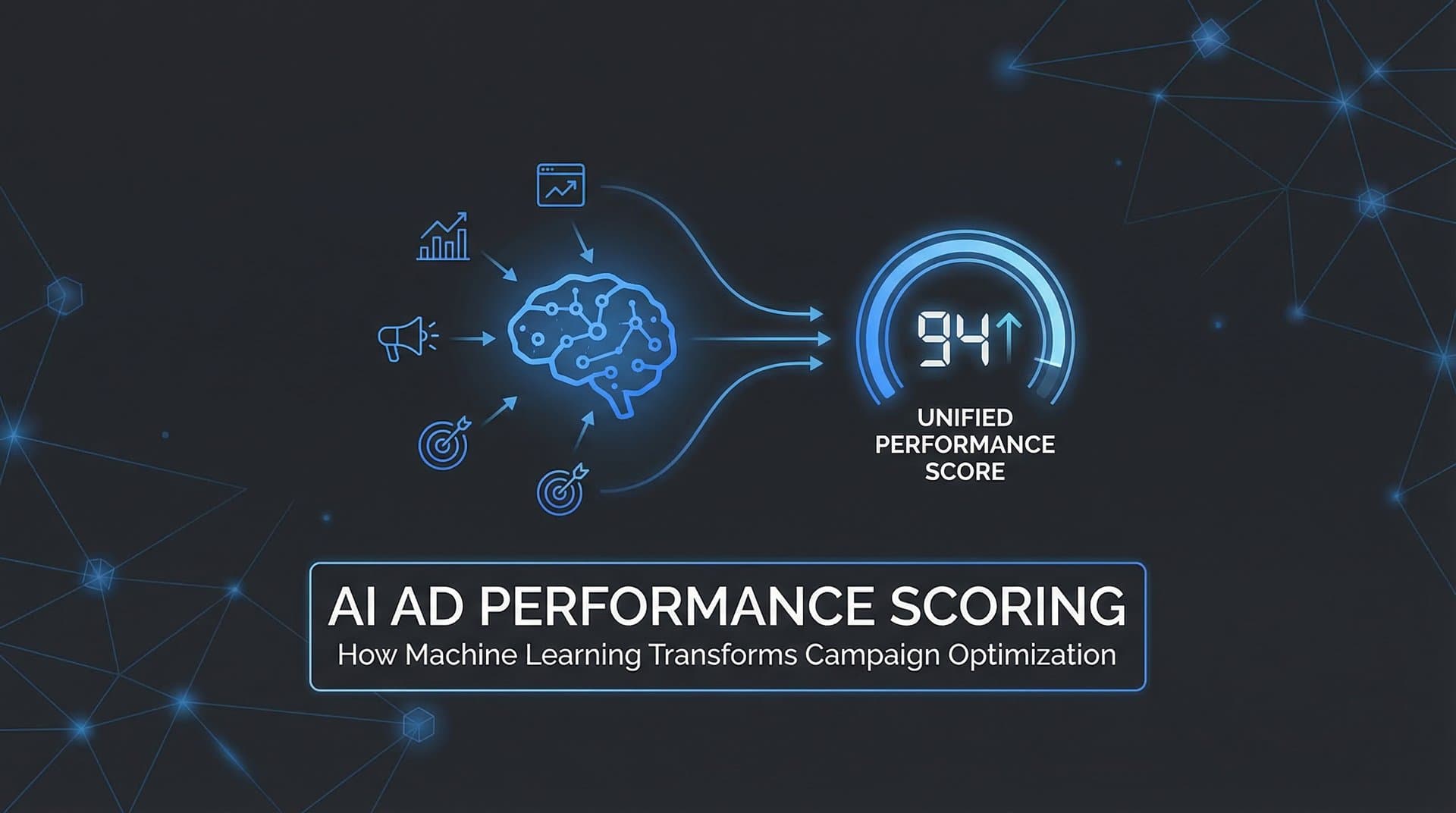
AI ad performance scoring cuts through this noise by doing what humans can't: analyzing dozens of performance signals simultaneously, weighing them against your specific business goals, and delivering a single, actionable score that tells you which ads deserve more budget and which need to be paused. Instead of spending hours comparing spreadsheets and second-guessing decisions, you get machine learning-powered recommendations that continuously adapt as your campaigns generate new data.
The Science Behind AI-Powered Ad Scoring
At its core, AI ad performance scoring uses machine learning algorithms to analyze multiple performance signals at once and generate composite scores that reflect true ad effectiveness. Unlike traditional methods where you might manually weigh CTR against conversion rate, AI systems process hundreds of data points simultaneously—click-through rates, conversion rates, engagement depth, cost metrics, revenue attribution, and dozens of other signals—to produce a unified performance ranking.
The fundamental difference between rule-based scoring and adaptive AI models is how they handle complexity. Rule-based systems follow predetermined formulas: if CTR exceeds X and CPA stays below Y, assign a high score. These rigid frameworks break down quickly because they can't account for context. An ad with a 5% CTR might score high in a rule-based system even if those clicks never convert, while an ad with 2% CTR that drives qualified buyers gets undervalued.
Adaptive AI models learn from your specific campaign data. They identify patterns unique to your audience, product, and funnel. If your business typically sees lower CTRs but higher conversion rates from certain ad formats, the AI recognizes this pattern and adjusts scoring accordingly. The system essentially builds a custom definition of "good performance" based on what actually drives results for your campaigns, not generic industry benchmarks.
Modern AI scoring operates in real-time, continuously updating scores as new data flows in. This is fundamentally different from historical analysis where you review last week's performance and make decisions based on lagging indicators. Real-time ad performance monitoring means the moment an ad starts underperforming—or suddenly takes off—the system flags it. You're not waiting for enough data to accumulate before taking action. The AI processes each new impression, click, and conversion as it happens, recalculating scores and surfacing insights while campaigns are still live and adjustable.
The machine learning models behind these systems typically use supervised learning approaches, where they're trained on historical campaign data that includes both performance metrics and outcomes. The AI learns which combinations of signals historically predicted success, then applies those learnings to score new ads. As your campaigns run and generate more data, the model's predictions become increasingly accurate—it's literally getting smarter about what works for your specific business every day.
Why Traditional Performance Metrics Fall Short
Single-metric optimization is one of the fastest ways to sabotage campaign performance. When you optimize purely for CTR, you often end up with clickbait that attracts curiosity seekers who never convert. Optimize only for lowest CPC, and you might fill your funnel with unqualified traffic. Focus exclusively on conversion rate, and you could be missing massive scale opportunities from audiences with slightly lower conversion rates but much larger volume potential.
The reality is that each metric tells only part of the story. High engagement doesn't guarantee revenue. Low cost per click means nothing if those clicks don't lead anywhere valuable. Strong conversion rates lose their appeal when you discover the customer lifetime value is minimal. You need to see how all these signals interact to understand true ad performance, but human brains aren't wired to process multidimensional data effectively.
We cover this in more depth in our guide to AI UGC vs real UGC.
Cross-platform inconsistency compounds the problem. Meta defines "engagement" differently than TikTok. Google's conversion tracking windows don't match LinkedIn's. Each platform has its own attribution model, its own way of counting impressions, its own standards for what qualifies as a "click." When you're running campaigns across multiple channels—which most marketers are—you're essentially comparing apples to oranges to pineapples. There's no unified standard, which makes tracking ad performance across channels nearly impossible without a system that normalizes data across platforms.
Then there's the time cost. Let's say you're running 50 ad variations across four platforms. That's 200 individual ads to evaluate. Even if you spend just five minutes reviewing each one's performance across multiple metrics, you're looking at 16+ hours of manual analysis. And that's assuming you only review performance once per week. Most campaigns need daily or even multiple-times-daily optimization to stay competitive.
We cover this in more depth in our guide to AI talking avatar ads generator.
Manual analysis also introduces bias and inconsistency. You might favor certain creative styles based on personal preference. Fatigue sets in after reviewing dozens of ads, making your later decisions less rigorous than your earlier ones. Different team members apply different standards. What one marketer considers "good enough" to keep running, another might pause immediately. Without a standardized, objective scoring system, your optimization decisions become subjective and unreliable.
The bottleneck isn't just time—it's opportunity cost. While you're stuck in spreadsheets trying to figure out which ads to scale, your competitors using AI scoring systems have already identified their winners, reallocated budget, and pulled ahead. In fast-moving auction environments where ad costs fluctuate hourly, speed of optimization directly impacts profitability.
Key Signals AI Scoring Systems Evaluate
Engagement quality indicators go far beyond surface-level clicks. Modern AI scoring systems track scroll depth on landing pages—did visitors engage with 25% of your content, or did they scroll all the way to the bottom? They measure time on page with nuance, distinguishing between someone who spent three minutes actively reading versus someone who left a tab open. Micro-conversions like video plays, add-to-cart actions, email signups, and tool interactions all feed into the scoring algorithm.
These deeper engagement signals reveal ad quality in ways that clicks alone never could. An ad might generate tons of clicks but consistently deliver visitors who bounce within seconds. That's a signal that the ad messaging doesn't align with landing page content, or that it's attracting the wrong audience. Conversely, an ad with moderate CTR might consistently bring visitors who engage deeply with content, watch product demos, and add items to cart—all strong indicators of purchase intent even before conversion happens.
Revenue attribution signals connect ad interactions to actual business outcomes. AI scoring systems track not just whether someone converted, but the quality of that conversion. Did this ad drive a $50 purchase or a $500 purchase? Did it bring in a one-time buyer or someone who's made three repeat purchases in the past month? Customer lifetime value becomes part of the scoring equation, meaning ads that attract high-value customers score higher than ads that drive cheap, one-off transactions.
Attribution gets particularly sophisticated when AI systems track the full customer journey. They recognize that someone might click your ad today, research for a week, see a retargeting ad, then convert. Instead of giving all credit to the last click, intelligent scoring models understand each touchpoint's role. An ad that consistently appears early in high-value customer journeys might score well even if it's not the final conversion driver—the AI recognizes its importance in the overall path to purchase. Understanding paid advertising performance metrics at this level transforms how you evaluate campaign success.
Creative performance patterns represent where AI scoring shows its most impressive capabilities. The system analyzes visual elements, copy components, and video content to identify winning patterns across your campaigns. It might discover that ads featuring your product in use consistently outperform studio shots. Or that headlines asking questions drive better engagement than declarative statements. Or that the first three seconds of video creative correlate strongly with conversion rates.
This pattern recognition operates at a level humans simply can't match. While you might notice that "blue backgrounds seem to work well," AI identifies that blue backgrounds specifically work well for your audience segment A, in carousel format, when paired with benefit-focused copy, but underperform for audience segment B who responds better to testimonial-style creative with neutral backgrounds. These multidimensional insights allow you to build increasingly effective creative based on what the data actually shows, not what conventional wisdom suggests.
The AI also identifies creative fatigue before it tanks your performance. By tracking how engagement and conversion rates decay over time for specific creative elements, the system can predict when an ad will stop performing and recommend refreshes proactively. This prevents the common scenario where a winning ad runs too long, burns out your audience, and starts hemorrhaging budget before you notice the decline.
Implementing AI Scoring in Your Ad Workflow
Data requirements come first—AI scoring is only as good as the data it receives. Before any AI system can effectively score your ads, you need clean tracking and proper attribution setup. This means implementing server-side tracking to capture accurate conversion data that isn't blocked by browser privacy features or ad blockers. It means ensuring your tracking pixels fire correctly across all conversion points. It means having a unified system that connects ad clicks to CRM events to actual revenue.
The "garbage in, garbage out" principle applies with full force here. If your conversion tracking is spotty, dropping 30% of events, the AI will make scoring decisions based on incomplete data. If your attribution windows are misconfigured, the system might undervalue ads that drive delayed conversions. If you're not passing revenue data back to your analytics platform, the AI can't differentiate between high-value and low-value conversions. Addressing unreliable marketing performance data isn't optional—it's the prerequisite for everything else.
Integration with existing platforms requires connecting all your ad channels to a unified scoring system. This typically means setting up API connections between Meta, Google, TikTok, LinkedIn, and any other platforms you advertise on. The goal is creating a single source of truth where performance data from all channels flows into one system that can normalize metrics, apply consistent scoring criteria, and give you cross-platform visibility.
The technical implementation varies by tool, but the concept remains consistent: your AI scoring platform needs read access to campaign performance data and, ideally, write access to make optimization changes automatically. Read-only access lets you see scores and recommendations but requires manual implementation. Full integration allows the AI to automatically adjust budgets, pause underperformers, and scale winners based on its scoring—though most marketers start with recommendations and maintain human approval before the AI takes autonomous action.
Acting on scores is where AI scoring transforms from interesting data to actual results. The system might recommend pausing ads scoring below a certain threshold, reallocating that budget to top performers scoring above your success benchmark. It might suggest increasing budget on an ad that's scoring well but hasn't reached its spend potential. It might flag creative fatigue on a previously high-scoring ad that's declining, prompting you to refresh the creative before performance tanks completely.
The key is building trust in the system gradually. Start by comparing AI recommendations against your own analysis. You'll likely find the AI catches things you missed—ads you thought were performing well that actually have poor downstream metrics, or ads you were ready to pause that show strong signals in dimensions you weren't monitoring. As the AI's recommendations prove accurate, you can increase your confidence in acting on them quickly, eventually moving toward more automated optimization where the system handles routine decisions while flagging unusual situations for human review.
Tools That Deliver AI Ad Performance Scoring
AdStellar AI represents the current generation of comprehensive AI ad platforms that combine creative generation with performance scoring. The platform generates ad creatives using AI, launches them directly to Meta with optimized audiences and copy, then automatically tests every combination and surfaces top performers with real-time insights. This end-to-end approach means you're not just getting scoring on existing ads—you're getting AI-powered creative production, campaign setup, and ongoing optimization all in one system.
 7 Proven AI UGC Strategies to Scale Your Ecommerce Ad Campaigns
What sets AdStellar apart is the integration of creative and performance. The AI doesn't just tell you which ads are winning—it understands why they're winning based on creative elements, audience targeting, and messaging. This allows the system to generate new variations that incorporate winning patterns while testing new approaches. You're essentially getting a creative team, media buyer, and analyst rolled into one AI-powered platform that works 24/7 to improve your campaign performance.
The platform handles everything from scroll-stopping image ads to video content and UGC-style creatives, all generated by AI. You can create AI image ads, AI video ads, or AI UGC avatar ads. You can launch campaigns without ever needing designers or video editors, and the system's real-time reporting shows performance across every creative variation, audience segment, and campaign. For marketers running high-volume creative testing, this eliminates the traditional bottleneck of creative production while ensuring every new ad gets immediately scored and optimized based on actual performance data.
For a deeper dive into this space, see our guide to AI UGC ads.
Platform-native AI features like Meta Advantage+ and Google Performance Max offer scoring capabilities, but within their own ecosystems. Meta's AI can identify your best-performing ads and automatically allocate more budget to them, but only within Meta's platforms. Google's Performance Max does similar optimization across Google's properties. These native tools are powerful for single-platform optimization, but they can't give you the cross-platform campaign performance analysis that multi-channel advertisers need.
The limitation becomes clear when you're running campaigns across multiple platforms. Meta's AI might tell you Creative A is your top performer on Facebook and Instagram, while Google's AI says Creative B dominates on YouTube and Display. Without a unified scoring system, you can't definitively answer which creative actually drives better overall results for your business. You're optimizing within silos rather than across your entire marketing mix.
Choosing the right approach depends on your campaign complexity and budget scale. If you're running simple campaigns on a single platform with straightforward conversion goals, platform-native AI features might be sufficient. They're included with your ad spend, require minimal setup, and work reasonably well for basic optimization. But as your campaigns grow more sophisticated—multiple platforms, complex funnels, various audience segments, high creative volume—dedicated ad performance optimization software becomes essential for maintaining performance at scale.
For marketers managing significant ad budgets across multiple channels, the investment in a comprehensive AI scoring platform pays for itself quickly. The time saved on manual analysis, the budget waste prevented by catching underperformers faster, and the revenue gained from scaling winners more aggressively typically deliver ROI within the first month. The question isn't whether AI scoring is worth it—it's whether you can afford to keep optimizing manually while competitors leverage AI advantages.
Putting AI Scoring to Work: A Practical Framework
Setting scoring thresholds starts with defining what "winner" means for your specific business goals. This isn't a one-size-fits-all number. An e-commerce brand optimizing for immediate purchases might set a high score threshold based on conversion rate and ROAS. A B2B company with longer sales cycles might weight engagement quality and lead quality signals more heavily. Your threshold should reflect what actually drives value for your business, not generic benchmarks.
Most AI scoring systems allow you to customize which metrics matter most. You might tell the system that conversion rate is your primary success metric, with CTR and engagement as secondary factors. Or you might prioritize customer lifetime value above all else, accepting lower conversion rates if the customers acquired are more valuable long-term. The AI then generates scores based on your priorities, ensuring recommendations align with your actual objectives rather than platform-defined success metrics. Learning how to evaluate marketing performance metrics helps you configure these systems effectively.
Building feedback loops trains AI systems to get increasingly accurate over time. This means consistently feeding conversion data back into the system, including offline conversions that happen outside the digital funnel. If someone clicks your ad, requests a demo, then converts via sales call three weeks later, that data needs to flow back to the AI. The more complete your feedback loop, the better the system understands which early signals predict eventual high-value outcomes.
The feedback also includes human input. When you override an AI recommendation—keeping an ad running that scored low because you have strategic reasons, or pausing a high-scoring ad due to inventory issues—logging that context helps the system learn. Over time, the AI incorporates these business considerations into its scoring, becoming a more sophisticated partner in optimization rather than a rigid algorithm.
Measuring the impact means tracking how AI-driven decisions improve overall campaign ROAS over time. The key metric isn't whether individual AI recommendations were right—it's whether your campaigns perform better with AI scoring than without it. Compare your ROAS, cost per acquisition, and overall conversion rates before and after implementing AI scoring. Track how much time you're saving on manual analysis. Monitor how quickly you identify and scale winners compared to your previous process.
Most marketers see measurable improvements within 2-4 weeks of implementing AI scoring consistently. The gains compound over time as the system learns more about your specific campaigns and audience. An ad that would have taken you three days to identify as a winner gets flagged by AI within hours, giving you a multi-day head start on scaling. An underperformer that might have burned $500 before you caught it gets paused after $50. These small advantages accumulate into significant performance improvements and budget savings across dozens or hundreds of ads.
The Competitive Advantage of AI-Driven Decisions
AI ad performance scoring isn't just about automation—it's about making smarter, faster decisions that compound over time. Every hour you spend manually analyzing performance is an hour your competitors using AI scoring are already optimizing and pulling ahead. Every dollar wasted on an underperforming ad that AI would have caught immediately is budget that could have been scaled on proven winners.
The marketers who adopt AI scoring now are building a fundamental competitive advantage. They're learning how to work with AI systems, training those systems on their specific business data, and developing optimization processes that simply operate at a different speed than manual analysis allows. As ad costs continue rising and auction competition intensifies, this speed and accuracy advantage becomes increasingly valuable.
The technology isn't replacing marketer judgment—it's augmenting it. You still make strategic decisions about positioning, messaging, and overall campaign direction. But you're freed from the tedious, time-consuming work of comparing metrics across dozens of ads and platforms. You can focus on creative strategy and audience insights while AI handles the computational heavy lifting of performance analysis and optimization recommendations.
Think about your current performance analysis workflow. How much time do you spend each week reviewing campaign data? How confident are you that you're catching every optimization opportunity? How often do you discover an ad that's been underperforming for days before you noticed? AI scoring eliminates these gaps and inefficiencies, giving you continuous, real-time performance intelligence that keeps your campaigns operating at peak efficiency.
Ready to elevate your marketing game with precision and confidence? Discover how Cometly's AI-driven recommendations can transform your ad strategy—Get your free demo today and start capturing every touchpoint to maximize your conversions.