You're running campaigns on Meta, Google Ads, TikTok, and LinkedIn. Each platform dashboard shows impressive numbers. Meta claims 500 conversions. Google says 450. TikTok reports 200. Add them up and you've got 1,150 conversions—except your actual sales data shows only 800.
This isn't a tracking error. It's the reality of modern marketing measurement.
Every ad platform uses its own attribution model, its own conversion window, and its own definition of success. They all want credit for the same customer. The result? Conflicting data, inflated metrics, and budget decisions based on incomplete information. You're trying to understand which channels actually drive revenue, but you're working with five different versions of the truth.
Cross-platform campaign performance analysis solves this problem by creating a unified view of your marketing performance. Instead of piecing together fragmented reports from each platform, you track the complete customer journey across all touchpoints in one system. You see which channels truly contribute to conversions, how they work together, and where your budget delivers real ROI.
This guide shows you exactly how to implement cross-platform analysis—from building your measurement infrastructure to optimizing budget allocation based on unified data. Let's start by understanding why platform-native analytics can't give you the full picture.
Why Siloed Platform Data Leads Marketers Astray
Platform dashboards weren't designed to tell you the truth about cross-channel performance. They were designed to make their platform look good.
Here's what happens: A potential customer sees your Meta ad on Monday. They don't click. On Wednesday, they search for your product and click a Google ad. On Friday, they see a retargeting ad on TikTok and finally convert. Meta claims the conversion because the customer saw their ad first. Google claims it because the customer clicked their ad. TikTok claims it because their ad was the last touchpoint before conversion.
Each platform is technically correct based on their own attribution rules. But when you're trying to understand which channel deserves credit—and therefore budget—you're stuck with three conflicting stories.
This over-counting problem gets worse as you add more platforms. The math becomes absurd: your platform dashboards might report 150% more conversions than actually occurred. You can't make smart budget decisions when your foundational data is inflated.
Beyond the double-counting issue, platform-native analytics fundamentally can't track cross-platform journeys. Meta doesn't know what happened on Google. Google doesn't know what happened on TikTok. Each platform only sees its own touchpoints. They're blind to the full story.
Think about your own buying behavior. You rarely convert the first time you see an ad. You research. You compare. You encounter the brand multiple times across different platforms before making a decision. Your customers do the same thing—but platform dashboards can't show you this reality.
The consequences are real. Many marketers over-invest in bottom-funnel channels like branded search because those platforms claim credit for conversions that were actually influenced by earlier touchpoints. Meanwhile, awareness-building channels get underfunded because their contribution isn't visible in last-click attribution.
Without unified measurement, you're essentially flying blind. You might think Meta is your best performer when it's actually Google driving the majority of revenue. Or you might cut budget from a channel that's crucial for starting customer journeys, even though it doesn't get last-click credit.
Core Components of Effective Cross-Platform Analysis
Building a unified view of campaign performance requires three foundational elements working together. Miss any one of them and you're back to fragmented data and guesswork.
Unified Tracking Infrastructure: The foundation is a tracking system that captures every customer interaction across all platforms in one place. This means implementing server-side tracking that doesn't rely on browser cookies or mobile device identifiers—both of which have become unreliable due to privacy changes.
Server-side tracking works by sending conversion data directly from your server to your analytics platform, bypassing browser limitations. When a customer converts, your server records the event and attributes it to the correct marketing touchpoints based on first-party data you control. This approach captures conversions that browser-based tracking would miss.
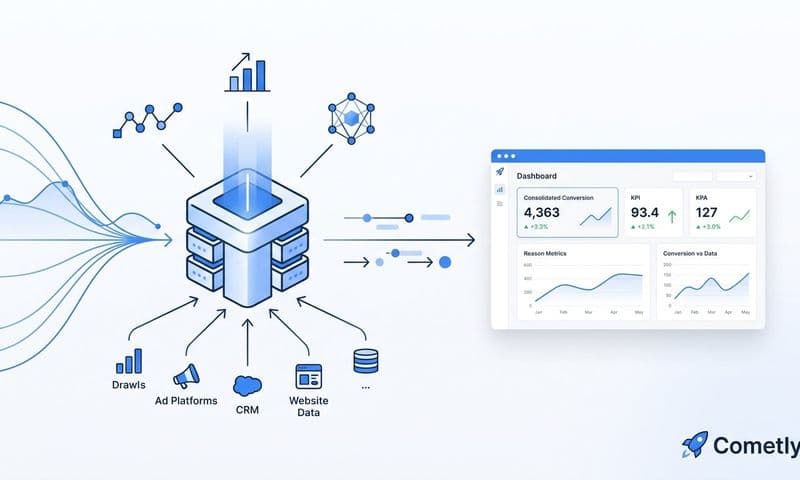
Your unified infrastructure needs to connect every data source: Meta Ads, Google Ads, TikTok Ads, LinkedIn Ads, your CRM, your website analytics, and any other platform where customer interactions happen. The goal is creating a single source of truth where you can see the complete customer journey from first ad impression to final conversion.
Standardized Metrics Framework: Once you're collecting data in one place, you need consistent definitions for measuring success. This sounds simple but it's where many marketers stumble.
Each platform calculates metrics differently. Meta might count a conversion within a 7-day click window. Google might use a 30-day window. Your definitions need to be standardized so you're comparing apples to apples. When you calculate ROAS for Meta and Google, both calculations should use the same conversion window, the same revenue attribution rules, and the same cost accounting.
The key metrics for cross-platform analysis include blended ROAS (total revenue divided by total ad spend across all platforms), customer acquisition cost by channel, time-to-conversion patterns, and customer lifetime value segmented by acquisition source. Define these metrics once, then apply them consistently across every channel. Understanding campaign performance metrics is essential for building this standardized framework.
Multi-Touch Attribution Modeling: This is where cross-platform analysis gets powerful. Instead of giving all credit to the last click, multi-touch attribution distributes credit across all touchpoints that contributed to a conversion.
Different attribution models work for different business models. Linear attribution gives equal credit to every touchpoint—useful for understanding overall channel contribution. Time-decay attribution gives more credit to recent touchpoints—helpful when recency matters more than early awareness. Position-based attribution credits both the first and last touchpoint heavily—valuable for businesses where both awareness and conversion tactics matter.
The right attribution model depends on your sales cycle. B2B companies with long, complex sales cycles often benefit from multi-touch models that recognize early awareness-building efforts. E-commerce businesses with shorter cycles might use time-decay or position-based models. The key is choosing a model that reflects how customers actually move through your funnel.
Multi-touch attribution reveals which channels work together. You might discover that customers who see both Meta and Google ads convert at twice the rate of those who only see one. Or that LinkedIn ads don't drive many direct conversions but significantly increase conversion rates from other channels. These insights are invisible in platform dashboards.
Building Your Cross-Platform Measurement Framework
Theory is one thing. Implementation is another. Here's the step-by-step process for building a measurement framework that actually works.
Step 1: Connect All Your Data Sources
Start by integrating every platform where you run campaigns or track customer behavior. This includes your ad platforms (Meta, Google, TikTok, LinkedIn, etc.), your CRM (Salesforce, HubSpot, Pipedrive), your website analytics, and any other tools in your marketing stack.
The integration needs to flow both ways. You're not just pulling data from these platforms—you're also sending conversion data back to them. This bi-directional flow is crucial because it allows ad platform algorithms to optimize based on your actual conversions, not just their platform-tracked conversions.
Most modern attribution platforms offer pre-built integrations with major ad platforms and CRMs. Look for solutions that use APIs rather than requiring manual data uploads. API connections update automatically and reduce the risk of data gaps. A robust marketing campaign attribution platform will handle these integrations seamlessly.
During setup, pay attention to conversion event naming. Use consistent naming conventions across all platforms. If you're tracking "Purchase" events, make sure that event name is identical everywhere. Inconsistent naming creates data fragmentation that defeats the purpose of unified tracking.
Step 2: Implement Server-Side Tracking
Browser-based tracking has become unreliable. iOS App Tracking Transparency means many mobile users opt out of tracking. Browser cookie restrictions limit your ability to track returning visitors. Ad blockers prevent tracking scripts from loading. If you're relying solely on client-side tracking, you're missing a significant portion of your conversions.
Server-side tracking solves this by capturing conversions on your server, where browser limitations don't apply. When a customer completes a purchase, your server records the conversion and sends that data to your attribution platform and back to your ad platforms.
Implementation typically involves adding a server-side tracking container to your website, configuring conversion events, and setting up server-to-server connections with your ad platforms. The technical complexity varies depending on your platform, but the payoff is substantial: more accurate conversion tracking and better data for ad optimization.
Server-side tracking also enables you to send enriched conversion data back to ad platforms. Instead of just telling Meta that a conversion happened, you can send the conversion value, customer lifetime value prediction, and other first-party data that helps their AI optimize more effectively. This approach can significantly improve Facebook Ads performance with better data.
Step 3: Choose and Configure Attribution Models
Now that you're collecting unified data, decide how you'll attribute credit across touchpoints. This isn't a one-time decision—you should analyze performance using multiple attribution models to understand how different approaches affect your insights.
Start with a multi-touch model that aligns with your business reality. If you run awareness campaigns that build brand recognition over time, use a model that credits early touchpoints. If you focus on direct response and quick conversions, use a model that weights recent interactions more heavily.
Many attribution platforms let you compare models side by side. You might look at the same campaign data through last-click, first-click, linear, and time-decay lenses. This comparison reveals which channels are getting over-credited or under-credited in different models.
Configure your attribution windows carefully. A 7-day window might work for e-commerce, but B2B companies often need 30, 60, or even 90-day windows to capture their longer sales cycles. Your window should match the typical time from first touchpoint to conversion in your business.
Analyzing Performance: From Raw Data to Actionable Insights
You've built the infrastructure. Your data is flowing. Now comes the valuable part: turning that unified data into decisions that improve your marketing performance.
Comparing True ROAS Across Platforms: The first insight most marketers discover is that their actual ROAS by channel looks very different from what platform dashboards reported.
When you remove platform self-attribution bias, some channels perform better than you thought, and others perform worse. A channel that claimed a 4x ROAS in its native dashboard might show a 2.5x ROAS in your unified analysis—still profitable, but not as stellar as it appeared. Meanwhile, a channel you were considering cutting might prove more valuable when you account for its role in multi-touch journeys.
Look at blended ROAS first—your total revenue divided by total ad spend across all platforms. This is your baseline. Then break down ROAS by channel using your chosen attribution model. The differences between platform-reported ROAS and attribution-modeled ROAS will be eye-opening. Mastering marketing performance analysis helps you interpret these differences accurately.
Pay attention to assisted conversions, not just last-click conversions. A channel might not drive many final conversions but could play a crucial role in starting customer journeys or moving prospects through your funnel. Channels that assist many conversions deserve credit even if they don't get the last click.
Identifying High-Value Channel Combinations: This is where cross-platform analysis becomes genuinely strategic. You're not just comparing channels in isolation—you're understanding how they work together.
Segment your customers by which channels they encountered before converting. You might find that customers who saw both Meta and Google ads have a 60% higher average order value than those who only saw one. Or that LinkedIn ads don't drive many conversions directly but increase conversion rates from email by 40%.
These interaction effects are invisible in platform dashboards but crucial for budget decisions. If two channels work synergistically, you should invest in both, not just the one with higher standalone ROAS. The combined impact exceeds what you'd get from investing in either channel alone.
Look for patterns in your highest-value customers. Which channel combinations do they encounter? How many touchpoints do they typically need before converting? What's the sequence of channels that produces the best outcomes? These patterns guide your media mix strategy. Effective multi channel campaign analysis reveals these critical insights.
Using Cohort Analysis for Lifetime Value: Conversion value matters, but customer lifetime value matters more. Cross-platform analysis lets you see which acquisition channels bring customers who stick around and generate ongoing revenue.
Create cohorts based on acquisition source and track their behavior over time. Customers acquired through Meta might convert quickly but have lower retention. Google customers might take longer to convert but generate higher lifetime value. This insight changes how you evaluate channel performance.
Calculate customer acquisition cost against lifetime value for each channel. A channel with a higher CAC might still be your best investment if it brings customers with significantly higher LTV. Conversely, a channel with low CAC might not be worth scaling if those customers churn quickly.
Cohort analysis also reveals how cross-platform exposure affects long-term value. Customers who encountered your brand on multiple platforms before converting often show higher engagement and retention than single-touchpoint customers. This insight justifies investing in multi-channel presence even when it's harder to attribute direct conversions. Using marketing funnel analysis tools can help you track these cohort behaviors effectively.
Optimizing Budget Allocation Based on Unified Data
Data without action is just interesting information. The goal of cross-platform analysis is making smarter budget decisions that improve your overall marketing ROI.
Shifting Spend Toward True Revenue Drivers: Armed with accurate attribution data, you can reallocate budget to channels that genuinely contribute to revenue rather than those that simply claim credit for conversions.
Start by identifying channels that are over-performing or under-performing relative to their current budget allocation. If a channel is generating 30% of your attributed revenue but only receiving 15% of your budget, that's an opportunity. Conversely, a channel getting 25% of budget but only driving 10% of revenue needs scrutiny.
Make incremental changes rather than dramatic shifts. Increase budget to high-performing channels by 20-30% and monitor results. Marketing performance isn't always linear—doubling spend doesn't necessarily double results. Test increases methodically and track how performance changes as you scale.
Don't abandon channels just because they don't get last-click credit. If your attribution analysis shows a channel consistently assists conversions or contributes to high-value customer acquisition, it deserves continued investment even if platform dashboards undervalue it.
Feeding Better Data Back to Ad Platforms: Here's where cross-platform analysis creates a virtuous cycle. The accurate conversion data you're collecting can be sent back to ad platforms to improve their AI optimization.
Ad platforms like Meta and Google use machine learning to optimize targeting and bidding. The quality of their optimization depends on the quality of conversion data they receive. When you send server-side conversion events back to these platforms, you're giving them more complete, accurate data than they could collect on their own.
This conversion sync improves campaign performance over time. Ad algorithms learn which audiences and creative approaches drive real conversions, not just platform-tracked conversions. Your targeting gets sharper, your cost per acquisition decreases, and your ROAS improves—all because the platforms are optimizing against better data. The right performance marketing tracking software makes this data synchronization seamless.
Prioritize sending high-value conversion events. If you're an e-commerce business, send purchase events with actual revenue values. If you're B2B, send qualified lead events or opportunity creation events from your CRM. The more valuable the conversion event, the more useful it is for platform optimization.
Establishing Ongoing Measurement Cadence: Cross-platform analysis isn't a one-time project. It's an ongoing process that needs regular attention to catch performance shifts and optimize continuously.
Set up a weekly or bi-weekly review cadence where you examine key metrics: blended ROAS, channel-specific ROAS, CAC trends, and attribution patterns. Look for significant changes that might signal opportunities or problems. A sudden drop in assisted conversions from a channel might mean your awareness campaigns need refreshing. A spike in multi-touch conversions could indicate your remarketing is working particularly well.
Create automated alerts for anomalies. If a channel's performance drops by more than 20% week-over-week, you want to know immediately so you can investigate. Early detection of performance issues prevents wasted spend and allows faster course correction. Implementing real time ad performance monitoring tools ensures you catch these shifts as they happen.
Use your unified data to run experiments. Test different budget allocations, new channel combinations, or alternative attribution models. The beauty of cross-platform analysis is you can see the full impact of changes across your entire marketing ecosystem, not just within individual platforms.
Moving Forward with Unified Marketing Measurement
Cross-platform campaign performance analysis transforms marketing from a collection of separate channel bets into a unified, data-driven strategy. When you can see the complete customer journey across all touchpoints, you stop making decisions based on platform-reported metrics that over-count conversions and under-represent cross-channel effects.
The marketers who embrace unified measurement gain a decisive advantage. They know which channels truly drive revenue. They understand how different platforms work together. They allocate budget based on actual contribution, not attribution bias. Most importantly, they scale with confidence because their decisions are grounded in complete, accurate data.
Implementation requires effort—connecting data sources, configuring server-side tracking, choosing attribution models. But the payoff is substantial: higher ROAS, lower customer acquisition costs, and marketing performance that compounds as you feed better data back to ad platforms.
The alternative is continuing to work with fragmented data, conflicting reports, and budget decisions based on incomplete information. In a competitive landscape where marketing efficiency determines who wins, that's not a viable path forward.
Ready to elevate your marketing game with precision and confidence? Discover how Cometly's AI-driven recommendations can transform your ad strategy—Get your free demo today and start capturing every touchpoint to maximize your conversions.