You're running campaigns across Meta, Google, TikTok, email, and your website. A customer sees your Instagram ad on Monday, clicks a Google search result on Wednesday, opens your email on Friday, and finally converts through a retargeted Meta ad on Sunday. Which channel gets the credit? Which one actually drove the decision?
Traditional attribution models force you to choose: give all the credit to the last click, split it evenly across every touchpoint, or follow some other predetermined rule that treats every customer journey exactly the same. The problem? Real buyer behavior is far more complex than any static rule can capture.
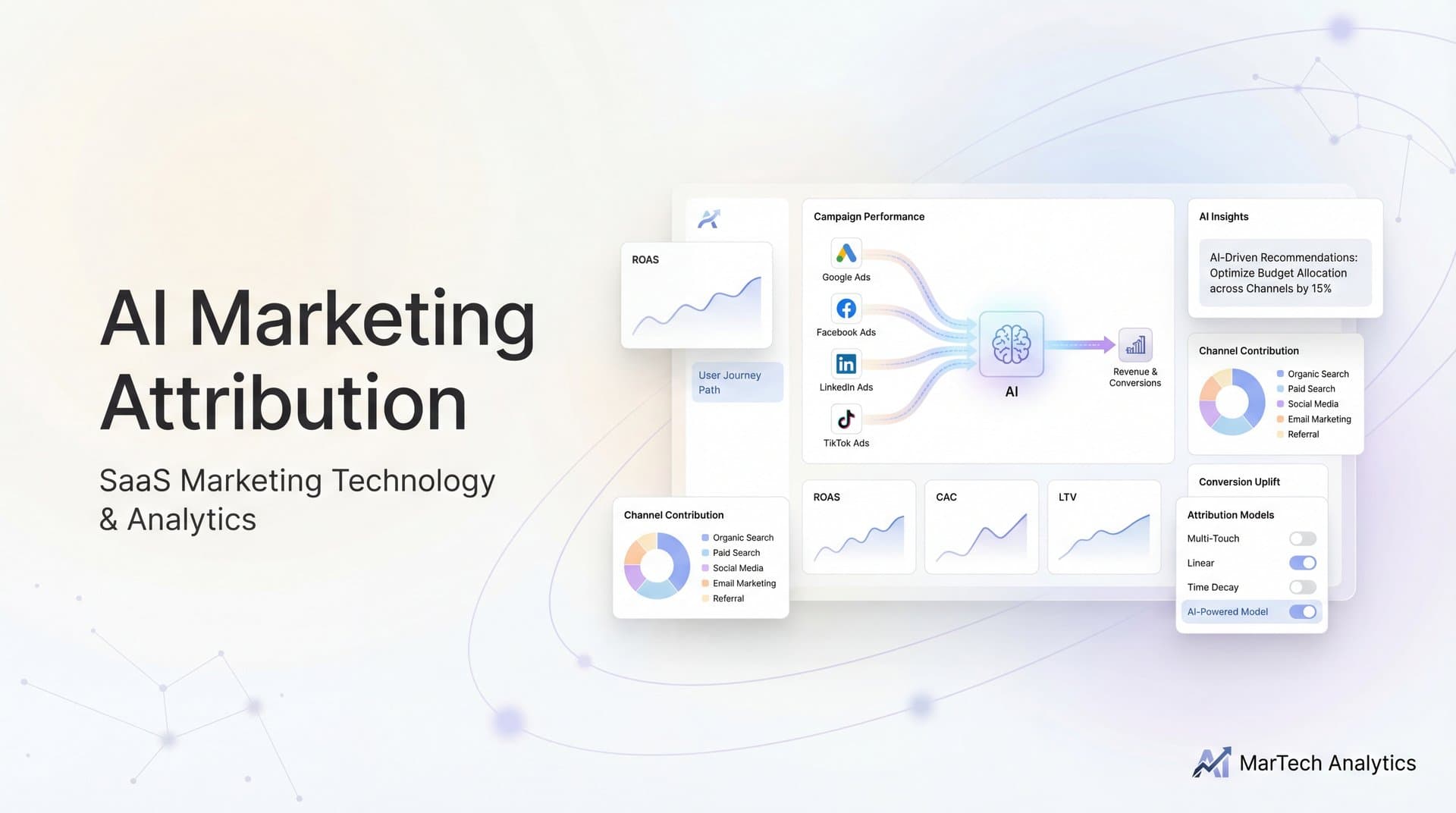
AI marketing attribution changes the game entirely. Instead of rigid rules, machine learning algorithms analyze patterns across millions of customer journeys to understand which touchpoints actually influence conversions. The technology dynamically assigns credit based on real impact, not arbitrary formulas—and it gets smarter with every data point it processes.
Why Traditional Attribution Models Can't Keep Up
Last-click attribution gives 100% of the credit to the final touchpoint before conversion. First-click assigns everything to the initial interaction. Linear splits credit equally across every touchpoint. These models were built for a simpler time when customer journeys were shorter and tracking was straightforward.
The reality today? Your customers interact with your brand across dozens of touchpoints before they convert. They switch between devices. They research on mobile and purchase on desktop. They see your ad, leave, come back through organic search, abandon their cart, then convert days later through a retargeted campaign.
Static rules can't account for this complexity. They treat a casual scroll-past impression the same as a deliberate product comparison visit. They ignore timing, sequence, and context—the very factors that determine whether a touchpoint actually moved someone closer to conversion or just happened to be in their path.
Here's where it gets worse: iOS privacy changes and cookie deprecation have created massive gaps in your tracking data. When Safari blocks third-party cookies and iOS limits tracking across apps, traditional attribution models don't just become less accurate—they become fundamentally broken. You're making budget decisions based on incomplete pictures of customer behavior.
Manual analysis doesn't solve the problem either. Trying to compare attribution models in your analytics dashboard, export data to spreadsheets, and piece together insights across platforms takes hours of work. By the time you've analyzed last week's performance, you've already spent this week's budget using yesterday's assumptions. Understanding the types of marketing attribution models available is essential, but knowing their limitations is equally important.
The cost of this guesswork compounds quickly. Underperforming channels keep getting budget because they happen to capture last clicks. High-impact awareness channels get cut because their value doesn't show up in simple models. Your best-performing campaigns remain invisible while you scale the wrong tactics.
How Machine Learning Reads Customer Journey Patterns
AI marketing attribution doesn't start with rules. It starts with data—thousands or millions of actual conversion paths from your campaigns. The algorithms analyze these paths to identify patterns: which sequences of touchpoints correlate with conversions, which channels appear consistently in successful journeys, and how timing and frequency affect outcomes.
Think of it like this: instead of deciding upfront that every touchpoint deserves equal credit, machine learning observes that customers who see your awareness campaign, then visit through organic search, then click a retargeting ad convert at 3x the rate of those who only see the retargeting ad. The algorithm weights those touchpoints accordingly—not because of a predetermined rule, but because the data shows their combined impact.
The technology goes deeper than simple correlation. Advanced AI models account for context: a touchpoint early in a long consideration cycle gets evaluated differently than the same touchpoint in a quick impulse purchase journey. A customer's third visit to your pricing page carries different weight than their first casual browse. For a deeper dive into this topic, explore how machine learning can be used in marketing attribution.
Sequence matters enormously. Machine learning can identify that customers who encounter Channel A before Channel B convert at higher rates than those who see them in reverse order. It recognizes that certain combinations of touchpoints create synergistic effects that isolated interactions don't produce.
This is where server-side tracking becomes critical. Browser-based tracking misses interactions that happen outside the web: app usage, phone calls, in-store visits, CRM events. AI attribution platforms that implement server-side tracking capture the complete picture—every ad click, every email open, every form submission, every deal stage change in your CRM.
The algorithms process this enriched data to build probability models. For each touchpoint in a customer's journey, the AI calculates: "If this interaction hadn't happened, how likely is it that this customer would have converted anyway?" Touchpoints that significantly increase conversion probability get higher attribution weight. Those that appear in journeys but don't correlate with conversion outcomes get less credit.
What makes this powerful is scale. A human analyst might review dozens of customer journeys and spot some patterns. Machine learning processes millions of data points simultaneously, identifying subtle patterns that would be impossible to detect manually. The models continuously learn and adapt as they ingest new data, so your attribution accuracy improves over time rather than becoming stale.
What AI Attribution Actually Does for Your Campaigns
The first capability that sets AI attribution apart: real-time budget optimization recommendations. Traditional analytics tell you what happened last week. AI-powered platforms analyze performance patterns as they emerge and suggest where to shift budget right now based on which channels are driving the highest-value conversions today.
These aren't generic suggestions. The algorithms identify specific campaigns, ad sets, or even individual creatives that are outperforming based on actual revenue impact, not just click-through rates or cost per click. You get actionable guidance: increase budget on this campaign by 20%, pause this underperforming ad set, test this high-performing creative in additional channels.
Cross-platform tracking becomes genuinely useful when AI connects the dots. A customer clicks your Meta ad, visits your site, leaves without converting, receives an email, clicks through to read a blog post, then converts three days later through a Google search. AI attribution maps this entire journey and assigns appropriate credit to each touchpoint based on how similar patterns have performed across your entire dataset.
This complete view extends beyond ad platforms. The technology tracks the customer journey all the way through your CRM—from initial lead to qualified opportunity to closed deal. You can see which marketing touchpoints correlate with deals that actually close, not just leads that enter your funnel. This changes everything about how you evaluate campaign performance. Platforms focused on marketing attribution revenue tracking make this connection seamless.
Predictive insights take this further. Machine learning algorithms can identify campaigns that are trending toward strong performance before you've spent your full budget. They spot patterns that indicate a campaign is resonating with high-intent audiences, even if early conversion numbers look modest. This early signal lets you scale winners faster and cut losers before you've wasted significant spend.
The AI also flags anomalies and opportunities you'd miss in manual analysis. Maybe a specific audience segment converts at 5x your average rate but only receives 10% of your budget. Or a channel that looks mediocre in last-click attribution actually plays a crucial role in your highest-value customer journeys. The platform surfaces these insights automatically rather than requiring you to dig through reports hunting for them.
The Feedback Loop That Makes Ad Platforms Smarter
Here's where AI attribution creates compounding value: it doesn't just analyze your marketing data—it feeds better data back to your ad platforms, making their algorithms work more effectively for your campaigns.
Platforms like Meta and Google use machine learning to optimize ad delivery. Their algorithms learn which users are most likely to convert and automatically show your ads to similar audiences. But these algorithms are only as good as the conversion data they receive. When tracking is incomplete or attribution is inaccurate, ad platforms optimize toward the wrong signals.
AI attribution platforms implement conversion sync—also called server-side conversion tracking or Conversions API integration. This technology sends enriched event data directly from your server to ad platforms, bypassing the limitations of browser-based tracking. The data includes not just "a conversion happened" but detailed context: conversion value, customer lifetime value predictions, which products were purchased, and crucially, which touchpoints actually influenced the decision.
This enriched data transforms how ad platforms optimize your campaigns. Instead of optimizing for any conversion, they can optimize for high-value conversions. Instead of treating all customers the same, they can identify and target users who match the patterns of your best customers. The targeting becomes more precise, the optimization more effective, and your acquisition costs drop as a result.
The feedback loop works like this: accurate attribution identifies which campaigns and audiences drive real revenue → conversion sync sends this enriched data to ad platforms → ad platform algorithms use better signals to optimize delivery → your campaigns perform more efficiently → you get clearer attribution data from better-qualified traffic → the cycle repeats and compounds.
This matters especially as third-party tracking degrades. When iOS blocks tracking and browsers limit cookies, ad platforms lose visibility into conversion events. Server-side conversion sync restores that visibility by sending conversion data directly from your systems, where tracking limitations don't apply. Your campaigns maintain optimization effectiveness even as browser-based tracking becomes less reliable.
The competitive advantage here is significant. Most advertisers are still sending incomplete conversion data to ad platforms, so those algorithms are optimizing with partial information. When you feed platforms complete, accurate data about which touchpoints drive valuable outcomes, your campaigns get better targeting and optimization than competitors who are flying blind.
Choosing the Right AI Attribution Platform
Start with integrations. An AI attribution platform is only as good as the data it can access. You need native connections to every ad platform you use—Meta, Google, TikTok, LinkedIn, and any other channels where you're spending budget. The platform should also integrate with your CRM to track leads through your sales pipeline and your website analytics to capture on-site behavior.
Server-side tracking capability is non-negotiable. If a platform relies entirely on browser-based tracking, it's already outdated. Look for solutions that implement server-side event tracking and Conversions API integration with major ad platforms. This ensures you're capturing accurate data even as third-party cookies disappear and privacy protections increase. Review the best software for tracking marketing attribution to find solutions with robust server-side capabilities.
Attribution model flexibility matters more than you might think. While AI-powered models are the goal, you should be able to compare different attribution approaches—last-click, first-click, linear, time decay, and AI-driven—to understand how each perspective changes your performance analysis. This comparison helps you communicate results to stakeholders who may be accustomed to traditional models. Understanding the importance of attribution models in marketing helps frame these conversations.
Ask specific questions about how the AI actually works. How does the platform weight different touchpoints? Can you see the logic behind attribution decisions, or is it a black box? What data does the algorithm use to make recommendations? Transparency in methodology helps you trust the insights and explain them to your team.
Actionable recommendations separate useful platforms from data dumps. You don't need another dashboard showing you what happened—you need clear guidance on what to do next. Look for platforms that provide specific, prioritized recommendations: which campaigns to scale, which to pause, where to test new creatives, how to reallocate budget for maximum impact.
Revenue connection is critical. The platform should track beyond leads and conversions to actual revenue outcomes. Can it show you which campaigns drive customers with the highest lifetime value? Can it connect ad spend to closed deals in your CRM? Attribution that stops at lead generation misses half the story. Robust marketing attribution analytics should connect every touchpoint to bottom-line results.
Implementation considerations include tracking setup complexity, team training requirements, and time to value. The best platforms provide clear onboarding, implementation support, and ongoing guidance. You should be able to get core tracking operational within days, not months, and start seeing actionable insights within the first week.
Measure success by asking: Are my budget decisions becoming more confident? Am I identifying high-performing campaigns faster? Is my cost per acquisition decreasing while conversion quality improves? These outcomes matter more than any specific feature list.
Making Confident Decisions With Complete Data
AI marketing attribution represents a fundamental shift from guessing which channels work to knowing with confidence what's actually driving revenue. Traditional models force you to choose between oversimplified rules that miss the nuance of real customer behavior. Machine learning analyzes the complete picture—every touchpoint, every sequence, every pattern—to show you what's really working.
The competitive advantage compounds over time. While competitors make budget decisions based on last-click data or gut instinct, you're optimizing based on actual revenue impact. While they struggle to connect ad spend to business outcomes, you're feeding enriched conversion data back to ad platforms, making their algorithms work harder for your campaigns.
This isn't about adding another analytics tool to your stack. It's about fundamentally improving how you understand marketing performance, allocate budget, and scale what works. Every dollar you spend gets directed toward the channels, campaigns, and audiences that actually drive results—not the ones that happen to capture last clicks.
The technology is here. The platforms exist. The question is whether you'll keep making marketing decisions with incomplete data or step into the clarity that AI-powered attribution provides.
Ready to elevate your marketing game with precision and confidence? Discover how Cometly's AI-driven recommendations can transform your ad strategy—Get your free demo today and start capturing every touchpoint to maximize your conversions.