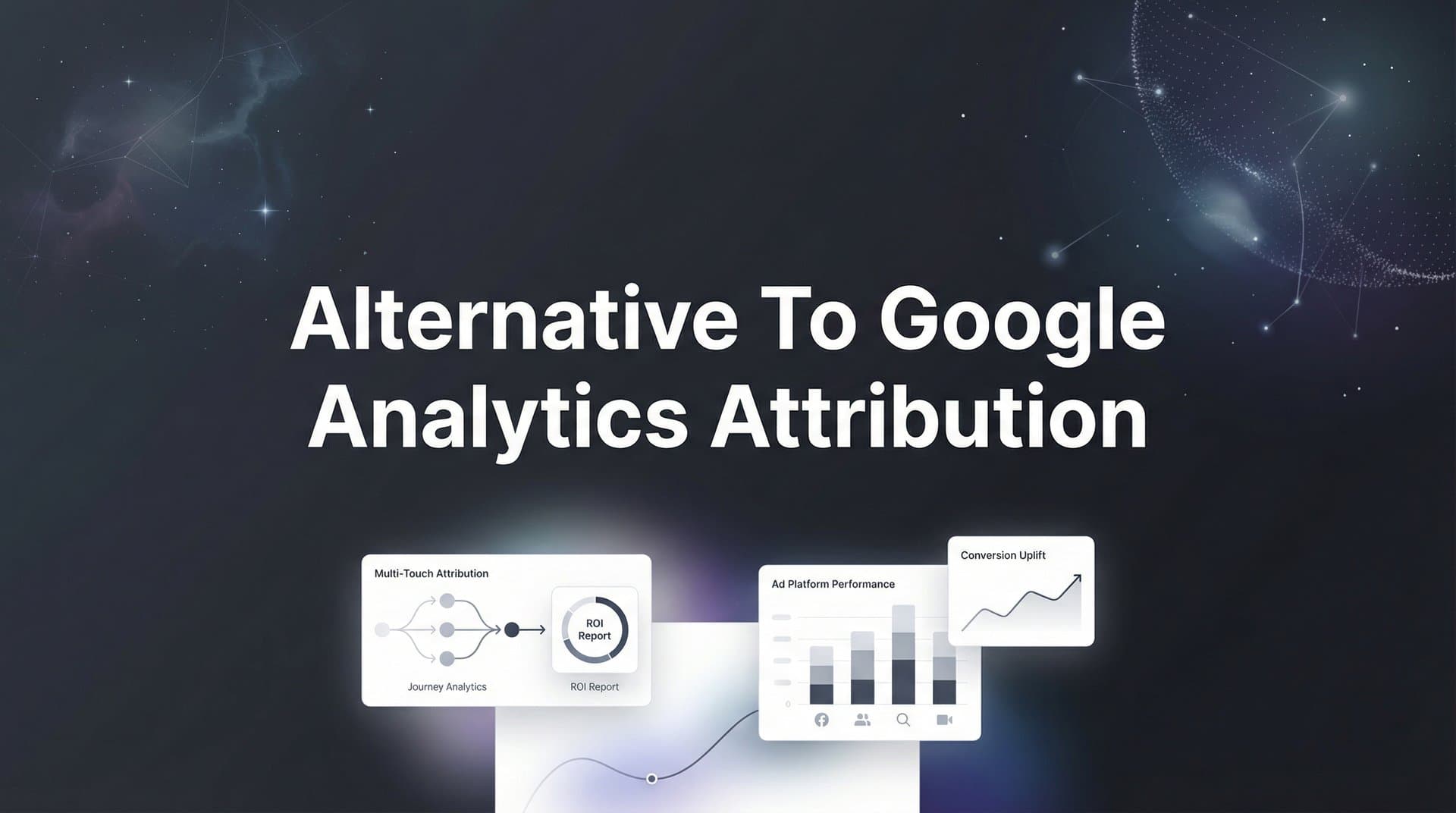
Google Analytics has long been the default choice for tracking website traffic and conversions, but when it comes to attribution—understanding which marketing touchpoints actually drive revenue—many marketers find it falls short. The platform's reliance on last-click attribution, sampling limitations, and challenges with cross-device tracking leave significant gaps in understanding the true customer journey.
For businesses running multi-channel paid advertising campaigns, these gaps translate directly into wasted ad spend and missed optimization opportunities. You're left making budget decisions based on incomplete data, crediting conversions to the wrong channels, and wondering why your campaigns aren't scaling as expected.
This guide explores seven actionable strategies for building a more accurate attribution system that connects every touchpoint to actual revenue, helping you make confident decisions about where to invest your marketing budget.
1. Implement Server-Side Tracking
The Challenge It Solves
Browser-based tracking has become increasingly unreliable. Ad blockers strip tracking scripts, Safari's Intelligent Tracking Prevention limits cookie lifespans, and privacy regulations restrict what data you can collect. When your tracking relies entirely on what happens in the browser, you're missing a significant portion of your actual conversions.
This creates a frustrating disconnect: your ad platforms show one set of numbers, your analytics shows another, and your actual revenue tells a completely different story. You're essentially flying blind, unable to trust the data that's supposed to guide your marketing decisions.
The Strategy Explained
Server-side tracking flips the script by sending conversion data directly from your server to ad platforms and analytics tools. Instead of relying on browser cookies and client-side scripts that can be blocked or restricted, your server captures the conversion event and transmits it securely to the platforms that need it.
Think of it like the difference between sending a letter through multiple intermediaries versus delivering it directly yourself. Browser-based tracking passes through multiple points where data can be lost or blocked. Server-side tracking creates a direct pipeline from your conversion events to your analytics and ad platforms.
This approach captures conversions that browser-based methods miss entirely, providing a more complete picture of your campaign performance. You're no longer at the mercy of browser restrictions or user privacy settings—you're tracking based on actual server-side events.
Implementation Steps
1. Set up a server-side tracking infrastructure that can capture conversion events from your website or application backend and transmit them to your analytics and ad platforms.
2. Configure conversion events in your server code to fire when key actions occur—purchases, form submissions, qualified leads—and send this data to platforms like Meta's Conversions API or Google's Enhanced Conversions.
3. Implement user identification methods that connect server-side events to the original traffic source, using hashed email addresses or secure customer IDs to maintain attribution while respecting privacy.
4. Test your implementation by comparing server-side reported conversions against your actual revenue data in your CRM or payment processor to ensure accuracy.
Pro Tips
Start with your highest-value conversion events first—purchases and qualified leads—before expanding to lower-funnel actions. This ensures you're capturing the most critical data immediately. Also, maintain both client-side and server-side tracking during the transition period to validate accuracy before fully committing to the new approach.
2. Connect Your CRM to Close the Attribution Loop
The Challenge It Solves
Most attribution systems stop at the lead or conversion point, but that's where the real story begins. A lead generated from a Facebook ad might close three months later for significant revenue, but if your attribution system doesn't connect those dots, you'll never know which campaigns actually drive your bottom line.
This disconnect becomes especially problematic for businesses with longer sales cycles or high-value products. You're optimizing campaigns based on lead volume when you should be optimizing for revenue. The campaigns generating the most leads might not be generating the best leads.
The Strategy Explained
CRM integration creates a closed-loop attribution system that tracks leads from their first marketing touchpoint all the way through to closed deals and revenue. When a lead enters your CRM, it carries attribution data about every marketing interaction—which ads they clicked, which content they engaged with, which emails they opened.
As your sales team works that lead through the pipeline, the attribution system continues tracking. When the deal closes, you can trace the revenue back to the specific marketing touchpoints that influenced it. This reveals which campaigns generate not just the most leads, but the most valuable customers.
The insight this provides transforms how you allocate budget. Instead of guessing which channels drive revenue, you have concrete data showing the true ROI of every marketing dollar spent.
Implementation Steps
1. Integrate your CRM with your attribution platform to automatically sync lead data, deal stages, and closed revenue back to your marketing analytics.
2. Establish a consistent lead identification system using email addresses or unique customer IDs that persist from the first marketing touchpoint through CRM entry and deal closure.
3. Configure your CRM to capture and maintain the original attribution data for each lead—first touch source, last touch source, and all touchpoints in between.
4. Create reports that show revenue by marketing source, campaign, and channel rather than just lead volume, revealing which marketing efforts actually drive profitable growth.
Pro Tips
Set up automated alerts when high-value deals close so you can quickly analyze which marketing touchpoints influenced them. This real-time feedback helps you double down on what's working before the opportunity passes. Also, track deal velocity by source to understand which channels generate leads that close faster.
3. Adopt Multi-Touch Attribution Models
The Challenge It Solves
Last-click attribution is like giving all the credit for a basketball game to whoever scored the final basket. It completely ignores the assists, defensive plays, and strategic moves that made that final shot possible. In marketing, this means the channel that gets the last touch before conversion receives 100% of the credit, even though multiple touchpoints influenced the decision.
This creates perverse incentives. You end up over-investing in bottom-funnel channels like branded search while starving the top-funnel awareness campaigns that actually generate demand. Your attribution model is actively misleading you about which marketing efforts drive growth.
The Strategy Explained
Multi-touch attribution distributes credit across all the touchpoints in a customer's journey based on their actual contribution to the conversion. Instead of arbitrarily crediting everything to the last click, you're using models that recognize how different channels work together throughout the funnel.
Different models weight touchpoints differently. Linear attribution gives equal credit to all touchpoints. Time-decay gives more credit to recent interactions. Position-based gives more weight to the first and last touchpoints. The key is choosing a model that reflects how your customers actually make decisions.
When you can see how awareness campaigns on social media lead to consideration through content engagement and ultimately conversion through retargeting, you make fundamentally different budget decisions. You understand the full ecosystem of how your marketing channels collaborate to drive revenue.
Implementation Steps
1. Map your typical customer journey to understand how many touchpoints customers experience before converting and which channels typically appear at each stage.
2. Choose an attribution model that aligns with your business reality—position-based for businesses where awareness and conversion moments matter most, time-decay for shorter sales cycles, or custom models for unique situations.
3. Implement the model in your attribution platform and run it alongside your existing last-click data for comparison, noting which channels gain or lose credit under the new approach.
4. Adjust your budget allocation gradually based on the new insights, testing whether increased investment in previously undervalued channels drives the expected lift in overall conversions.
Pro Tips
Don't just adopt one model and call it done. Run multiple models simultaneously to understand how different approaches value your marketing mix. This gives you a range of perspectives on channel performance rather than a single potentially biased view. Pay special attention to channels that consistently perform well across multiple models—those are your reliable performers.
4. Unify Cross-Platform Data
The Challenge It Solves
Every ad platform reports metrics slightly differently. Meta counts conversions one way, Google Ads counts them another, and LinkedIn has its own methodology. When you're trying to compare performance across platforms, you're essentially comparing apples to oranges to pineapples—and making budget decisions based on incompatible data.
This fragmentation means you can't confidently answer basic questions like "Which platform drives the best ROI?" or "Where should I shift budget this quarter?" You're stuck toggling between multiple dashboards, manually reconciling numbers, and hoping your spreadsheet math is correct.
The Strategy Explained
Data unification brings all your marketing platform data into a single source of truth with consistent definitions and measurement methodologies. Instead of each platform tracking conversions according to its own rules, you establish one conversion definition and apply it uniformly across all channels.
This creates an apples-to-apples comparison where you can see actual performance differences rather than measurement differences. When you look at cost per acquisition across platforms, you know you're comparing the same metric calculated the same way from the same source data.
The unified view also reveals insights that individual platforms can't show you. You see how channels work together—prospects who see your Facebook ad and later convert through Google search, customers who engage with LinkedIn content before clicking a retargeting ad. This cross-channel understanding is impossible when data lives in separate silos.
Implementation Steps
1. Connect all your advertising platforms to a centralized attribution system that can pull data from Meta, Google, LinkedIn, TikTok, and other channels you use.
2. Establish standard conversion definitions that apply across all platforms—what counts as a lead, what qualifies as a purchase, how you value different conversion types.
3. Create unified dashboards that show performance metrics using consistent calculations across all channels, making true performance comparison possible.
4. Set up automated reporting that pulls from this unified data source rather than individual platform exports, ensuring everyone on your team works from the same numbers.
Pro Tips
Include your organic channels in this unified view—email marketing, organic social, SEO traffic—not just paid advertising. The most valuable insights often come from understanding how paid and organic work together. Also, segment your unified data by customer type or product line to see which channels excel for different business objectives.
5. Feed Enriched Conversion Data to Ad Platforms
The Challenge It Solves
Ad platform algorithms are only as good as the data you feed them. When you send basic conversion signals—just "a purchase happened"—the algorithm has limited information for optimization. It doesn't know if that purchase was worth $50 or $5,000, whether it came from a qualified lead or a tire-kicker, or whether that customer is likely to return.
This leads to suboptimal targeting and bidding. The algorithm treats all conversions equally when some are clearly more valuable than others. You end up with campaigns that generate volume but not quality, hitting your conversion targets while missing your revenue goals.
The Strategy Explained
Conversion enrichment sends detailed, valuable data back to ad platforms to supercharge their optimization algorithms. Instead of just telling Meta that a conversion happened, you send the purchase value, customer lifetime value prediction, lead quality score, and other signals that help the algorithm understand which conversions matter most.
When platforms like Meta's Advantage+ or Google's Performance Max receive this enriched data, they can optimize toward high-value conversions rather than just conversion volume. The algorithm learns to identify and target users who are likely to become valuable customers, not just users who are likely to convert.
This creates a virtuous cycle. Better data leads to better targeting, which generates better results, which provides even more data to improve the algorithm. Your campaigns become progressively more efficient at finding and converting your ideal customers.
Implementation Steps
1. Configure your conversion tracking to capture and send value-based data—actual purchase amounts, predicted customer lifetime value, or custom lead quality scores based on your business criteria.
2. Set up enhanced conversion tracking through tools like Meta's Conversions API or Google's Enhanced Conversions that allow you to send enriched data points beyond basic conversion signals.
3. Implement customer matching by sending hashed email addresses or phone numbers with your conversion data, helping platforms better identify and target similar high-value users.
4. Create value-based optimization campaigns that explicitly tell ad platforms to maximize conversion value rather than conversion volume, leveraging the enriched data you're sending.
Pro Tips
Don't wait until you have perfect data to start sending enriched conversions. Even basic revenue data significantly improves algorithm performance compared to binary conversion signals. Start with what you have and refine over time. Also, regularly audit what data you're sending to ensure it's accurate—garbage in, garbage out applies especially to algorithm optimization.
6. Track the Complete Customer Journey
The Challenge It Solves
Most attribution systems show you isolated touchpoints—this ad was clicked, that page was viewed—but they don't connect those moments into a coherent story. You see individual data points without understanding the sequence and relationship between them. It's like reading random pages from a book instead of following the narrative from beginning to end.
This fragmented view obscures critical insights about how your marketing actually works. You don't see that prospects typically engage with three pieces of content before requesting a demo, or that customers who interact with both paid social and email have twice the lifetime value, or that a specific sequence of touchpoints consistently leads to high-value conversions.
The Strategy Explained
Complete journey tracking maps every interaction a prospect has with your brand from first awareness through conversion and beyond. You're creating a timeline that shows not just which touchpoints occurred, but in what order, with what timing, and with what cumulative effect.
This reveals the paths that lead to conversion. You see that successful customers often follow a pattern: they discover you through paid social, return via organic search a week later, engage with an email sequence, and finally convert through a retargeting ad. Understanding this pattern lets you design campaigns that guide prospects along high-converting paths.
Journey tracking also shows you where prospects drop off. If you see that leads who engage with your content but never see a retargeting ad have low conversion rates, you know to improve your retargeting strategy. The complete view highlights both what's working and what's missing.
Implementation Steps
1. Implement tracking that captures and links every touchpoint to a persistent user identifier—cookie ID, email address, or customer ID—creating a connected timeline of interactions.
2. Map out the key stages in your customer journey—awareness, consideration, decision, retention—and tag touchpoints according to which stage they represent.
3. Create journey visualization reports that show common paths to conversion, revealing which sequences of touchpoints most frequently lead to successful outcomes.
4. Analyze journey length and complexity to understand how many touchpoints and how much time prospects need before converting, informing your budget planning and campaign pacing.
Pro Tips
Segment journey analysis by customer value to see if your highest-value customers follow different paths than average customers. Often, they do—and understanding those differences helps you design campaigns specifically for high-value acquisition. Also, track post-conversion journeys to understand which marketing touchpoints drive retention and expansion.
7. Leverage AI-Powered Insights
The Challenge It Solves
You're drowning in data but starving for insights. Your attribution system shows you thousands of data points—campaign performance, audience metrics, conversion rates, customer journeys—but connecting those dots to understand what actually matters requires hours of analysis. By the time you spot a trend, the opportunity has often passed.
Even when you identify patterns, knowing what to do about them isn't obvious. Should you increase budget on that campaign? Which audiences should you prioritize? What creative elements drive the best performance? The gap between data and action leaves you making educated guesses rather than confident decisions.
The Strategy Explained
AI-powered analysis transforms your attribution data from a historical record into a decision-making engine. Instead of manually sifting through reports to find patterns, AI continuously analyzes your data to identify high-performing campaigns, audiences, and creative elements—then provides specific recommendations for scaling what works.
The AI doesn't just tell you what happened; it tells you what to do about it. It spots the campaign that's generating qualified leads at half your target CPA and recommends increasing budget. It identifies the audience segment with the highest customer lifetime value and suggests expanding targeting. It recognizes the creative approach that drives the best results and recommends testing similar variations.
This shifts your role from data analyst to strategic decision-maker. You're spending less time building reports and more time acting on insights, with the confidence that comes from AI-validated recommendations backed by comprehensive data analysis.
Implementation Steps
1. Implement an attribution platform with built-in AI analysis capabilities that can automatically identify patterns and anomalies in your marketing performance data.
2. Configure the AI to analyze the metrics that matter most to your business—whether that's cost per acquisition, customer lifetime value, or revenue by channel—so recommendations align with your actual goals.
3. Set up automated alerts that notify you when the AI identifies significant opportunities or issues requiring attention, enabling you to act quickly on time-sensitive insights.
4. Create a testing framework for implementing AI recommendations systematically, measuring results, and feeding that performance data back to improve future recommendations.
Pro Tips
Start by implementing AI recommendations for lower-stakes decisions—budget adjustments within existing campaigns, audience expansions, creative tests—to build confidence in the system before making major strategic shifts. Also, maintain a feedback loop where you document which recommendations you implemented and what results they generated, helping the AI learn what works specifically for your business.
Putting It All Together
Building a robust attribution system that goes beyond Google Analytics isn't about finding a single replacement tool—it's about implementing a strategy that captures complete data, connects marketing to revenue, and provides actionable insights.
Start with the fundamentals: server-side tracking and CRM integration to ensure you're capturing accurate, complete data. These two strategies form the foundation that makes everything else possible. Without reliable data capture and revenue connection, any attribution model you implement will be built on shaky ground.
Then layer on multi-touch attribution models and cross-platform unification to understand the full customer journey. This is where you move from seeing isolated data points to understanding how your marketing ecosystem actually works. You'll gain insights that fundamentally change how you allocate budget and design campaigns.
Finally, close the loop by feeding better data back to ad platforms and leveraging AI to scale what's working. This creates a virtuous cycle where better data drives better performance, which generates better data, continuously improving your marketing efficiency.
The implementation order matters. Trying to adopt multi-touch attribution before you have reliable server-side tracking is like building a house starting with the roof. Focus on data accuracy first, then sophisticated analysis, then optimization and scaling.
For marketing teams ready to make data-driven decisions with confidence, platforms like Cometly bring these capabilities together in one place—connecting your ad platforms, CRM, and website to track every touchpoint and show exactly which ads drive revenue. From server-side tracking to AI-powered recommendations, you get a complete attribution system that captures every touchpoint, connects marketing to actual revenue, and provides clear guidance on where to invest your budget.
Ready to elevate your marketing game with precision and confidence? Discover how Cometly's AI-driven recommendations can transform your ad strategy—Get your free demo today and start capturing every touchpoint to maximize your conversions.