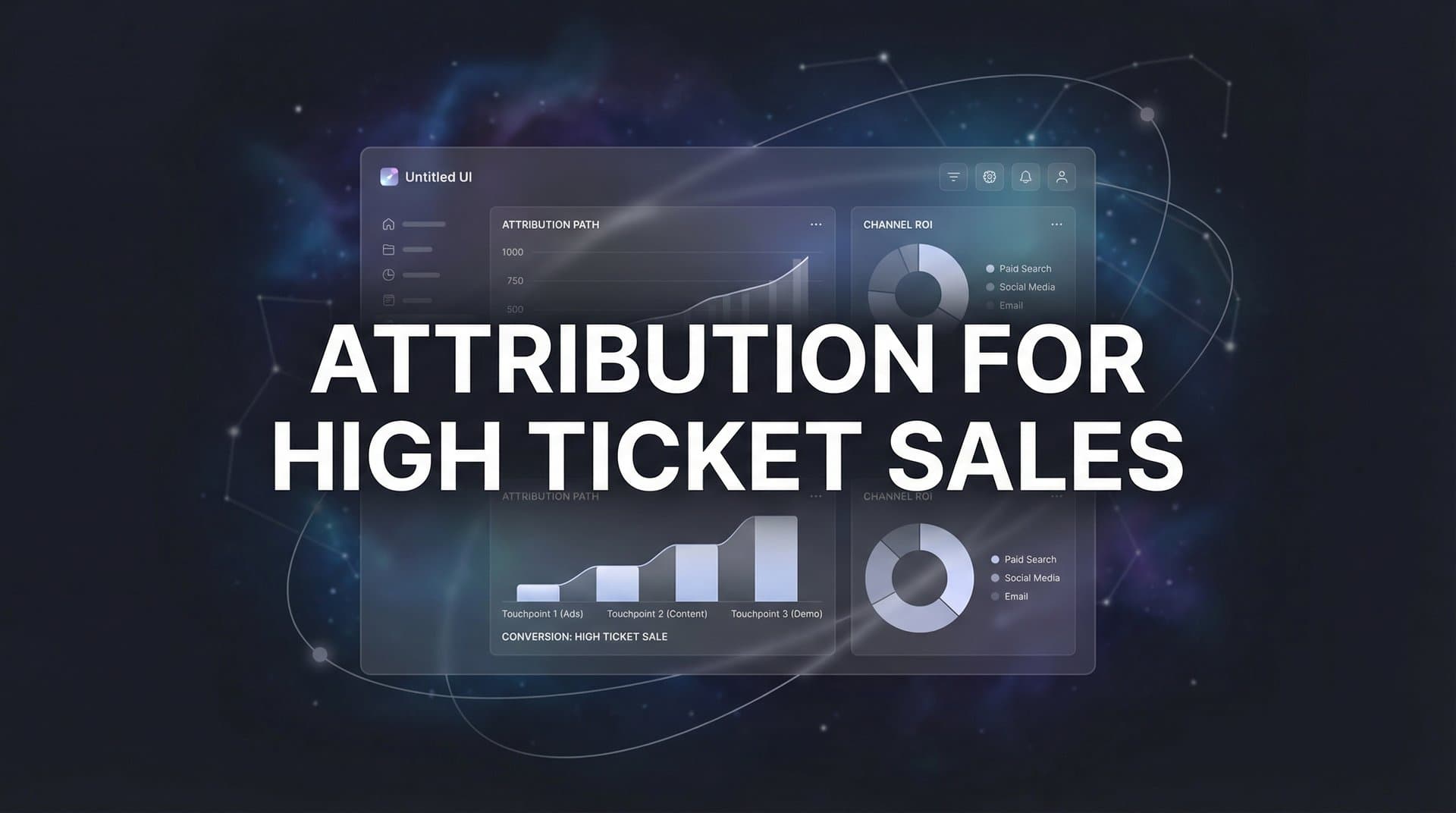
High ticket sales present a unique attribution challenge: longer sales cycles, multiple decision-makers, and numerous touchpoints spanning weeks or months before a deal closes. When a $10,000+ sale finally converts, which of the 15 touchpoints actually deserves credit?
Standard last-click attribution fails spectacularly here, often crediting a branded search that happened moments before purchase while ignoring the webinar, case study, and demo that actually built buying intent.
This guide delivers seven battle-tested attribution strategies specifically designed for high ticket sales environments—whether you're selling enterprise software, premium services, or high-value products. You'll learn how to track the full customer journey, assign meaningful credit across touchpoints, and finally understand which marketing investments actually drive your most valuable conversions.
1. Implement Multi-Touch Attribution Models Built for Long Sales Cycles
The Challenge It Solves
Last-click attribution tells you a $50,000 deal came from a branded Google search, but it completely ignores the LinkedIn ad that introduced your brand, the webinar that educated the prospect, and the case study that built confidence. When sales cycles stretch across months, single-touch models create a distorted reality that leads to terrible budget decisions.
You end up starving the top-of-funnel campaigns that actually generate demand while over-investing in bottom-funnel tactics that simply capture existing intent.
The Strategy Explained
Multi-touch attribution distributes credit across every touchpoint in the customer journey, giving you visibility into how different channels work together to close high-value deals. For high ticket sales, this means choosing models that recognize the complexity of extended buying cycles.
Position-based models assign more weight to first and last touchpoints while acknowledging middle interactions. Time-decay models give more credit to recent touchpoints as the deal progresses. Linear models distribute credit equally, useful when you're still learning your customer journey patterns.
The key is moving beyond the simplistic "one touchpoint gets all the credit" approach to understanding how your entire marketing ecosystem contributes to revenue.
Implementation Steps
1. Map your typical customer journey from first awareness through closed-won, identifying all common touchpoints along the way.
2. Choose an attribution model that matches your sales cycle complexity—start with position-based or time-decay for high ticket sales.
3. Implement tracking that captures every touchpoint including paid ads, organic search, email, content downloads, and direct interactions.
4. Review attribution reports monthly to identify which channels consistently appear in winning journeys versus those that rarely contribute to closed deals.
Pro Tips
Don't get paralyzed choosing the "perfect" attribution model. Start with position-based attribution, then refine as you learn your actual customer behavior patterns. The goal is better decisions, not perfect precision. Compare multiple models side-by-side to understand how different approaches change your channel performance story.
2. Connect Your CRM to Create a Unified Revenue Picture
The Challenge It Solves
Your analytics platform shows 500 leads generated, but your sales team closed 12 deals worth $600,000. Which marketing channels actually drove that revenue? Without CRM integration, you're optimizing for lead volume instead of revenue quality.
Marketing celebrates hitting lead targets while sales complains about lead quality. The disconnect happens because your attribution stops at form submission instead of following prospects through to closed revenue.
The Strategy Explained
CRM integration connects marketing touchpoints to actual revenue outcomes, letting you see which campaigns generate leads that become customers. This transforms attribution from a lead generation metric into a revenue intelligence system.
When your CRM data flows into your attribution platform, you can track how a prospect moved from initial ad click through multiple nurture touchpoints, sales calls, and proposal stages before closing. You see not just which channels generate leads, but which channels generate leads that close at high values.
This visibility changes everything. You might discover that LinkedIn ads generate fewer leads but close at 3x the average deal size, while Facebook generates volume that rarely converts to high ticket sales.
Implementation Steps
1. Audit your current data flow to identify where marketing touchpoint data and CRM revenue data currently live in separate systems.
2. Implement a tracking system that captures unique identifiers for each prospect, allowing you to connect marketing interactions to CRM records.
3. Configure your CRM integration to push closed-won deal data back to your attribution platform, including deal value, close date, and customer segment.
4. Build reports that show marketing channel performance by revenue generated, not just leads created, with segments for different deal sizes.
Pro Tips
Focus on closed-won revenue first before getting sophisticated with opportunity stages. Once you can reliably track which marketing efforts drive actual revenue, then layer in pipeline stage analysis. Make sure your sales team understands they need to consistently track lead source in your CRM—attribution only works when data flows cleanly from first touch through closed deal.
3. Track Offline Conversions and Sales Calls in Your Attribution
The Challenge It Solves
Your attribution dashboard shows digital touchpoints beautifully, but completely misses the 45-minute demo call that actually closed the deal. For high ticket sales, phone conversations, in-person meetings, and sales presentations often represent the most critical conversion moments.
When these offline interactions remain invisible in your attribution data, you're making decisions based on an incomplete picture. You might cut budget from channels that consistently drive demo requests simply because the demo-to-close conversion happens outside your tracking system.
The Strategy Explained
Offline conversion tracking captures non-digital interactions and feeds them into your attribution model as weighted touchpoints. This means treating a scheduled demo call or completed sales presentation as a trackable event with attribution value.
The approach requires connecting your call tracking system, calendar bookings, and sales activity logs to your attribution platform. When a prospect books a demo after clicking a Facebook ad, you track both the ad click and the demo completion as separate touchpoints in the journey.
For high ticket sales where phone conversations and personal interactions drive decisions, this visibility is essential. You finally see the complete path from digital awareness through offline relationship-building to closed revenue.
Implementation Steps
1. Implement call tracking that captures which marketing source drove each inbound phone call, connecting calls to specific campaigns or channels.
2. Set up tracking for demo bookings, consultation requests, and other high-intent offline conversion actions that indicate serious buying interest.
3. Configure your CRM to log sales calls, meetings, and presentations as trackable events with timestamps and associated contact records.
4. Create custom conversion events in your attribution platform for key offline milestones like "demo completed," "proposal sent," and "contract negotiation started."
Pro Tips
Start by tracking just the highest-value offline conversions—demos and sales calls—before trying to capture every interaction. Use dynamic phone numbers on landing pages to automatically attribute calls to specific campaigns. Consider implementing conversational intelligence tools that can detect deal-advancing moments in sales calls and feed those signals into your attribution system.
4. Use Server-Side Tracking to Capture Every Touchpoint
The Challenge It Solves
Browser-based tracking increasingly fails as privacy features block cookies, ad blockers strip tracking parameters, and iOS restrictions limit visibility. When 30-40% of your traffic becomes invisible due to tracking limitations, your attribution data becomes unreliable.
For high ticket sales with long consideration periods, prospects often return multiple times across different devices and browsers. Standard client-side tracking fragments these journeys into disconnected sessions, making it impossible to understand the complete path to conversion.
The Strategy Explained
Server-side tracking captures data on your own servers before it reaches the browser, bypassing client-side limitations that cause data loss. Instead of relying on browser cookies that can be blocked or deleted, you collect first-party data directly from user interactions with your website and applications.
This approach maintains tracking accuracy even when browsers block third-party cookies or users enable ad blockers. When a prospect visits your site, server-side tracking captures their journey through your own infrastructure, creating a persistent record that survives across sessions and devices.
For high ticket attribution, this means capturing touchpoints that would otherwise disappear, giving you a more complete view of how prospects engage over extended sales cycles.
Implementation Steps
1. Implement a server-side tracking container that captures events on your web server before sending data to analytics platforms.
2. Configure first-party cookie tracking to maintain user identity across sessions without relying on third-party cookies that browsers increasingly block.
3. Set up event forwarding that sends conversion data from your server to ad platforms, ensuring they receive accurate conversion signals even when browser tracking fails.
4. Test your server-side implementation by comparing data capture rates to your previous client-side setup, verifying improved tracking coverage.
Pro Tips
Run server-side tracking parallel to your existing client-side setup initially, comparing data quality before fully switching over. Focus on capturing high-value conversion events server-side first—form submissions, demo bookings, purchases—before tracking every page view. Server-side tracking requires more technical setup but delivers dramatically better data accuracy for high ticket attribution where every touchpoint matters.
5. Build Custom Attribution Windows That Match Your Sales Cycle
The Challenge It Solves
Default attribution windows typically span 7 to 28 days, but your high ticket sales cycle runs 90 days or longer. When attribution windows expire before deals close, you lose visibility into which early-stage touchpoints actually initiated successful customer journeys.
That LinkedIn ad someone clicked 60 days ago gets zero credit when they finally convert because your attribution window already closed. You're essentially flying blind on which top-of-funnel investments actually drive eventual revenue.
The Strategy Explained
Custom attribution windows extend your tracking timeframe to match your actual sales cycle length, ensuring you capture the complete customer journey from first awareness through final purchase. For high ticket sales, this often means 60, 90, or even 180-day windows.
The strategy involves analyzing your historical sales data to understand typical time-to-close, then configuring attribution windows that exceed this timeframe by 20-30%. If your average deal closes in 75 days, set a 90-day attribution window to ensure you capture outliers.
Different channels may require different windows. Brand awareness campaigns might need longer attribution windows than retargeting campaigns that engage prospects already deep in the buying process.
Implementation Steps
1. Calculate your average sales cycle length by analyzing time from first known touchpoint to closed deal across your last 50-100 customers.
2. Identify your longest sales cycles to understand the maximum attribution window you need—use the 90th percentile, not just the average.
3. Configure your attribution platform with custom windows that extend 20-30% beyond your typical sales cycle to capture edge cases.
4. Set different attribution windows for different channel types—longer for awareness campaigns, shorter for bottom-funnel retargeting.
Pro Tips
Start with a 90-day window for high ticket sales unless your data shows you need longer. Review attribution reports quarterly to see if deals are still falling outside your window, then adjust accordingly. Remember that longer windows capture more touchpoints but can also dilute attribution credit—balance completeness with actionability.
6. Segment Attribution by Deal Size and Customer Type
The Challenge It Solves
Averaging attribution data across all deals masks critical patterns. The channels that drive $10,000 deals might be completely different from those that generate $100,000 enterprise sales, but blended reporting makes both look equally effective.
When you optimize for average performance, you make decisions that work for no one. You might increase spend on channels that excel at mid-market deals while unknowingly starving the campaigns that actually drive your most valuable enterprise opportunities.
The Strategy Explained
Attribution segmentation separates your analysis by deal size, customer type, industry vertical, or other meaningful categories. This reveals how different customer segments discover and convert through distinct journey patterns.
Enterprise deals might start with LinkedIn thought leadership, progress through multiple content downloads, and close after executive demos. Mid-market deals might begin with Google search, convert quickly through self-service trials, and require minimal sales involvement.
By segmenting attribution data, you can optimize channel mix and messaging for each segment independently rather than making compromised decisions based on blended averages.
Implementation Steps
1. Define meaningful segments for your business—typically deal size tiers, customer company size, industry verticals, or product lines.
2. Ensure your CRM captures segment information for every closed deal so you can filter attribution reports by these categories.
3. Build separate attribution reports for each key segment, analyzing which channels and touchpoints appear most frequently in winning journeys.
4. Compare journey patterns across segments to identify where different customer types require different marketing approaches.
Pro Tips
Start with just two segments—your highest-value deals versus everything else—before creating complex segmentation schemes. Look for patterns where certain channels over-index for specific segments, then adjust budget allocation to double down on what works for your most valuable customer types. Review segmented attribution monthly to catch shifts in how different customer types discover and evaluate your solution.
7. Feed Enriched Conversion Data Back to Ad Platforms
The Challenge It Solves
Ad platforms optimize toward the conversion signals you send them, but standard tracking only reports that a conversion happened—not that it was a $50,000 deal versus a $5,000 one. Platform algorithms treat all conversions equally, unable to prioritize campaigns that drive high-value revenue.
This creates a fundamental optimization problem. Your Facebook or Google campaigns might generate plenty of conversions, but if the algorithm can't distinguish between qualified enterprise leads and low-value tire-kickers, it will optimize for volume rather than revenue quality.
The Strategy Explained
Conversion value optimization sends enriched data back to ad platforms, including actual deal value, customer lifetime value predictions, and lead quality scores. This allows platform algorithms to optimize for revenue outcomes rather than just conversion volume.
When you feed closed-won revenue data back to Facebook or Google, their machine learning systems learn which audience segments, ad creatives, and targeting approaches actually drive high-value deals. Over time, algorithms automatically shift delivery toward prospects who match the profile of your best customers.
For high ticket sales, this feedback loop transforms ad platform performance. Instead of generating generic leads, campaigns begin attracting prospects who match the characteristics of deals that actually close at high values.
Implementation Steps
1. Implement conversion value tracking that captures actual deal value when opportunities close in your CRM.
2. Configure your attribution platform to send conversion value data back to ad platforms through their conversion APIs.
3. Set up offline conversion imports that feed closed-won deal data back to platforms even when conversions happen weeks after the initial ad click.
4. Monitor how campaign performance changes as algorithms receive enriched data, typically seeing improvement after 2-4 weeks of learning.
Pro Tips
Start by sending conversion value data for your highest-volume ad platforms first—typically Facebook and Google. Use value-based bidding strategies that explicitly optimize for conversion value rather than just conversion volume. Be patient—algorithms need time to learn from enriched data, so expect a 2-4 week adjustment period before seeing performance improvements. The long-term payoff is campaigns that automatically prioritize high-value prospects.
Putting It All Together
Mastering attribution for high ticket sales requires moving beyond basic tracking to build a comprehensive system that captures every touchpoint, connects to your CRM, and feeds insights back to your ad platforms.
Start with strategy one—implementing multi-touch attribution—then progressively layer in CRM integration and server-side tracking. These foundational elements give you visibility into the complete customer journey rather than fragmented snapshots.
Next, customize your attribution windows and implement offline conversion tracking to ensure you're capturing the full sales cycle, including the phone calls and demos that often close high-value deals.
Finally, segment your attribution data by deal size and feed enriched conversion data back to ad platforms. This creates a continuous improvement loop where your marketing intelligence gets smarter over time.
The payoff is substantial: you'll finally understand which marketing investments actually drive your highest-value deals, allowing you to double down on what works and cut what doesn't.
For marketing teams ready to implement these strategies without building custom infrastructure, platforms like Cometly provide the attribution foundation specifically designed for complex, high-value sales cycles. From multi-touch attribution and CRM integration to server-side tracking and conversion sync, you get the complete toolkit for understanding what really drives revenue.
Ready to elevate your marketing game with precision and confidence? Discover how Cometly's AI-driven recommendations can transform your ad strategy—Get your free demo today and start capturing every touchpoint to maximize your conversions.